




 Research Article
Addition Table – An Unscripted Milieu for Inquiry- Based Mathematics Teacher Education
Received Date: July 24, 2023; Published Date: August 01, 2023
Abstract
The paper is a reflection on the author’s asynchronous teaching of a graduate level elementary mathematics teacher education course using the discussion forum as a tool through which the subject matter knowledge of teacher candidates can be uplifted. A specific focus of the paper is on the addition table – an underused instructional milieu conducive to the accommodation of digital and tactile technology. Within this milieu, a number of didactic ideas and topics considered important around the world such as diversity of thinking, proof, triangulation, historical connections, theoretical vs. experimental probability, all supported by the appropriate use of technology, have been discussed. Reflective comments on the course by teacher candidates are shared.
Keywords: Addition table; Technology; Mathematics teacher education; Proof; Problem solving; Computational experiment; Probability; Historical connections
Introduction
What is the main purpose of using numeric tables in a mathematics classroom? The author’s experience based on many years of interaction with elementary teacher candidates suggests that tables are typically used for memorization. They support learning of mathematics through scripted instruction [1] by memorizing the results of arithmetical operations, usually addition and multiplication, applied to two integers. In the digital era, such type of undeviating learning emphasizing the primality of procedural skills [2] and encouraged in the elementary mathematics classroom under the umbrella of drill and practice [3], rarely motivates open-ended investigation [4–6] the outcome of which has the potential to go far beyond the basic script. Instead, the use of digital tools in the context of numeric tables enables one to resolve the dichotomy of the Type I vs Type II technology application [7] by replacing the pragmatic tradition of drill and practice with an open-ended potential of conceptual development.
It appears that the multiplication table is the main numeric table used in the schools as the addition table has been rarely mentioned by students, in an asynchronous mathematics education graduate level course taught by the author, when reflecting on their own past studies and present teaching of elementary mathematics. Even in a notable book [8] written for a wide readership interested in the history and cultural significance of mathematics, one can find only a note that “in school we study the abstract multiplication table, that is, a table for multiplying one abstract number by another” (p.1) as evidence of abstractness of the subject matter. Nonetheless, both tables can be seen as the first experience for young children with recoding the results of arithmetical operations on two numbers (addends and factors, respectively) by using two directions that tables, in general, afford – horizonal for one thing and vertical for another thing. Such experience, preceding one’s encounter with a big mathematical idea enabling students already in grade five to “graph points on the coordinate plane to solve real-world and mathe- matical problems” [9], has hidden cultural-historical significance. Indeed, as mentioned in connection with the rise of spreadsheets in industry and education, “the two-dimensional table would arise spontaneously in any civilization where a writing surface was used” [10].
History of mathematics preserved examples of using numeric tables as tools of advancing computational ideas. Ahmes, an ancient (ca. 1500 B.C.) Egyptian scribe, who may be considered as one of the first expositors of mathematics in the history of civilization because being the author of the oldest presentation of mathematical results in a written form [11], is credited with developing a table, representing fractions of the form 2/n as a sum of distinct unit fractions. Such table was part of the Egyptian papyrus roll found in the 19th century by Henry Rhind, a Scottish scholar and collector of antiques [12,13]. Michael Stifel, a 16th century German monk and mathematician, used a table, known as Stifel’s triangle [14], to recursively compute binomial coefficients. In the 17th century, Blaise Pascal, one of the founders of probability theory, constructed his famous triangle through recording sample spaces of experiments of tossing coins from where one can determine chances of having a certain result of an experiment [15]. In the 18th century, Élie de Joncourt, a Dutch minister of church and mathematics teacher, used the fact that within a numeric table comprised of triangular numbers the sum of two consecutive triangular numbers is the square of the rank of the larger number (known as the theorem of Theon, a Greek mathematician of the 4th century), to compute squares and square roots [16].
This paper reflects on the author’s work preparing elementary teacher candidates (some of them are practicing teachers, including former undergraduate mathematics majors, working on their master’s degree in education) to teach mathematics through open-ended problem solving. One of the topics discussed with the candidates concerned computer-supported exploration of numeric tables through emphasizing more than one way of obtaining an answer. Many candidates see benefits from taking a mathematics education course focusing not only on more than one correct answer but on more than one correct solution to a problem [17,18]. With the advent of the Common Core State Standards [9] in the United States, expecting students to be able “to compare the effectiveness of two plausible arguments ... decide whether they make sense ... and ask useful questions to clarify or improve the arguments” (p. 7), teacher candidates do appreciate learning new ways of teaching mathematics. As mentioned by one of the author’s students, “I recall having found the correct answer using a different approach and it not being accepted as it was not the approach we were taught or told to use. It really makes me see how much times have changed in our thinking. I find it great that students are now encouraged to know more than one way to solve a problem.” This comment is consistent with other recommendations for teachers and standards for teaching mathematics [19,20].
As will be shown in the paper, among conceptual, inquiry-based activities associated with addition tables is finding the sum of numbers in a square size addition table using multiple strategies. Likewise, one can find the sums of numbers with special properties (e.g., multiples of two or three or four) in the table. Using different strategies in mathematical computations can be considered as an extension of the concept of triangulation, a scholarly pursuit that provides evidence of rigor in education research [21,22], to mathematics education [23]. Similarly, rigor in mathematical problem solving can be achieved by arriving at the same answer through different problem-solving techniques. As mentioned by the author’s another student, “Math has always appealed to me considering that a lot of the time there are multiple ways to find an answer. I remember learning how to resolve these problems in math class and learning multiple ways to do so. I think it is important that we teach our students a few alternative approaches to help them truly understand. In my opinion, this may give children the idea that they can choose which instructional strategies they want to use when solving a math problem.”
In the digital era, when answers to many traditional tasks may be just “googled,” there is a need not only to teach mathematics by approaching problem solving from different perspectives, but to teach through tasks for which each route to the answer has two parts – cognitive and computational. In fact, this is how mathematics developed over the centuries – through the joint use of argument and computation [8]. At the very simple level, even when using a calculator, a first-grade student must understand which key to press and should have at least some idea of how the answer may look like [24]. For example, whereas the calculator keys “+ “and “÷ “may look similar, the results of, say, 5+6 and 5÷6 look very different. Thus, whereas selecting the right key on a calculator may be seen as a cognitive part of adding 5 and 6, pressing the key selected yields the computational part of the addition task. Several (more challenging) tasks with two such parts will be considered in the sections that follow.
Materials and Methods
Two types of materials have been used by the author when working on this paper. The first type is technological; digital and tactile tools referred to by mathematics educators in the United States as “mathematical action technologies” [25]. In the paper, these technologies include computer spreadsheets, computational knowledge engine Wolfram Alpha developed by Wolfram Research (www.woframalpha.com; accessed on July 23, 2023), Maple [26] – mathematics software for education and STEM fields, and virtual manipulatives. One of the reasons of using the tools within a single problem is to provide the result with computational triangulation [23] aimed at avoiding both procedural and conceptual errors.
The second type of materials used by the author included teaching and learning mathematics standards used by countries such as Australia [27], Canada [28], England [29], Japan [30], Singapore [31], South Africa [32], and the United States [9, 19, 20, 25]. The standards uniformly call for integrating mathematical reasoning and digital computations when solving problems. As will be shown in the paper, the context of addition table provides ample opportunities for such integration.
Methods specific for mathematics education used in this paper include computer-based mathematics education, standards-based mathematics, and problem solving. In particular, those methods are conducive to presenting “teacher candidates with experiences in mathematics relevant to their chosen profession” [20]. As future teachers of mathematics, the candidates learn how to think computationally by “expressing problems in such a way that their solutions can be reached using computational steps and algorithms” [28]. The university where the author works is located in Upstate New York in close proximity to Canada and many of the author’s students are Canadians pursuing their master’s degrees in education. This diversity of students suggests the importance of aligning mathematics education courses with multiple international perspectives on teaching and learning mathematics in the digital era.
Finally, problem-solving methods and conceptual methodology used in this paper follow the TITE (technology-immune/technology- enabled) framework introduced in [33]. This framework is discussed in detail in Section 4. Problems that integrate the TITE framework are discussed in Sections 5 and 6.
Using Scripts for Conceptual Development
If a numeric table is to be used for explorations, the addition table offers a variety of opportunities for deep inquiry into elementary mathematics, something that is especially important as a research-like mathematical experience for teacher candidates. In particular, a deep inquiry into addition table allows one to discover pentagonal numbers [34] representing partial sums of an arithmetic sequence with the first term one and difference three and their connection to trapezoidal numbers [35] representing integers through the sums of consecutive counting numbers. Although the types of exploratory activities with addition and multiplication tables are similar, mathematical concepts that may be uncovered within the two tables are both similar and different. For example, the sum of four numbers adjacent (vertically and horizontally) to a number in the addition table as well as in the multiplication table is four times this number. The similarity deals with the symmetry of numbers in the tables. One can also use algebra to explain this phenomenon by using symbols n and n×m to represent entries in the addition and the multiplication tables, respectively. Such unexpected discoveries within a pretty mundane context uplift teacher candidates’ curiosity about mathematics. As mentioned by an elementary teacher candidate, ““Many of the problems we did in class or on homework could be solved algebraically but we weren’t concerned with algebra. We were concerned with solving it using basic reasoning and logic. That class sounds great. It’s very rare for someone to like math, but it’s great that the class was able to make you feel better about it. The idea of math not being black and white and opening students minds up to thinking and having other ideas can be a great way to make math welcoming.”
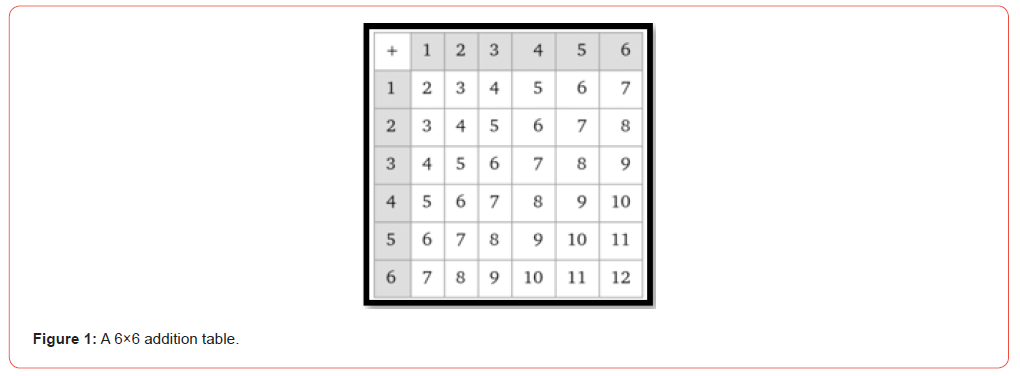
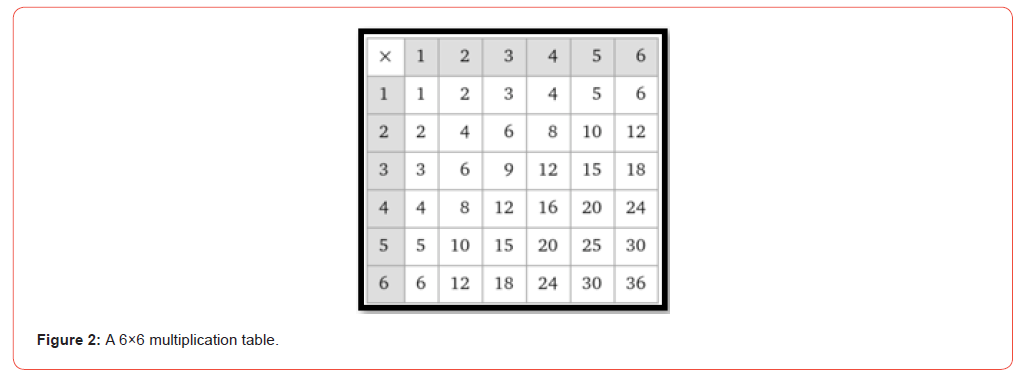
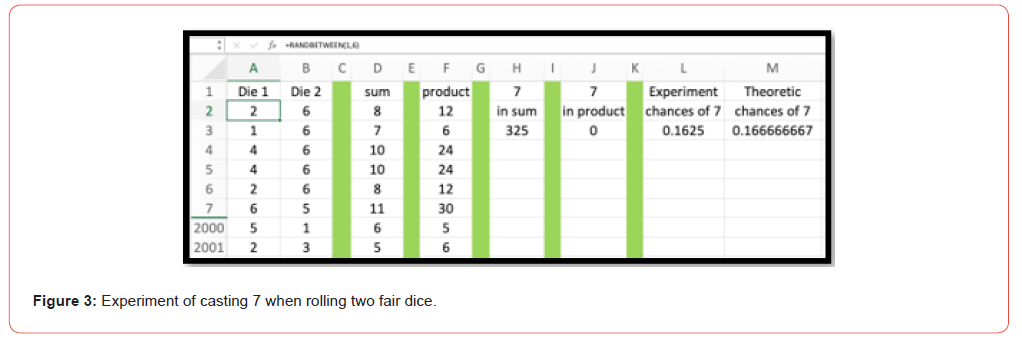
Another similarity deals with almost the same number of perfect squares within both tables of the same size, although squares are typically associated with multiplicative structures. For example, each of the 10×10 tables have 16 squares and the number of squares in both the 9×9 tables and the 6×6 tables (Figures 1 and 2) differ by one. The distinction between the tables deals with differences between multiplicative and additive structures where multiplication is seen as repeated addition and addition is not limited to repeating addends. For example, in the 6×6 addition table (Figure 1) the number 7 appears six times and it is absent in the 6×6 multiplication table (Figure 2). Both tables were generated by Wolfram Alpha – a computational knowledge engine available free on-line (https://www.wolframalpha.com/). These visual recognitions can be put in the context of die rolling to suggest that it is not possible to cast 7 when rolling one die and when rolling two dice the likelihood to cast 7 is the highest. In terms of rolling two dice, the likelihood to cast the sum (the product) of 7 is 1/6=0.666... (zero). Recognition of those differences may be considered as the first step towards using scripts for epistemic development rather than for pure memorization. These theoretical observations can be confirmed experimentally (Figure 3) by rolling two dice, say, 2000 times, and finding that an experimental likelihood to cast 7 is 0.1625, the result being close to the theoretical one, 0.666... Reflecting on using Wolfram Alpha in the context of dice rolling, one of the teacher candidates noted, “We can use Wolfram Alpha to construct a sample space of an experiment of rolling two dice by typing in “sample space for rolling two dice”. After typing this in the box, Wolfram Alpha generates the probability and the results. With these results shown below, we can then use Wolfram Alpha to create an addition table that shows the sample space of rolling two dice.”
These are just few examples of using a numeric table (a script) for conceptual development supported by computation. In other words, when one, after recognizing in a script what is displayed becomes curious about the display, then, in the spirit of Dewey’s [36] distinction, “Recognition deals with already mastered; observation is concerned with delving in the unknown” (p. 252), the recognition is likely to result in the observation. In mathematics teacher education, an observation in that sense may be associated with findings that are new to teacher candidates, like seeing the 6×6 addition table as a sample space for rolling two six-sided dice. This prompts the next question about ways of finding a sample space for rolling three such dice. This question was among the prompts of a discussion forum of the course demonstrating how Wolfram Alpha, when asked for a “sample space of rolling three dice,” generates 216 triples of numbers appearing on the six faces of three dice. An important aspect of a discussion forum in an asynchronous course is to include cognitive prompts the answers to which can be developed computationally. That is, to motivate the joint use of cognitive and computational means in the study of elementary mathematics.
TITE Problem Solving
The concept of technology-immune/technology-enabled (TITE) problem was introduced elsewhere [33] as an extension of the Type II (using technology as a conceptual tool) vs. Type I (memorization followed by drill and practice) technology applications educational framework [7]. In order to benefit from this framework in the context of mathematics, a student has to be proficient in dealing with tasks that are still cognitively challenging despite (or perhaps because of) the available power of symbolic computations and graphic constructions. A TITE problem cannot be automatically solved by software (thus, it is immune from the direct use of technology), yet the role of software in solving the problem remains critical (thus, its solution is enabled by technology) because, as mathematics educators in Japan [30] believe, especially “in complex calculations, the effectiveness of learning can be enhanced by using computation tools” (p. 149). Similarly, Canadian [28] educators argue that “strategic use of technology ... can extend and enrich teachers’ instructional strategies ... and foster the development of mathematical reasoning” (p. 93). Computational tools in Australia [27] “enhance the potential for teachers to make mathematics interesting to more students” (p. 9). In Singapore [31], appropriate uses of such tools “develop positive attitudes towards mathematics” (p. 22), something that in England [29] enables students to “solve problems ... with increasing sophistication”. The above expectations are both TE and TI ones for they require teachers’ both cognitive and computational contribution to mathematics education. Indeed, in the words of educators in South Africa [32], “mathematics teachers, and not ICT tools, are the key to quality education” (p. 78). So, as voices of educators around the world suggest, the TITE teaching framework is of critical importance in the modern-day mathematics classroom.
An important aspect of the TITE idea is that when the TI part precedes the TE part of problem solving, depending on a problem, there are at least two outcomes available: an error in the TI part (e.g., mistakenly selecting the “÷” key on a calculator when adding two numbers) would either be neglected or recognized through the action of the TE part. That is why, checking the result of symbolic computations in a special case, the accuracy of which is semi-evident (the so-called base clause), should be included in a TITE problem solving. Likewise, a TI activity may follow a TE one and while the latter would have no error, the former may lead to erroneous interpretation of the results of the latter (e.g., interpreting even slightly different experimental chances of casting 7 on two dice as a computational error). Another important aspect of the TITE idea deals with its duality in a sense that whereas the TE part may inform the TI part, the latter, without conceptual understanding of the former, may lead desired generalization astray (see Section 9 below). At the same time, a TI part can be used to improve the efficiency of a TE part, which, in turn, supports the advancement of another TI part when one attempts to generalize (see Section 8 below).
A TITE problem solving often requires intervention of the “more knowledgeable other” [37] capable of initiating “inquiry about inquiry” [38]. Indeed, often students’ findings might belong to hidden mathematics curriculum [39] which, by representing “biologically secondary information ... requires direct, explicit instruction” [40]. Sometimes, in the context of TITE problem solving, such direct instruction may include proving different statements that some teacher candidates might either doubt or be interested in from a teaching perspective. In particular, the importance of using different reasoning strategies is indicative of triangulation ensuring agreeable rigor in proof. Specific examples of TITE tasks discussed with and carried out by teacher candidates will follow.
A TITE Problem Discussed in an Asynchronous Mathematics Education Course
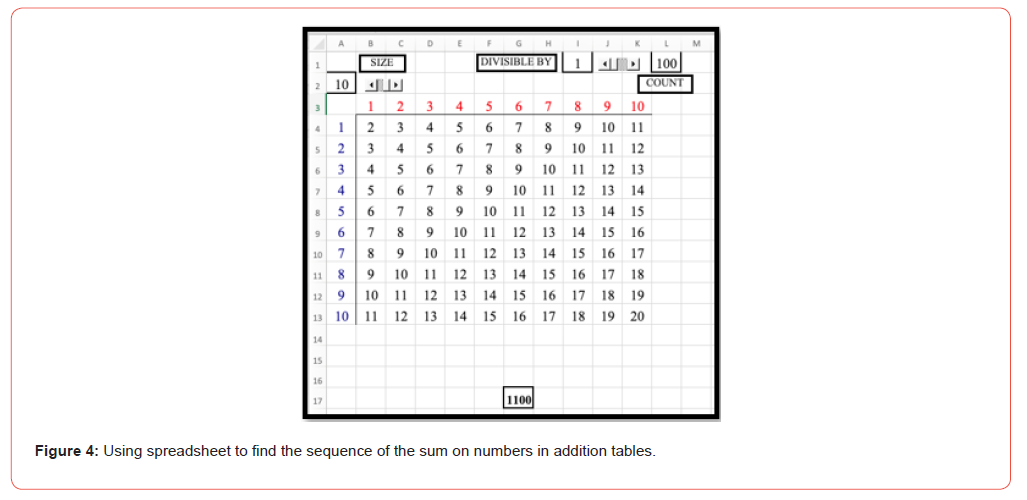
A downside of an asynchronous mathematics methods course is the difficulty in teacher-students communication and the challenge of motivation. How can teacher candidates be motivated to embark on a TITE problem solving when communication is limited to written directions and references to pages of a textbook? The lack of face-to-face communication can be substituted by the discussion forum in which the candidates are asked motivational questions (prompts) and reflect on each other responses. In order to motivate exploration of the addition table, the teacher candidates were given a spreadsheet-based addition table (Figure 4) designed to calculate (in cell G17) the sum of numbers in the tables within the range [1,10]. The programming of such a spreadsheet can be found at https://www.worldscientific.com/worldscibooks/ 10.1142/9601#t=suppl – the supplementary site to the book [41, Chapter 2, Figure 2.16] in which the spreadsheet is included. As a result, the number sequence
2, 12, 36, 80, 150, 252, 392, 576, 810, 1100 _ (1) was generated by the spreadsheet and recorded by the candidates. Whereas there are TI methods of finding closed formula for this sequence, especially when one might have an idea of how the answer should look like [24], this route was not the intent of the activities. Instead, the candidates were introduced to the Online Encyclopedia of Integer Sequences (OEIS®, http://oeis.org/, accessed on July 23, 2023), a rich source of mathematical information not all of which is grade appropriate for elementary teacher candidates. In particular, using this source does require certain competence in managing the abundance of information provided online [42]. Thus, the candidates were asked to collect only relevant information (if any) about this sequence. Whereas the candidates did find this sequence in the OEIS®, no reference to addition table was found there.
As an alternative, several terms of sequence (1) were entered into the input box of Wolfram Alpha. The tool recognized the sequence and provided (Figure 5) its closed form
an=n3+n2 _ (2)
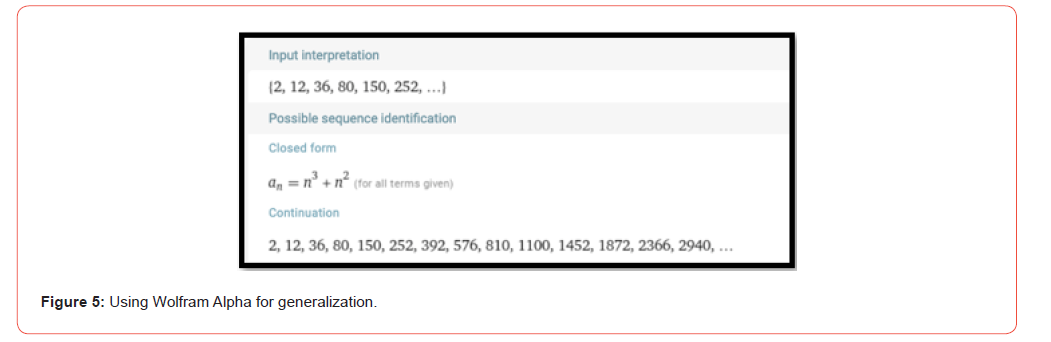
Unlike the OEIS®, Wolfram Alpha does not provide possible interpretations of numeric sequences. This motivated the candidates to explore ways of finding the sum of numbers in the n×n addition table using different reasoning techniques. That is, in one of the course assignments a TITE problem was formulated as follows: Find the sum of numbers in the (Wolfram Alpha generated) 6×6 addition table using different methods and generalize your findings to the n×n table.
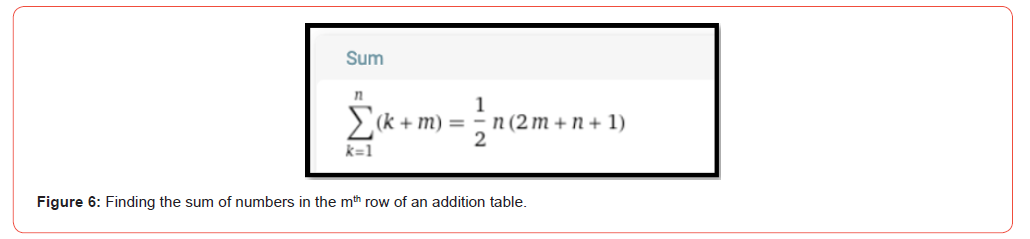
Without having experience in finding the sum of numbers in a table other than adding numbers one by one, the candidates needed directions of how to do that. One way of finding the sum of numbers in the addition table discussed with the teacher candidates was to add the numbers in each row (column, recognizing the symmetry in the table) by noting that the sum of numbers in the row (column) of, say, rank three is (3+1) +(3+2) +⋯+(3+6). Generalizing to the row (column) of rank m in the n×n addition table, n ≥ m, yields the sum (m+1) +(m+2) +⋯+(m+n). This understanding was a TI part of the problem. A TE part was to use Wolfram Alpha to find the sum. Such computations resulted in the sum n(2m+n+1)/2 (Figure 6). The next computational step was to add the sums across n rows (columns) of the table by using Wolfram Alpha. The result shown in Figure 7 confirms formula (2) found by Wolfram Alpha using different strategies.
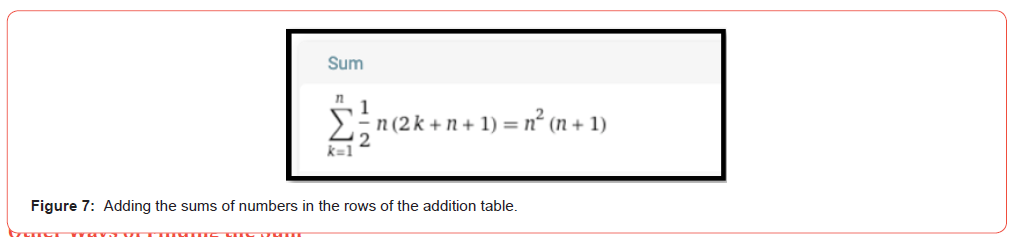
The second way of finding the sum of numbers in the addition table is to note that in each row, the sums of numbers equidistant from the borders of the table are the same. For example, in the 3rd row of the table of Figure 1 such (three) sums are 4 + 9, 5 + 8, and 6 + 7, each of which is equal to 13=6+2×3+1, where 6 and 3 are, respectively, the size of the table and the row considered. Generalizing to row m and n×n table, such sums are equal to n+2m+1 and each row has n/2 sums (when n is odd, the number in the middle of the row partners with itself). This, once again, requires a TE part which, with the help of Wolfram Alpha (Figure 7), carries out the
Introduction
Introduction
Introduction
Introduction
Introduction
Introduction
References
-

This work is licensed under a Creative Commons Attribution-NonCommercial 4.0 International License.




