


 Research Article
Developing Pre-service Chemistry Teachers’ Manipulative Skills Using a Five-level Hierarchy Framework
Received Date:November 24, 2025; Published Date:December 02, 2025
Abstract
Science education contributes to secondary school curricula globally. One of the distinctive features of science education compared to other school subjects is the use of practical laboratory work in its learning and teaching. Chemistry is one of the secondary school science subjects that studies chemical reactions. Based on this feature, practical laboratory work is integral to chemistry education. Consequently, developing students’ manipulative skills for practical laboratory work is essential. Insufficient manipulative skills can be dangerous in chemistry because fatal consequences may result from improper handling of apparatus and chemicals. Furthermore, inadequate manipulative skills significantly prevent students from acquiring other desirable skills and learning outcomes. Thus, students with competent manipulative skills ensure laboratory safety and better opportunities for them to learn science through doing science. However, a systematic framework for developing students’ manipulative skills is lacking. It is common for a teacher to demonstrate a skill merely to students, and then students mechanically imitate the skill in many secondary school laboratories globally. Yet, this kind of practice is ineffective because of the imbalance between the declarative and procedural stages. Literature reported that students’ declarative and procedural knowledge is needed for practical laboratory work. We referred to the literature and developed a five-level hierarchy framework of manipulative skills for a teacher development project which targeted pre-service chemistry teachers. In this paper, I will explain how pre-service chemistry teachers’ manipulative skills can be progressively developed through the five-level hierarchy framework by developing their declarative and procedural knowledge. Furthermore, I will describe how a four-stage teacher development project develops pre-service chemistry teachers’ competencies of teaching manipulative skills for secondary school practical laboratory work by using the framework.
Keywords: Laboratory work; Practical work; Manipulative skills; Chemistry education; Teacher education
Introduction
Secondary school curricula around the world include science education. One of the distinctive features of science education compared to other school subjects is the use of practical laboratory work for learning and teaching. Chemistry is the study of chemical reactions, one of the science subjects offered to senior secondary students, equivalent to grades 9-12. Consequently, practical laboratory work is considered an integral part of chemistry education. Hence, it is a common agenda to examine how to effectively use practical laboratory work to enhance chemistry learning and teaching in secondary schools.
In chemistry learning and teaching, proper manipulative skills are essential to perform experiments for two significant reasons. First, inadequate manipulative skills can be dangerous in chemistry because serious consequences may result from improper handling of apparatus and chemicals. For example, we should slowly add concentrated acid to a large amount of water with gentle stirring when diluting the concentrated acid. However, if we perform the dilution incorrectly, such as adding water to the concentrated acid, the concentrated acid, which is corrosive, may splash out, and the large amount of heat released may vaporise the acid; consequently, causing fatal consequences. Thus, students and teachers with competent manipulative skills ensure laboratory safety.
Second, literature [1-3] has documented that secondary school students’ interest and enthusiasm in the understanding of science can be seized by ‘doing’ science, when they have the firsthand experiences to perform experiments. On the other hand, insufficient manipulative skills can significantly prevent students from acquiring desirable skills and outcomes, causing them to be unable to make important observations and gather relevant data [4]. Hence, students with competent manipulative skills ensure better learning opportunities for them to learn chemistry.
Although Anderson [5] explained that the acquisition of skills is related to the development of cognitive skills, which involve the declarative and procedural stages, for more than forty years, secondary school chemistry teachers worldwide have not paid attention to his claim. It is common for a teacher to demonstrate a skill to students merely, and then students mechanically imitate it. This kind of learning and teaching regarding developing manipulative skills is ineffective because of the imbalance between the declarative and procedural stages.
We explained the importance of developing students’ manipulative skills. However, manipulative skills are generally given little attention in learning and teaching [6]. Important stakeholders such as teachers and school principals focus on the high-stakes exams. Meanwhile, the advancement of technologies like generative artificial intelligence (Gen-AI) shifts our focus to the virtual environment, but bleaching authentic learning experiences where students need to perform experiments with proper manipulative skills. Furthermore, research on chemistry manipulative skills is limited, and greater attention should be given to developing students’ chemistry manipulative skills.
This study addresses the gap in the literature by achieving the
following two aims:
(1) To develop a framework of manipulative skills by
considering declarative and procedural knowledge; and
(2) To develop a teacher development project for pre-service
chemistry teachers to develop their manipulative skills and
teaching competencies.
Methodology
Developing a Manipulative Skills Framework
The acquisition of skills involves declarative and procedural knowledge in a two-stage manner according to Anderson [5]. In the first stage, when a learner receives an instruction about a particular skill, the learner will encode the instruction as a set of facts about the skill. Then, in the second stage, the learner will interpret the facts and generate the desired behaviour. From the Anderson’s learning model, performing psychomotor skills relates to an individual’s cognitive understanding of the functions corresponding to physical movement. Following this rationale, for example, a student needs to understand the functions of a volumetric pipette to successfully manipulate this apparatus to transfer a definite volume of solution.
A systematic review of research [7] reported that secondary school science students need to be prepared theoretically and practically to be able to handle the procedures and various apparatuses. This finding aligns with Anderson’s learning model of skills acquisition. However, despite Anderson having concretely proposed the learning model for over forty years, the review reported that students found it challenging to transfer acquired theoretical knowledge to actionable practice in the laboratory. They suggested that learning certain procedures may be task-specific, and teachers need to support students in the knowledge transfer process through systematically developing students’ manipulative skills. The review reveals two critical issues to address the gap. First, a framework for progressive students’ manipulative skills development is needed. Second, teachers’ training in this aspect is essential because they are the key agents in students’ learning.
The literature indicates several aspects related to the development of students’ chemistry manipulative skills, but also reveals gaps in systematic approaches to their development. Acquisition of a skill should not be considered as ‘all or none’ from a developmental perspective. On the other hand, manipulative skills can be developed progressively, which implies a hierarchical framework with several levels. Meanwhile, publications rarely provide a specific hierarchy framework for manipulative skills development.
Fadzil and Saat [6] regarded students’ manipulative skills as having technical skills and functional aspects of performing the experiment. They formulated a five-level hierarchy of technical skills that can be used as a framework for systematically developing students’ skills in handling the procedures and apparatus from level 1 to 5 (Table 1). However, little attention is paid to their framework when implementing it in daily chemistry learning and teaching. More importantly, empirical data to validate the framework is still needed.
We referred to the literature and borrowed Fadzil and Saat’s framework to develop a five-level hierarchy framework of manipulative skills concerning three types of chemistry practical laboratory work for pre-service teachers, which is further explained in the following section of this paper.
Developing a Teacher Development Project
Teachers are students’ role models in manipulative skills. Therefore, teachers should develop their manipulative skills well, and thus they can progressively develop students’ declarative and procedural knowledge for accomplishing practical laboratory work.
Developing the manipulative skills of pre-service chemistry teachers can be approached through various educational strategies and frameworks highlighted in recent studies. One effective method is the introduction of small-scale chemistry approaches through inquiry-based laboratory activities. This method allows pre-service chemistry teachers to enhance their laboratory skills by engaging in practical activities that use daily materials, thereby fostering creativity and adaptability in teaching environments with limited resources [8].
In addition, participation in structured training programmes, such as a certificate programme for non-specialist teachers in chemistry, has been shown to improve teachers’ content knowledge and practical skills. The programme emphasises handson laboratory activities, including the use of improvised materials, which can enhance the ability to conduct experiments effectively and assess student learning through various methods [9].
Furthermore, the dual role of pre-service teachers as both instructors and observers during school practice can significantly contribute to their reflective practices and manipulative skills. By teaching and simultaneously observing their peers, pre-service teachers can identify areas for improvement in their own teaching methods and obtain insights into effective laboratory practices [10]. This reflective process is essential for developing an in-depth understanding of pedagogical content knowledge and enhancing practical skills.
Lastly, integrating innovative technologies and experiential learning opportunities in chemistry education can also support the development of manipulative skills. Engaging students with authentic examples and interdisciplinary approaches can improve their critical thinking and communication skills, which are vital for practical laboratory work [11].
We referred to the literature and found that developing preservice chemistry teachers’ manipulative skills can be achieved through inquiry-based practices, structured training programmes, reflective teaching experiences, and innovative educational strategies.
Results
A Five-Level Hierarchy Manipulative Skills Framework
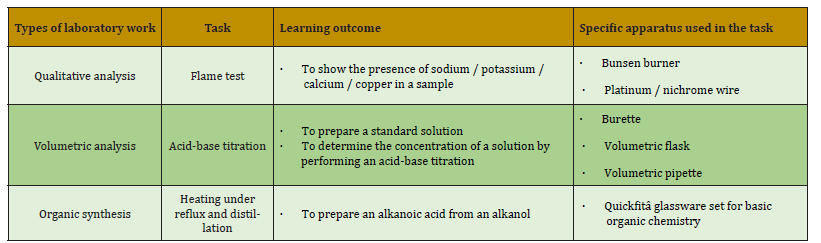
High school chemistry curricula always involve the following three types of practical laboratory work: (1) Qualitative analysis, (2) Volumetric analysis, and (3) Organic synthesis. Students and teachers found these types of work challenging because graduated and sequential apparatuses are involved. More specifically, students should have the proper manipulative skills when using those apparatuses in correct sequences when performing practical laboratory work.
Literature [7] suggested that manipulative skills development is task-specific. Thus, first, we proposed suitable tasks and related learning outcomes for accomplishing the three types of practical laboratory work. Second, we identified specific apparatus used in the tasks. Finally, we borrowed Fadzil and Saat’s framework and formulated a five-level hierarchy framework of manipulative skills for accomplishing the tasks. Table 2 below presents the specific tasks, the related learning outcomes and specific apparatuses for achieving the three types of practical laboratory work we used in the teacher development project.
Table 1:The five-level hierarchy of technical skills [6].
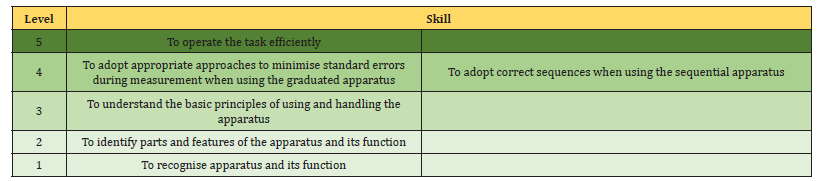
Table 2:Specific practical tasks, the related learning outcomes and apparatuses.
A Teacher Development Project
We designed a teacher development project to develop preservice chemistry teachers’ manipulative skills for accomplishing the tasks by adopting the five-level hierarchy framework. Undergraduate students enrolled in the Bachelor of Education (Science) programme were invited to participate in the project on a voluntary basis. Participants were pre-service chemistry teachers, and most of them had not yet conducted a teaching practicum. A minority of participants performed a teaching practicum once, with the teaching subject being junior secondary science. Hence, it is reasonable to assume that the project participants do not have any full-time experience in chemistry teaching.
The project consists of four stages. In Stage 1 of the project, we organised five three-hour workshops, one for qualitative analysis, two for volumetric analysis, and two for organic synthesis. Each workshop aims to develop participants’ declarative knowledge and procedural knowledge. For example, in a workshop related to volumetric analysis, we planned to show the specific apparatuses to be used in the task. More importantly, we explained the functions of the apparatuses, as well as the features and functions of different parts of each apparatus. Then, we demonstrated the basic principles of using and handling the apparatuses in a correct sequence. At the same time, we explained how to minimise standard errors when using the apparatus. We developed participants’ declarative knowledge through our well-planned instruction. Meanwhile, we adopted an interactive learning and teaching approach, such as asking participants inquiry-based questions to guide them in constructing knowledge. The workshops also allowed participants to practice using the apparatuses, respectively, and using a set of apparatuses to accomplish a task.
In Stage 2, project participants were shadowed by experienced chemistry educators to develop instructional materials that enhance the manipulative skills of high school chemistry students. We encouraged participants to apply innovative technologies such as Gen-AI when producing instructional materials. For example, they applied Gen-AI tools to create short videos and instructional PowerPoint presentations with photos and diagrams.
In Stage 3, project participants conducted on-site visits to observe how experienced secondary school chemistry teachers perform practical laboratory work for their students. Furthermore, professional dialogues were arranged between school teachers and participants to further develop the participants’ reflective experiences.
In Stage 4, project participants conducted on-site teaching by mentoring secondary school chemistry students to develop their manipulative skills for accomplishing practical laboratory work.
To summarise, the teaching development project develops participants’ chemistry manipulative skills in practice through a progressive and systematic approach. Furthermore, the project develops participants’ teaching competencies of teaching manipulative skills for secondary school practical laboratory work through an authentic teaching and reflective process.
Conclusions
Practical laboratory work plays an essential role in chemistry education. Completing laboratory tasks requires adequate manipulative skills that can be developed progressively and systematically. Meanwhile, the gap in the literature reveals the lack of widely adopted, systematic, and curriculum-integrated frameworks for the progressive development and assessment of chemistry manipulative skills. Existing approaches tend to be either extracurricular, ad hoc, or reactive to specific challenges rather than part of a coherent, scaffolded educational design [12-15]. More importantly, existing approaches do not seriously consider an appropriate learning model, where declarative and procedural knowledge should be considered.
We addressed the gap in the literature by considering Anderson’s learning model [5] and Fadzil and Saat’s framework [6] to develop a five-level hierarchy framework of manipulative skills development. We fully recognise the significant role of teachers in students’ learning. Consequently, we base our work on the five-level hierarchy framework to design a teacher project to develop preservice chemistry teachers’ manipulative skills for accomplishing three types of practical laboratory tasks. The project is promising because we included inquiry-based practices, reflective teaching experiences, and innovative educational strategies when designing structured learning activities, which are informed by literature.
Based on existing work, future work includes developing a questionnaire to examine the effectiveness of the teacher development project. Furthermore, it should be essential to explore how to integrate innovative technology such as Gen-AI tools, virtual experiments, etc., when developing students’ manipulative skills in this AI era.
Acknowledgments
This study is supported by the Faculty-based Teaching Development and Enhancement Grants Scheme (FTDEGS), grant number 0315I, by the Faculty of Library Arts and Social Sciences (FLASS), the Education University of Hong Kong (EdUHK).
Conflict of Interest
No conflict of interest.
References
- Hasni A, Potvin P (2015) Student’s interest in science and technology and its relationships with teaching methods, family context and self-efficacy. International Journal of Environmental and Science Education 10(3): 337-366.
- McFarlane DA (2013) Understanding the challenges of science education in the 21st century: New opportunities for scientific literacy. International Letters of Social and Humanistic Science 4: 35-44.
- Schwichow M, Zimmerman C, Croker S, Hartig H (2016) What students learn from hands-on activities? Journal of Research in Science Teaching 53(7): 980-1002.
- Johnstone AH, Al-Shuaili A (2001) Learning in the laboratory: Some thoughts from the literature. University Chemistry Education 5: 42-51.
- Anderson JR (1982) Acquisition of cognitive skill. Psychological Review 89: 369-406.
- Fadzil HM, Saat RM (2017) Exploring students’ acquisition of manipulative skills during science practical work. Eurasia Journal of Mathematics Science and Technology Education 13(8): 4591-4607.
- Gericke N, Hogstrom P, Wallin J (2023) A systematic review of research on laboratory work in secondary school. Studies in Science Education 59(2): 245-285.
- Hidayah FF, Imaduddin M, Yuliyanto E, Gunawan G, Djunaidi MC (2022) Introducing the small-scale chemistry approach through inquiry-based laboratory activities for pre-service teachers. EduChemia 7(1): 14–35.
- Jusayan SR, Mandadero LA, Magno RM, Arellano EL (2012) Initial impact of certificate program for non-specialists teachers in chemistry: Implications to reforms in teachers’ continuing professional development. WVSU Research Journal 1(1): 1-15.
- Krzeczkowska M, Augustinovič A (2024) The dual role of a reflective future teacher during school practise. Acta Educationis Generalis 14(1): 1–19.
- Loughlin WA, Cresswell SL (2025) A review of undergraduate chemistry teaching in higher education during 2019–2023. Journal of Chemical Education 102(5): 1960–1971.
- Hyde J, Wright JS, Xie A (2024) Progression from Chinese high school onto a transnational Chinese-UK university joint BSc degree in chemistry: An international study focussing on laboratory practical skills. Chemistry Education Research and Practice 25: 151-170.
- Jacobsen FE (2023) Use of student-generated technique videos to increase laboratory skills in an online general chemistry laboratory. Journal of Chemical Education 100(4): 1460–1465.
- Rempel BP, Snyman M, King D, Kariuki J, McGinitie EG (2024) Design and implementation of a mentorship course that utilizes senior undergraduate chemistry students as learning assistants in the introductory chemistry laboratory to foster transferable skill development. Journal of Chemical Education 101(9): 3795–3804.
- Wang J, Zhou W, Li Y, Yu M, Zhu Z (2024) The laboratory skills contest: An activity to improve and evaluate students’ laboratory practice through the determination of water hardness. Journal of Chemical Education 101(4): 1758–1765.
-

This work is licensed under a Creative Commons Attribution-NonCommercial 4.0 International License.