


 Research Article
Assessment-Informed Teacher Preparation: Developing Practitioner Researchers Through OSEP Pathways to T.E.A.C.H.
Received Date: August 19, 2026; Published Date: September 08, 2026
Abstract
This chapter examines assessment-informed teacher preparation as a framework for developing practitioner researchers through OSEP Pathways to T.E.A.C.H. The summer enrichment experience combined supervised clinical observation, criterion-referenced language and learning assessment, reflective documentation, and interdisciplinary consultation. Eighteen Pre-K children ages 4 to 5 who were preparing to transition to kindergarten participated in the two-week enrichment period. Teacher candidates engaged with the Assessment of Basic Language and Learning Skills-Revised (ABLLS-R), the Verbal Behaviour Milestones Assessment and Placement Program (VB-MAPP), direct observation, and structured reflection while working alongside behavioural, mental health, and literacy professionals. Quantitative cohort summaries indicated uneven performance across language, social, and early academic domains, including a notable receptive-expressive discrepancy and substantial variability in literacy-related skills. Qualitative observation and reflection entries illustrated candidates’ growing attention to learner strengths, contextual influences on performance, functional communication, self-regulation, and the connection between assessment evidence and instructional planning. The chapter presents the experience as a descriptive mixed-methods program evaluation rather than a test of intervention efficacy. It argues that clinically rich assessment experiences can help teacher candidates learn to collect evidence responsibly, interpret data cautiously, collaborate across disciplines, and translate assessment findings into individualized educational recommendations. Implications are offered for teacher preparation, early childhood practice, and future research on assessment literacy and practitioner inquiry.
Keywords: Assessment-informed practice; Teacher preparation; Practitioner research; Early childhood special education; ABLLS-R; VB-MAPP; Data literacy; Clinical practice
Abbreviations:
ABLLS-R – Assessment of Basic Language and Learning Skills-Revised
VB-MAPP – Verbal Behaviour Milestones Assessment and Placement Program
LRFFC – Listener responding by function, feature, and class
MTS – Matching to sample
OSEP – Full expansion not provided in the source manuscript
T.E.A.C.H. – Full expansion not provided in the source manuscript
Introduction
The preparation of effective early childhood and special education professionals requires more than exposure to theory, curriculum, and classroom management. It requires the intentional development of educators who can identify learner needs, collect and interpret evidence, connect findings to instructional decisions, and engage in reflective inquiry that improves practice. In increasingly diverse early learning environments, candidates must be prepared to use assessment not as an isolated compliance activity, but as part of an ongoing cycle of observation, interpretation, planning, implementation, and reflection.
Assessment-informed teacher preparation therefore occupies an important space between coursework and clinical practice. Candidates need opportunities to work with authentic learner data, administer or observe assessments under supervision, examine contextual variables, discuss findings with professionals from multiple disciplines, and practice explaining how evidence should influence instruction. A systematic review by Sandoval-Ríos et al. [1] concluded that data-literacy training is strengthened when teachers and preservice teachers encounter authentic contexts, collaborative learning, and structured opportunities to use data for instructional decision-making. Cornelius and Owiny [2] similarly found that preservice special educators benefited from explicit instruction and guided practice but often needed additional support to move from collecting formative data to actually revising instruction in response to those data.
The development of practitioner researchers adds a second dimension to this work. Practitioner research positions educators as professionals who systematically examine practice, ask answerable questions, document evidence, and use findings to improve learning conditions. Briscoe [3] reported that teacher candidates who engaged in research coursework and action research developed broader understandings of inquiry-based and evidence-based teaching, while also describing growth in professional agency and identity. Within special education teacher preparation, Balikci et al. [4] further demonstrated the value of performance feedback for strengthening preservice teachers’ implementation of instructional practices. Together, these findings suggest that assessment literacy, clinical rehearsal, feedback, and reflection should be intentionally connected rather than taught as separate competencies.
OSEP Pathways to T.E.A.C.H. provides a context for examining this connection. During a summer enrichment experience, candidates participated in supervised assessment and observation activities with 18 preschool-aged children preparing to enter kindergarten. Candidates maintained reflection documentation, organized assessment information, identified patterns in language, behaviour, social interaction, and early academic performance, and developed recommendations in consultation with a Board-Certified Behaviour Analyst, a licensed clinical mental health professional, and a language-literacy coach. The experience also included guided shadowing of behaviour technicians, giving candidates opportunities to observe how assessment information was translated into real-time instructional and behavioural support.
This chapter presents the summer experience as a descriptive mixed-methods program evaluation. The purpose is not to establish causal effects of the enrichment program or to validate the assessment instruments. Rather, the chapter examines (a) patterns visible in the cohort-level assessment summaries, (b) how candidates used observational and reflective evidence to reason about learner needs, and (c) how an assessment-informed clinical model can support the development of practitioner-researcher habits in teacher preparation.
Conceptual and Empirical Foundation
Assessment Literacy and Data-Informed Decision-Making
Assessment literacy involves more than the technical ability to score an instrument. For educators, it includes understanding what a measure can and cannot support, recognizing the quality and limitations of available data, interpreting patterns in relation to instructional goals, and making decisions that are proportionate to the evidence. This distinction is particularly important in special education, where instructional decisions often depend on multiple forms of evidence collected across settings and over time. Sandoval- Ríos et al. [1] identified authentic practice, collaboration, and structured decision-making as recurring features of effective dataliteracy preparation. Cornelius and Owiny [2] likewise showed that explicit teaching of data collection alone does not guarantee strong data use; candidates need opportunities to analyse evidence, reflect on it, and revise instruction accordingly.
Progress monitoring is also central to responsible data use. The National Center on Intensive Intervention [5] emphasizes decision rules that help educators examine trends rather than react to isolated data points. For preservice educators, learning to distinguish a pattern from a single observation is a foundational research habit. It encourages candidates to avoid deficit-based conclusions, seek corroborating evidence, and treat instructional recommendations as hypotheses that should be monitored and refined.
Criterion-Referenced Assessment in Language and Learning
Two assessment systems were central to the summer experience: the Assessment of Basic Language and Learning Skills-Revised (ABLLS-R) and the Verbal Behaviour Milestones Assessment and Placement Program (VB-MAPP). The ABLLS-R is a criterion-referenced assessment, curriculum guide, and skillstracking system used to identify strengths and skill needs across language, learning, academic, self-help, and related domains [6]. The VB-MAPP is also criterion referenced and is organized around language, social, learning, and early academic milestones informed by the analysis of verbal behaviour [7]. Its Milestones Assessment includes domains such as mand, tact, listener responding, intraverbal behaviour, independent play, social behaviour and social play, visual perceptual and matching-to-sample skills, linguistic structure, group and classroom skills, and early academics.
Because both instruments are criterion referenced, their scores should not be interpreted as population norms in the same manner as a norm-referenced standardized test. This distinction is important for the present chapter. The summer team summarized cohort performance using locally developed “below,” “average,” and “above” descriptive bands to facilitate instructional discussion. Those labels are used only to report the locally summarized cohort data and should be understood as local cohort-summary categories, not as official ABLLS-R or VB-MAPP normative classifications.
Assessment administration also requires training and fidelity. Barnes et al. [8] found that behavioural skills training—including instruction, modelling, rehearsal, feedback, and remedial teaching—substantially improved professionals’ accuracy in administering the VB-MAPP compared with reading the manual alone. This finding is especially relevant to teacher preparation: supervised assessment experiences should be designed as learning opportunities, with explicit modelling and feedback, rather than as unsupervised practice with high-stakes implications for children.
Observation, Functional Assessment, and Context
The summer experience also incorporated naturalistic observation and, when behavioural concerns warranted closer examination, antecedent-behaviour-consequence documentation and function-based thinking. Current U.S. Department of Education guidance describes functional behavioural assessment as a process for identifying factors that contribute to behaviour so that positive, proactive, and function-based supports can be developed [9]. The guidance emphasizes direct and indirect data, collaboration with families and professionals, environmental context, and the use of findings to support students in inclusive learning environments.
For teacher candidates, this contextual perspective is important because behaviour and academic performance do not occur in isolation. A child may demonstrate a skill in one setting and not another, perform differently depending on task demands or available supports, or use behaviour as communication when more efficient communication responses are not yet established. Exposure to multiple settings can therefore help candidates move beyond labels and ask more useful questions: Under what conditions does the child succeed? What antecedents are associated with difficulty? What supports increase engagement? What communication or selfregulation skills may serve as meaningful alternatives?
Reflective Practice and Practitioner Research
Reflection turns clinical experience into professional learning when it is anchored in evidence rather than impression. In the Pathways experience, candidates maintained weekly documentation of observations, questions, emerging interpretations, and professional learning. These reflections were not collected as a psychometrically validated measure of candidate growth; instead, they functioned as formative practitioner-research records. The value of this approach lies in helping candidates articulate the connection between what they observed, what the assessment data suggested, what the literature indicated, and what they would do next in practice.
This approach aligns with Briscoe’s [3] finding that research engagement can strengthen teacher candidates’ inquiry orientation and professional identity. It also complements performancefeedback literature in special education teacher preparation, which emphasizes repeated opportunities to practice, receive feedback, and refine implementation [4]. Within Pathways, reflection and interdisciplinary consultation served as mechanisms for slowing down interpretation, challenging assumptions, and connecting technical assessment skills to ethical and instructional reasoning.
Purpose and Guiding Questions
The chapter was guided by three questions:
1. What descriptive patterns were evident across selected language, social, learning, and early academic domains for the 18-child Pre-K cohort?
2. How did candidate observation and reflection records illustrate the use of assessment information to understand learner strengths, contextual needs, and instructional priorities?
3. What design features of an assessment-informed clinical experience appear useful for developing practitionerresearcher habits in early childhood and special education teacher preparation?
Materials and Methods
Design
The summer experience is presented as a descriptive mixedmethods program evaluation. Quantitative data consisted of cohortlevel counts across locally defined performance bands for selected language, learning, social, and early academic domains. Qualitative data consisted of naturalistic observation notes, anecdotal records, candidate reflection documentation, and case-based professional interpretations. The design was descriptive and interpretive rather than experimental; no control group, random assignment, or inferential statistical testing was used. Accordingly, the results are intended to identify patterns and generate instructional and teacher-preparation implications rather than establish intervention effects.
Participants and Setting
The child cohort included 18 Pre-K students, ages 4 to 5, participating in a summer enrichment experience as they prepared to transition to kindergarten. Data collection occurred at Ascend Academy in Winston-Salem, North Carolina, across classroom, natural-environment, and individual assessment contexts. Classroom observations occurred during structured learning, centre-based activities, play, transitions, meals, and other daily routines. Individual assessment sessions occurred in a quieter setting designed to reduce distractions and allow direct presentation of assessment tasks.
The teacher-preparation participants were OSEP Pathways to T.E.A.C.H. candidates engaged in supervised clinical learning. Program documentation identified collaboration with a Board- Certified Behaviour Analyst, a licensed clinical mental health professional, a language-literacy coach, and behaviour technicians. Candidates participated in observation, assessment-related activities, reflection, data organization, pattern identification, and recommendation development. Because complete candidateparticipant counts and demographic characteristics were not documented, no candidate-level demographic comparisons are reported.
Data Sources and Measures
Multiple data sources were used to support a whole-child view of performance. Direct observations documented communication attempts, social interactions, participation, emotional responses, task engagement, transitions, and adaptive behaviours across naturally occurring activities. Anecdotal records were supplemented, when relevant, by antecedent-behaviour-consequence documentation designed to clarify contextual patterns surrounding behaviour. Teacher input and informal caregiver information were also used as contextual sources for understanding skills, concerns, preferences, and developmental history.
The ABLLS-R and VB-MAPP served as structured criterionreferenced assessment frameworks and were interpreted according to their intended criterion-referenced use rather than as normreferenced diagnostic tests. Cohort-level data were subsequently summarized into three local descriptive bands—below, average, and above—for internal instructional analysis. These local bands are not official categories of either instrument and should not be interpreted as standardized comparative scores.
Procedures
The evaluation window was two weeks. Candidates participated in supervised observation and assessment-related activities across multiple contexts. Structured tasks were used to sample selected language, social, learning, and early academic skills, while naturalistic observations were used to examine how children engaged with peers, adults, routines, and instructional demands. Candidates maintained reflection documentation throughout the experience and discussed emerging patterns with supervising professionals. The intent of the process was to connect assessment evidence to individualized instructional reasoning rather than to rank children or make high-stakes placement decisions.
For behavioural concerns, candidates were introduced to function-based observation practices. Antecedents, observable behaviour, and consequences were documented when appropriate, and candidate recommendations emphasized prevention, replacement-skill instruction, reinforcement, communication, and environmental supports. This approach is consistent with federal guidance that function-based assessment should inform positive and proactive supports rather than punitive responses [9].
Data Analysis
Quantitative analysis was descriptive. Counts for each local performance band were converted to percentages of the 18-child cohort to improve interpretability. No inferential tests were conducted because the sample was small, the evaluation period was brief, and the local performance bands were not normative scores. The analysis focused on cross-domain contrasts that could inform instruction, such as differences between receptive and expressive language-related performance and the distribution of students across early academic domains.
Qualitative observation and reflection records were reviewed iteratively for recurring ideas related to communication, selfregulation, engagement, contextual influences, assessment interpretation, and instructional decision-making. Because a formal coding protocol, multiple coders, and interrater reliability procedures were not documented, the qualitative findings are reported as illustrative themes rather than as a formal thematic analysis with claims of saturation or prevalence.
Ethical and Interpretive Considerations
Study documentation indicates that student names were not used in research records and that initials were used to protect privacy. Assessment and observation information was described as being used for educational and instructional purposes, with an emphasis on identifying strengths and supportive interventions rather than labelling or stigmatizing children. The manuscript therefore reports only aggregated cohort data and de-identified illustrative observations.
Author Query Before Submission: Confirm and insert the applicable institutional review/IRB determination, organizational permission, and parent consent/waiver language required by the target publisher or institution. This information was not documented in the source manuscript and has not been invented in this revision.
Results and Discussion
Results
Cohort-Level Descriptive Profile
Table 1 summarizes the available general language and learning skill data for the cohort. The most notable pattern is that at least half of the cohort fell in the locally defined below band for labelling, social interaction, and reading. At the same time, each domain also included a smaller group of children in the above band, indicating substantial within-cohort variability rather than a uniform developmental profile.
Table 1: Distribution of ever-married females by age group and gravida and para, Kampung Peninjau Lama, December 2013.

Note. Performance bands were locally defined for cohort summary and are not normative ABLLS-R classifications.
Table 2 presents selected domains summarized from the VBMAPP- related cohort data. Because the original team converted performance into local three-band categories, the table should be interpreted descriptively rather than as a reproduction of standard VB-MAPP scoring. The strongest distributions in the above band were observed for independent play (66.7%), listener/receptive performance (61.1%), and social/social-play skills (55.6%). By contrast, no child was placed in the local above band for math, intraverbal responding, listener responding by function, feature, and class (LRFFC), tact/expressive naming, or linguistic structure. The largest below-band proportions occurred in linguistic structure (72.2%), tact/expressive naming (66.7%), LRFFC (61.1%), intraverbal responding (55.6%), writing (50.0%), and mand/ requesting (50.0%).
Table 2: Selected VB-MAPP-Related Domain Summary.
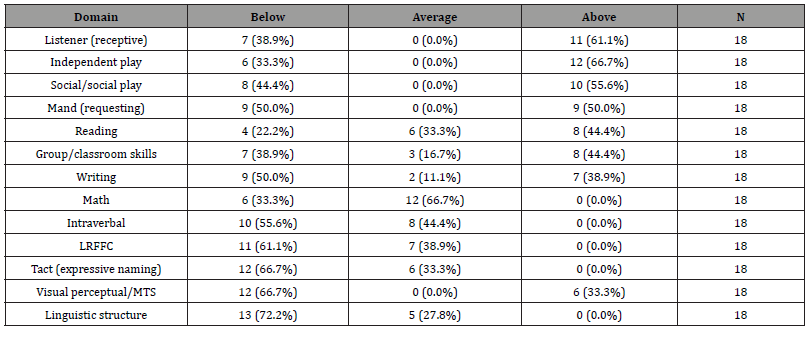
Note. LRFFC = listener responding by function, feature, and class; MTS = matching to sample. Performance bands were locally defined by the summer team and are not standard VB-MAPP normative categories.
Pattern 1: Receptive-Expressive Discrepancy
The clearest cross-domain contrast involved receptive and expressive language-related performance. Eleven children (61.1%) were placed in the local above band for listener/receptive skills, whereas 12 children (66.7%) were in the below band for tact/ expressive naming and 10 (55.6%) were in the below band for intraverbal responding. This pattern suggests that some children were more successful when responding to spoken directions or identifying stimuli than when independently generating labels or conversational responses. The data do not establish why this discrepancy occurred, but they support closer instructional attention to expressive communication opportunities and to the conditions under which children demonstrate knowledge.
For classroom practice, the implication is not to replace receptive tasks entirely or to require speech from children whose communication system includes other modalities. Rather, educators can create systematic opportunities for expressive responding through speech, augmentative and alternative communication, sign, gesture, or other appropriate modalities; use prompting and prompt fading; and monitor whether children can generalize responses across people, materials, and settings. Assessment should distinguish a lack of knowledge from difficulty producing a response in a particular form.
Pattern 2: Structured and Naturalistic Social Performance
A second contrast appeared between structured play/social domains and broader social interaction. Independent play and social/social-play domains showed relatively high proportions in the local above band, while the general social-interaction summary placed 50.0% of children in the below band. Candidate observation records also described children who participated successfully in structured or adult-supported activities but required more support during peer conflict, transitions, or less predictable interactions. This difference reinforces the value of observing skills across settings. A child’s successful performance in a structured task does not necessarily demonstrate spontaneous use of the same repertoire during natural peer interaction.
Pattern 3: Language Demands and Early Academic Performance
Linguistic structure, LRFFC, and intraverbal responding were among the lower-performing domains, while math scores clustered in the local average band (66.7%) with no children in the above band. One plausible interpretation is that language demands may have influenced how some children demonstrated mathematical knowledge; however, the descriptive data cannot establish a causal relationship. Future assessment should examine whether children perform differently when mathematical concepts are presented with reduced language demands, visual supports, manipulatives, or explicit vocabulary instruction.
Pattern 4: Heterogeneity in Early Literacy
Reading and writing distributions were heterogeneous. In the general reading summary, 50.0% of the cohort fell in the below band and 33.3% in the above band. In the VB-MAPP-related reading summary, 22.2% were below, 33.3% average, and 44.4% above; writing showed 50.0% below, 11.1% average, and 38.9% above. Differences across these summaries may reflect the use of different task sets or scoring frameworks. Rather than treating the distributions as evidence of a single developmental “gatekeeper,” the data support differentiated instruction and more precise skilllevel assessment of phonological awareness, print concepts, lettersound knowledge, emergent writing, fine-motor demands, and task engagement.
Illustrative Candidate Reflection Themes
The candidate reflection and observation records provide a second lens on the experience. Because the records were not analyzed through a formal qualitative protocol, the themes below are presented as illustrative patterns in professional reasoning rather than as prevalence estimates.
Table 3: Selected VB-MAPP-Related Domain Summary.
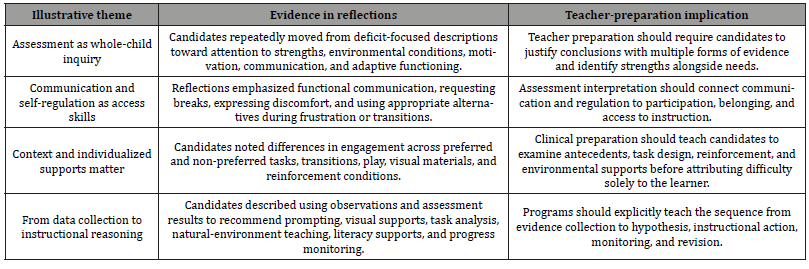
Note. Themes are interpretive summaries of the available reflection and observation records; formal qualitative coding procedures and theme frequencies were not documented.
Discussion
The Pathways summer experience illustrates how assessment can become a bridge between clinical practice and practitioner research. The most important contribution of the experience is not the presence of any one assessment tool. Rather, it is the structured sequence in which candidates encountered learner evidence, discussed its meaning, compared performance across contexts, reflected on their own interpretations, and translated findings into instructional recommendations. This sequence closely aligns with current literature emphasizing authentic data use, guided practice, reflection, and performance feedback in teacher preparation [1,2,4].
The child-level findings also demonstrate why assessment literacy matters. The same cohort showed relatively strong receptive and structured play performance alongside weaker expressive language-related domains and wide variability in literacy. A less careful interpretation could reduce these patterns to simplistic labels. An assessment-informed practitioner instead asks what each measure sampled, whether the classification is criterion referenced or normative, how the child performed in natural contexts, and what additional evidence is needed before making a decision. This habit of cautious interpretation is central to both ethical assessment and practitioner research.
The local performance bands used during the summer provided a practical way to summarize data for group discussion, but they also reveal an important training opportunity. Because the ABLLS-R and VB-MAPP are criterion-referenced systems, translating their scores into “below,” “average,” and “above” categories can imply norm-referenced meaning that the instruments do not provide. Teacher preparation programs should explicitly teach candidates how scoring systems differ, what claims are warranted by each type of assessment, and how to communicate results without overstating precision.
The reflection records further suggest that interdisciplinary consultation helped candidates interpret child behaviour in context. Candidates described communication, emotional regulation, transition support, motivation, and academic readiness as interconnected rather than isolated problems. This perspective is consistent with federal guidance encouraging collaborative, function-based approaches when behaviour interferes with learning [9]. It also supports a broader view of teacher preparation in which educators learn to collaborate with behaviour analysts, mental health professionals, speech-language and literacy specialists, families, and other members of a child’s support team.
Implications for Teacher Preparation
Teach Assessment Fidelity Through Rehearsal and Feedback
Candidates should not be expected to learn complex criterion referenced assessments by reading manuals alone. Programs can use behavioural skills training principles—explicit instruction, modelling, rehearsal, performance feedback, and corrective practice—to build administration and interpretation competence. Barnes et al. [8] provide direct evidence that this type of training can improve VB-MAPP administration accuracy, while Balikci et al. [4] demonstrate the broader value of performance feedback in special education teacher preparation.
Make the Data-to-Decision Cycle Explicit
Clinical experiences should require candidates to document the full reasoning chain: What evidence was collected? What pattern does it suggest? What alternative explanations remain plausible? What instructional action is justified? What data will show whether that action is working? This structure can reduce the tendency to collect data without using it meaningfully, a challenge identified by Cornelius and Owiny [2].
Require Cross-Context Evidence
The Pathways data show why a single structured assessment context can be insufficient. Candidates should compare direct assessment performance with classroom observation, play, transitions, peer interaction, and other relevant contexts. Crosscontext analysis can help distinguish skill deficits from performance variability and supports more individualized recommendations.
Integrate Reflection With Scholarly Inquiry
Weekly reflections should be more than narrative journals. Programs can structure them as short practitioner-research memos requiring candidates to state an observation, connect it to evidence or literature, identify an instructional implication, and name the next question or data source needed. This format turns reflection into disciplined inquiry and may strengthen the research-oriented professional identity described by Briscoe [3].
Center Ethical, Strengths-Based Interpretation
Assessment training should explicitly address confidentiality, family partnership, culturally and linguistically responsive interpretation, learner dignity, multimodal communication, and the limits of assessment tools. Candidates should learn to report strengths and support needs without converting descriptive patterns into fixed labels. When behavioural concerns are present, function-based and proactive supports should be emphasized over punitive responses [9].
Implications for Early Childhood Practice
For early childhood educators and program leaders, the cohort findings support differentiated rather than uniform instruction. Children who demonstrate stronger receptive than expressive performance may benefit from systematic opportunities to communicate knowledge using appropriate modalities, structured prompt-fading plans, vocabulary expansion, and generalization across settings. Children whose social performance changes substantially between structured and unstructured contexts may benefit from explicit peer-entry scripts, visual supports, transition preparation, natural-environment teaching, and coached practice during authentic routines.
Literacy and early academic instruction should similarly be responsive to skill-level data. The heterogeneous reading and writing profiles argue for targeted assessment of component skills rather than broad judgments about “readiness.” Smallgroup instruction can be organized around specific needs such as phonological awareness, letter-sound knowledge, emergent decoding, print concepts, fine-motor or graphomotor support, and language comprehension. Progress should be monitored using repeated measures and predetermined decision rules rather than impression alone [5].
For school and program leaders, the broader implication is organizational. Assessment-informed practice requires time for collaborative review of data, access to trained specialists, professional development in data literacy and function-based support, and systems that allow teachers to adjust instruction based on evidence. Leadership should also ensure that assessment tools are used within the boundaries of their intended purpose and that staff receive appropriate training before administering specialized instruments.
Policy and Systems Considerations
The Pathways model also suggests several system-level priorities. First, preparation grants and teacher education programs should continue to fund clinically rich experiences in which candidates work with authentic learner evidence under expert supervision. Second, professional learning investments should include assessment literacy and data-use competence, not simply the acquisition of assessment products. Third, early childhood accountability systems should preserve space for developmentally appropriate, criterion-referenced, observational, and progressmonitoring data rather than relying on a single high-stakes indicator. Finally, cross-sector partnerships among universities, early childhood programs, behavioural health professionals, and families can strengthen both candidate learning and the quality of support available to young children.
Limitations
Several limitations should shape interpretation of this chapter. First, the child cohort was small (N = 18), drawn from a single program, and observed during a brief two-week summer window. The findings therefore should not be generalized to broader populations. Second, the cohort summary used locally defined below, average, and above categories that are not normative classifications of the ABLLS-R or VB-MAPP. Third, the evaluation did not include random assignment, a comparison group, or inferential statistical analysis; consequently, no causal claims about the enrichment experience or intervention effectiveness are warranted.
Fourth, the available program documentation contains descriptive observation and reflection records but does not document a formal qualitative coding protocol, coder training, interrater agreement, or saturation. Candidate reflection themes are therefore illustrative. Fifth, assessor fidelity and interobserver agreement were not reported. Future implementations should document training procedures, fidelity checks, scoring agreement, and the operational rules used to transform criterion-referenced scores into any cohort-level summary categories. Finally, the formal institutional ethics determination and consent language required for publication were not available in the manuscript materials reviewed for this chapter; these items must be confirmed by the authors before submission.
Future Research
Future studies should examine assessment-informed teacher preparation using stronger program-evaluation designs. A multisite study could follow candidates across coursework and field placements, measure assessment-administration fidelity, evaluate changes in data-interpretation competence, and analyse structured reflection artifacts using a documented qualitative protocol. Candidate outcomes could include performance-based assessment tasks, data-use rubrics, self-efficacy measures, and observed instructional adjustments following assessment review. Child-level outcomes should be measured separately and should not be used as a proxy for candidate learning unless the design supports that inference.
For the child assessment component, future work should preserve the criterion-referenced scoring structures of the ABLLS-R and VB-MAPP or clearly document any local transformation rules. Repeated assessment across a longer period would allow examination of growth trajectories rather than one-time cohort distributions. Researchers should also examine whether receptiveexpressive discrepancies persist across communication modalities and whether performance changes when language demands, visual supports, task complexity, and naturalistic contexts are systematically varied.
Conclusion
Assessment-informed teacher preparation offers a practical pathway for connecting clinical learning, data literacy, reflective inquiry, and practitioner research. The OSEP Pathways to T.E.A.C.H. summer experience placed candidates in authentic situations where they had to observe carefully, use structured assessment information, consider context, collaborate with professionals, and translate evidence into instructional reasoning. The 18-child cohort demonstrated meaningful variability across language, social, learning, and early academic domains, reinforcing the need for individualized interpretation rather than broad assumptions about school readiness.
Equally important, the experience showed how assessment can shape the professional habits of future educators. When candidates are taught to collect evidence with fidelity, question the limits of a measure, examine patterns across contexts, reflect on alternative explanations, and monitor the effects of instructional decisions, they begin to work as practitioner researchers. This orientation is especially important in early childhood and special education, where learner needs are complex and where responsible decisions require both technical competence and disciplined professional judgment. Assessment should not end with a score. In effective teacher preparation, it becomes the beginning of inquiry, collaboration, and responsive action.
Acknowledgements
None.
Conflict of Interest
No conflict of interest.
References
- Sandoval-Ríos F, Gajardo-Poblete C, López-Núñez JA (2025) Role of data literacy training for decision-making in teaching practice: A systematic review. Frontiers in Education 10: Article 1485821.
- Chezan LC, Bauer AM, McCammon MN, Drasgow E (2024) Functional communication training in schools: A systematic analysis of the evidence for ecological validity. Behaviour Modification 48(5–6): 502–536.
- Cornelius KE, Owiny RL (2026) Preparing special education candidates to collect and use data in rural settings. Rural Special Education Quarterly. Advance online publication.
- Briscoe P (2025) Teacher candidates’ learning in a research course: Implications for future teaching practices and professional identity formation. International Online Journal of Education and Teaching 12(3): 30–55.
- Balikci S, Gulboy E, Rock ML, Rakap S (2025) A meta-analysis of performance feedback as an evidence-based practice in special education teacher preparation. Teacher Education and Special Education 48(3): 169–191.
- National Center on Intensive Intervention (2024) Decision rules for analysing academic progress monitoring data.
- Partington JW (2006) The assessment of basic language and learning skills–revised (ABLLS-R): Scoring instructions and IEP development guide. Behaviour Analysts, Inc., Pleasant Hill, CA, USA.
- Sundberg ML (2008) Verbal behaviour milestones assessment and placement program: The VB-MAPP. AVB Press, Concord, CA, USA.
- Barnes CS, Mellor JR, Rehfeldt RA (2014) Implementing the Verbal Behaviour Milestones Assessment and Placement Program (VB-MAPP): Teaching assessment techniques. The Analysis of Verbal Behavior 30(1): 36–47.
- S. Department of Education, Office of Special Education and Rehabilitative Services, Office of Elementary and Secondary Education (2024) Using functional behavioural assessments to create supportive learning environments.
-

This work is licensed under a Creative Commons Attribution-NonCommercial 4.0 International License.