


 Research Article
Integrating Innovative Sustainable Strategy into Strategic Management Education: A CDIO-Based Experiential and AI-Collaborative Teaching Practice
Received Date:October 23, 2025; Published Date:December 15, 2025
Abstract
This study develops and empirically validates a CDIO-based instructional model that integrates experiential and AI-collaborative learning to promote sustainability competence in strategic management education. Addressing persistent challenges in business curricula - such as low learning motivation, limited innovation, insufficient AI literacy, weak teamwork, and underdeveloped sustainability thinking - the research applies experiential and AI-collaborative learning within the CDIO framework to enhance students’ engagement and sustainable competence. Findings indicate that this CDIO-based approach significantly improves student engagement, teamwork, and the capacity for sustainability-oriented and innovative thinking. The results confirm the adaptability of the CDIO framework beyond engineering contexts and highlight its potential to cultivate sustainability-driven innovation and digital fluency in management education. The study concludes with implications for embedding Education for Sustainable Development and Global Goals (ESDG) principles into higher education curricula to bridge academic learning with workplace readiness.
p>Keywords: Conceive-Design-Implement-Operate (CDIO); Experiential learning; AI-collaborative learning; sustainability educationIntroduction
Business and management education in higher education institutions is undergoing a period of significant transformation as sustainability imperatives, digitalization, and artificial intelligence (AI) reshape learning paradigms. Universities worldwide are expected to cultivate graduates who can combine analytical reasoning with creativity, collaboration, and social responsibility to address complex societal and environmental challenges [1,2]. However, despite substantial curricular reform efforts, many business programs continue to encounter persistent pedagogical challenges that hinder students’ learning engagement and realworld readiness.
Across diverse tertiary contexts, students in business disciplines frequently demonstrate low learning motivation and limited engagement, largely due to teacher-centered and assessmentdriven pedagogies that constrain experiential and reflective learning [1]. Moreover, creative and innovative thinking skills - essential for strategic problem-solving - remain underdeveloped in conventional curricula [3]. The accelerated diffusion of digital technologies has also exposed deficiencies in AI literacy and data analytics skills among students, restricting their capacity to apply technology in managerial contexts [4]. Likewise, teamwork and communication - core competencies for professional collaboration - are insufficiently cultivated in lecture-based classrooms [5].
Another critical concern is the absence of sustainability-oriented thinking, despite growing calls for embedding environmental, social, and governance (ESG) principles into management education [6]. This deficiency undermines students’ ability to connect business performance with broader social and environmental accountability. Collectively, these challenges weaken graduates’ employability and capacity to contribute to sustainable innovation [7].
To address these issues, this study employs the Conceive- Design-Implement-Operate (CDIO) framework as an integrative pedagogical model that unites experiential learning and AIcollaborative learning in strategic management education. By embedding innovative and sustainable strategy concepts into authentic, technology-enhanced learning experiences, this research seeks to enhance students’ engagement, teamwork, and sustainability competence. The study contributes to the growing discourse on Education for Sustainable Development and Global Goals (ESDG) by empirically validating a CDIO-based instructional model that equips students to apply sustainability-driven innovation and digital fluency in real-world management practice.
Literature Review
CDIO in Higher Education
The CDIO framework emphasizes the entire lifecycle of conceiving, designing, implementing, and operating a system, thereby linking theory to professional application [8]. Its structured approach cultivates technical mastery alongside communication, leadership, and reflective skills. Lin [9] found that integrating CDIO with problem-based learning improved marketing students’ learning satisfaction, while Thomassen and Lai [10] integrating CDIO principles, such as management education, not only enhances learners’ self-awareness and teamwork but also fosters their access to practical experiences in risk management and sustainable value creation.
Experiential Learning
Experiential learning emphasizes learning through authentic experiences, reflection, and practical application [11]. In higher education, it bridges the gap between theory and practice, allowing students to apply classroom concepts to real-world contexts. Recent research highlights its positive effects on student motivation, creativity, and self-regulated learning in business and management education [12]. Contemporary studies identify three core mechanisms: authentic participation, reflective practice, and transformative application. Authentic participation immerses learners in realistic problem-solving and decision-making, enhancing engagement and contextual understanding [13]. Reflective practice deepens comprehension through structured self-assessment and feedback [14], while transformative application encourages learners to adapt and transfer knowledge across contexts [15].
Simulation- and project-based approaches further extend experiential learning by creating conditions for iterative experimentation and collaboration. When combined with AIassisted tools, these experiences improve teamwork, problemsolving ability, and sustainability awareness [2]. Integrating experiential learning with sustainability and ESG-oriented curricula enhances students’ ethical reasoning, systems thinking, and innovation competencies - skills increasingly vital in Industry 5.0 workplaces [16]. Within the CDIO framework, experiential learning concretizes the design and implementation phases through authentic simulation, reflection, and applied action, thereby cultivating analytical, collaborative, and ethical capacities essential for creating sustainable business value.
AI-Collaborative Learning
AI collaborative learning refers to the pedagogical integration of artificial-intelligence tools to support interaction, co-creation, and adaptive feedback among learners. Rather than replacing human collaboration, AI functions as an intelligent partner that scaffolds teamwork and cognitive development. In business education, AI applications such as ChatGPT and data-driven analytics promote real-time information processing, creative ideation, and evidence-based decision-making [2]. Studies show that AIsupported environments enhance critical thinking, reflection, and communication by personalizing feedback and facilitating collective problem solving [17].
Recent research highlights that when AI is integrated within project-based or experiential learning contexts, students demonstrate stronger engagement, higher cognitive persistence, and improved innovation performance [3]. However, effective implementation requires ethical awareness and appropriate instructional design to prevent overreliance and ensure academic integrity. Within the CDIO framework, AI collaborative learning reinforces the design and implementation stages by enabling students to prototype ideas, analyse data, and iteratively refine sustainability-oriented solutions. This synergy between human creativity and algorithmic intelligence cultivates digital literacy, teamwork, and responsible innovation—competencies central to education for sustainable development.
Methodology”
Research Context and Participants
The study was conducted during the spring semester of 2025 at a northern Taiwan university of technology. Participants included 62 senior undergraduate students from the department of Business Administration enrolled in a Strategic Management course. The course was selected because it emphasizes applied decision-making, strategic analysis, and sustainability planning - key competencies aligned with the study’s objectives. Participation was voluntary and informed consent was obtained prior to data collection.
Course Design
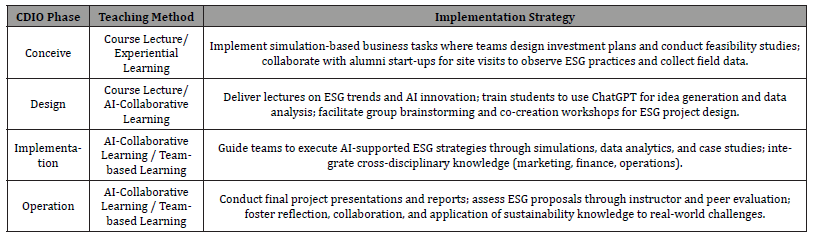
The course was structured in accordance with the CDIO framework and integrated multiple teaching methods-lecturebased instruction, authentic learning, out-of-school learning, and AI-collaborative learning-to strengthen sustainability-oriented and technology-enhanced management competencies. Table 1 summarizes the pedagogical stages and implementation strategies, which are elaborated below.
Table 1:Course Design Framework and Implementation Strategies.
Instruments
A structured questionnaire was developed to assess students’ perceptions across five learning constructs, adapted from validated and widely recognized instruments. Course learning items, learning interest and learning effectiveness were drawn from Yin’s [18] to evaluate curriculum design, intrinsic motivation and satisfaction. Experiential Learning was constructed according to Kolb’s [11] Experiential Learning Theory, emphasizing active participation, reflection, and authentic application. Finally, AI collaborative learning items were designed based on contemporary frameworks of human–AI collaboration in education [17], focusing on interaction, co-creation, and feedback-driven learning. Each construct consisted of three to four items measured on a fivepoint Likert scale (1=strongly disagree to 5=strongly agree). The questionnaire was reviewed by three domain experts to ensure content validity, clarity, and contextual appropriateness before data collection.
Results
Reliability and Descriptive Statistics
The instrument demonstrated strong psychometric properties. The Kaiser–Meyer–Olkin (KMO) value was .89 and Bartlett’s test of sphericity was significant (χ² = 623.74, p < .001), confirming the adequacy of the data for factor analysis. Cronbach’s α coefficients ranged from .86 to .91 across the five constructs, indicating excellent internal consistency. Composite reliability (CR) values ranged from .87 to .93 and average variance extracted (AVE) values from .61 to .73, demonstrating convergent validity. A confirmatory factor analysis (CFA) revealed good model fit: χ²/df = 1.98, CFI = .962, TLI = .951, RMSEA = .062, SRMR = .047, indicating sound construct validity. Descriptive statistics and paired-sample t-test results are presented in Table 2.
Table 2:Descriptive Statistics, Reliability, and Effect Sizes of Pre- and Post-Learning Constructs.

Interpretation
All constructs demonstrated statistically significant improvement (p < .01) after the CDIO-based instructional intervention. Effect sizes, measured by Cohen’s d and η², ranged from medium to large (d = 0.60–0.77; η² = .13–.21), suggesting pedagogically meaningful gains.
The largest effect was observed in Learning Effectiveness (d = 0.77), indicating notable progress in students’ perceived learning outcomes and problem-solving abilities. AI Collaborative Learning (d = 0.69) also showed strong growth, reflecting the positive influence of AI-assisted teamwork and iterative project design on student engagement. Similarly, Learning Interest (d = 0.63) and Experiential Learning (d = 0.60) increased significantly, supporting the motivational benefits of integrating authentic, simulationbased, and AI-driven learning experiences.
Overall, the results confirm that the CDIO framework, when combined with authentic and AI-collaborative learning, significantly improved both cognitive and motivational outcomes, demonstrating strong reliability, validity, and educational effectiveness.
Conclusion
This study provides empirical evidence that integrating the CDIO framework with experiential and AI-collaborative learning can effectively enhance students’ engagement, learning effectiveness, and sustainability-oriented competencies in business education. The integration of AI within higher education fosters creativity, reflective reasoning, and teamwork, while experiential and project-based learning environments strengthen higher-order cognitive engagement and real-world problem-solving. Embedding sustainability-focused projects into management curricula further reinforces students’ ethical awareness and systems thinking. Collectively, these findings support the pedagogical argument that AI-supported experiential learning within the CDIO enables students to translate conceptual knowledge into actionable strategies, thereby improving employability, digital fluency, and the ability to apply sustainable innovation in practical settings. For educators and institutions, the results underscore the importance of reimagining business curricula through integrative, technologyenhanced, and sustainability-driven teaching models that nurture continuous learning, social responsibility, and adaptive professional competence. Future research should continue to explore longitudinal outcomes and cross-institutional validation to assess how CDIO-based AI-collaborative instruction influences graduates’ innovation capacity and professional development across diverse educational and cultural contexts.
Acknowledgment
None.
Conflict of Interest
No conflict of interest.
References
- Greenland S, Saleem, M, Misra, R, Mason, J (2022) Sustainable management education and an empirical five-pillar model of sustainability. International Journal of Management in Education 20(3): 100658.
- Giuggioli G, Pellegrini MM (2023) Artificial intelligence as an enabler for entrepreneurs: a systematic literature review and an agenda for future research. International Journal of Entrepreneurial Behavior & Research 29(4): 816-837.
- Ratten V, Jones P (2023) Generative artificial intelligence (ChatGPT): Implications for management educators. The International Journal of Management Education 21: 100857.
- Ocen S (2025) Artificial intelligence in higher education institutions: review and future research directions. Frontiers in Education 10: 1530247.
- Dornemann S (2025) Teamwork in higher education doesn't just happen: Assessing collaborative skill development in lecture-based contexts. 11th International Conference on Higher Education Advances (HEAd’25), Val`encia.
- Lähteenkorva M (2025) From knowledge to wisdom in sustainable management education: Bridging the gap in higher business education. Innovations in Education and Teaching International 62(1): 41–57.
- De Silva TA (2024) Is the accounting curricula keeping up with sustainability and ESG integration? Accounting Education 33(5): 467–482.
- Edström K, Kolmos A (2014) PBL and CDIO: Complementary models for engineering education development. European Journal of Engineering Education 39(5): 539-555.
- Lin CH (2023) The Implication of Project-Based Learning with CDIO, and Team Teaching on Business-Management Course. 2023 Innovative Technologies and Learning (ICITL 2023), Portugal.
- Thomassen ML, Lai YC (2022) Sustainable entrepreneurship in a CDIO context. 18th International CDIO Conference, Iceland.
- Kolb DA (1984) Experiential learning: Experience as the source of learning and development. Prentice-Hall.
- De la Fuente J, Martínez-Vicente JM, Santos FH, Sander P, García-Berbén AB (2019) Promoting innovative experiential learning practices to improve academic performance: Empirical evidence from a Spanish Business School. Journal of Innovation & Knowledge 4(2): 97–103.
- Nachtigall V, Shafer DW, Rummel N (2022) Stirring a secret sauce: A literature review on the conditions and effects of authentic learning. Educational Psychology Review 34(3): 1479–1516.
- Vermunt JD (2023) Understanding, measuring and improving simulation-based learning in higher education: Student and teacher learning perspectives. Learning and Instruction 86: 101773.
- McAlpin E, Levine M, Plass JL (2023) Comparing two whole task patient simulations for two different dental education topics. Learning and Instruction 83: 101690.
- Carminati L, Lagorio A, Cimini C, Pirola F, Jurczuk A, Boucher X (2025) Integrative skills framework for Industry 5.0: insights from a systematic literature review and a European survey study, Journal of Environmental Management 394(17): 127425.
- Kovari A (2025) A systematic review of AI-powered collaborative learning in higher education: Trends and outcomes from the last decade, Social Sciences & Humanities Open 11: 101335.
- Yin J, Goh TT, Yang B, Xiaobin Y (2021) Conversation technology with micro-learning: The impact of chatbot-based learning on students’ learning motivation and performance. Journal of Educational Computing Research 59(1): 154-177.
-

This work is licensed under a Creative Commons Attribution-NonCommercial 4.0 International License.