


 Mini Review
6G-IoV Networks: Technologies, Trends, and Opportunities
Received Date: March 17, 2025; Published Date:March 25, 2025
Abstract
Vehicle to Everything (V2X) communication technology is a primary technology for data exchange between associated smart vehicles. It has also become a vital technique for observing the surroundings for future self-governing vehicles due to the advancement of Internet of Vehicles (IoV) technologies. This study describes architectures of 6G-V2X communication networks that use device-to-device communications to deliver low latency, high dependability, and large capacity cellular telecommunications services. We explore their basics, essential traits, and issues, advantages,and future research directions. IOTA-based architecture for IoV is proposed for exchanging information and communication between the vehicles and roadside units (V2R).
Introduction
With the swift advancement of Internet technology, 5G technology has been integrated into the daily life of individuals. Since 5G is maturing, governments throughout the world have started to investigate 6G technology. Nevertheless, many nations have yet to achieve an agreement on the progress path of 6G technology. At the moment, most people believe that 6G technology must be based on 5G technology and merge mobile satellite interconnections, artificial intelligence (AI), and analysis on big data to build a foundation for mobile technologies in the future [1]. Compared to 5G technology, 6G technology will operate at higher frequencies, significantly increasing the number of connections and coverage and speed of networks.
Furthermore, 6G technology will consist of a broader commercial reach than 5G technology. Its shape and work will be developed in a new manner [2]. The Internet of Vehicles (IoV) idea is evolved from the Internet of Things (IoT) technology, which plays a vital role in smart cities development. The IoV is formed by connecting cars, wireless networks, and other items as a network that is accessible and interconnected. It will serve as the platform for future selfdriving smart automobiles and intelligent transportation networks. Vehicle-to-network(V2N), vehicle-to-vehicle(V2V), V2R, vehicleto- road infrastructure are the primary applications of IoV. The 6G network will cover the entire planet by combining terrestrial wireless and satellite communications. Through the integration of satellites into 6G cellular networks, worldwide smooth and continuous coverage is accomplished. This network will reach any distant town, enabling people to get telemedicine and obtain distance learning [3]. 6G communication technology is more than just an increase in bandwidth and transmission capacity. It is about closing the digital gap and achieving the ultimate objective of the Internet of Everything (IoE), which is precisely what 6G means. In terms of vehicle connectivity, major improvements will happen due to 6G. The 6G channel debate will give us an essential conceptual foundation for 6G research and generalization. Another strategy for 6G technology was proposed in [4], claiming that it will outperform mobile Broadband and support AI services. Moreover, artificial intelligence will impact developing and enhancing architecture and protocols and the activities of 6G.
Another emerging technology that will fulfil that helps to reach the consensus finality, unlike the blockchain, is IOTA. IOTA is a cryptocurrency and fully accessible distributed ledger developed for the Internet of Things. It stores transactions on its ledger using a directed acyclic graph, inspired by the promise for greater scalability above blockchain technology. IOTA, which is based on trustworthiness in device transactions and data, will thereby assist in boosting the full potential of DLT and blockchain. While platforms such as Bitcoin and Ethereum utilize the Blockchain, which includes successive blocks, with numerous transactions within a block, the Iota uses a much less restricted DAG known as the Tangle. There are no blocks in the Iota Tangle network, and each new transaction refers to the prior two transactions and is not required to gain instant consensus [5]. When a participant wishes to add a new event to Tangle, he must first approve any two already connected transactions. Because network users authenticate the transactions, no miners are required, and hence the cost of a transaction is simply the computational cost of verifying two previous transactions [6].
The Tangle graph network comprises nodes, which are units that issue and authenticate Tangle transactions, and each node also represents a transaction.
Following is the procedure for connecting a transaction to Tangle: (a) A node selects two additional transactions to authorize using the Markov Chain Monte Carlo (MCMC) tip selection method; (b) the node determines both transactions are in dispute and disapproves problematic transactions (double-spending); (c) For a node to publish a legitimate transaction, it must first resolve a proof-of-work (PoW), which is accomplished by locating a nonce and concatenating its hash with certain data from the authorized transaction. This computation complexity is very light as compared to that of Blockchain [19]; (d) following that, the sender submits its transaction to the network, so it becomes a tip, i.e., unapproved transaction; (e) the tip needs to wait for verification through approval till its gathered weight attains the threshold value. IOTA can execute billions of transactions every second. There is no other platform that is capable of doing so. IOTA transactions are rapid at scale because you must first verify two transactions for any transaction you intend to perform [7].
Issues and concerns for 6G-IoV
Because 6G-IoV is still in its early stages, its architecture and corresponding techniques differ from previous IoV systems. 6G networks are expected to be intelligent and versatile, with a variety of approaches and applications. Some concerns relating to 6G network technologies are discussed below:
Scalable and Flexible 6G-IoV Architecture Design
As it is well known, IoV applications fall into three categories: information service applications for customer experiences, intelligent applications for vehicle driving, and smart transport applications for communication. As a result, the research on performance standards and essential technologies of the applications, as mentioned earlier, serves as the foundation for designing the 6G-IoV architecture. Because 6G-IoV includes 5G vehicle units, 6G BS(s), 6G mobile terminals, 6G cloud servers, and other components, it has a more flexible framework than traditional IoV. Aside from V2X information interaction, 6G-IoV will actualize the connectivity of the OBU, BS, mobile, and cloud servers and support them with particular features and communication modes.
Identity Authentication and Privacy Protection Strategies
Greater bandwidth and effective security measures are required for the 6G wireless connectivity system to support increased data traffic. More frequent authentication between users and multiple access points is required to prevent fraudulent terminals and intermediaries. Because data transfer for 6G-IoV users and vehicles will be typically performed via vehicle units, mobile terminals, and base stations (BSs), effective mechanisms for guaranteeing data security and integrity must be developed. 6G will combine several networks, such as ground and satellite networks, to achieve broad exposure and high portability. However, due to the huge latency and inter-satellite interconnections, merging satellite communication and ground communication is difficult [8]. These difficulties can have an impact on synchrony, access, signal recognition, and performance receiving. As a result, advanced solutions must be provided to properly get the benefits of an integrated communication system while minimizing the problems associated with them.
The Perception and Demands Of 6G
Relying on the preceding analysis of 5G advances, it is possible to predict that 6G will solve the shortcomings of 5G and the scope of the system and IoE. On the other hand, to satisfy the needs of mobile connectivity of 2030 and beyond, the mission of 6G is transforming society into a smart society. By analysing the developments of 5G, 6G will be enhanced to reach ten to hundred times high data rate, efficiency, and system capability compared to 5G, which will also lower the delay, resulting in increased speed to support an intelligent growth Mobile Society.
6G should be a universal and interconnected network with larger coverage, short-range device-to-device connection, and so on. 6G can serve in a variety of contexts such as airways, land, and sea. Furthermore, 6G is planned to work at a high frequency to attain a broader capacity, such as mmWave, Terahertz, and visible light. In addition, 6G is a customized network. When combined with AI technology, 6G will enable containerized connectivity with the network transitioning from a typical function-cantered type to a new 3-centralized kind, i.e., user-centralized, data-centralized, and content-centralized. 6G will support satellite connectivity systems as well as satellite navigation and systems of positioning.
Moreover, 6G can generate a huge amount of data through the Internet of Everything (IoE). It may also be combined with new techniques like cloud services, edge computing, AI, blockchain, etc. The capabilities of 6G include, 6G will have a lot more extensive application situations than that of 5G. Schemes incorporate traditional eMBB or URLLC, but numerous forthcoming ones, like holographic correspondence, monitoring personally, Internet of robots, wireless computer interconnections, etc. Holographic communication will be amongst the most important requirements of 6G. 6G is projected to improve data throughput, density, and energy efficiency ten times compared to 5G. 6G is projected to improve transmission and spectral usage by three times, and it is expected to reduce delay to less than one millisecond.
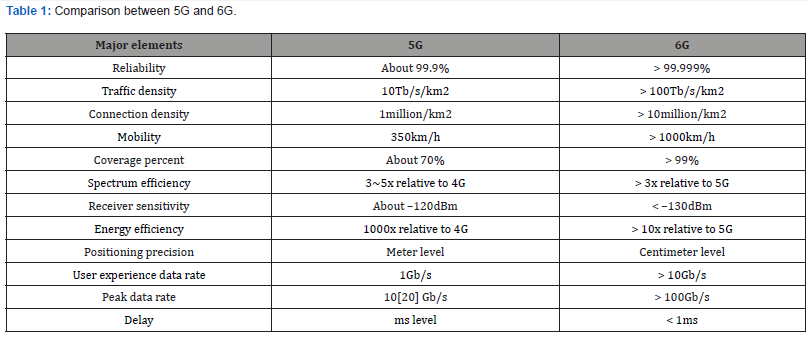
Furthermore, 6G will increase scope from 70 to 99 percent for those newly added KPIs. 6G will raise dependability from 99.9 to 99.999 percent. It will decrease positioning error from meters to centimetres and improve receiver sensitivity higher than 130 dBm. A comparison between 5G and 6G is shown in Table 1. Moreover, the evaluation and future of cellular technology that is 6G are shown in Figure 2.
Table 1:Comparison between 5G and 6G.
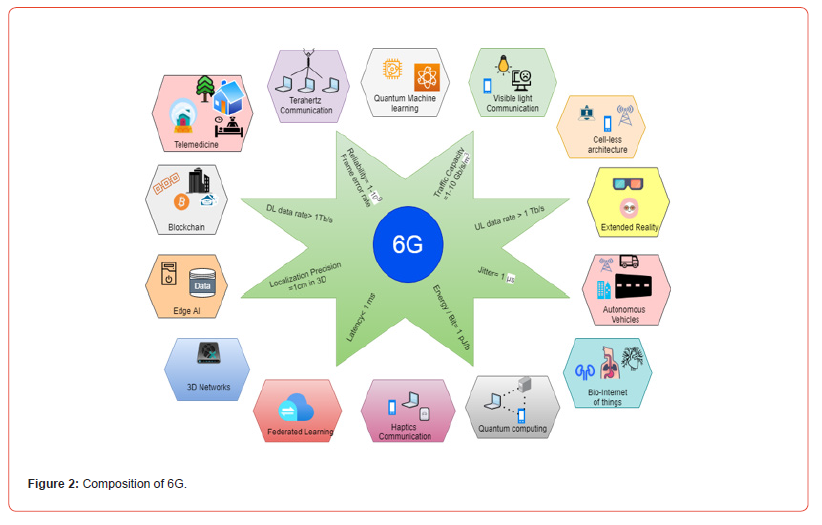
6G will emerge not just as a result of the problems and performance restrictions posed by 5G but also due to a paradigm change caused by technologies and the ongoing growth of cellular networks. Based on the study mentioned earlier, communication channels such as terahertz (THz), satellites, unmanned aerial vehicle (UAV), light band, V2V, and oceans will be investigated, leading to 6G technology. The research into V2V connectivity and highspeed rail is intended to offer an essential conceptual foundation for vehicle connectivity 6G requires additional “densified” BS(s) and Wi-Fi updates. The frequency of the 6G transmission is now in the THz range. This frequency has entered the molecular rotation energy level spectrum, which can be digested easily in the atmosphere by water molecules. Frequency is directly proportional to the loss. The 6G base station network density will be limitless to assure signal and connectivity experience [9]. It is necessary to construct a full-dimensional composite network. Because 6G is intended to reach the whole globe, terrestrial base stations alone will not be enough. It also requires space collaboration with UAVs, aeroplanes, or satellites during a flight. Only in this manner, 6G can cover the entire globe. From a technological standpoint, if a cell phone wishes to sustain a 100Mbps speedy connection directly with any satellite from thousands of kilometres away, it requires extreme transmission power. Humans, on the other hand, cannot withstand such intense electromagnetic assault. The answer is to deploy thousands of satellites and millions of base stations in geographically advantageous areas like the United States.
6G and IOTA “DEVICE-TO-DEVICE COMMUNICATIONS”
Network congestion occurs when the quantity of high-density vehicles is discussing security information and vehicles surpasses the size of BS. In traditional networks, traditional low data mobile services Infrastructures are typically operated via BS. Therefore, the speed of direct communication is being considered with the rapid development of high data rates. A key technology of communications or D2D Communications is enabled, known as LTE and 6G, to increase latency, efficiency, and energy efficiency. Transparency, output, and increasing network spectrum are transmitted over the core network and BS [10]. However, to meet the complex IOV and network structure, topology, and environment, to meet the requirements due to frequent changes in the struggle of traditional D2D communication technology mentioned earlier. For the impact of vehicle movement and multicellular network in IOV, massive and dynamic services requirements are unresolved issues of D2D communication.
IOTA based 6G-IoV network
The network can be integrated with VANET vehicles and their applications since SDN supports dynamic features. On a large scale, network management and optimization are used to advances the resources of virtualized wireless. ITS, SDN, the strict requirements of cloud computing and MEC, can be considered for accomplishing, known as the future of 6G network. However, a huge amount of data is transmitted due to an increase in the number of vehicles connected to a network. Leading to an overload of SDN as a controller. Meanwhile, frequent changes to fast mobile vehicles and their network will significantly impact the quality of service on the network.
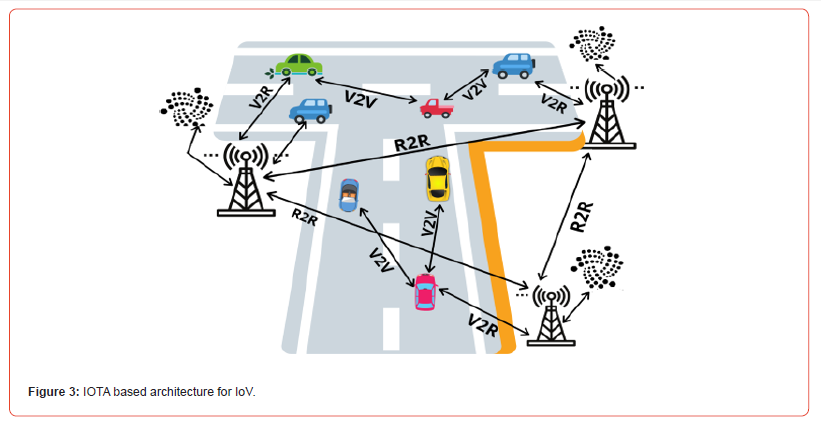
IOTA is a distributed ledger technology known as a Directed Acyclic Graph (DAG) for creating distributed networks and reducing the required computation. IOTA to store transactions between nodes within the network. The proposed model uses both vehicles and RSUs as nodes. Each vehicle should be able to communicate directly with RSUs and other vehicles. RSUs are also able to communicate with one another. Transactions in the IOTA network include vehicular data like vehicle speed, acceleration, and heading direction. If required, additional information like vehicle brake status, data transmission state and report, steering direction or angle and guessing the route can be added. This information can be shared between vehicles and RSUs according to requirements. Figure 2 illustrates the method of applying IOTA in IoV technology. It shows how transactions are added to the “IOTA tangle.” These transactions are referred for communication between RSUs and Vehicles. Verified using the older events. Different colours indicate the status of these transactions, but the red colour transaction cannot be verified. At the same time, previous transactions have confirmed the blue-coloured transactions. Only when the transaction is in consensus, it changes to green. The proposed network uses vehicles and RSUs as nodes. A Unique digital identity that includes private and public key addresses of nodes is assigned to each node within the network for communication between other centres.
Tangle creation
Nodes can issue data requests from their digital identities for network transactions. These nodes are responsible for verifying the issuance of transactions in the network. A new vehicle must approve the transactions of the other vehicles before it can enter the network. Once verified, the transaction can then be added to the network. Repeated additions of transactions create a DAGlike structure known as the tangle. A start transaction is the first transaction that has been approved directly or indirectly by all other transactions. All IOTA tokens of the first transaction are present in a tangle graph. IOTA tokens, the cryptocurrency used to make seamless and instant transactions between nodes in IOTA, are what IOTA tokens are. Each transaction added to the network must be verified by the previous transactions.
There is not any necessity for complex puzzles to solve to choose the miner. That is how IOTA reduces computational dependency compared to blockchain. Blockchain never achieves consensus finality. Different miners can simultaneously mine a block in a generic blockchain network that follows proof-of-work consensus. The competition is won by the fastest miner who can present a block that has been successfully mined in less time. His block is then accepted into the main blockchain.
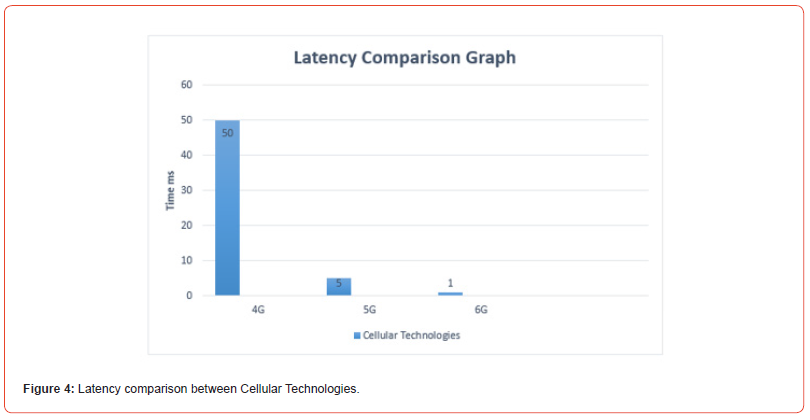
In some cases, more than one miner may present a block simultaneously. When this happens, perfectly mined blocks remain acknowledged as two forks in the central chain. As the chain grows, one block becomes the longest, and the other must be cut. A transaction that is in consensus at one time might be pruned later. Because of the possibility of pruning, the consensus is not reached at any stage. The IOTA network uses the concept of weight associated with each node to reach a consensus. The amount of work the issuing node has invested in it determines the weight of a node within the tangle. The transaction’s weight is three times its value. The transaction’s weight determines the importance of the transaction. In contrast, new weights and no new node can create many transactions, proving that the weight of transactions plays an important role in the network. As existing transactions verify new transactions, the weight of transactions slowly increases. An increase in weight indicates that the transaction is more authentic. This process allows for consensus without the need to pay transaction fees or mining fees. It is different from the bitcoin consensus, where miners are charged a fee to validate transactions or my blocks. IOTA will help for real-time addition of new vehicles to the chain, unlike Blockchain, which takes some time to add new blocks. A graph in Figure 3. is presented, comparing 5G and 6G with respect to latency [11]..
Future Research Directions
Privacy security is more concerned with guaranteeing communication security, which decides whether users widely accept IoV. OBU requires an algorithm that changes the anonymity at a specific time interval and dynamically reveals its name or when the vehicle enters other locations and eliminates the attack of capturing the vehicle’s true identity through anonymous collection and evaluation. Given the different heterogeneous networks in 6G-IoV, developing new secure communication and privacy protection protocol is required
Acknowledgment
None.
Conflict of Interest
No conflict of interest.
References
- E Calvanese Strinati (2019) 6G: The Next Frontier: From Holographic Messaging to Artificial Intelligence Using Subterahertz and Visible Light Communication. IEEE Veh. Technol. Mag.
- T Huang, W Yang, J Wu, J Ma, X Zhang, et al. (2019) A Survey on Green 6G Network: Architecture and Technologies. IEEE Access.
- J Gozalvez (2019) Welcome to the December 2019 Issue [From the Editor]. IEEE Vehicular Technology Magazine.
- KB Letaief, W Chen, Y Shi, J Zhang, YJA Zhang (2019) The Roadmap to 6G: AI Empowered Wireless Networks. IEEE Commun. Mag.
- I Makhdoom, M Abolhasan, H Abbas, W Ni (2019) Blockchain’s adoption in IoT: The challenges, and a way forward. Journal of Network and Computer Applications.
- U Sarfraz, M Alam, S Zeadally, A Khan (2019) Privacy aware IOTA ledger: Decentralized mixing and unlinkable IOTA transactions. Comput. Networks.
- R Crites (2021) What are the most promising applications of IOTA [Online].
- S Chen, YC Liang, S Sun, S Kang, W Cheng, et al. (2020) Vision, Requirements, and Technology Trend of 6G: How to Tackle the Challenges of System Coverage, Capacity, User Data-Rate and Movement Speed. IEEE Wirel. Commun.
- TS Rappaport (2019) Wireless communications and applications above 100 GHz: Opportunities and challenges for 6g and beyond. IEEE Access.
- L Gallo, J Häerri (2017) Unsupervised Long- Term Evolution Device-to-Device: A Case Study for Safety-Critical V2X Communications. IEEE Veh. Technol. Mag.
- What’s the Difference Between 5G vs. 6G? Here’s What You Need to Know.
-

This work is licensed under a Creative Commons Attribution-NonCommercial 4.0 International License.