

 Case Report
Intramasseteric Schwannoma Resection Via a Transoral Approach
1 Philadelphia College of Osteopathic Medicine, Philadelphia PA, USA
2 Division of Otolaryngology-Head & Neck Surgery, Cooper University Health Care, Camden NJ, USA
3 Head and Neck Cancer Center, MD Anderson Cancer Center at Cooper, Camden NJ, USA
Received Date: June 02, 2025; Published Date: June 13, 2025
Abstract
Schwannomas in the parotid-masseteric region are rare and challenging to manage due to their proximity to the facial nerve. Traditionally, external approaches like submandibular or transparotid methods require facial nerve dissection. This case report describes a 23-year-old male with an intramasseteric schwannoma successfully resected using an intraoral approach, which offers a safe and cosmetically superior alternative, particularly when preserving facial nerve function. Masseter nerve schwannoma should be considered in the differential for slow-growing intramasseteric lesions.
Keywords: Intramasseteric schwannoma, transoral approach to masseter muscle tumor, facial nerve preservation
Introduction
Schwannomas are benign, encapsulated neurogenic tumors derived from Schwann cells [1]. While these can arise from any peripheral nerve with Schwann cells, they are most frequently found in the head and neck region [1, 2]. Common nerves of origin include the vagus nerve, vestibular nerve and sympathetic trunk [2, 3]. Schwannomas arising from within the masseter muscle, presumably from the masseteric nerve, are exceptionally rare, with only a small handful of cases identified in the literature [4- 8]. These reports describe surgical excision through a transcervical or transparotid approach [5-7]. We offer the first description of transoral excision of a masseteric nerve schwannoma.
Casen
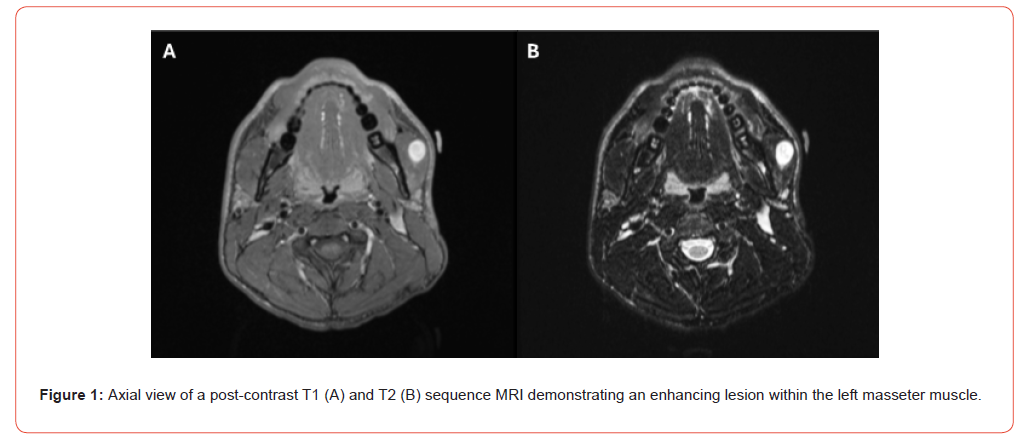
A 23-year-old male was referred to our office for an asymptomatic, chronic left facial lesion. Upon clenching his teeth or smiling, there was visible protrusion of the mass at the level of the mandibular angle. An MRI revealed a 2cm enhancing lesion within the left masseter muscle extending to buccal soft tissues (Figure 1). An FNA was nondiagnostic, revealing scant specimen consisting of tiny fragments of fibrous tissue with few spindle cells, skeletal muscle and blood. Observation was considered, however surgical excision was ultimately pursued to rule out malignancy and prevent future growth.
Operative Details
General anesthesia was administered with a transoral endotracheal tube. The facial nerve was monitored intraoperatively and no long-active paralytic was given. With external compression, the mass could be palpated transorally against the lateral aspect of the mandibular ramus. A 3cm vertical incision was made along the lateral retromolar trigone and extended along the mandibular body. The buccinator muscle was incised posteriorly and the masseter muscle was identified. Guided by manual palpation, we dissected bluntly through the masseter muscle parallel to the fibers until the mass was encountered. External compression facilitated displacement of the mass around the anterior border of the ramus, and the capsule of the mass was released circumferentially from surrounding masseter muscle fibers. A small stalk arising from the masseteric nerve was divided. The excised specimen was sent for permanent pathologic analysis, which ultimately revealed S100 and SOX10-positive staining cells consistent with schwannoma. The surgical wound was irrigated and closed primarily with 4-0 chromic sutures. The patient was given peridex rinses for 1 week post-operatively and had an uneventful post-operative course. On post-operative examination, he had full facial nerve function, no trismus and resolution of his mass lesion.
Discussion
Surgical management of schwannomas within the parotidmasseteric region presents unique challenges due to the proximity of critical structures such as the facial nerve. Traditional transcervical or transparotid approaches are commonly selected and are effective. However, these require an external neck incision and often facial nerve dissection and mobilization to reach the lateral masseter muscle for tumor removal. As demonstrated in this case, for carefully selected patients, the intraoral approach offers a significant advantage. By remaining medial to the facial nerve branches, the surgeon can perform the entire tumor removal without facial nerve dissection, minimizing the risk of facial nerve weakness or injury. The intraoral approach also results in a more favorable cosmetic outcome by avoiding visible external scars. This approach can be particularly beneficial for young patients such as ours and those concerned about aesthetic results.
One risk of this approach would be surgical site infection from intraoral bacterial translocation. In this instance and in our experience with similar cases, water-tight closure and postoperative peridex is usually sufficient to avoid this complication. Another risk of this approach would be facial nerve injury on the lateral aspect of the tumor. To avoid this complication, we would only recommend this approach if the tumor is contained within the masseter muscle, or with minimal extension into the soft tissue. When dissecting the lateral aspect of the tumor, the surgeon should proceed cautiously to avoid unintentional stretch or thermal damage to the facial nerve. Intraoperative facial nerve monitoring is essential. Transoral visualization can also be challenging due to the posterior location of the masseter. Careful incision planning, a headlight and competent retraction are needed. Externally displacing the palpable mass towards the incision was also helpful in this case.
Conclusion
We describe an intraoral approach for intramasseteric schwannoma resection as a safe and effective alternative to traditional external approaches. In select patients, facial nerve dissection and external scars can be avoided.
Acknowledgment
None.
Conflict of Interest
No conflict of interest.
Funding
This research did not receive any specific grant from funding agencies in the public, commercial, or not-for-profit sectors.
References
- Malone JP, Lee WJ, Levin RJ (2025) Clinical characteristics and treatment outcome for nonvestibular schwannomas of the head and neck. Am J Otolaryngol 26(2): 108-112.
- Kang C, Khee Chee Soo, Dennis (2007) Extracranial Non-vestibular Head and Neck Schwannomas: A Ten-year Experience. Ann Acad Med Singap 36(4): 233-240.
- Ansari I, Ansari A, Graison AA, Patil AJ, Joshi H (2018) Head and Neck Schwannomas: A Surgical Challenge-A Series of 5 Cases. Case Rep Otolaryngol 2018: 4074905.
- He Y, Fu HH, He J, Zhu HG, Zhang ZY (2010) Schwannoma arising from intramasseteric region. J Craniofac Surg 21(6):1998-2001.
- Matsumine H, Sasaki R, Fujii K, Sakurai H (2019) Intramasseteric Schwannoma Derived from the Masseteric Nerve. Plast Reconstr Surg Glob Open 7(3): e2175.
- El Khatib N, Nehme A, Nasser S, Moukarzel N, Abtar HK (2018) Intramasseteric Schwanoma mimicking an isolated cheek mass: Case report and review of literature. Int J Surg Case Rep 46: 24-27.
- Hwang JH, Lee DG, Sim HS, Kim KS, Lee SY (2019) Intramasseteric schwannoma treated with facelift incision and retrograde facial nerve dissection. Arch Craniofac Surg 20(6): 388-391.
- Nakamura A, Iguchi H, Kusuki M, Zushi T, Yamane H, et al. (2006) Intramasseteric schwannoma in a child. Auris Nasus Larynx 33(3): 347-350.
-

This work is licensed under a Creative Commons Attribution-NonCommercial 4.0 International License.