




 Review article
Time to Probe Physics Origin of Universal Unusual Anisotropic Magnetoresistance
Received Date: April 19, 2024; Published Date: May 07, 2024
Abstract
The universal unusual anisotropic magnetoresistance (UAMR) has been observed in a vast number of seemingly different systems. Whether the UAMR has the same physics origin is a natural question. Two theories exist. One is the popular theory based on modification of electron transport by the spin-Hall effects and the inverse spin-Hall effects with various different origins which are termed as spin-Hall magnetoresistance (MR), orbital-Hall MR, the Hanle MR, the Rashba-Edelstein MR, unidirectional MR. The other is a theory based only on two vectors. Two theories differ fundamentally from each other and are distinct enough to be tested by experiments. The time is right for determining the physics origin of UAMR.
Introduction
One surprising discovery in nano-magnetism, during the debate of the transverse spin Seebeck effect [1-3] in magnetic semiconductors and insulators, is magnetoresistance (MR) of a non-magnetic (NM) nanometre-thick metallic film which depends on the magnetization direction of an adjacent magnetic insulator or a strong magnetic field. The dependence of longitudinal resistance of a nanometre-thick Pt on the YIG magnetization direction was initially thought to be the usual anisotropic MR (AMR) [3], a universal phenomenon of all polycrystalline ferromagnetic metals [4,5], and was used as an evidence of magnetic proximity effect of YIG on Pt, a traditional method in magnetism.
Surprisingly, it was soon realized that Pt shows not only the usual AMR whose longitudinal resistance depends on the angle between the magnetization and the current, but also an unknown phenomenon in which Pt resistance varies when YIG magnetization rotates in the plane perpendicular to the current [6- 8].
The observation was quickly explained as the consequences of spin-Hall effect (SHE) and inverse spin-Hall effect (ISHE) in YIG/Pt bilayers and is known as spin-Hall MR (SMR) which has nothing to do with usual AMR. The explanation is widely known as the SMR theory. However, as discussed in our early publications [9,10], one needs to add many new ingredients into SMR theory in order to explain the same behavior to many seemingly different systems discussed below. I believe that the observed phenomenon comes from the common physics that involves two vectors. One is a magnetization whose interactions with itinerant electron leads to the usual AMR [4,5] and the other is an interfacial field universally existing in the systems. Therefore it is more proper to call the observed phenomenon an unusual AMR (UAMR). Subsequent investigations of UAMR found that the same phenomenon were observed in three distinct systems illustrated in Figure 1(a-c).
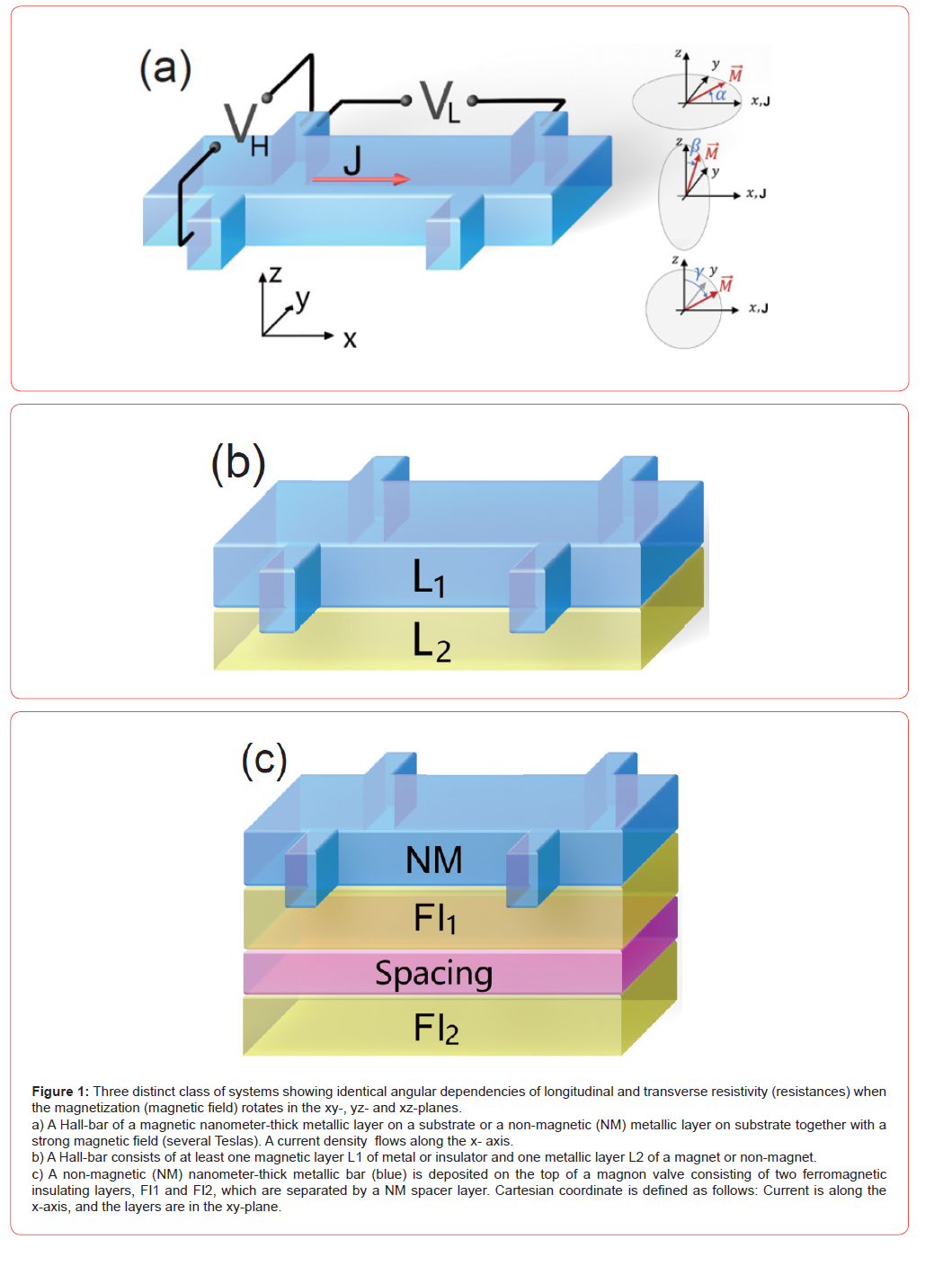
It was observed in a single nanometre-thick ferromagnetized layer on a substrate or a non-magnetic (NM) metallic layer on a substrate and under an influence of a strong magnetic field as shown in Figure 1(a) [11,12]. Direct application of SMR theory to this class of systems encountered obvious difficulties. A variation of SMR theory which hybrids SHE and ISHE with the Hanle effect is used to explain the observed same UAMR, and the theory is termed as Hanle MR (HMR). The same UAMR were observed in all kinds of bilayers [13-19] as shown in Figure 1(b). Some of them are ferromagnetic-insulator (FI)/heavy-metal bilayers and were associated to SMR. The NM layer of many other bilayers may or may not be heavy metals, or even a non-metal at all, and the magnetic layer may or may not be insulating, as long as one layer is magnetic and one layer is metallic. For example, it can exist in a magnetic polycrystalline metallic-film [20] in contact with a non-magnetic insulating layer.
Again, a direct application of SMR to these bilayers is not consistent with other known physics, and various spin-off notions of SMR are invented such as the unidirectional MR (EMR) [21,22] and the Rashba-Edelstein MR (EMR) [23-29]. Even more surprisingly, the same UAMR was observed in non-magnetic (NM) nanometre-thick metal deposited on magnon valves, comprising two nanometre-thick FIs such as YIGs separated by a nanometrethick NM metallic film [30,31] as illustrated in Figure 1c.
In a Cartesian coordinate, as illustrated in Figure 1(a-c), in which the x-axis is along the current direction and the sample films is lying in the xy-plane, the longitudinal resistivity and transverse resistivity of the UAMR systems take the forms of
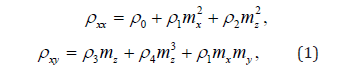
where ρi(i = 0, 1, 2, 3, 4) are constants for a given system and
 is the unit vector of magnetization
 . Equations (1) agree with
the observed UAMR in all three dinstinct systems [6,7,11-31]. ρ0
is the longitudinal resistivity when the magnetization is along the
y-direction, and ρ1
describes the usual AMR and planar Hall effect
[5]. This interpretation of ρ1
is of course very strange because ρxx
in many of the systems is from a NM metals which do not have the
notion of AMR and planar Hall effect. In the literature, people do not
summarize spin-Hall related MR by Equation (1) but as 2
ρxx = ρ2 m2 y
predicted by SMR theory and also observed in YIG/Pt bilayers [6,7].
In order to explain the appearances of ρi(i = 0, 1, 2, 3, 4) in various
NM metals, one has to come up with the notions of HMR, EMR, UMR
etc. One natural question is whether the identical behavior of these
system comes from so many different physics. Or does Equation
(1) come from the general common features of all those seemingly
different systems?
Indeed, such a common feature exists in all systems discussed above, and a competing theory, not originated from the SHE and ISHE, is recently proposed [9,10]. Based on the facts that all systems observed UAMR are controlled by two and only two vectors, Equation (1) is the natural outcome of the tensor nature of resistivity. One of two vectors is the magnetization of magnetic layer or a strong external magnetic field (several Teslas) in case of NM 3d-metallic layer without any magnetic layer. The other is the interfacial field in bilayers or multilayers in the case of nanometrethick NM metal on magnon valves. The physics of why electron transport can be influenced by the magnetization in an adjacent layer and interfacial field was explained in a recent publication [10]. As discussed in the theory of tensor analysis, the differences in the predictions of the two theories are distinct enough to allow an experimental testing.
In fact, the tensor analysis is powerful and is used recently to predict the anomalous SHE and anomalous ISHE in magnetic materials. Interestingly, both effects were recently verified in Co/Pd multilayers [33] and Py/YIG multilayers [34]. The same approach predicts also the universal AMR in magnetic single crystals, and the prediction was also verified in experiments of CoFe [35].
Conclusion
In conclusion, the time is right to determine the physics origin of UAMR observed in a vast number of distinct systems. Investigations of physics origin of the UAMR shall deepen our understandings of fundamental physics involving spins and orbital motion. Such investigations are likely to bring us new knobs of controlling spin and electron transport.
Funding
This work is supported by the National Key Research and Development Program of China (No. 2020YFA0309600), the NSFC Grant (No. 12374122), and Hong Kong RGC Grants (No. 16300522, 16300523, and 16302321).
Acknowledgement
None.
Conflict of Interest
None.
References
- K Uchida, S Takahashi, K Harii, J Ieda, W Koshibae, et al. (2008) Observation of the spin Seebeck effect. Nature 455(7214): 778-81.
- Jaworski C M, J Yang, S Mack, D D Awschalom, J P Heremans, et al. (2010) Observation of the spin-Seebeck effect in a ferromagnetic semiconductor. Nature Materials 9(11): 898-903.
- Huang S Y, X Fan, D Qu, Y P Chen, W G Wang, et al. (2012) Transport magnetic proximity effects in platinum. Phys. Rev. Lett 109(10): 107204.
- Y Zhang, H W Zhang, X R Wang (2016) Extraordinary galvanomagnetic effects in polycrystalline magnetic films. Europhys Lett 113: 47003.
- X R Wang (2022) A theory for anisotropic magnetoresistance in materials with two vector order parameters. Chin. Phys Lett 39: 027301.
- M Schmid, S Srichandan, D Meier, T Kuschel, J M Schmalhorst, et al. (2013) Transverse spin Seebeck effect versus anomalous and planar Nernst effects in permalloy thin films. Phys Rev Lett 111(18): 187201.
- Y T Chen, S Takahashi, H Nakayama, Matthias Althammer, Sebastian T B Goennenwein, et al. (2016) Theory of spin Hall magnetoresistance (SMR) and related phenomena. J Phys Condens Matter 28(10): 103004.
- Y T Chen, S Takahashi, H Nakayama (2013) Theory of spin Hall magnetoresistance. Phys Rev B 87: 144411.
- XR Wang, C Wang, X S Wang (2023) A theory of unusual anisotropic magnetoresistance in bilayer heterostructures. Sci Rep 13(1): 309.
- X R Wang (2024) A theory of magnetoresistance of non-magnetic metal on magnon valves, AIP Advances 14: 045101.
- S Velez, VN Golovach, A Bedoya-Pinto, M Isasa, E Sagasta, et al. (2016) Hanle Magnetoresistance in Thin Metal Films with Strong Spin-Orbit Coupling. Phys Rev Lett 116: 016603.
- G Sala, H Wang, W Legrand, P Gambardella (2023) Orbital Hanle Magnetoresistance in a 3d Transition Metal. Phys Rev Lett 131(23): 156703.
- H Nakayama, M Althammer, Y T Chen, K Uchida, Y Kajiwara, et al. Spin Hall magnetoresistance induced by a nonequilibrium proximity effect. Phys Rev Lett 110(20): 206601.
- B F Miao, S Y Huang, D Qu, C L Chien (2013) Inverse spin Hall effect in a ferromagnetic metal. Phys Rev Lett 111: 066602.
- T Shang, Q F Zhan, H L Yang (2015) Extraordinary Hall resistance and unconventional magnetoresistance in hybrids. Phys Rev B 92: 165114.
- S Meyer, R Schlitz, S Geprags (2015) Anomalous Hall effect in YIG|Pt bilayers. Appl Phys Lett 106: 132402.
- B F Miao, L Sun, D Wu, C L Chien, H F Ding, et al. (2017) Tuning the magnetoresistance symmetry of Pt on magnetic insulators with temperature and magnetic doping. Appl Phys Lett 110: 222402.
- Z Ding, B L Chen, J H Liang, J Zhu, J X Li, et al. (2014) Spin Hall magnetoresistance in Pt / Fe3O4 thin films at room temperature. Phys Rev B 90: 134424.
- S Cho, Sh C Baek, KD Lee, Y Jo, BG Park (2015) Large spin Hall magnetoresistance and its correlation to the spin-orbit torque in W/CoFeB/MgO structures. Sci Rep 5: 14668.
- S Ding, Z Liang, D Go, Chao Yun, Mingzhu Xue, et al. (2022) Observation of the orbital Rashba-Edelstein magnetoresistance. Phys Rev Lett 128(6): 067201.
- C O Avci, K Garello, A Ghosh, M Gabureac, SF Alvarado, et al. (2015) Unidirectional spin Hall magnetoresistance in ferromagnet/normal metal bilayers Nat Phys 11: 570.
- C O Avci, J Mendil, G S D Beach, P Gambardella (2018) Origins of the unidirectional spin Hall magnetoresistance in metallic bilayers. Phys RevLett 121: 087207.
- A Kobs, S Hesse, W Kreuzpaintner, G Winkler, D Lott, P Weinberger, et al. (2011) Anisotropic Interface Magnetoresistance in Pt=Co=Pt Sandwiches. Phys Rev Lett 106(21): 217207.
- V L Grigoryan, W Guo, GEW Bauer, J Xiao (2014) Intrinsic magnetoresistance in metal films on ferromagnetic insulators. Phys Rev B 90: 161412.
- S S L Zhang, G Vignale, S Zhang (2015) Anisotropic magnetoresistance driven by surface spin-orbit scattering. Phys Rev B 92: 024412.
- T Hupfauer, A Matos-Abiague, M Gmitra, F Schiller, J Loher, et al. (2015) Emergence of spin-orbit fields in magnetotransport of quasitwo-dimensional iron on gallium arsenide. Nat. Commun 6: 7374.
- H Nakayama, Y Kanno, H An, T Tashiro, S Haku, et al. (2016) Rashba-Edelstein Magnetoresistance in Metallic Heterostructures. Phys Rev Lett 117: 116602.
- H Nakayama, H An, A Nomura, Y Kanno, S Haku, et al. (2017) Temperature dependence of Rashba-Edelstein magnetoresistance in Bi=Ag=CoFeB trilayer structures. Appl Phys Lett 110: 222406.
- J Kim, YT Chen, S Karube, S Takahashi, K Kondou, et al. (2017) Evaluation of bulk-interface contributions to Edelstein magnetoresistance at metal/oxide interfaces. Phys Rev B 96: 140409.
- H Wu, L Huang, C Fang, B S Yang, C H Wan, et al. (2018) Magnon valve effect between two magnetic insulators. Phys Rev Lett 120(9): 097205.
- C Guo, C H Wan, W Q He (2020) A nonlocal spin Hall magnetoresistance in a platinum layer deposited on a magnon junction. Nat Electron 3: 304.
- X R Wang (2021) Anomalous spin Hall and inverse spin Hall effects in magnetic systems. Commun Phys 4: 55.
- M Yang (2022) Anomalous inverse spin Hall effect in perpendicularly magnetized Co/Pd multilayers. Phys Rev B 105: 224426.
- M Yang (2024) Highly efficient field-free switching of perpendicular yttrium iron garnet with collinear spin current, Nature Communications.
- Y Miao, J Sun, C Gao, D Xue, XR Wang, et al. Anisotropic magnetoresistance in single cubic crystals: A theory and its verification, arXiv:2312.00340.
-

This work is licensed under a Creative Commons Attribution-NonCommercial 4.0 International License.




