




 Short Communication
Tailoring Phase Transition and Dielectric Response in BaTiO3 Ceramics via Sb2O3 Doping
Received Date:January 19, 2026 Published Date: February 19, 2026
Abstract
The practical applications of ferroelectric materials are highly dependent on their phase transition behaviors and dielectric properties. To broaden the application scope of BaTiO3, direct Sb2O3 introduction was adopted as a strategy to modulate the phase transition in this work. Experimental results demonstrate that Sb2O3 doping induces a structural transformation of BaTiO3 from tetragonal to pseudo-cubic symmetry, and facilitates the transformation of the original first-order phase transition to a diffuse type, while simultaneously shifting the Curie temperature toward room temperature. This modification pathway provides a promising avenue for optimizing the comprehensive performances of BaTiO3 and expanding its application potential in pyroelectric, electrocaloric and energy storage fields.
Introduction
Ferroelectric ceramics are extensively utilized in advanced fields such as pyroelectric sensors, energy storage devices, and electrocaloric refrigeration systems. These applications are highly reliant on their phase transition behavior and dielectric properties. For instance, remarkable pyroelectric and electrocaloric effects are typically achieved near the Curie temperature (TC), where the ferroelectric-to-paraelectric phase transition occurs [1]. Similarly, superior energy storage performance, characterized by low energy loss, requires excellent relaxor ferroelectric characteristics [2].
Barium titanate (BaTiO3) is a classic lead-free ferroelectric material that undergoes a sharp first-order ferroelectric-toparaelectric phase transition around TC ≈ 125°C [3]. This inherent feature severely restricts its room-temperature pyroelectric, electrocaloric performances, and energy storage capability. To broaden its application scope, cation substitution is the most conventional and effective strategy for tailoring the phase transition and dielectric response. Typical routes include replacing Ba2+ with Ca2+, Sr2+, or rare-earth ions (RE3+, where RE = La, Ce, Nd, Sm, Eu, Gd, Dy, Er) and substituting Ti4+ with Zr4+, Sn4+, or Hf4+ [4].
Different from the conventional cation substitution strategy, this work proposes directly introducing the metal oxide Sb2O3 into BaTiO3 ceramics to tailor its phase transition and dielectric response. This novel modification approach is expected to optimize its pyroelectric, electrocaloric, and energy storage performances, thereby further expanding its application scope.
Experimental
BaTiO3+xSb2O3 ceramics (x = 0, 0.01, 0.02, 0.03) were prepared by a conventional solid-state reaction method, using BaCO3, TiO2, Sb2O3. The homogenized mixed powders were calcinated at 1150°C for 3 h, followed by sintering at 1350°C for 2 h to obtain bulk ceramics. The phase structures were characterized by an X-ray diffractometer (XRD, Shimadzu LabX, Japan). A differential scanning calorimeter (DSC, TA Q2000, USA) was employed to collect heat flow data. Dielectric properties were measured by precision impedance analyzer (Wayne Kerr WK6500P, UK) coupled with a temperature-control and data-collect system (BALAB DMS- 2000, China).
Results and Discussion
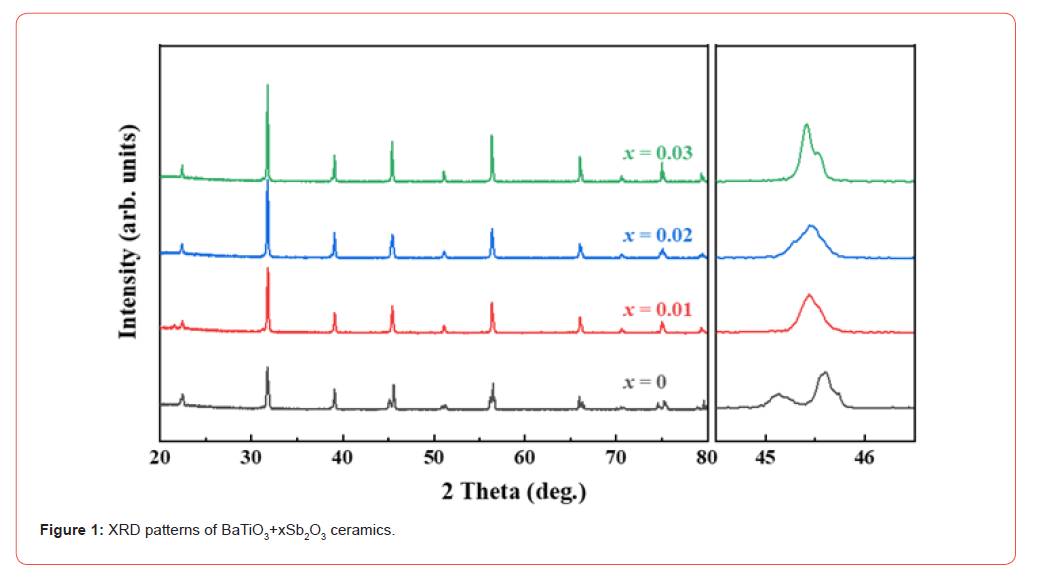
Figure 1 presents the XRD patterns of BaTiO3+xSb2O3 ceramics. All samples exhibit a pure perovskite structure without detectable secondary phases, indicating that Sb2O3 has been fully incorporated into the BaTiO3 lattice. Undoped BaTiO3 displays a distinct (002)/ (200) peak splitting at 2θ ≈ 45°, which is consistent with tetragonal (T) P4mm symmetry [5]. In contrast, a single diffraction peak is obtained near 2θ ≈ 45° for doped BaTiO3, manifesting a pseudocubic structure. This result demonstrates that the introduction of Sb2O3 disturbs the long-range ordered lattice structure of BaTiO3.
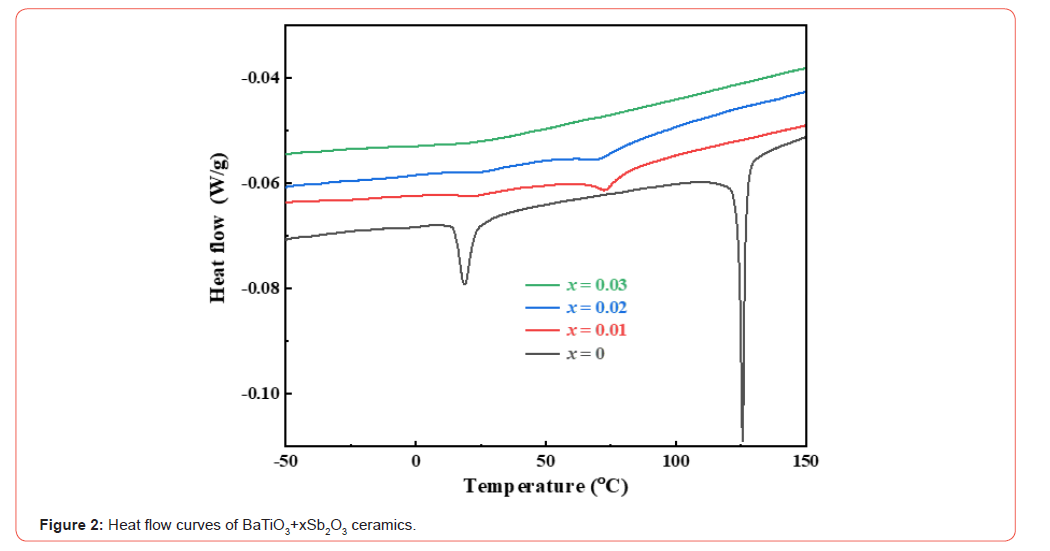
Figure 2 presents the heat flow curves of BaTiOsub>3+xSb2O3 ceramics measured in the temperature range of -50°C to 150°C during heating. For pure BaTiOsub>3, two sharp endothermal peaks are observed, among which, the low-temperature peak near 19°C corresponds to orthorhombic-tetragonal (O-T) first-order ferroelectric phase transition, while the high-temperature peak at 125°C, i.e TC, arises from the tetragonal-cubic (T-C) first-order ferroelectric-to-paraelectric phase transition [6]. When Sb2O3 is doped at x=0.01, both endothermal peaks weaken significantly, and TC shifts to a lower temperature (75°C). With further increasing Sb2O3 doping content, the endothermal peaks gradually diminish. This indicates that Sb2O3 doping facilitates the transformation of the phase transition from a first-order to a diffuse type.
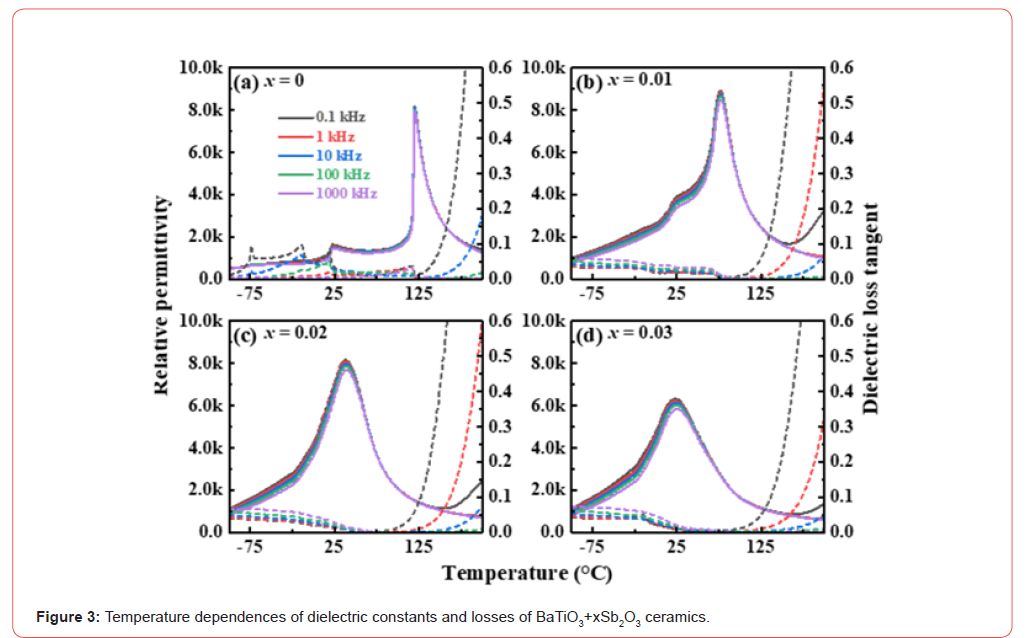
Figure 3 illustrates the temperature dependences of dielectric constants (εr) and losses of BaTiO3+xSb2O3 ceramics at frequencies ranging from 0.1 to 1000 kHz. Consistent with the heat flow results, pure BaTiO3 exhibits first-order phase transitions around 19°C (OT) and 125°C (T-C). Additionally, an extra dielectric peak is observed at -75°C, corresponding to the rhombohedral-orthorhombic (R-O) phase transition [6]. For the x=0.01 doped sample, the TC shifts to 77°C, and the dielectric peaks corresponding to the R-O and O-T phase transitions become flattened. Notably, x=0.02 and x=0.03 samples only show a single dielectric peak corresponding to TC at 38°C and 22°C, respectively, which is conducive to their roomtemperature applications.
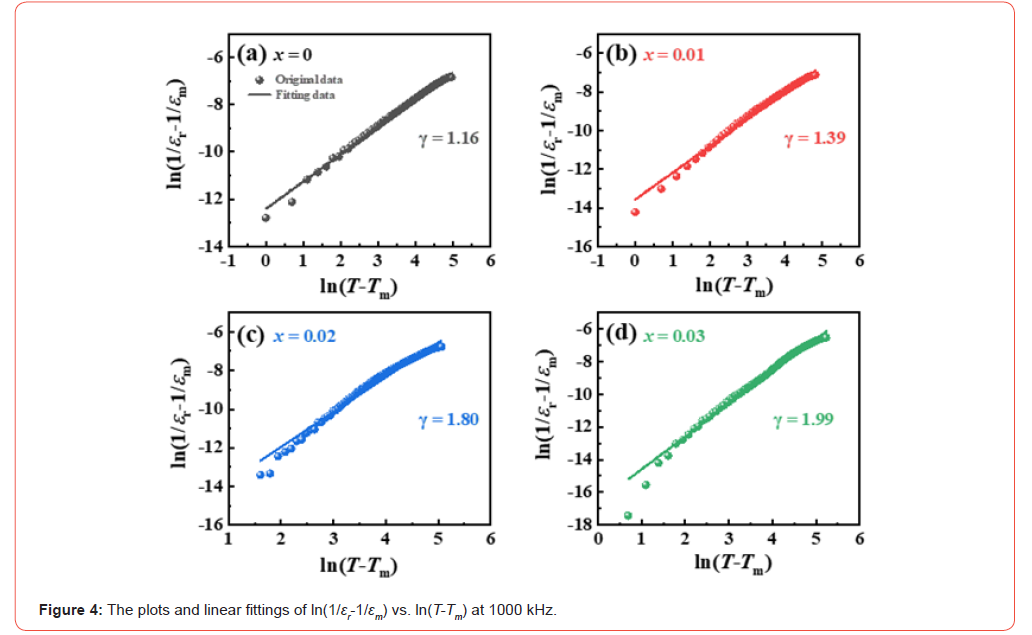
To further quantify the phase transition diffuseness, the modified Curie–Weiss law was employed [7]. Figure 4 displays the plots and linear fittings of ln(1/εr-1/εm) and ln(T-Tm) at 1000 kHz, where εm is the maximum dielectric constant and Tm is the temperature corresponding to εm. All sample data can be well fitted linearly, and the slope of the fitting line is defined as the diffusion factor (γ). With the increase of Sb2O3 doping content from x = 0 to x = 0.03, the diffusive factor increases from γ = 1.05 to γ = 1.99. A γ value close to 1 indicates a normal ferroelectric, while a γ value approaching 2 is characteristic of a relaxor ferroelectric. This result further confirms that Sb2O3 doping converts the phase transition of BaTiO3 from a first-order to a diffuse type.
Conclusion
This work achieves BaTiO3 modification via direct Sb2O3 introduction. The results show that Sb2O3 can be fully dissolved into the BaTiO3 lattice to form a pure perovskite phase, triggering a structural transformation from tetragonal to pseudo-cubic symmetry. Meanwhile, it converts original first-order phase transition of BaTiO3 to a diffuse type, endowing the material with relaxor ferroelectric properties, and shifts the Curie temperature toward room temperature. This novel modification strategy provides effective support for optimizing the performances of BaTiO3 and expanding its application prospects.
Acknowledgement
This work was supported by the National Undergraduate Innovation and Entrepreneurship Training Program (No. 202410621019).
References
- Y Hou, J Li, R Yin, X Su, Y Su, et al. (2025) The critical role of phase transition and composition regulation in inorganic perovskite electrocaloric materials. J Mater Chem C 13: 5406-5423.
- L Yang, X Kong, F Li, H Hao, Z Cheng, et al. (2019) Perovskite lead-free dielectrics for energy storage applications. Prog Mater Sci 102: 72-108.
- X Moya, E Stern-Taulats, S Crossley, D González-Alonso, S Kar-Narayan, et al. (2013) Giant Electrocaloric Strength in Single-Crystal BaTiO3. Adv Mater 25(9): 1360-1365.
- C Zhao, Y Huang, J Wu (2020) Multifunctional barium titanate ceramics via chemical modification tuning phase structure. InfoMat 2: 1163-1190.
- G Canu, G Confalonieri, M Deluca, L Curecheriu, M T Buscaglia, et al. (2018) Structure-property correlations and origin of relaxor behaviour in BaCexTi1-xO3. Acta Mater 152: 258-268.
- J Li, D Zhang, S Qin, T Li, M Wu, et al. (2016) Large room-temperature electrocaloric effect in lead-free BaHfxTi1−xO3 ceramics under low electric field. Acta Mater 115: 58-67.
- J Li, R Yin, Z Xiong, Y Bao, X Zhang, et al. (2024) Manipulating Zr/Ti ratio based on phase diagram for large electrocaloric effects with multiple target operation temperatures in PLZT ceramics. J Adv Ceram 13: 1422-1431.
-

This work is licensed under a Creative Commons Attribution-NonCommercial 4.0 International License.




