

 Research Article
Enhancing Nursing Practice through Reflective Learning: A Case Study of Hypoglycaemia Management in a Surgical Ward
Received Date:April 08, 2026; Published Date:April 20, 2026
Abstract
Background: Reflective practice is essential in nursing for integrating theory with clinical practice and improving patient outcomes.
Aim: To critically analyse a clinical incident involving hypoglycaemia using Driscoll’s Model of Reflection.
Methods: A qualitative reflective case study was conducted using personal observations, clinical documentation, and team interactions.Analysis followed the “What?”, “So What?”, and “Now What?” framework.
Results: Key findings demonstrated effective use of SBAR communication, timely identification of hypoglycaemia, and strong mentorship
support. Identified gaps included limited diagnostic reasoning, delegation challenges, and emotional vulnerability.
Conclusion: Structured reflection enhances clinical competence, supports professional development, and improves patient safety in acute care
settings.
Keywords:Reflective practice; Nursing education; Hypoglycaemia; Driscoll’s model; Patient safety; Professional development
Background
Reflective practice has been recognised as a cornerstone of professional development in nursing, providing an essential mechanism for integrating theoretical knowledge with practical clinical experience to improve patient care outcomes [1]. In acute healthcare environments such as surgical wards, nurses are frequently confronted with complex, high-pressure scenarios requiring rapid, evidence-informed responses. One such challenge is the management of hypoglycaemia; a potentially life-threatening complication commonly associated with type 1 diabetes mellitus (T1DM). The capacity to reflect on such incidents facilitates not only skill development but also the cultivation of emotional resilience, clinical judgment, and patient-centred care competencies.
Driscoll’s Model of Reflection is particularly relevant in such scenarios due to its structured approach, which encourages practitioners to explore experiences through three sequential questions: “What?”, “So What?”, and “Now What?” [2]. This framework allows practitioners to examine not only the factual details of an incident but also its emotional, cognitive, and systemic dimensions. Its action-oriented design promotes meaningful change in practice by linking reflective insights to targeted interventions [3]. For nursing students and newly qualified practitioners, structured reflection is a critical tool for navigating the complexities of clinical practice while adhering to professional standards and ensuring patient safety.
This paper reflects on the clinical management of Mr. Smith, a 69-year-old patient with T1DM, who experienced an episode of hypoglycaemia during a surgical ward placement. The reflection explores the practical application of theoretical knowledge, evaluates the effectiveness of clinical interventions, and examines the emotional responses elicited during the incident. It also considers the role of mentorship, interprofessional collaboration, and evidence-based practice in ensuring safe, high-quality care. Additionally, it identifies gaps in knowledge and skills, providing a foundation for the development of a Personal Development Plan (PDP) to address these areas.
Research Problem and Objectives
During clinical placements, Nursing Associate students must navigate the dual challenges of applying theoretical knowledge and developing practical skills under supervision. The clinical incident involving Mr. Smith presented an opportunity to evaluate the effectiveness of nursing practice, communication, and decisionmaking in a real-world setting.
The primary objective of this reflective study is to critically analyse a clinical incident through the application of Driscoll’s Model of Reflection, with the aim of identifying professional strengths, limitations, and areas for further development. The study specifically examines the clinical management of hypoglycaemia in a high-risk surgical patient, while also identifying key professional learning needs, particularly in relation to diagnostic reasoning, delegation, and emotional resilience. In addition, it seeks to develop a structured Personal Development Plan (PDP) to address these identified gaps and enhance future clinical performance. The reflection further explores personal vulnerabilities and evaluates strategies to mitigate stress within high-pressure clinical environments. Moreover, the study considers the role of mentorship and interdisciplinary collaboration in strengthening clinical competence and supporting professional growth. Collectively, these objectives contribute to the broader discourse on reflective practice, nursing education, and patient safety, offering insight into the practical and emotional challenges encountered by novice practitioners in acute care settings, in alignment with standards set by the Nursing and Midwifery Council (2021).
Literature Review
Reflective practice has been widely recognised as a core element of professional development in nursing, facilitating critical thinking, self-awareness, and continuous improvement in patient care [4]. Structured models of reflection, such as Driscoll’s, provide a systematic approach to analysing clinical experiences, promoting learning and enhancing practice. The three-stage process—”What?”, “So What?”, and “Now What?”—encourages practitioners to examine incidents comprehensively, linking personal experiences to theoretical knowledge, clinical guidelines, and professional standards.
Hypoglycaemia is a frequent complication in patients with T1DM and represents a significant clinical risk [5]. Studies indicate that individuals with T1DM experience, on average, two mild hypoglycaemic episodes per week, with severe hypoglycaemia occurring annually in 30–40% of cases [6]. Untreated hypoglycaemia can result in seizures, cognitive impairment, or cardiac complications, underscoring the importance of early recognition and intervention [7]. Evidence-based guidelines, such as those published by the National Institute for Health and Care Excellence (NICE), emphasise the importance of prompt glucose testing, timely administration of glucose solutions, and continuous monitoring to prevent complications [8].
Effective communication is central to patient safety, particularly in acute care settings. Frameworks such as SBAR provide a structured approach for conveying critical clinical information concisely and accurately, supporting timely decision-making and reducing the risk of [9]. Additionally, mentorship and supervision play a vital role in supporting novice practitioners, enhancing both clinical competence and emotional resilience [10]. Emotional resilience is essential for coping with high-pressure environments, preventing burnout, and sustaining high-quality care delivery [11]. Research has shown that resilience training, mindfulness, and structured debriefing improve nurses’ ability to manage stress, regulate emotions, and make sound clinical judgments under pressure [12].
While reflective practice is well-established, there is limited research on its application by Nursing Associate students in acute care environments. Novice practitioners often face challenges such as limited diagnostic reasoning, unclear delegation, and emotional vulnerability when managing high-risk patients [13]. By examining a clinical incident in detail, this study contributes to understanding how structured reflection can enhance learning, improve patient outcomes, and support professional development in early-career nursing practitioners.
Methodology
Research Design and Approach
A qualitative approach was adopted to explore the clinical incident and its implications for professional development. Driscoll’s Model of Reflection provided the analytical framework, facilitating a structured examination of the experience and its consequences. The three-stage process—”What?”, “So What?”, and “Now What?”—was used to evaluate the situation, analyse its significance, and develop actionable strategies to improve future practice.
Data Collection Methods and Tools
Data were collected during an external placement in a surgical ward, including real-time observations, interactions with the healthcare team, and digital documentation of vital signs, interventions, and outcomes [9]. The selected case involved Mr. Smith, a 69-year-old patient with T1DM, admitted for an elective surgical procedure. This case was chosen for its complexity and the opportunity it provided to explore clinical reasoning, patient safety, and professional growth.
Sampling Technique and Study Population
A single-case design was employed, focusing on Mr. Smith, a 69-year-old male with type 1 diabetes admitted for an elective procedure. His case was selected due to its complexity and rich learning opportunities, occurring under the supervision of a senior nurse.
Data Analysis Methods
Analysis followed the three-stage Driscoll framework, integrating evidence-based guidelines, professional standards, and literature on hypoglycaemia management.
Ethical Considerations
This reflective case study was conducted in accordance with the professional ethical standards outlined in the Nursing and Midwifery Council (NMC) Code [14] and relevant institutional guidelines for practice-based learning. The study is based on a reflective account using Driscoll’s reflective model and does not constitute formal clinical research; therefore, formal ethical approval was not required. Patient confidentiality was strictly maintained through anonymisation, with the use of a pseudonym (“Mr. Smith”), and all identifiable information was removed in line with professional and legal requirements. Informed consent was obtained prior to inclusion in this reflective account. The study adhered to principles of confidentiality, professional integrity, and duty of care throughout. The reflective analysis was structured using Driscoll’s model, summarised in Table 1, to systematically evaluate the clinical incident.
Table 1:Summary of Reflection Using Driscoll’s Model.

Clinical Trial Registration: Not applicable.
Results
Presentation of Key Findings
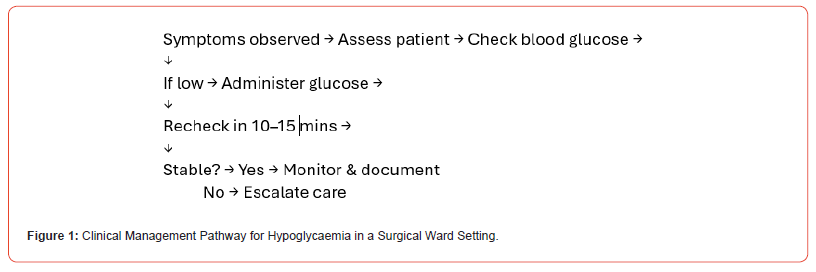
During the placement, I was responsible for monitoring a bay of pre- and post-operative patients, including Mr. Smith. He suddenly exhibited excessive sweating, drowsiness, and shakiness, which immediately raised clinical concern. Recognising these as potential signs of hypoglycaemia, I assessed his condition, asking whether he felt dizzy, light-headed, or shaky. He reported feeling sweaty, hungry, and unsteady, consistent with his T1DM diagnosis and nil-by-mouth (NBM) status. Despite initial anxiety, I remained composed and focused on patient safety. The clinical decisionmaking process followed during the incident is illustrated in Figure 1, demonstrating adherence to evidence-based guidelines.
I employed the SBAR framework to deliver a structured handover to the senior nurse, detailing the situation, patient background, assessment findings, and recommended actions. The communication process was structured using the SBAR framework, as illustrated in Table 2, which facilitated clear and timely escalation. The senior nurse provided guidance, acknowledged my initiative, and instructed me to perform a capillary glucose test. While maintaining supervision of the HCA to monitor other patients, I conducted the test, which confirmed critically low glucose levels. With Mr. Smith’s verbal consent, the senior nurse administered a glucose liquid shot, while I offered reassurance, explained the process, and prepared for subsequent monitoring.
Table 2:SBAR Communication.

After 15 minutes, a repeat glucose test confirmed stabilisation. The medical team decided to postpone the planned surgery and discontinue the NBM protocol. I updated the digital patient record and bedside board and coordinated a follow-up meal containing complex carbohydrates to prevent recurrence. Throughout the incident, I provided holistic care, addressing both physiological and psychological needs. Observing the senior nurse’s composed management reinforced my confidence and highlighted the value of mentorship in clinical learning [15].
Supporting Data
The initial glucose test indicated a critical low (exact value recorded digitally), with later tests showing stabilisation postintervention. Vital signs revealed a slightly elevated heart rate but overall stability. Delegation ensured uninterrupted care, though my instructions to the HCA lacked precision.
Discussion
The clinical incident with Mr. Smith provided an invaluable opportunity to critically examine the integration of theoretical knowledge, practical skills, and emotional regulation in nursing practice. Reflective analysis identified several areas for development, summarised in Table 3, including diagnostic reasoning, delegation, and emotional resilience. The incident emphasised the pivotal role of clinical vigilance in detecting hypoglycaemia, enabling timely intervention to prevent complications such as seizures, cardiac arrhythmias, or neurological impairment [6]. Early recognition of deteriorating patients is a core competency in nursing and is reinforced in the Nursing and Midwifery Council [15] standards as essential for patient safety. This experience highlighted the importance of routine observation, effective prioritisation of highrisk patients, and the capacity to respond promptly under pressure.
Table 3:Skills Gap Analysis.

The use of the SBAR framework was instrumental in ensuring clear, structured communication with the senior nurse. This method facilitated the rapid transmission of relevant clinical information, reducing the risk of miscommunication and enabling immediate decision-making. Effective communication is particularly critical in high-risk scenarios where time-sensitive interventions can prevent deterioration or adverse outcomes. By providing a clear summary of Mr. Smith’s symptoms, type 1 diabetes diagnosis, and NBM status, I ensured that the senior nurse was able to make an informed decision regarding glucose testing and subsequent intervention. This aligns with evidence indicating that structured communication frameworks reduce errors, enhance interdisciplinary collaboration, and improve patient outcomes [16].
Despite these positive aspects, reflection revealed areas for improvement. My initial assessment focused predominantly on hypoglycaemia, while alternative differential diagnoses—such as electrolyte imbalance, infection, or cardiac issues—were not fully explored. Cognitive biases, such as confirmation bias, may have influenced my immediate clinical reasoning, highlighting the need for more expansive diagnostic approaches. Recognising these limitations underscores the value of continuous professional development, structured reflection, and mentorship in enhancing clinical judgment and decision-making.
Delegation was another area requiring refinement. While the task of monitoring other patients was appropriately delegated to the Healthcare Assistant (HCA), the instructions provided could have been more precise. Effective delegation involves not only assigning tasks but also ensuring that delegated responsibilities are understood, monitored, and evaluated to maintain patient safety [17]. This reflection emphasises that delegation is not merely a managerial function but a critical clinical competency that directly impacts workflow efficiency, error reduction, and overall patient care quality.
Emotional resilience emerged as a significant theme during the incident. Initially, I experienced anxiety and a sense of vulnerability, common responses for novice practitioners in highstress situations. The emotional responses experienced throughout the incident are outlined in Table 4, highlighting their impact on clinical performance and learning. The senior nurse’s calm, composed approach served as a stabilising influence, illustrating the importance of mentorship, role modelling, and supervision in developing professional confidence. This aligns with existing literature emphasizing that mentorship fosters experiential learning, supports emotional regulation, and enhances competence among early-career nurses [18]. Reflection on my emotional response reinforces the notion that clinical competence is not solely technical but also closely linked to psychological readiness, resilience, and professional composure.
Table 4:Emotional Response Reflection.

The psychological impact of hypoglycaemia on patients must also be considered. Research indicates that hypoglycaemic episodes can induce significant anxiety and distress, particularly in elderly patients or those with complex comorbidities [19]. Providing reassurance, clear explanations, and emotional support constitutes holistic care, ensuring that interventions address both physiological and psychosocial needs. In this incident, regular communication with Mr. Smith, explanation of procedures, and follow-up monitoring facilitated a sense of safety and involvement in his care plan, reflecting the principles of patient-centred care [20].
Interdisciplinary collaboration played a crucial role in the effective management of the incident. Coordination between the senior nurse, HCA, myself, and the medical team ensured that timely assessments, interventions, and adjustments to the care plan were implemented. Patient-Centred Care (PCC) emphasises the importance of collaboration among healthcare professionals and the active involvement of patients in their care, optimising outcomes through shared decision-making and communication [21]. This approach is particularly pertinent in high-risk cases such as hypoglycaemia management, where the timely exchange of information and cooperative problem-solving are essential to prevent adverse events.
The incident also highlighted the relevance of clinical governance and quality assurance in ensuring safe, effective care. Accurate documentation in the digital patient record system and updates to the bedside board ensured continuity of care, supporting transparency and accountability. Clinical governance encompasses systematic monitoring, audit, and evaluation processes to uphold patient safety, standardised care protocols, and adherence to evidence-based practices [22]. For example, documenting Mr. Smith’s glucose readings, interventions, and follow-up measures allowed for retrospective review, audit, and learning, demonstrating professional accountability and quality assurance in practice.
This reflection also considers the broader context of resilience and workforce sustainability in nursing. High-pressure clinical environments, heavy workloads, and staffing shortages contribute to stress and burnout, potentially compromising patient safety and workforce retention. The NHS National Retention Strategy [23] emphasises resilience-building interventions, mentoring programs, and structured professional development to reduce turnover and maintain competent, motivated healthcare teams. My experience with Mr. Smith reinforces the importance of selfawareness, emotional regulation, and resilience in maintaining effective practice under pressure.
Personal Development Plan (PDP)
The reflective analysis of this incident has identified key areas for professional growth, which have informed the creation of a comprehensive Personal Development Plan (PDP). The PDP focuses on enhancing diagnostic reasoning, delegation skills, emotional resilience, and evidence-based clinical practice. A structured Personal Development Plan was developed to address these gaps (see Table 5), outlining targeted goals, actions, and evaluation strategies.
Table 5:Personal Development Plan.

Improving diagnostic reasoning will involve participation in case-based workshops, simulation exercises, and reflective practice sessions over the next five months. These activities aim to broaden my differential diagnostic capabilities, reduce cognitive bias, and strengthen clinical judgment in high-pressure scenarios [24]. Delegation skills will be enhanced through structured mentorship and feedback sessions over three months, allowing me to practice assigning tasks with clarity, monitoring delegated responsibilities, and evaluating outcomes in a supportive environment [25].
Emotional resilience will be targeted through six months of mindfulness-based interventions, debriefing sessions, and reflective journaling. Mindfulness practices have been shown to reduce stress, mitigate burnout, and foster self-compassion, supporting improved decision-making and well-being among healthcare professionals. Regular debriefing sessions with mentors will provide an opportunity for reflective discussion, emotional processing, and constructive feedback, reinforcing experiential learning and professional growth.
Additionally, the PDP includes ongoing documentation of progress through an e-portfolio, enabling systematic tracking of skills development, reflection, and evidence of competency. This aligns with NMC standards for continuous professional development and revalidation, ensuring accountability and commitment to lifelong learning [26].
The PDP also integrates strategies for maintaining personal well-being, recognising that emotional resilience is inseparable from clinical effectiveness. Techniques such as stress management exercises, structured breaks, peer support, and reflective practice are incorporated to promote psychological stability and reduce vulnerability in high-pressure clinical environments [27].
Practical and Theoretical Implications
The incident demonstrates that reflective practice, when structured and systematic, has both practical and theoretical significance in nursing. Practically, the reflection reinforced the importance of clinical vigilance, structured communication, mentorship, interdisciplinary collaboration, and evidence-based care in achieving safe patient outcomes. The use of SBAR, accurate documentation, and adherence to NICE guidelines exemplifies how theory translates into practice, reducing risk and enhancing quality of care [28].
Theoretically, this reflection illustrates the utility of Driscoll’s model as a tool for professional development, linking experiential learning to actionable strategies for improvement. By systematically analysing strengths, weaknesses, and areas for growth, reflective practice bridges the gap between theoretical knowledge and clinical application, fostering critical thinking, self-awareness, and professional accountability.
Furthermore, integrating resilience training, structured mentorship, and emotional support into nursing education aligns with contemporary evidence highlighting the interplay between psychological well-being and clinical effectiveness [29]. Embedding reflective practice into routine clinical training provides a sustainable mechanism for continuous learning, professional competence, and improved patient outcomes.
Future Research Directions
While this reflective case study provides rich insights into the application of structured reflection in clinical practice, it is limited by its single-case design and reliance on self-reported reflections, which may introduce bias. Future research could explore reflective practice across diverse acute care settings, involving multiple practitioners and patients, to evaluate generalisability and cumulative learning outcomes. Additionally, studies investigating the long-term impact of structured PDPs, resilience training, and mentorship programs on novice practitioners’ competence and emotional well-being are warranted. Research could also examine the integration of digital reflective tools, simulation-based learning, and interdisciplinary debriefing sessions in enhancing reflective practice and patient safety.
Conclusion
This reflective essay demonstrates the efficacy of Driscoll’s Model in evaluating a clinical incident involving hypoglycaemia in a surgical ward. Key strengths included effective communication, clinical vigilance, mentorship, and person-centred care, while areas for development encompassed diagnostic reasoning, delegation, and emotional resilience. The experience reinforced the importance of structured reflection, evidence-based practice, and interdisciplinary collaboration in achieving safe, high-quality patient outcomes.
The development of a Personal Development Plan (PDP) targeting diagnostic reasoning, delegation, and emotional resilience provides a structured approach to addressing learning needs and enhancing professional growth. By integrating reflective practice, mentorship, and resilience-building strategies, novice practitioners can strengthen competence, decision-making, and emotional regulation, ultimately improving patient safety and care quality.
In conclusion, reflective practice is a powerful tool for bridging the gap between theory and practice, fostering continuous professional development, and promoting high standards of nursing care. Structured reflection, when coupled with evidencebased practice and mentorship, supports the holistic development of nursing professionals, ensuring compassionate, competent, and safe care for all patients [30,31].
Acknowledgment
None.
Conflict of Interest
No conflict of interest.
References
- Tanguay E, Hanratty P, Martin B (2025) Reflective Writing for Nursing, Health, and Social Work. Bloomsbury Publishing.
- Driscoll J (2007) Practicing Clinical Supervision: A Reflective Approach for Healthcare Professionals. Elsevier.
- Bulman C, Schutz S (2019) Reflective Practice in Nursing.
- Scheel LS, Bydam J, Peters MDJ (2021) Reflection as a learning strategy for the training of nurses in clinical practice setting. JBI Evidence Synthesis, Publish Ahead of Print (12).
- NHS (2024) Living with type 1 diabetes.
- Graveling A, Walden E, Flanagan D (2023) The Hospital Management of Hypoglycaemia in Adults with Diabetes Mellitus.
- Lake A, Arthur A, Byrne C, Davenport K, Yamamoto JM, Murphy HR (2019) The effect of hypoglycaemia during hospital admission on health‐related outcomes for people with diabetes: a systematic review and meta‐analysis. Diabetic Medicine 36(11): 1349–1359.
- NICE (2022) Hypoglycaemia. NICE.
- NHS (2023) Hypoglycaemia (low blood sugar) symptoms and treatment.
- Mikkonen K, Tomietto M, Tuomikoski A, Miha Kaučič B, Riklikiene O, et al. (2021) Mentors’ competence in mentoring nursing students in clinical practice: Detecting profiles to enhance mentoring practices. Nursing Open 9(1).
- Foster K, Roche M, Delgado C, Cuzzillo C, Giandinoto JA, Furness T (2019) Resilience and mental health nursing: An integrative review of international literature. International Journal of Mental Health Nursing 28(1): 71–85.
- Sarazine J, Heitschmidt M, Vondracek H, Sarris S, Marcincowski N, et al. (2020) Mindfulness workshops effects on nurses’ burnout, stress, and mindfulness skills. Holistic Nursing Practice 35(1): 10–18.
- O Sullivan ED (2022) Cognitive Bias Is a Crucial Factor in Nurses’ Decision Making. Evidence Based Nursing 26(1): ebnurs-2022-103585.
- Nursing and Midwifery Council (2018) The Code Professional Standards of Practice and Behaviour for Nurses and Midwives Nursing and Midwifery Council. [online] Nursing and Midwifery Council. London: Nursing and Midwifery Council.
- NMC (2021) Serious concerns which could result in harm to patients if not put right.
- Attenborough J, Abbott S, Brook J, Knight RA (2019) Everywhere and nowhere: Work-based learning in healthcare education. Nurse Education in Practice 36(36): 132–138.
- Royal College of (2023) Revalidation. Royal College of Nursing.
- Masamha R, Alfred L, Harris R, Bassett S, Burden S, Gilmore A (2022) ‘Barriers to Overcoming the barriers’: A Scoping Review Exploring 30 years of Clinical Supervision Literature. Journal of Advanced Nursing 78(9).
- Sharkiya SH (2023) Quality Communication Can Improve patient-centred Health Outcomes among Older patients: a Rapid Review. BMC Health Services Research 23(1): 1–14.
- Care Quality Commission (2023) Therapeutic Engagement - Care Quality Commission.
- Baek H, Han K., Cho H, Ju J (2023) Nursing Teamwork Is Essential in Promoting patient-centered care: a cross-sectional Study. BMC Nursing 22(1).
- NHS England (2019) Clinical audit. NHS England.
- NHS Digital (2023) National Diabetes Audit 2021-22, Type 1 Diabetes - Detailed Analysis Report.
- Gassas R (2021) Sources of the knowledge-practice gap in nursing: Lessons from an integrative review. Nurse Education Today 106(1):105095.
- Royal College of Nursing (2024) Accountability and Delegation Guide | Royal College of Nursing. Royal College of Nursing.
- Nursing and Midwifery Council (2023) Standards for Education and Training Standards for Student Supervision and Assessment. [online] Nursing and Midwifery Council.
- Cleary M, Visentin D, West S, Lopez V, Kornhaber R (2018) Promoting emotional intelligence and resilience in undergraduate nursing students: An integrative review. Nurse Education Today 68(68):112–120.
- NICE (2023) Blood glucose | Information for the public | Diabetes (type 1 and type 2) in children and young people: diagnosis and management | Guidance | NICE.
- The Health Foundation (2023) Quality Improvement Made Simple. The Health Foundation.
- NHS England (2023) NHS England» Looking After Our People – Retention.
- Nursing and Midwifery Council (2018) Future Nurse: Standards of Proficiency for Registered Nurses. [online] Nursing and Midwifery Council. Nursing and Midwifery Council.
-

This work is licensed under a Creative Commons Attribution-NonCommercial 4.0 International License.