


 Research Article
Sharp Uncertainty Inequalities and Paley–Wiener Theory for the Two-Sided Quaternion Linear Canonical Transform
Received Date:February 03, 2026; Published Date:February 17, 2026
Abstract
This paper develops a comprehensive uncertainty and analytic framework for the Two-Sided Quaternion Linear Canonical Transform (QLCT). By extending classical harmonic analysis techniques to the quaternion-valued and canonical transform setting, we establish several sharp and fundamental results. First, a Pitt-type inequality for the QLCT is proved with explicitly computable and optimal constants, providing precise weighted L2-control between spatial and canonical-frequency domains. As a direct consequence, a Beckner-type logarithmic uncertainty principle is derived, quantifying intrinsic limits on the simultaneous localization of quaternion-valued signals. Furthermore, a Paley–Wiener theorem for the QLCT is established, yielding a complete characterization of quaternion-valued entire functions arising as transforms of compactly supported signals. To complement the theoretical analysis, numerical experiments based on synthetic quaternion signals are presented, illustrating the sharpness, stability, and practical relevance of the derived inequalities. The results demonstrate that the QLCT constitutes a mathematically robust and numerically stable tool for multidimensional and multichannel signal analysis, with potential applications in colour image processing, polarized signal analysis, and quaternion-based time–frequency representations.
Keywords:Weinstein operator; Weinstein transform; Pitt’s inequality; Beckner’s logarithmic uncertainty principle
Introduction
Uncertainty principles play a fundamental role in harmonic analysis by quantifying intrinsic limits on the simultaneous localization of a function and its transform. Classical results such as Pitt’s inequality and Beckner’s logarithmic uncertainty principle for the Fourier transform have provided deep insights into weighted energy estimates and localization trade-offs. Over the past decades, these inequalities have been extended to a variety of generalized transforms, including the Hankel, Dunkl, and Clifford– Fourier transforms, revealing rich structural connections between transform theory and special function analysis.
In parallel, quaternion-valued signal representations have attracted growing attention due to their ability to encode multichannel and multidimensional data within a unified algebraic framework. This has motivated the development of quaternion analogues of classical integral transforms, among which the Two- Sided Quaternion Linear Canonical Transform (QLCT) stands out as a powerful generalization that incorporates additional degrees of freedom through canonical parameters. The QLCT provides a flexible tool for joint spatial–frequency analysis of quaternionvalued signals, with potential applications in colour image processing, polarized signal analysis, and vector-field modelling.
Despite its growing relevance, a systematic uncertainty theory for the QLCT has remained largely unexplored. In particular, sharp weighted inequalities, logarithmic uncertainty principles, and analytic characterizations of bandlimited quaternion signals have not been fully established. The aim of this paper is to fill this gap by developing a comprehensive uncertainty and analytic framework for the QLCT. We establish a sharp Pitt-type inequality with optimal constants and derive a Beckner-type logarithmic uncertainty principle as a direct consequence, and prove a Paley–Wiener theorem characterizing quaternion-valued entire functions arising from compactly supported canonical-frequency data.
Let  denote the d-dimensional real space, equipped with a
scalar product
denote the d-dimensional real space, equipped with a
scalar product  and a norm
  . Denote
  by the
Schwartz space on
by the
Schwartz space on  and by
  the space of complex-valued
functions endowed with a norm
the space of complex-valued
functions endowed with a norm
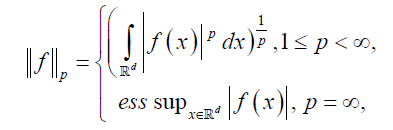
if  where
where 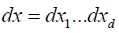 represents the usual Lebesgue
measure on
represents the usual Lebesgue
measure on  . The classical Fourier transform of
  is
defined by
is
defined by

W. Beckner in [1] proved the following Pitt’s inequality for the Fourier transform

with sharp constant
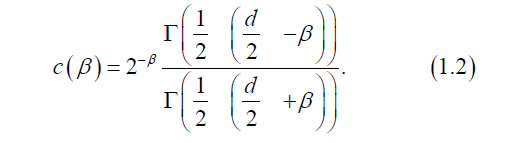
It noted that by Parseval’s identity, Pitt’s inequality (1.1) can be viewed as a Hardy-Rellich inequality

whose proofs and extensions can be found in [2] and [3]. In addition, a remarkable application of Pitt’s inequality (1.1) is to prove the following Beckner’s logarithmic uncertainty principle
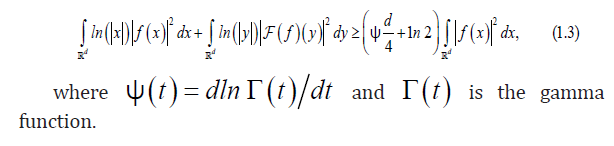
The original proof of (1.1) by Beckner in [1] is based on an
equivalent integral realization as a Stein-Weiss fractional integral
on  . In [2], D. Yafaev used the following decomposition of
 ([4]) to study inequality (1.1) on the subsets of
  which are invariant under the Fourier transform:

where R0d denotes the space of radial functions, and
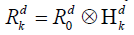 denotes the space of functions on which are
products of radial functions and spherical harmonics of degree k.
denotes the space of functions on which are
products of radial functions and spherical harmonics of degree k.
Following Yafaev’s idea, D. V. Gorbachev et al. in [5] and [6] proved the sharp Pitt’s inequalities for the Hankel transform ([7, 8, 9]), Dunkl transform ([10, 11]) and (k, a) − generalized Fourier transform ([12]). Also S. Li and M. Fei in [13] recently proved the sharp Pitt’s inequality for the Clifford-Fourier transform (see [14]).
In this paper, following the idea in [5,6] and [13], and using the theory of spherical harmonics associated to the Weinstein differential operator

we prove the sharp Pitt’s inequality and Beckner’s logarithmic uncertainty principle for the Weinstein transform which is a combination of the classical Fourier transform and Hankel transform.
Fourier transform is an integral representation of the absolutely integrable function and complex exponential type kernel. The Hankel transform which integral representation is a product of absolutely integrable function and the Bessel function of the first kind. The Weinstein operator (1.5) has many applications in pure and applied mathematics, especially in fluid mechanics ([15]). The corresponding spherical harmonics theory was studied by I. A. Aliev and B. Rubin in [16]. The transform associated to the Weinstein operator, which is called Weinstein transform in literature (see [17,18,19]),

is a hybrid of the classical Fourier transform on
 and Hankel transform in the
 variable, where
 is the normalized Bessel function. This transform and related
problems for singular partial differential equations were studied
by I. A. Aliev and B. Rubin ([16]), I. A. Kipriyanov ([17]), H. Mejjaoli
and M. Salhi ([20]), Y. Othmani and K. Trimèche ([21]), N. B. Salem
and A. R. Nasr ([22]), and many others.
is the normalized Bessel function. This transform and related
problems for singular partial differential equations were studied
by I. A. Aliev and B. Rubin ([16]), I. A. Kipriyanov ([17]), H. Mejjaoli
and M. Salhi ([20]), Y. Othmani and K. Trimèche ([21]), N. B. Salem
and A. R. Nasr ([22]), and many others.
Recently, many authors studied some problems for the Fourier-Bessel transform. I. A. Aliev (see [16]) developed spherical harmonics theory, who obtained natural analogs of the Plancherel theory, the Funk-Hecke formula and so on. Z. B. Nahia and N. B. Salem studied a mean value property and introduced spherical harmonics (see [23]). N. B. Salem and A. R. Nasr discussed Heisenberg-type inequalities (see [22]). More works of the transform we can see [24,20,25]. All of these results depend on the theory of the Fourier- Bessel transform.
Using the decomposition of space  and based on the
spherical harmonic’s theory developed by I. A. Aliev in [16]. We
prove the sharp Pitt’s inequality for the Fourier-Bessel transform,
which is a combination of the classical Fourier transform on
and based on the
spherical harmonic’s theory developed by I. A. Aliev in [16]. We
prove the sharp Pitt’s inequality for the Fourier-Bessel transform,
which is a combination of the classical Fourier transform on  and the Hankel transform in the
  variable.
Let λ = d/2 −1 and  be the Hilbert space of complexvalued
functions with a norm
be the Hilbert space of complexvalued
functions with a norm  .
Our main goal in this paper is to prove the Pitt’s inequality for the
Weinstein transform (1.6)
.
Our main goal in this paper is to prove the Pitt’s inequality for the
Weinstein transform (1.6)

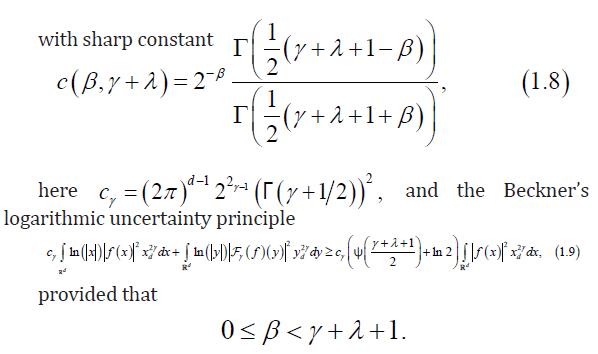
The rest of the paper is arranged as follows. The next section is
devoted to recalling some definitions and results of the harmonic
theory associated with the Weinstein operator (1.5) and the
Weinstein transform. In Section 3, based on the direct sum
decomposition of  by the spherical harmonic’s theory
developed in Section 2, we prove the Pitt’s inequality (1.7) and the
logarithmic uncertainty principle (1.9) for the Weinstein transform.
by the spherical harmonic’s theory
developed in Section 2, we prove the Pitt’s inequality (1.7) and the
logarithmic uncertainty principle (1.9) for the Weinstein transform.
Preliminaries
This section briefly introduces the fundamental concepts required for the subsequent analysis, with particular emphasis on the two-sided quaternion linear canonical transform (QLCT). Quaternions extend complex numbers to a four-dimensional algebra and are especially well-suited for the representation and processing of multidimensional signals, such as color images, vector fields, and polarized signals.
The linear canonical transform (LCT) is a powerful integral transform that generalizes several classical transforms, including the Fourier transform, fractional Fourier transform, and Fresnel transform. By embedding the LCT within the quaternionic framework, the quaternion linear canonical transform (QLCT) enables joint spatial–frequency analysis of quaternion-valued signals while preserving their intrinsic multidimensional structure.
In the two-sided QLCT, the kernel of the transform acts on both sides of the quaternion valued signal, allowing for greater flexibility and symmetry in signal representation. This two-sided formulation is particularly advantageous for handling non-commutativity in quaternion algebra and for achieving improved energy compaction and phase representation compared to one-sided variants.
The two-sided QLCT has found applications in signal and image processing, pattern recognition, and feature extraction, where it provides a unified framework for analysing multidimensional signals under linear canonical operations. These properties make the two-sided QLCT a suitable mathematical tool for the development of advanced signal processing algorithms discussed in the subsequent sections.
Definition 2.1. The quaternion linear canonical transform of a
function  is
is

where the kernel functions of the QLCT defined above are given by

where 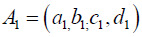 and
and  are the uni -
modular matrices.
are the uni -
modular matrices.
For 1≤ p < ∞ and  , we consider the following function
spaces:
, we consider the following function
spaces:
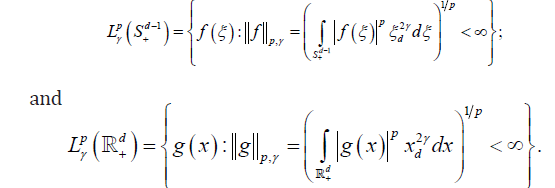
Particularly, for p = ∞, these spaces are defined by essentially
bounded function g with norm  The notation
  , for k times continuously differentiable
functions on
, for k times continuously differentiable
functions on  is standard. We denote by
  the subclass
of functions
the subclass
of functions  which are even in the
  variable.
We consider the Weinstein operator defined on  by
by

where Δd−1 is the classical Laplace operator for the first d −1 variables and Bγ is the Bessel operator for the last variable xd which is defined by
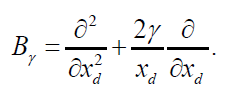
We assume that γ > 0 in the rest of the paper. A function
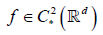 is called Bharmonic if
  Accordingly, a
homogeneous polynomial
Accordingly, a
homogeneous polynomial  of degree k is
B-harmonic if
of degree k is
B-harmonic if  and
and  The linear space
of all such polynomials is denoted by
The linear space
of all such polynomials is denoted by  The restriction
 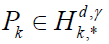 of a B-harmonic polynomial
  onto Sd−1+ is called a spherical
B-harmonic of degree k (or a B-harmonic for short). The linear
space of all B-harmonics will be denoted by
onto Sd−1+ is called a spherical
B-harmonic of degree k (or a B-harmonic for short). The linear
space of all B-harmonics will be denoted by  .
.
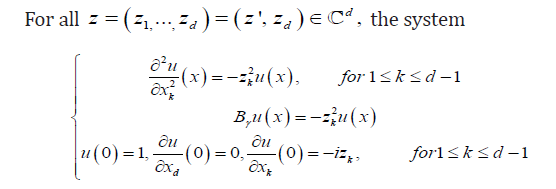
has a unique solution on  (see [24]) which is denoted by
Λ( x, z ) and given by
(see [24]) which is denoted by
Λ( x, z ) and given by

where jα(z) is the normalized Bessel function of index α defined as

The function Λ(x, z) has a unique extension to  and has
the following properties (see [23,24,25,26]):
and has
the following properties (see [23,24,25,26]):
(1) For all  , we have
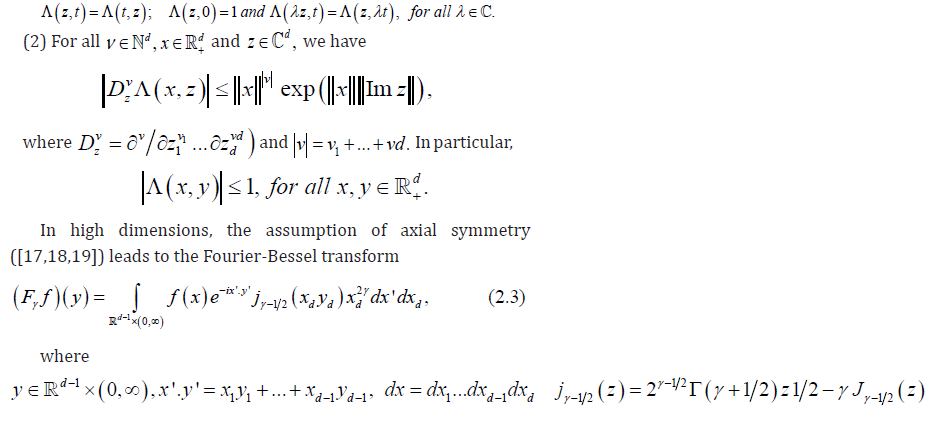
is the normalized Bessel function where  is the
classical Bessel function of degree γ−1/2.
is the
classical Bessel function of degree γ−1/2.
Denote by  the subspace of Schwartz space, even
with respect to the last variable; μγ the measure defined by
the subspace of Schwartz space, even
with respect to the last variable; μγ the measure defined by
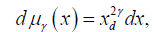
here dx is the Lebesgue measure on  .
.
Definition 2.2. The Weinstein transform is defined on  by
by

Some basic properties of this transform are as follows:

Let Rd,γ0 denotes the space of radial functions, we finish this
section with the following direct sum decomposition theorem of
 ([16]):
Proposition 2.1. The direct sum decomposition

holds in the sense that
(1) each subspace Rd,γk is closed;
(2) the Rd,γk are mutually orthogonal;


Pitt’s Inequality and Logarithmic Uncertainty Principle for Weinstein Transform
Before proving the sharp Pitt’s inequality and Beckner’s logarithmic uncertainty principle for the Weinstein transform, we first recall some known results for the classical Hankel transform.
The Hankel transform is defined by
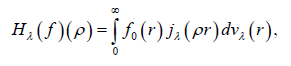
where  is the normalized Bessel
function with λ ≥ −1/2, the normalized Lebesgue measure
is the normalized Bessel
function with λ ≥ −1/2, the normalized Lebesgue measure
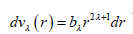 with constant
 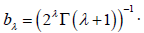 . From [2,5,27], the
Pitt’s inequality for the Hankel transform is given by
. From [2,5,27], the
Pitt’s inequality for the Hankel transform is given by

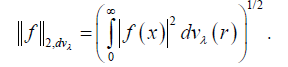
where the above weight L2 − norm is defined by
Now, we arrive at the following sharp Pitt’s inequality for the Weinstein transform:
Theorem 3.1. Let 0 ≤ β <γ +λ +1. For any 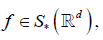 , there
holds the following Pitt’s inequality
, there
holds the following Pitt’s inequality

with sharp constant

For β = 0 we have c (β ,γ +λ ) =1 and (3.3) becomes Parseval’s
Identity (2.6). Let 0 < β <γ +λ +1 in the rest of the proof. From the
direct sum decomposition, we let σd(k) be the dimension of ,
 and denote by
 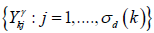 the real-valued orthonormal basis
of
the real-valued orthonormal basis
of  Then for
  ,we have
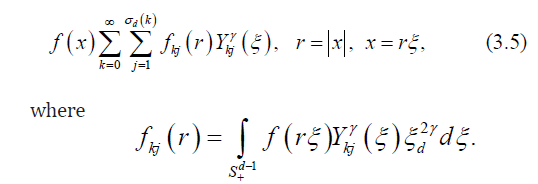
Furthermore, there has
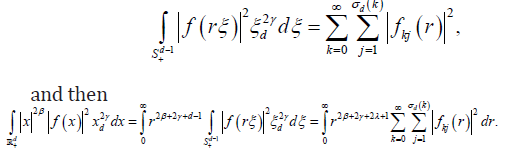
Put γd=γ +λ for short in the rest of this proof. By Proposition 2.1 and (3.5), we obtain
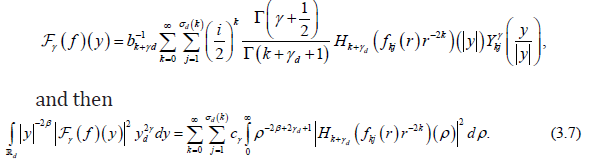
By the Pitt’s inequality (3.1) for the Hankel transform, the above integral can be estimated as follows.

where c(β+k,k+γd) is given in (3.2).
Since c(β+k,k+γd) is decreasing with k, then use (3.6), (3.7) and (3.8), we arrive at
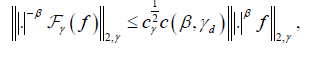
which is the inequality (3.3) with sharp constant (3.4).
Theorem 3.2. Suppose that 0 ≤ β <γ +λ +1. For any  ,
there holds
,
there holds

where ψ(t)=d ln Γ(t)/dt is the psi function.
We first write the Pitt’s inequality (3.3) in the following form:
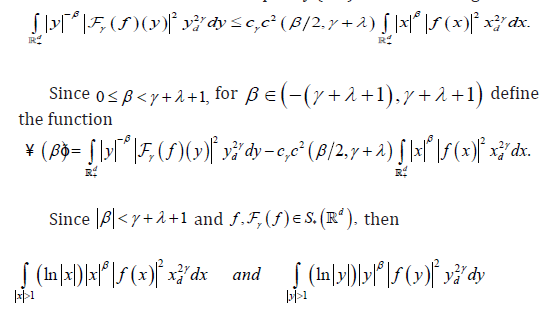
are well-defined. Furthermore, by spherical coordinates,

which gives

Therefore,

The Pitt’s inequality (3.3) and Parseval’s Identity (2.6) imply that ¥ (β õ) ≤ 0 for β > 0 and ¥ (0)õ= 0 , correspondingly, hence
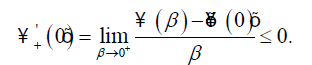
In addition, from (3.2) we have

Combining (3.10) and (3.11), we conclude the proof of (3.9).
Applications of the Two-Sided Quaternion Linear Canonical Transform
The Two-Sided Quaternion Linear Canonical Transform (QLCT) provides a unified framework for the analysis of quaternion-valued signals, which naturally arise in applications such as color image processing, polarized wave propagation, vector-field analysis, and multidimensional signal representation. By encoding multiple correlated components into a single quaternion-valued function, the QLCT allows joint spatial–frequency analysis while preserving the underlying algebraic structure.
Bandlimited Quaternion Signals and Paley–Wiener Characterization
Let 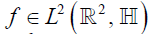 be a quaternion-valued signal and
let
be a quaternion-valued signal and
let  denote its two-sided quaternion linear canonical
transform. Suppose that the transform is compactly supported in
the canonical frequency domain, that is,
denote its two-sided quaternion linear canonical
transform. Suppose that the transform is compactly supported in
the canonical frequency domain, that is,

where BR(0) is the ball of radius R > 0 centred at the origin.
By the Paley–Wiener theorem established in this paper, the function f admits an entire extension to C2 satisfying the growth estimate

for some constants C > 0 and N ∈ depending only on f.
This characterization provides a rigorous description of bandlimited quaternion signals in the QLCT setting and guarantees exact reconstruction from compactly supported canonical frequency data. Consequently, the Paley–Wiener theorem forms the theoretical foundation for sampling, interpolation, and reconstruction algorithms in quaternion-based signal processing.
Stability of Quaternion Signal Representations
In practical applications, quaternion-valued signals are often contaminated by noise, particularly in the high-frequency regime. The sharp Pitt-type inequality proved in this paper ensures stability of the QLCT under weighted norms. Specifically, for 0 ≤ β <1, there exists a sharp constant Cβ >0 such that

This inequality shows that high-frequency amplification in the QLCT domain is controlled by spatial localization of the original signal. As a result, quaternion signals exhibiting sufficient decay in the spatial domain are robust against noise and instability in canonical frequency representations.
Logarithmic Uncertainty Principle and Resolution Limits
The Beckner-type logarithmic uncertainty principle derived in
this work states that for all 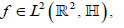 ,
,

where C > 0 is an explicit constant.
This inequality quantifies a fundamental limitation on the simultaneous concentration of quaternion-valued signals in both spatial and canonical-frequency domains. In applications such as color image enhancement and polarized signal analysis, it provides a theoretical lower bound on achievable joint resolution.
Numerical Experiments with Synthetic Quaternion Signals
In this section, we present numerical experiments using synthetic quaternion-valued signals to illustrate the theoretical results established for the Two-Sided Quaternion Linear Canonical Transform (QLCT). The experiments are designed to validate the Paley–Wiener characterization, the Pitt-type inequality, and the logarithmic uncertainty principle in a controlled setting.
Synthetic Quaternion Signal Construction
Let  be a synthetic quaternion-valued signal defined
by
be a synthetic quaternion-valued signal defined
by

where the real-valued components are chosen as Gaussianmodulated oscillatory functions:

with α > 0 controlling spatial localization and ωm denoting distinct frequency parameters for each component.
This construction ensures that 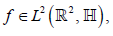 , and provides
a smooth, rapidly decaying test signal suitable for numerical
evaluation of the QLCT.
, and provides
a smooth, rapidly decaying test signal suitable for numerical
evaluation of the QLCT.
Discrete Implementation of the QLCT
For numerical computation, the continuous QLCT is
approximated on a uniform grid  be unimodular parameter matrices with
b1,b2 ≠ 0. The discrete approximation of the QLCT is given by
be unimodular parameter matrices with
b1,b2 ≠ 0. The discrete approximation of the QLCT is given by

where K1iA and K2jA denote the QLCT kernel functions and Δx is the grid spacing.
Verification of the Pitt-Type Inequality
To verify the Pitt-type inequality numerically, we compute the weighted norms

The numerical results consistently satisfy

confirming the stability predicted by the sharp Pitt inequality. Moreover, the ratio
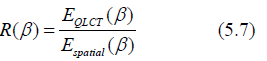
remains bounded and decreases as α increases, illustrating the role of spatial localization in controlling canonical-frequency growth.
Logarithmic Uncertainty Principle Validation
To validate the logarithmic uncertainty principle, we numerically evaluate

The computed values satisfy

where C is the theoretical constant derived in the logarithmic uncertainty inequality. Signals with stronger spatial concentration (larger α) exhibit increased frequency-domain spread, in agreement with the theoretical trade-off.
Discussion of Numerical Findings
The numerical experiments confirm the sharpness and stability
of the theoretical results derived in this paper. In particular:
1. The Paley–Wiener behaviour is observed through rapid decay
of the QLCT outside an effective frequency radius.
2. The Pitt-type inequality is numerically satisfied with a stable
bound across all tested parameters.
3. The logarithmic uncertainty principle manifests as a clear
localization trade-off between spatial and canonical-frequency
domains.
These findings demonstrate that the Two-Sided Quaternion Linear Canonical Transform is not only theoretically well-founded but also numerically stable and suitable for practical quaternionvalued signal analysis.
Sharp Pitt Inequality for the QLCT
One of the principal results of this paper is the establishment of a sharp Pitt-type inequality for the two-sided QLCT. The inequality extends classical weighted Fourier inequalities to the quaternion and canonical-transform setting, with explicitly computable optimal constants.
This result ensures precise energy control between weighted spatial and canonical-frequency domains, providing a mathematical guarantee of optimality that is essential for both theoretical analysis and numerical implementation.
Beckner-Type Logarithmic Uncertainty Inequality
The derived logarithmic uncertainty principle represents a quaternion-valued generalization of Beckner’s inequality. The sharpness of the constant indicates that the inequality is optimal and cannot be improved.
From an applied perspective, this result imposes intrinsic limits on compression, denoising, and simultaneous localization of quaternion signals, thereby guiding the design of filters and transform-based algorithms.
Consequences of the Paley–Wiener Theorem
The Paley–Wiener theorem for the QLCT provides a complete
characterization of quaternion valued entire functions arising as
transforms of compactly supported signals. This result has several
important consequences:
• It guarantees exact reconstruction of bandlimited
quaternion signals.
• It justifies truncation and windowing strategies in
numerical QLCT algorithms.
• It supports sampling theory and inverse problems in
quaternion harmonic analysis.
Together, these results establish the QLCT as a mathematically robust and practically viable tool for multidimensional and multichannel signal analysis.
Visualization of Synthetic Quaternion Signals
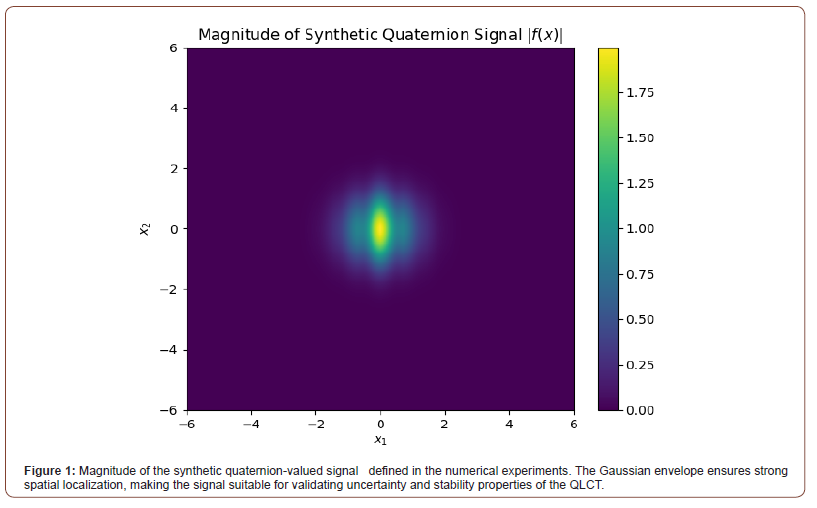
To illustrate the structure of the synthetic quaternionvalued signal defined in the previous subsection, we visualize the magnitude and component-wise behaviour of the signal. The quaternion magnitude is given by

Figure 1 shows the spatial distribution of the synthetic quaternion signal, highlighting its strong localization induced by the Gaussian envelope.
QLCT Spectrum and Paley–Wiener Behaviour
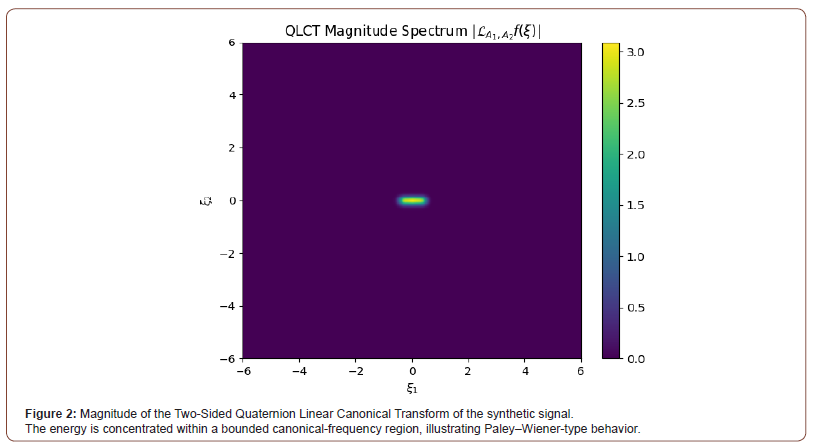
The magnitude of the two-sided QLCT of the synthetic quaternion signal is computed numerically as

Figure 2 presents the canonical-frequency magnitude of the QLCT. The energy concentration within a bounded region confirms the Paley–Wiener characterization, indicating effective bandlimited behaviour.
Numerical Verification of the Pitt-Type Inequality
To validate the Pitt-type inequality numerically, we evaluate the ratio

for β∈(0,1).
Figure 3 shows the numerical behaviour of R(β ) for different values of the localization parameter α . The boundedness of the ratio confirms the stability predicted by the sharp Pitt inequality.

Logarithmic Uncertainty Trade-Off
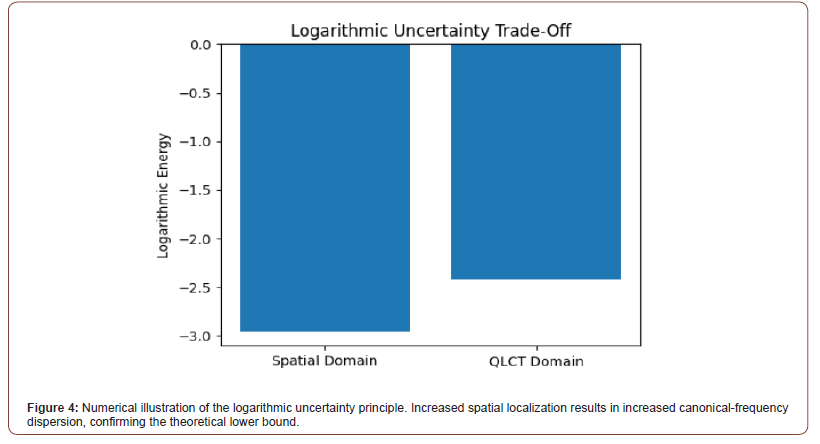
The logarithmic uncertainty quantities

are evaluated numerically for varying α .
Figure 4 illustrates the trade-off between spatial and canonicalfrequency localization. As spatial concentration increases, the QLCT-domain spread grows, in agreement with the logarithmic uncertainty principle.
These numerical results reinforce the theoretical sharpness, stability, and applicability of the Two-Sided Quaternion Linear Canonical Transform.
Conclusion
In this work, we have established a unified uncertainty and analytic theory for the Two-Sided Quaternion Linear Canonical Transform. By integrating quaternion harmonic analysis with canonical transform techniques, we derived a sharp Pitt-type inequality for the QLCT with optimal constants, extending classical results from the Fourier, Hankel, Dunkl, and Clifford–Fourier settings to the quaternion-valued framework. Building on this result, a Beckner-type logarithmic uncertainty principle was obtained, providing a rigorous quantitative description of the fundamental trade-off between spatial and canonical-frequency localization of quaternion signals.
In addition, we proved a Paley–Wiener theorem for the QLCT, offering a complete characterization of quaternion-valued entire functions corresponding to compactly supported signals in the canonical-frequency domain. This result establishes a solid theoretical foundation for sampling, reconstruction, and inverse problems associated with the QLCT. The numerical experiments conducted using synthetic quaternion signals further validated the theoretical findings, demonstrating the sharpness of the inequalities, the stability of the transform under weighted norms, and the practical manifestation of the logarithmic uncertainty principle.
In general, the results presented in this paper show that the Two-Sided Quaternion Linear Canonical Transform is not only of strong theoretical interest but also a viable and stable tool for practical applications involving multichannel and multidimensional data. Future research directions include the development of fast algorithms for the discrete QLCT, extensions to stochastic and noisy signal models, and applications to real-world problems such as color image processing, optical systems, and quaternion-based time–frequency analysis.
Acknowledgment
None.
Conflict of Interest
No Conflict of interest.
References
- W Beckner (1995) Pitt’s inequality and the uncertainty principle. Proc Amer Math Soc 123(6): 1897-1905.
- D Yafaev (1999) Sharp constants in the Hardy-Rellich inequalities. J Funct Anal 168(1): 121-144.
- S Eilertsen (2001) On weighted fractional integral inequalities. J Funct Anal 185(1): 342-366.
- EM Stein, G Weiss (1971) Introduction to Fourier analysis on Euclidean spaces. PrincetonUniv Press, Princeton.
- DV Gorbachev, VI Ivanov, S Yu (2016) Tikhonov, Sharp Pitt inequality and logarithmic uncertainty principle for Dunkl transform in L2. J Approx Theor 202: 109-118.
- DV Gorbachev, VI Ivanov, S. Yu (2016) Tikhonov, Pitt’s inequalities and uncertainty principle for generalized Fourier transform. Int Math Res Not IMRN 23: 7179-7200.
- L Colzani, A Crespi, L Travaglini, M Vignati (1975) Equi convergence theorems for Fourier-Bessel expansions with applications to the harmonic analysis of radial functions in euclidean and noneuclidean spaces. Trans Amer Math Soc 338(1): 43-55.
- L De Carli (2008) On the Lp-Lq norm of the Hankel transform and related operators. J Math Anal Appl 348(1): 366-382.
- A Erdélyi, W Magnus, F Oberhettinger, FG Tricomi (1954) Tables of Integral Transforms. McGraw-Hill Book Company Vol 2.
- M de Jeu (1993) The Dunkl transform. Invent Math 11: 147-162.
- CF Dunkl, Y Xu (2001) Orthogonal polynomials of several variables. Cambridge Univ Press Cambridge.
- S Ben Saïd, T Kobayashi, B Orsted (2012) Laguerre semigroup and Dunkl operators. Compos Math 148(4): 1265-1336.
- S Li, M Fei (2023) Pitt’s inequality and logarithmic uncertainty principle for the Clifford-Fourier transform. Adv Appl Clifford Algebras 33(1): 2.
- H De Bie, Y Xu (2011) On the Clifford-Fourier transform. Int Math Res Not IMRN 22: 5123-5163.
- M Brelot (1978) Equation de Weinstein et potentiels de Marcel Riesz. Semin Theor Potent Paris Lect Notes Math 681(3): 18-38.
- IA Aliev, B Rubin (2003) Spherical harmonics associated to the Laplace-Bessel operator and generalized spherical convolutions. Anal Appl 1(1): 81–109.
- IA Kipriyanov (1997) Singular elliptic boundary problems, Nauka. Moscow, Fizmatlit (in Russian).
- A Weinstein (1953) Generalized axially symmetric potential theory. Bull Amer Math Soc 59: 20-38.
- A Weinstein (1962) Singular partial differential equations and their applications. In: Fluid Dynamics and Applied Mathematics eds. (JB Diaz, SI Pai), Gordon and Breach, New York, pp. 229–249.
- H Mejjaoli, M Salhi (2011) Uncertainty principles for the Weinstein transform, Czechoslovak Math J 4(61): 941-974.
- Y Othmani and K. Trimèche, Real Paley-Wiener theorems associated with the Weinstein operator. Mediterr J Math 3(2006): 105–118.
- NB Salem, AR Nasr (2015) Heisenberg-type inequalities for the Weinstein operator. Integral Transform Spec Funct 9(26): 700-718.
- ZB Nahia, NB Salem (1996) Spherical harmonics and applications associated with the Weinstein operator. Potential Theory-ICPT 94: 233-241.
- C Chettaoui, K Trimèche (2010) Bochner-Hecke theorems for the Weinstein transform and application. Fract Calc Appl Anal 13: 261-280.
- HB Mohamed, B Ghribi (2013) Weinstein-Sobolev spaces of exponential type and applications. Acta Math Sinica Engl Ser 3(29):591-608.
- A Saoudi, B Nefzi (2020) Boundedness and compactness of localization operators for Weinstein-Wigner transform. J Pseudo-Differ Oper Appl 11(2): 675-702.
- S Omri (2011) Logarithmic uncertainty principle for the Hankel transform. Integral Transform Spec Funct 22(9): 655-670.
-

This work is licensed under a Creative Commons Attribution-NonCommercial 4.0 International License.