


 Research Article
Increasing the Course Quality in Higher Education through Action Research: A Graduate Teaching Assistant’s Inquiry
Received Date:February 17, 2024; Published Date:February 26, 2024
Abstract
This action research study examined the steps a graduate teaching assistant (GTA) took to improve the quality of instruction in an undergraduate course designed for pre-service teachers (PTs). The purpose of this study was two-fold: (a) to explore both PTs and GTA’ perceptions of the course content and design, using multiple surveys and interviews, and (b) to compare PTs’ reported perceptions with how and what they learned in the course and how to improve the overall design of the course. Action research served as the methodology for this study, where the author planned and enacted strategies, observed the impact of these strategies, and reflected on our efforts and their impact on student learning. The findings revealed that both GTA and PTs valued practice-based course assignments and in-class activities, appreciated high-quality lectures sufficiently covering the course topics and assigned readings, and enjoyed active interactions through discussion. The implication suggests a new model for the course comprised of two parts: what instructors can consider at the designing stage of the course and what they can adjust and consider during the course throughout the semesters.
Keywords: Action Research; Graduate Teaching Assistant; Pre-service Teachers; Course Evaluation; Higher Education
Action Research in Higher Education
Action research serves a critical role in changing current practice by applying ongoing strategies in the classroom. Despite its benefits to both students and teacher researchers, action research has been widely used in the K-12 setting, reinforcing its signature importance in improving instruction, student learning, and overall school climate. Interestingly, fewer examples of the integration of action research exist in higher education [1]. To improve the quality of course instruction and students’ learning experience, there has been a substantial movement in higher education to incorporate action research in universities throughout the U.S. [1]. Similar to a K-12 setting, action research is one of the iterative strategies and models for change, enhancing the teaching-learning experience at the college level because of its potential to improve instructional practices [2].
As an example of action research in higher education, van Zee [3] conducted a study with PTs with the aim of improving the overall quality of her science method class at the university. Results from her practical inquiry suggested that action research supported her efforts to not only improve the quality of her instruction and curriculum but also better prepare her preservice teachers to integrate science education reform effectively into their practice. Similarly, Raubenheimer and Jennifer [1] concluded that action research provided a systematic and self-critical means of collecting data on the impact their instructional attempts made on student learning in zoology. In particular, the authors compared the correlation between the “learning preference” rank and the “enjoyment preference” rank of the activities provided in their course. The results showed students not only similarly ranked items for each set (Kendall’s coefficient of concordance results of student’s preferred learning activities was W=.491, p<0.001, and rankings of enjoyment was W=.325, p<0.001) but also, overall ranking of the two categories was significantly correlated (Spearman’s rank-order correlation showed that the overall ranking of the two categories is significantly correlated, ρ=.729, p=0.01). Results from their work indicated that students liked the activities from which they felt they learned the most. The data provided evidence to the instructors about what activities were most effectively applied to the students. The researchers contended that their action research experience “has the power to transform teaching in higher education by providing a systematic means of gathering data about the effect of the instructional change on student learning” [1].
According to Gibbs et al. [4], there is an increasing trend in higher education to explore action research at the institutional level by “breaking down the demarcations between traditional scholarship, research, and administration/organization” (p. 5). Overall, this aims to enhance and facilitate the learning environment through reflection by putting research into practice [5]. Researchers have shown that action research at the university level can be widely used for the innovation of curriculum design [6], teaching [7], and assessment [8,9]. Fostering students’ engagement and participation in the practice may empower the value of action research since it provides clear evidence of how the students experience contemporary higher education [4,10]. Students can be involved in the study of engagement in teaching and the learning process [11], curriculum development [12], and the building of a community of mutual collaboration for the practice [6,13].
Although the interpretation of students’ engagement in the action research may vary [4], it is important to note that students, as stakeholders in undergraduate education, play a vital role in relation to the action researchers and the institutions. Kur et al. [14] reported students’ engagement in the action research not only raised their voices in the field but also positively affected their personal growth. Furthermore, it improved the course curriculum for faculties. Moor and Gayle [15] also suggested a positive effect of students participating in action research, such as improving the relationship with the faculty via collaboration. Measuring their engagement in the course and providing fair and relevant assessment tools to students helped the students more actively participate in the class, subsequently leading to positive change through action research [16].
The Role of GTAs – Action Researcher’s Positionality
In the U.S., research-led and large universities have historically hired graduate students to teach undergraduate students [17-19]. Studies related to concerns and issues of the role of GTAs, and their quality have been conducted since the 1960s [18]. Since the GTA is a legitimate participant and prospective leader in the academy, it is important to study their experience, perspectives, role, and status to gather an insider perspective on the overall quality of course instruction and design.
Luckie et al. [20] reported four practices of the GTA, based on the previous literature, which include the roles of (a) facilitator, (b) teacher, (c) supplemental, and (d) collaborator. To be specific, with the role of facilitator, GTAs promote communication among the groups and facilitate conversations to guide students to understand the concepts of the topics. In terms of the teacher’s role, they evaluate students’ assignments, serve in a recitation or laboratory section where they lead weekly meetings for small groups of students, review the course materials and gauge group performance, and ask students’ opinions concerning the effectiveness of the class. As supplemental instructors, GTAs hold office hours for the students, advise students on the assignment or exam preparation, and help students with personal problems if needed. Lastly, they meet with the instructor on record (e.g., professor) regularly to plan and discuss the course contents of the week, reflecting on the issues of the previous week and update and inform the instructor of the student’s strengths or weaknesses based on “mastering concepts” of the learning. As such, GTAs have multiple roles, and their philosophy and quality may directly influence undergraduate students’ learning outcomes.
After surveying 51 undergraduate students, 10 GTAs, and eight academic staff, Muzaka [18] found that GTAs have an ambiguous niche in that they have multiple roles of teachers, researchers, students, and employees simultaneously. In terms of the merits of having GTAs, students perceived it is beneficial to run a small group seminar by GTAs since they cannot only get additional knowledge from them but also feel more comfortable because the session run by GTAs may be less formal and intimidating. She also indicated that students reported GTAs are familiar with the latest materials, tend to avoid unrelated monologues, better use the technology, try new methods of teaching instructions, and are more open to the ideas from the group discussion. On the other hand, in relation to the problems and issues related to GTAs, it was also reported that GTAs themselves perceived a lack of authority in the modules as well as general class organizations and issues. Some students indicated that if the seminars or recitations run by GTAs were not strongly in line with the lectures, they felt uncomfortable since it was evidence of a lack of communication between the GTAs and the instructor. Similarly, O’Neal et al. [21] pointed out that GTAs can eliminate uncertainty by explicitly discussing the expectations for individual assignments and courses in general. Their study also highlighted that the GTAs’ efforts to create a positive learning environment can enhance students’ learning process, which was perceived by over 2,100 undergraduate students who participated in their study. The quote from one of the undergraduate students who participated in O’Neal et al.’s [21] study underscored the importance of the GTA’s role:
“The TA’s ability to make the lab atmosphere fun… definitely made doing the labs a lot easier. Furthermore, his cool attitude made it a lot easier to listen to what needed to be done, making the learning process more effective. It increased my interest in doing a science major (Asian male sophomore, course grade=A)” [21].
Although GTAs may confront issues caused by their multiple roles and their identity as contact persons between students and the instructor [22], their role is a key component in raising the quality of the course and developing a positive learning experience among undergraduate students. Even if the GTAs may not feel they have sufficient authority to organize the course, Park [22] stated that the GTA’s effectiveness can still be improved by reflective practices, including keeping a journal including the successes and failures of the activities and their self-awareness. Based on previous research related to the experiences or perception of GTAs, continuous study understanding of their status, beliefs, and effectiveness needs to be further explored, given their rising importance in higher education [18].
Purpose of the Study and Research Questions
The purpose of this study was to examine PTs and GTA’s perceptions of the course design and in-class activities as a means of improving the overall quality of instruction. The author was one of two GTAs for the course, Classroom Management designed to teach PTs who will be working in elementary schools. In this capacity, both GTAs facilitated interactions among the students during class discussions and directed a recitation session where she reviewed the contents of the lecture and provided practical tips for the instructor on record. GTAs collaborated with the instructor on the re-design of key assignments and in-class activities. Based on the observations from two years of co-teaching the course, the author questioned how effective the course assignments and activities were in helping preservice teachers develop an informed understanding of fundamental practices for effective teaching (i.e., classroom management, student motivation, and differentiated instruction). As a result, the author elected to plan, implement, and reflect on her own self-reflective, critical inquiry into what students’ perceptions were and how students’ perceptions aligned with their learning of course material. By gaining insight and feedback from her students and input from a fellow GTA, the author aims to learn how to leverage their responses to improve her practice while advancing PTs’ understanding of effective teaching. Thus, this action research study is guided by the following questions:
1) What is the undergraduate PTs and the GTA’s perceptions
of course contents and their engagement in the class?
2) To what extent do undergraduate PTs and the GTA’s
perceptions inform ways to improve the design of the course?
Method
Context of the Study
Course Description
This study took place in the context of a required undergraduate course housed in a nationally ranked teacher preparation program at a large research-intensive university in the Midwest region of the United States. Classroom Management course was designed to develop advanced pre-service teachers’ (i.e., junior, senior) educational skills in recognizing classroom processes and understanding how teachers’ beliefs and practices affect elementary students’ engagement, learning, and motivation. The course focused on the notion of effective teaching, specifically how it is defined, what it looks like, and different ways to enact it in the classroom. The course is based on three dimensions: (a) organization and managing student behavior; (b) creating high-quality learning opportunities for all students, including assessing students’ understanding and learning, and differentiating instruction; and (c) creating a positive and supportive environment where children are psychologically comfortable to learn and develop.
Learning Objectives of the Course
The course learning outcomes include the following: (a) develop skills for building classroom communities; (b) analyze different approaches to classroom discipline and the effects of those approaches on the cognitive, social, and emotional development of diverse students; (c) develop a personal philosophy of classroom discipline; (d) recognize how student diversity, developmental levels, technology, instructional design, room arrangement, and assessment techniques influence the classroom community and climate; (e) identify strategies for effective management of professional time and tasks; (f) collaborate with colleagues and parents to enhance student learning and development; (g) create a comprehensive plan for establishing and managing a learning environment in a real or simulated teaching situation.
Participants
A total of 37 pre-service elementary school teachers participated in the course and action research study. PTs typically take this course during their junior or senior year as a required course to learn how to design and create a positive class environment. The course not only covers educational theories but also uses scenariobased activities and discussions to promote their understanding. The course is comprised of a lecture and corresponding recitation. In the lecture, the instructor on record leads discussions related to the weekly topic based on the educational theories and readings assigned, while GTAs help him foster students’ discussion during the class. The GTAs direct the recitations one or two days after the lecture to assist students with applying the knowledge from the lecture. In this study, PTs were asked to share their thoughts and evaluate the course, including in-class exercises and assignments.
Research Design and Methodological Framework
The research design of this study is a mixed method, drawing on both quantitative and qualitative data [23,24]. This study can also be considered as multi-perspectival, conveying the perceptions of undergraduate and graduate students. As a methodological framework, mixed methods-grounded theory (MM-GT) was employed [25-30]. The purpose of the traditional grounded theory widely used in qualitative study is to develop a new theory inductively after reviewing one or more techniques to collect empirical data [31]. Although grounded theory is a systematic methodology, it is also flexible in designing an explanatory model representing the studied phenomenon [32,33]. In this respect, key scholars of MM-GT underlined the potential of grounded theory to be used for both quantitative and qualitative data [27-30,34]. Considering the rapid expansion of the mixed-method movements [28], Charmaz [26] referred to MM-GT as “pragmatist grounded theory,” and Babchuk [25] viewed this paradigm as the latest addition to the grounded theory’s family. As such, MM-GT is based on pragmatism and pluralism to develop a practical theory [35] and is “revolutionary if properly illuminated” [30].
Data Collection
The author distributed and collected data three times through surveys (two formative assessments and one summative assessment) during the semester. The first and second formative assessments were used in the 1/3 and 2/3 of the semester to understand the thoughts about the lecture course contents and design (see Appendix A for the formative assessment survey). The summative assessment (see Appendix B) was distributed at the end of the semester, and through it, the PTs could evaluate the course topics and quality in general. As the assessments were voluntarybased to improve GTAs’ understandings of creating a future course as an extra task, not every PT participated in the survey; 21 PTs for formative assessment 1, 13 PTs for formative assessment 2 (it is important to note that many of the PTs had already left the campus because of the 2020 COVID-19 pandemic), and 31 PTs for the summative assessment (they filled out the online survey). In addition, the author interviewed her colleague who also worked in this course as a GTA to get an additional understanding of her thoughts about this course (see Appendix C for the interview protocol).
Surveys
According to Angelo and Cross (2012), classroom assessment techniques (CATs) serve as formative evaluations that provide information used to modify and improve course contents. The formative assessment used in this study is comprised of two main parts: course-contents review (part I) and students’ attitudes, values, and self-awareness (part II). In the course content part, students were asked to answer (a) the most important things that they learned, (b) contents that they understood least, (c) suggestions or alternative pathways for the concepts that they did not understand, and (d) weekly reading lists where they can rate from one to five. This part was designed to check whether the students sufficiently understood the contents of the week. In part II, six questions were included for the group work evaluation [36] to check the quality of the discussion activity during class.
The summative assessment had a total of seven questions under two main parts: checking the topics of the course and general course quality. Adopted from Angelo and Cross [36], “interest in possible course topics” was additionally included in the summative survey so that students could rate each week’s topic (n=11) and suggest new content they would like to learn. “Group instructional feedback techniques” adopted by Angelo and Cross (2012) involved asking students to provide examples of what the instructor did that was most and least helpful for them and to suggest practical changes to improve the learning in the class. Students were also asked to note the percentage of the current and ideal class structure (i.e., lecture, discussion, individual works, hands-on activity, off-tasks, and others). Descriptive statistics were used to analyze the data.
Interview
The author interviewed a fellow GTA who was involved in the course. The purpose of this interview was to capture the different ideas and perspectives of the colleague who worked as a GTA for several years in this course. Her interview is expected to help us build new strategies and plans that we might miss from the students’ data and the first author’s understanding of the course. The interview protocol involved ten basic questions, and extra follow-up questions were asked based on her replies. The questions were mainly about course contents, design, and management. The interview lasted 30 minutes, and the recorded interview file was transcribed verbatim. The author had been involved in this course as a GTA for four semesters when the research was conducted, whereas it was the interviewee’s eighth time teaching, indicating that she has sufficient experience to share her thoughts regarding this course.
The author used a strategy of member-checking with the interviewee’s transcript to improve the rigor of the qualitative research. The GTA was provided a verbatim transcript of her interview data to offer clarification and verify accuracy [37]. This process of allowing the interviewee to edit and correct the original interview data builds trustworthiness [38,39]. Further from checking the verbatim, the author also shared the categories and interpretation of the data for confirmation and elaboration [34,40,41]. This member validation is “the most crucial technique for establishing credibility” [39], and it is particularly more significant in our study as we used a single subject as an interviewee to collect additional ideas. The coding themes of interview data were generated through careful reading and re-reading of the transcribed data [42]. The authors used the five steps of the thematic analysis technique (Braun & Clarke, 2006): (a) familiarizing with data, (b) generating initial coding, (c) searching for themes, (d) reviewing themes, and (e) defining and naming themes.
Results
PTs’ Surveys
A total of 11 course modules were addressed, and students were asked to rate each topic that best represents their level of understanding or interest (1: least helpful to 4: most helpful). Students were also encouraged to share their ideas on additional topics that would be helpful to incorporate in this course. Results indicated that students were relatively satisfied with each module (range 3.35 to 3.90 out of 4.00); the module that received the highest score was “Setting the tone: Procedures, routines, and rules,” and the topic with the lowest score was “Expectations and mindsets” (see Table 1). These results suggest that students found concrete, hands-on, and practice-based concepts more appealing than theory-based concepts (e.g., motivation, mindset). In terms of additional topics that they wanted to learn, students (n=19) reported topics such as dealing with behavioral issues (e.g., how to handle disruptive students, n=6), more in-depth differentiation methods (n=3), creating lesson plans (n=3), working with colleagues (n=2), classroom organization (n=2), and others (n=3) such as communication with parents and incorporating special education (see Table 2) (Tables 1-3).
Table 1: Student’s Content Evaluation.
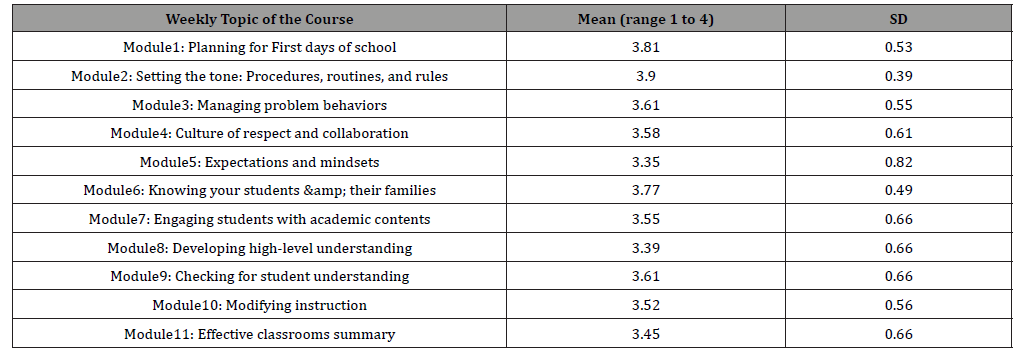
Table 2: Topics for the Future Course.
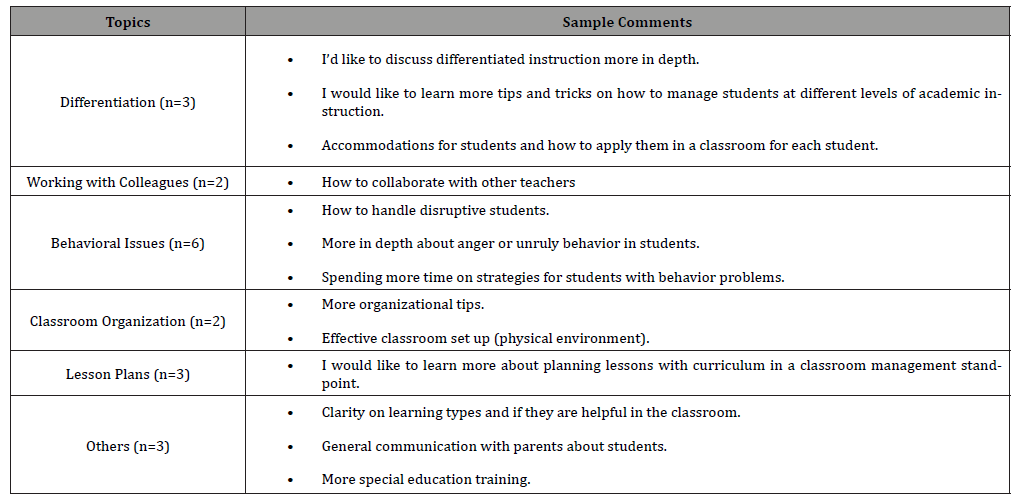
Table 3: Sample Positive Comments on the Course.
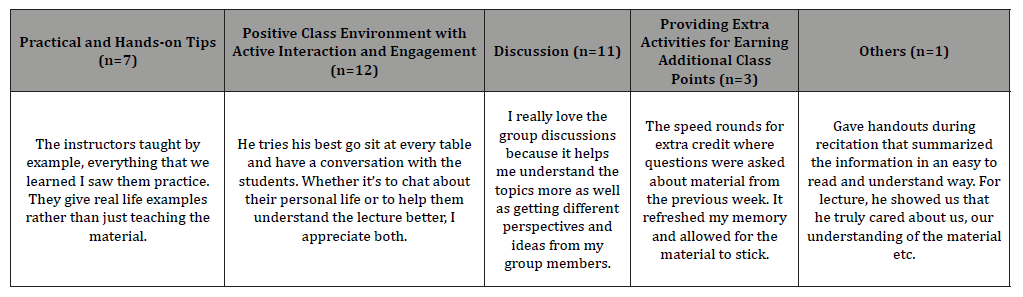
Note: 34 comments were created by 28 PTs.
The instructors taught by example, everything that we learned I saw them practice. They give real life examples rather than just teaching the material. He tries his best to sit at every table and have a conversation with the students. Whether it’s to chat about their personal life or to help them understand the lecture better, I appreciate both. I really love group discussions because it helps me understand the topics more as well as getting different perspectives and ideas from my group members. The speed rounds for extra credit where questions were asked about material from the previous week. It refreshed my memory and allowed for the material to stick. Gave handouts during recitation that summarized the information in an easy to read and understand way. For lecture, he showed us that he truly cared about us, our understanding of the material etc.
When asked to provide answers for the instructors’ most and least helpful learning strategies and their suggestions, students (28 students created 34 comments) indicated that they appreciated the positive class environment with active interaction and engagement (n=12), discussion (n=11), practical and hands-on tips (n=7), providing extra activities for earning additional class points (n=3), and summarizing the concepts again in the recitation session after the lecture (n=1). Table 3 describes the sample comments. Students (n=17) also reported experiences that they perceived to be least helpful during the course; these were discussion time (n=9), readings and content coverage (n=5), and others (n=3). It is important to note that it is controversial, as students also noted that the discussion time was too long. Students also stated that the readings were not always covered in the lecture because of the “excessive amount of time spent on the discussion” (See Table 4). To improve the quality of the course, students shared several different suggestions (23 comments were created from 22 students). Among 23 comments, 11 were related to reducing the discussion time and including more questions to explore during class discussions. In terms of the course structure (lecture and recitation), seven responses included suggestions to combine lecture and recitation to minimize redundancy in course content. The remaining comments included requests for addressing all course readings, providing more concrete examples during lectures, and increasing the number of hands-on in-class activities.
Table 4: Sample Negative Comments on the Course.

Note: 23 comments were created from 22 PTs.
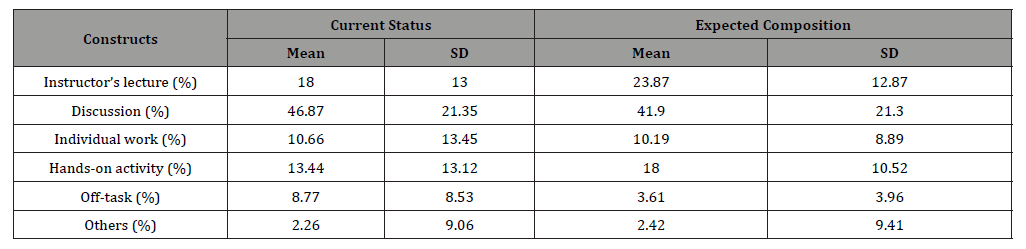
In terms of the class discussion, students appreciated discussions because they could learn different perspectives and insights from other group members, however, students also indicated that not everyone necessarily engaged and the length of the discussion time was too long, which yielded talking off-topic. Based on their two-formative assessment feedback, the GTAs and the instructor tried to walk around more often and actively facilitate discussions (see Table 5 for the details of students’ perceived quality of course contents and class discussion). Since discussion occupies a lot in our lecture session, we were curious how PTs perceive the time allocation for each activity (i.e., lecture, discussion, individual work, hands-on activity, off-task, and others). PTs were asked to write percentages of each portion, making the total 100%. They also answered the same question one more time for the “ideal” composition of each activity after filling out the current status. Table 6 shows the differences between current and ideal perspectives. Although the current instruction time was perceived to be 18.0% of the total lecture, students thought that it needed to be at least 23.87%. Similarly, hands-on activities currently account for 13.44% perceived by PTs; however, PTs would like to have more than 18.0%. The discussion was perceived to occupy 46.87% of the current lecture, and they think it would be great if it were reduced to 41.90%. PTs thought that an average of 8.77% of the portion was used as off-tasks, however, they acknowledged that it needs to be shortened to 3.61% (Tables 5,6).
Table 5: PTs’ Formative Assessment Results.
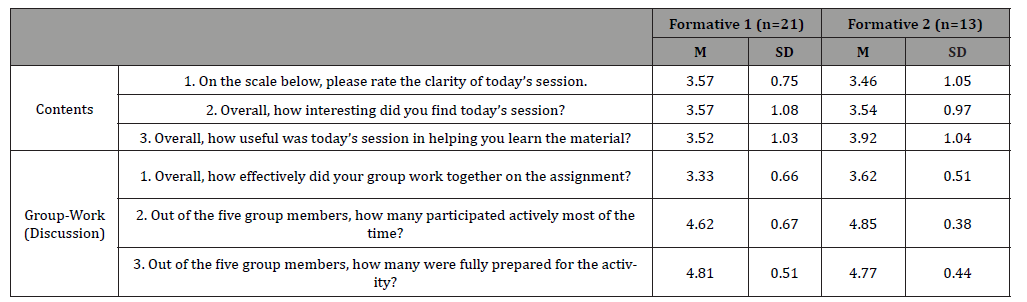
Table 6: Current and Ideal Course Structure.
GTA’s Perceptions
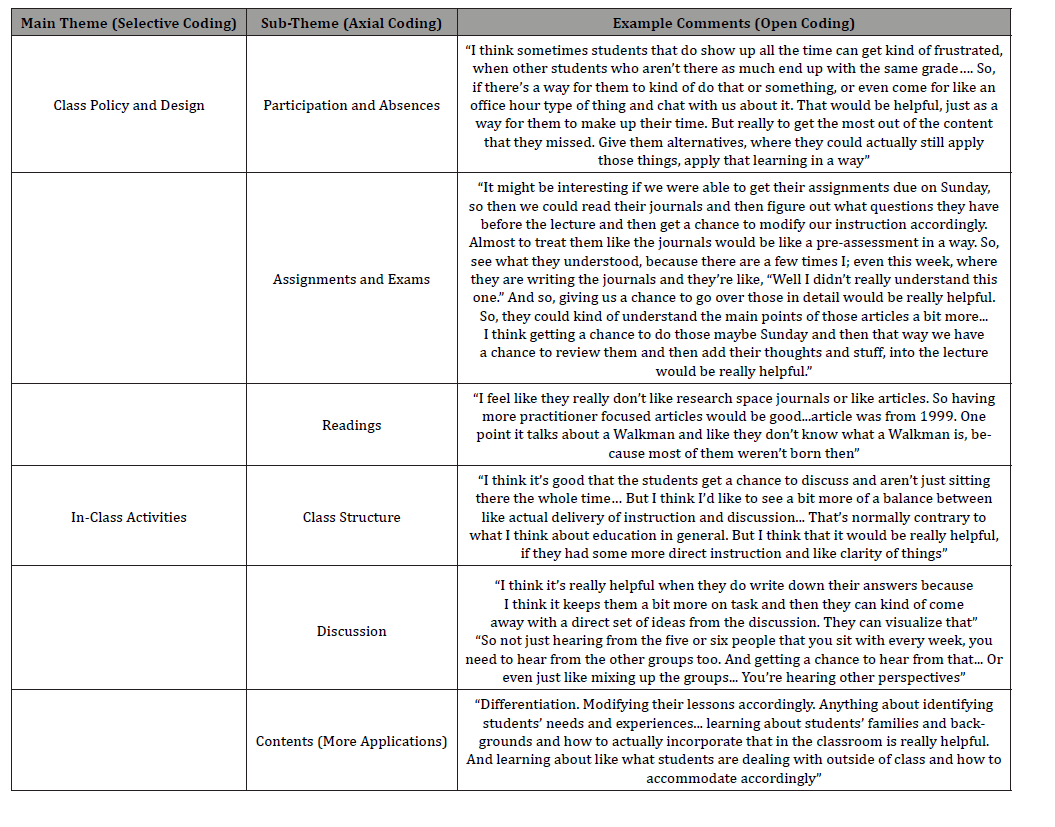
The interview data were analyzed with two main themes (selective coding) – (a) class policy and design, and (b) in-class activities. Under the first theme, we created three sub-themes (i.e., participation and absences, assignments and exams, and readings) that represent the interview data (axial coding). Similarly, the second main theme includes three sub-themes (i.e., class structure, discussion, and contents) that capture the interviewee’s idea (see Table 7 for the themes and example comments).
Table 7: Themes and Comments of Interview Data.
Class Policy and Design
Participation and Absences (20% of the total grading): In our course, we provide full participation scores when PTs miss classes less than three times, whether excused or unexcused. Most of the PTs do not miss more than the cut-off lines; however, we noticed that there have been more absences this semester. Therefore, the author asked her fellow GTA what she thinks about it. The fellow GTA said that the PTs who attended each class would feel frustrated if they received the same grade. But, since some uncertain events may happen to PTs, it would be helpful if we provided extra office hours so the students could make up for their absences. She stated that, by providing this alternative option to cover for the contents they missed, PTs would still have a chance to learn, even though the instructor or GTA may need to work extra hours.
Assignments and Exams (40% respectively for each): The instructor planned to have weekly journal articles based on the course readings and prepared one final exam for this semester. When the author asked the fellow GTA about the weekly assignments, she indicated that, although it takes a lot of time for GTAs to read and grade (it was a biweekly journal article last semester), it is helpful for PTs to understand and prepare for the contents before they come to school. She also pointed out that it would be great if the assignment deadline were at least two or three days before the lecture - not right before the lecture starts as we did. By doing so,
“We could read their journals and then figure out what questions they have before the lecture, then get a chance to modify our instructions accordingly. Almost treating the journals like a preassessment in a way”.
Her suggestion would function as a flipping class format, through which students learn the concepts by themselves first, and the instructor can prepare and modify the contents after reviewing students’ reflections in the journals. With regards to the exams, she is satisfied with the current format (we used to have pop quizzes and mid-term exams when we worked as GTAs with another instructor), as she indicated that she prefers no high-stakes exams. However, she mentioned that she would like to switch the group final exam (groups of 1-3 students can collaborate) to an individual format since they already had so many opportunities to have group discussions.
Readings: An average of three articles (two to four, depending on the contents) is on the list of weekly readings that cover the topics. Although many practitioner-based articles were assigned, there are few research-based articles as well. After reviewing and grading PTs’ journal reflections, the GTA thought that PTs seemed to enjoy a more practitioner-focused paper because it is easy to understand. She added that if she designed this course, she would like to have many more of such articles, and also wanted to update some outdated articles (e.g., she provided the example of an article that mentions the “Walkman”, which our current students might not know about). In addition, she pointed out that it is important to teach or introduce some basic knowledge on how to read statistics in the provided research-based article because some students do not know how to interpret the results.
In-Class Activities
Class Structure: This course is designed with lecture sessions and recitation sessions where PTs can learn about theories and applications, respectively. The fellow GTA indicated that she is satisfied with this class format because the students have a better chance to understand the contents within small-group classes fully. In terms of the lecture itself, she liked the discussions because they allowed PTs to talk with each other; however, she perceived that there needs to be a balance between instructions and discussions. Since even the lecture section this year is composed of many discussion times, she shared her opinion as
“I think a slightly more direct instruction would be more helpful. That’s normally contrary to what I think about education in general. But I think that it would be really helpful if they had some more direct instructions and, like, clarity of things”.
She thought that through the instructional time, PTs could learn the core concepts of the topic and have a chance to review the contents they might have missed.
Discussion: Since the lecture time includes many discussions, she shared her thoughts about how to improve the quality of discussion among students. She perceived that the current discussion time is a little lengthy and that it would be helpful to do the following: (a) “I think it [writing down their answers and thoughts] keeps them a bit more on task, then they can kind of come away with a direct set of ideas from the discussion and then visualize,” (b) “not just hearing from the five or six people that you sit with every week, you need to hear from the other groups too. And getting a chance to hear from that,” or “I think it would be better if we switched groups more often,” and (c) “... If you have a large enough group, they’re going to be people who are less likely to share, so they’re not going to get a chance to engage in that, or they may choose not to engage in it”, thus indicating it would be helpful to reduce the group size. By asking PTs to write their thoughts on the group board, frequently switching the group members, and making each group with a small number of students, she thought the PTs could more constructively hear others’ perspectives and get a chance to verbalize their thoughts and ideas.
Contents: Generally, she perceived that the current course covers sufficient topics that can be addressed by PTs focusing on the “how of teaching, not just what”. When she was asked what contents, she would like to add or modify if she were the main instructor, however, she indicated that she would spend more time on differentiating and teaching students how to adjust their lesson plans based on students’ needs and experience. Furthermore, she wanted to add some out-of-school factors, such as collaborating and understanding families, “learning about students’ families and backgrounds, and how to incorporate that in the classroom is helpful. Also, learning about what students are dealing with outside of class and how to accommodate them accordingly”. Overall, no matter which topics she teaches, she implies that more applications and scenarios are needed so that we can communicate and discuss openly before they go into the field.
Discussion
This action research was designed to understand PTs’ and the GTA’s perception of the course design, policy, and activities in the college-level class. Since the GTA may become the main instructor in the future, it is important to ask and understand students’ and the GTA’s opinions as to what would be the most and least helpful to plan and create a quality class. In this sense, this action research is meaningful because it provides evidence-based findings and efforts to improve the course quality in higher education [1,2]. Although this action research was not mainly aimed at helping current PTs who were currently in the course when the action research was conducted but more likely to help future students in similar classes based on their feedback, the PTs’ input is still significant as it critically serves to create and plan more constructive course designed for future PTs [15] (Figure 1).
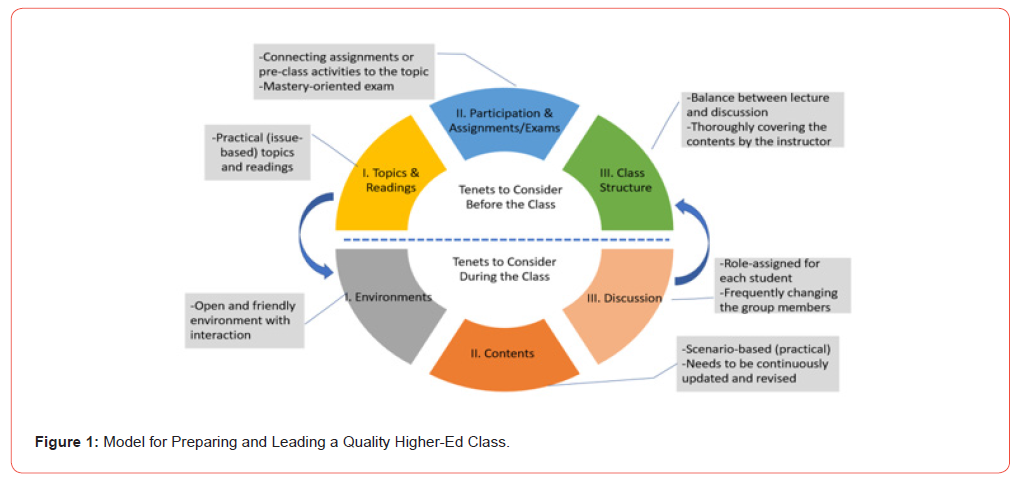
Based on the results of the data from students and the GTA, we found that both PTs and the GTA similarly perceived a quality class to be highly connected to the readings, contain more practicalbased contents, appreciate the interaction, and value equality of both lectures and discussions. The findings from both participants suggested we create an iterative model that the instructor may want to consider when designing and leading the class. The final description and interpretation of the data and the model after combining both PTs’ and GTA’s ideas were shared with the GTA as a dynamic co-construction [43. The model (see Figure 1) includes two parts: tenets to highly consider and refer to before the class starts and the ones the instructor continuously needs to take into account during the semester. The model graphically summarizes the key points of the results of this action research based on the MM-GT approach [25-30].
Future Strategies for the Future Courses
Course Structure – Balance between Quality Lecture (e.g., Teaching) and Interaction (e.g., Discussion)
The findings from the PTs’ survey and GTA’s interview revealed that it is important to maintain a balance between the class constructs of the activities (e.g., lecture, discussion, hands-on activities). It was meaningful that not only the instructor or GTA but also the PTs wanted to be involved in the class where the contents of the topic are fully addressed and explained thoroughly through readings and lectures before they are actively involved in the discussion or handson activities. This aligns with the class structure composition in that students wanted to see more “instruction” from the instructor and reduce “discussion” time. However, it is important to note that this result may come from the unique condition of the current course structure in which we have plenty of discussion time, even in the lecture session. When planning future courses, the author would design the class structure to be balanced between quality lectures thoroughly covering the weekly contents and preparing interaction time, such as discussion sessions where students can actively share their experiences and ideas.
Actively Connecting Reading Assignments to the Lecture
Based on PTs’ survey data and the interview results of the GTA, they would like to see the weekly reading contents more actively incorporated into the lecture. It is not only our class, but many college courses include weekly readings such as journal articles or chapters from a textbook that addresses the assigned topic. Although those are encouraged to be reviewed before the class, we cannot gauge how many students sufficiently spent time studying the topic in advance unless quizzes are included. The current strategy of asking students to write weekly reading reflections seems to be one of the effective ways to encourage students to study the class materials before the class begins. The author would like to continue this method, as their level of preparation of the topic affects the general class discussion quality; however, we will be modifying the deadline as my colleague GTA suggested. Rather than assigning the deadline right before the class starts, we will set up the due date at least two days before the class so that we can review students’ understandings as a formative assessment before we prepare the course materials. In addition, as several students pointed out, the contents of the readings must be addressed enough in the lecture session. This can be connected to the reflection assignments, in which we want to ask students to include the parts that they did not fully understand from the readings and any content they want to be addressed in more detail in the lecture or questions that they may have. In this way, the contents of the readings can be sufficiently addressed and discussed together with students as a needs-based course structure.
Hands-on and Scenario-based Contents
Both PTs and the GTA pointed out that they would like to see more of the hands-on activities in the class. For instance, PTs perceived that the current class is composed of 13% of the handson activities but considered they would be more benefitted if it is increased to 18%. In terms of the future topics, they want this course to incorporate, the students also drew attention to the behavioral issues of students they may encounter in the classroom. The GTA similarly brought up the idea that she would include more scenario-based content and applications, including modifying lesson plans and figuring out students’ individual needs based on their family backgrounds. The ideas were consistent with their valuing practical-based content and experience that they can directly apply to the educational environment rather than talking thoroughly about the theories and the assigned topics. Therefore, when planning future courses, the author would share more reallife examples and problem-based scenarios, even when introducing and talking about educational theories and deeper content.
Reflection of Conducting Action Research and the Limitations
As the previous research indicated, the findings from this action research would help the author design and modify course syllabi and activities that will positively affect students’ learning [1]. PTs’ feedback and fellow GTA’ ideas and suggestions provided insights as to how to plan curriculum design, teaching, and assessment of the future course that the author will be teaching [6-9]. This study is even more significant because those students’ feedback suggested by current PTs in the class that the stakeholders were involved actively in the action research [15,16], which will create positive effects for the future pre-service teachers.
Overall, it is noteworthy that the GTA has a limited role in sharing and implementing changes to the current course run by the main instructor [18,22]. Although the author sufficiently informed and discussed with the main instructor about the purpose and the expected outcome of conducting action research in the current class, the actions were still limited by not actively implementing strategies in the current class but rather focused on planning for future students. In addition, as the author already had objectives and perceived opinions about the action research project, the results of the data analyses and its procedures might have been affected by the authors simply confirming our beliefs [44]. The interview process and the interviewees’ responses may also have been shaped by the author in the same vein since the author had already built rapport [45] with the other GTA and frequently talked about the current classes.
However, current action research conducted by a GTA, aiming to figure out the perception of quality courses in the college designed for pre-service teachers, is still important to be addressed to design quality classes in higher education. The quantitative and qualitative outcomes of this action research project are also meaningful as the findings did not end with simple analysis and interpretation but aimed to convey them to be helpful to the readers [44]. In this respect, ongoing action research is critical in developing and evolving a high-quality course that fits the student’s needs. As a next step, the future study may focus on students’ in-class “discussion,” as to how we (instructor and students) can develop the strategies together to promote the active participation of every group member. Furthermore, action research to develop meaningful course assignments and exams by working with PTs and evaluating their field experiences as a pre-service teacher might be the areas of the next steps [46,47].
Acknowledgment
None.
Conflict of Interest
No conflict of interest.
References
- Raubenheimer CD, Myka JL (2005) Using action research to improve teaching and student learning in college. Journal of College Science Teaching 34(6): 12-16.
- Krockover G, Adams P, Eichinger D, Nakhleh M, Shepardson D (2001) Action-based research teams: Collaborating to improve science instruction. Journal of College Science Teaching 30(5): 313-317.
- Van Zee EH (1998) Preparing teachers as researchers in courses on methods of teaching science. Journal of Research in Science Teaching: The Official Journal of the National Association for Research in Science Teaching 35(7): 791-809.
- Gibbs P, Cartney P, Wilkinson K, Parkinson J, Cunningham S, et al. (2017) Literature review on the use of action research in higher education. Educational Action Research 25(1): 3-22.
- Gibbs P, Angelides P, Michaelides P (2004) Preliminary thoughts on a praxis of higher education teaching. Teaching in Higher Education 9(2): 183-194.
- Walton J (2011) A living theory approach to teaching in higher education. Educational Action Research 19(4): 567-578.
- Abraham A (2014) Making sense of power relations in a Malaysian English-as-a-second-language academic writing classroom. Educational Action Research 22(4): 472-487.
- Bisman J (2011) Engaged pedagogy: A study of the use of reflective journals in accounting education. Assessment & Evaluation in Higher Education 36(3): 315-330.
- Simms M (2013) A teacher-educator uses action research to develop culturally conscious curriculum planners. Democracy and education 21(2): 1-10.
- Millican J (2014) Higher education and student engagement: Implications for a new economic era. Education+ Training 56(7): 635-649.
- Kurzel F (2011) Characteristics of an equitable instructional methodology for courses in interactive media. Interdisciplinary Journal of E-Learning and Learning Objects 7(1): 143-156.
- Coates N, Dickinson J (2012) Meeting international postgraduate student needs: A programme-based model for learning and teaching support. Innovations in Education and Teaching International 49(3): 295-308.
- Gordon SM, Edwards JL (2012) Enhancing student research through a virtual participatory action research project: Student benefits and administrative challenges. Action Research 10(2): 205-220.
- Kur E, DePorres D, Westrup N (2008) Teaching and learning action research: Transforming students, faculty and university in Mexico. Action Research 6(3): 327-349.
- Moore T, Gayle B (2010) Student learning through co-curricular dedication: Viterbo University boosts faculty/student research and community services. Transformative Dialogues: Teaching & Learning Journal 4(1): 1-7.
- Crean M, Prunty C (2011) Formative Assessment Structures to Enhance Student Learning Despite Resource Limitations, presented at 5th International Technology, Education and Development Conference. EasyBib Publishing.
- DAndrea VM (1996). Starting a teaching assistants’ training programme: Lessons learned in the USA. Journal of Geography in Higher Education 20(1): 89-99.
- Muzaka V (2009) The niche of graduate teaching assistants (GTAs): Perceptions and reflections. Teaching in Higher Education 14(1): 1-12.
- Shannon DM, Twale DJ, Moore MS (1998) TA teaching effectiveness: The impact of training and teaching experience. The Journal of Higher Education 69(4): 440-466.
- Luckie DB, Mancini BW, Abdallah N, Kadouh AK, Ungkuldee AC, et al. (2020) Undergraduate teaching assistants can provide support for reformed practices to raise student learning. Advances in Physiology Education 44(1): 32-38.
- ONeal C, Wright M, Cook C, Perorazio T, Purkiss J (2007) The impact of teaching assistants on student retention in the sciences: Lessons for TA training. Journal of College Science Teaching 36(5): 24-29.
- Park C (2004) The graduate teaching assistant (GTA): Lessons from North American experience. Teaching in Higher Education 9(3): 349-361.
- Morse JM (2003) Principles of mixed methods and multimethod research design. A Tashakkori, C Teddlie (Eds.), Handbook of mixed methods in social and behavioral research. Sage pp. 189-208.
- Westhues A, Ochocka J, Jacobson N, Simich L, Maiter S, et al. (2008) Developing theory from complexity: Reflections on a collaborative mixed method participatory action research study. Qualitative Health Research 18(5): 701-717.
- Babchuk WA (2015) Pragmatist grounded theory: Advancing mixed methods for educational inquiry [Paper presentation]. 34th Annual Research-to-Practice in Adult and Higher Education, Oklahoma City, Oklahoma.
- Charmaz K (2014) Constructing grounded theory: A practical guide through qualitative analysis (2nd ed.). Sage.
- Glaser BG (2008) Doing quantitative grounded theory. Sociology Press.
- Guetterman TC, Babchuk WA, Howell Smith MC, Stevens J (2019) Contemporary approaches to mixed methods–grounded theory research: A field-based analysis. Journal of Mixed Methods Research 13(2): 179-195.
- Johnson R, McGowan M, Turner L (2010) Grounded theory in practice: Is it inherently a mixed method? Research in the Schools 17(2): 65-78.
- Walsh I (2015) Using quantitative data in mixed design grounded theory studies: An enhanced path to formal grounded theory in information systems. European Journal of Information Systems 24(5): 531-557.
- Bitsch V (2005) Qualitative research: A grounded theory example and evaluation criteria. Journal of agribusiness 23(1): 75-91.
- Glaser BG, Strauss AL (1967) The discovery of grounded theory: Strategies for qualitative research. Aldine.
- Hutchison AJ, Johnston LH, Breckon JD (2010) Using QSR‐NVivo to facilitate the development of a grounded theory project: an account of a worked example. International journal of social research methodology 13(4): 283-302.
- Charmaz K (2006) Constructing Grounded Theory. Sage
- Onwuegbuzie AJ, Johnson RB (2006) The validity issue in mixed research. Research in the Schools 13(1): 48-63.
- Angelo TA, Cross KP (2012) Classroom assessment techniques. Jossey Bass Wiley.
- Hagens V, Dobrow MJ, Chafe R (2009) Interviewee transcript review: Assessing the impact on qualitative research. BMC medical research methodology 9(1): 47.
- Cresswell JW, Miller DL (2000) Determining validity in qualitative inquiry. Theory Into Practice 39(3): 124–130.
- Lincoln YS, Guba EG (1985) Naturalistic Inquiry. Sage
- Doyle S (2007) Member checking with older women: A framework for negotiating meaning. Health care for women international 28(10): 888-908.
- Richards K (2003) Qualitative Inquiry in TESOL. Springer.
- Fereday J, Muir-Cochrane E (2006) Demonstrating rigor using thematic analysis: A hybrid approach of inductive and deductive coding and theme development. International journal of qualitative methods 5(1): 80-92.
- Harvey L (2015) Beyond member-checking: A dialogic approach to the research interview, International Journal of Research & Method in Education 38(1): 23-38.
- Jacelon CS, ODell KK (2005) Analyzing qualitative data. Urologic Nursing 25(3): 217-220.
- Ryan F, Coughlan M, Cronin P (2009) Interviewing in qualitative research: The one-to-one interview. International Journal of Therapy and Rehabilitation 16(6): 309-314.
- Braun V, Clarke V (2006) Using thematic analysis in psychology. Qualitative Research in Psychology 3(2): 77-101.
- National Research Council (1996) National Science Education Standards. National Academy Press, Washington, DC, USA.
-

This work is licensed under a Creative Commons Attribution-NonCommercial 4.0 International License.