


 Research Article
The Impact of Employing AI Programs in Developing Reading Skill among First-Cycle Students
Received Date:October 13, 2025; Published Date:October 22, 2025
Abstract
This study examines the impact of employing AI-based reading technologies on developing reading skills among First-Cycle Students in Al Ain City, United Arab Emirates. The study utilizes a descriptive-experimental approach and relied on reading records as the primary measurement tool. The research was conducted on a random sample of 20 students (grade two), divided into two groups: a control group (10 students) that did not receive the program, and an experimental group (10 students) that was exposed to AI-based reading programs. The results highlight the importance and necessity of implementing AI-based reading technologies such as “Read Along” and “Microsoft Read Coach,” to develop reading skills among young readers.
Introduction
In the field of education, AI applications have contributed to improving learning methods, especially with regard to developing reading skills. The use of AI can enhance student motivation and help determine each student’s level, enabling the provision of personalized lessons tailored to their individual needs. This technology is capable of improving students’ reading skills by adopting advanced methods aimed at raising comprehension levels and increasing academic achievement [1]. AI has become an effective element in improving students’ reading skills, enhancing their success in the educational process.
Reading is one of the key factors for a student’s success in school. It is not just an educational skill, but rather an important tool that helps students better integrate into the educational system. Reading has been described as a cognitive, sensory, and perceptual process that requires concentration, attention, and understanding of words. To achieve academic success, students need to continuously develop their reading skills. Numerous studies have highlighted the importance of learning to read for mastering the Arabic language, which is one of the most important cultural and civilizational languages, in addition to being one of the most widely spoken languages globally [2].
In this context, developing reading skills is key to improving students’ Arabic proficiency. The more these skills develop, the better their ability to understand and comprehend the language, enhancing their educational success. Because reading relies heavily on mental and sensory perception, individuals need to pay attention and focus on words and texts, trying to compare them to their previous knowledge. This makes the reading process essential for achieving deep understanding and mastery of the Arabic language. With the emergence of artificial intelligence technologies, many programs and applications have also emerged that aim to improve reading skills. Among these programs are “Read Long” and “Microsoft Red Coat,” which rely on artificial intelligence technologies. In this program, children learn to read with the help of a virtual companion named “Dia,” who reads texts to them and listens to their reading, encouraging them to continue and motivating them to improve. The application has proven remarkably successful, with statistics showing that children who read fewer than 45 correct words per minute achieved improvements ranging from 35% to 85% in their reading ability within a short period [3]. This reflects the power of artificial intelligence in supporting the development of reading skills in an effective and innovative way.
The United Arab Emirates has not been far behind in this trend, having made significant efforts to improve the level of Arabic language education, particularly with regard to developing reading skills. The UAE has worked to qualify teachers by offering specialized courses, in addition to developing Arabic language curricula that focus on basic reading skills such as distinguishing sounds, segmenting words, and correct pronunciation. It has also developed electronic tools to help students improve their pronunciation and read correctly, reflecting the country’s commitment to keeping pace with global developments in the fields of education and artificial intelligence. The UAE has adopted clear movements toward integrating artificial intelligence technologies into education with the aim of continuously improving the educational process. These technologies offer new and innovative approaches to teaching reading and improving students’ language skills. For example, using AI, learning programs can be tailored to each student’s level, automatically analysing their performance and providing individualized exercises tailored to their needs. These technologies also contribute to interactive language teaching by enhancing the distinction between different sounds and improving pronunciation and writing.
Despite these efforts, there is scarcely evident on the impact of such AI based technologies to develop reading skills among young learners. This highlights the need for more educational interventions and intensive training programs for teachers to effectively use AI technologies. Developing AI-based curricula can help improve students’ reading skills. The use of these technologies is an important step toward improving the educational process, but comprehensive strategies are needed to ensure that all students benefit equally from these tools [4].
Study Questions
1. What is the impact of employing artificial intelligence
reading programs (Read Long and Microsoft Read Coach) in
developing grade two students’ reading skills?
2. Is there any statistically significant difference at a
significance level of 0.01 between the control group and the
experimental group in developing skills in reading words?
Literature Review
The use of artificial intelligence (AI) programs in reading instruction represents a major shift in modern education methods. These programs contribute to providing innovative solutions that enhance reading skills by customizing individualized learning plans based on performance analysis, helping students improve their reading abilities faster and more effectively. These tools also provide an interactive learning experience that increases student motivation, enhances reading comprehension, and increases reading speed. Additionally, these tools provide immediate feedback and precise guidance to improve weak areas. These programs also enhance students’ interest in reading through interactive and engaging content, contributing to the continuous and effective development of their skills.
Artificial intelligence (AI) programs in Reading Instruction
The use of artificial intelligence (AI) programs in reading instruction represents a major shift in modern education methods. These programs contribute to providing innovative solutions that enhance reading skills by customizing individualized learning plans based on performance analysis, helping students improve their reading abilities faster and more effectively. These tools also provide an interactive learning experience that increases student motivation, enhances reading comprehension, and increases reading speed. Additionally, these tools provide immediate feedback and precise guidance to improve weak areas. These programs also enhance students’ interest in reading through interactive and engaging content, contributing to the continuous and effective development of their skills. The applications used in the field of learning how to read in Arabic using AI are evident in the following points:
Speech recognition technology:
This technology uses a deeper understanding of the structure of sound to understand natural language. It relies on speech processing through acoustic analysis using syllables and small phonetic units, processing a large body of data spoken by individuals, especially speakers of different accents and languages. This method helps learn to read in a simple and easy way [5].
Text recognition and reading aloud with expressions:
This technology relies on processing smaller units in language writing and reading systems, known as “graphemes,” which represent the smallest unit in phonetic systems. The computer processes these units in their various forms and converts them into readable and spoken texts [5].
Sentence reading technology,”ReadLong” and “Microsoft ReadCoach” programs:
Microsoft Read Coach and “ReadLong” are educational tools that help children learn to read by displaying an image that represents a written sentence, which the student is asked to read. This program aims to develop students’ reading skills, increase their ability to comprehend what is read, increase reading speed, and stimulate the learning process. The program counts spoken sentences and assesses whether pronunciation is correct or incorrect, allowing the teacher to correct errors and reward students. The program includes a variety of educational stories, such as “Race Stories,” “I Learn,” “Fun,” “Where’s My Toy,” “Natural Colors,” and “Neighborhood Hugs.” This approach is considered more effective compared to traditional learning methods, which may lack visual support and a dedicated teacher.
Developing Reading Skills
Reading is defined as a mental process that includes
interpreting the symbols the reader receives through their eyes. It
requires understanding meanings and connecting them to personal
experiences [6]. Reading skills include several important aspects
that help develop students’ abilities, including:
• Word discrimination relies on distinguishing between
word images while reading and distinguishing between
similar letters and their shapes, which helps students build a
vocabulary that enables them to recognize words upon sight.
• Eye movement significantly affects the correct reading of
each letter of a word. The more words a student can read at
each pause, the fewer pauses they will need, enhancing their
comprehension.
• Reading independent units of thought by reading a group
of words that form a single idea, reading speed and content
comprehension can be enhanced.
• Reading speed is one of the essential skills in light of the
technological revolution, and is measured by the time it takes a
child to read a specific text [2].
In addition to above, reading skills also consist of phonological awareness, which focuses on detecting and processing sounds, and reading fluency, both vocal and silent, which helps master reading skills. It also includes decoding ability-relates to applying alphabetical principles to the language- that helps identify unfamiliar words. Therefore, reading skills are multiple and varied, and mastery of them is essential for good and rapid reading. These skills are assessed by measuring students’ fluency, control, and reading accuracy, which helps improve overall reading performance.
Developing Reading Skills through Artificial Intelligence Applications
A study conducted by Daweli and Mahyoub [7] at Taibah University in Saudi Arabia explored the opinions of 150 students regarding the impact of AI tools on improving the reading skills of English as a foreign language learner. The results showed that the Microsoft Reading Coach application significantly improved reading fluency and increased students’ self-confidence, and that the immediate feedback helped correct errors quickly and improve language skills. The study recommended the wider integration of these tools into reading instruction and the training of teachers on their effective use, suggesting future research to explore the impact of AI on other language skills such as writing and listening.
Hsiao et al.’s [8] study, titled “The Impact of Mobile AI Applications on Reading Comprehension: Personalized Learning and Student Engagement,” focused on the impact of mobile AI applications on improving students’ reading comprehension. The study aimed to explore how these applications can be personalized to support individual students’ learning and enhance their motivation and engagement in learning activities. The study included 200 students from various grade levels. Using a descriptive approach, the results showed that these applications improved reading comprehension skills by tailoring lessons to students’ needs, helping them better comprehend texts. They also increased motivation and interaction among students who used these applications, in addition to providing immediate feedback to help them correct mistakes and improve comprehension. The study recommended the greater integration of artificial intelligence applications into education and training teachers on their effective use. It also recommended conducting future studies to measure the impact of these technologies in other areas, such as writing and speaking.
Goren [9] aimed to assess students’ skills using a Bayesian active learning algorithm that continuously assesses a child’s wordreading skills. The study used an experimental model in which the child plays a board game to create a new story with a robot. The robot is imagined as a younger peer who wants to learn to read. The study reached a number of findings, most notably that the algorithm accurately represents children’s word-reading skills across a wide age range, ranging from 4 to 8 years old. Furthermore, using assessment-based tutoring for the child leads to learning independent of age and initial reading skills, compared to random tutoring. Applying the same learning algorithm to the robot’s reading skills demonstrated the acquisition of knowledge similar to what the child believed the robot had learned. Similarly, Al-Talouhi, [10] study aimed to investigate the impact of artificial intelligence platforms on the e-learning environment in teaching Arabic, including reading skills. The study used a quasi-experimental and descriptive-analytical approach. The research sample consisted of (30) fifth-grade primary school students at the Arab International Academy in Qatar. The sample was divided into two groups: one, an experimental group that used artificial intelligence technology in the e-learning environment and consisted of 15 students, and the other, a control group that used the traditional method and consisted of 15 students. An achievement test was developed to measure academic achievement in the Arabic language subject. The study concluded that the use of artificial intelligence platform technology in the e-learning environment has a positive impact on teaching Arabic language and reading skills.
A study by L. Vall & R. Araya [11] titled “Interactive Learning through AI: Enhancing Reading Skills and Cultural Exposure” explored the impact of interactive AI tools on improving students’ reading skills and accelerating learning. The study aimed to personalize learning experiences according to students’ needs and enhance reading comprehension, while enabling them to learn about diverse cultures. The study included 180 students from different schools and universities. The results showed improved reading skills and increased student engagement with texts. The tools also helped improve cultural understanding and increased motivation to learn. The study recommended expanding the use of AI in education, training teachers to integrate these tools into curricula, and encouraging future studies in other educational fields.
Muhammad [12] aimed to determine the use of ChatGPT in improving reading skills in the era of education. The study used quantitative methods and data obtained through interviews and questionnaires. The study reached a set of conclusions, the most important of which is that the use of ChatGPT in education can benefit students and develop reading skills. The research demonstrated its effectiveness and efficiency in education, with 80% of students achieving top scores on reading tests. Many uses for AI applications were also found that could be used as alternatives to improve students’ reading skills.
Research Design
The researcher relied on the use of the descriptive experimental approach to identify the effect of employing artificial intelligence programs to develop reading skills among first-cycle students in Al Ain City. This is because the methodology is appropriate to the nature and objectives of the study, “revealing the facts related to its variables in an objective manner, understanding phenomena, and accurately describing, analysing, and describing them, which enables us to understand how they occur and their impact” [13].
The descriptive-experimental method focuses on describing, analysing, and interpreting the research phenomenon. This method is used to identify it by collecting data about the research phenomenon, then attempting to understand and analyse this data in order to understand the research phenomenon [13]. The research also used the experimental method, which focuses on studying the effect of one or more independent variables on one or more dependent variables, with the goal of determining the role of this effect in improving the dependent variable [12].
The study population consists of all second-grade students
at the school, ranging in age from 7 to 8 years. The study sample
consisted of 20 male and female second-grade students, randomly
selected from each grade to represent the original population. All
students had different reading levels. Sample number percentage
(male students 10 and female students 10). The sample will be
divided into two groups:
• Experimental group: Includes (10) students receiving
instruction using artificial intelligence programs.
• Control group: Includes (10) students receiving
instruction using the traditional method.
• The current study examined the following independent
and dependent variables:
• Independent variable: The use of artificial intelligence
programs RedLong and Microsoft RedCoach in teaching reading
skills.
• Dependent variable: Students’ reading skills, which will be
measured through reading logs before and after implementing
artificial intelligence programs.
Reading logs from the second grade of the Ministry of Education were used as the study tool. The logs include a set of simple sentences of varying difficulty, divided into ten paragraphs. Each sentence is scored three times: one for accuracy, one for speed and fluency, and one for correct reading. The final total for the reading log is 30 points. A student receives a score for each sentence if they meet the three conditions (speed and fluency, accuracy, and correct reading), while no score is awarded if these conditions are not met. These logs were administered to students in the experimental group after using the Red Long program and Microsoft Red Coach. The results were then compared between the group exposed to the program and the group that did not, to measure the program’s impact on developing reading skills.
Analysis and Discussion
To answer the first research question, which states, “What is the effect of employing artificial intelligence reading programs (Read Long and Microsoft Read Coach) in developing students’ reading skills?”, the frequencies and averages of the sample members’ responses in the records were calculated. The frequencies and averages of the sample members’ responses to each sentence within the records can be explained as follows:
Table 1:Frequencies and Means of Responses to Each Sentence in Reading Records.
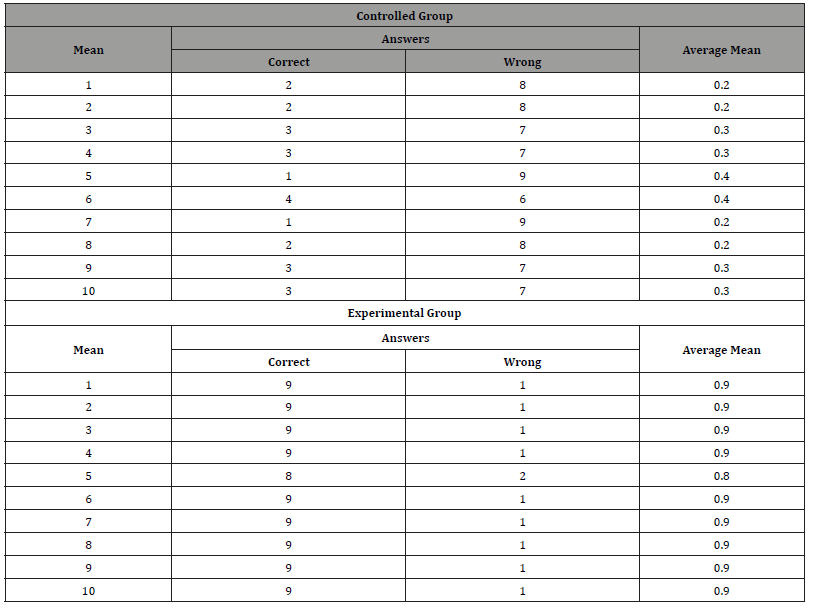
Table 1 shows that most sentence means for the control group were low, not exceeding 0.40 for all sentences. This indicates that most correct answers did not exceed 2 out of 10 students. It can be concluded that traditional methods of teaching reading were not effective in developing students’ reading skills. In contrast, the experimental group’s arithmetic mean for all sentences was close to 0.90, and the percentage of correct answers in almost all sentences was 90%, meaning that most students were able to read the sentences correctly. These results indicate that the artificial intelligence reading programs (Red Long and Microsoft Red Coach) were highly effective in improving reading skills and developing the reading skills of second-grade students.
To answer the second research question, “Is there any statistically significant difference at the significance level (α ≥ 0.01) between the control group and the experimental group in developing sentence reading skills?”, the differences between the records of the control and experimental groups were identified across all sentences. A t-test was used for related groups to determine whether there were statistically significant differences at the significance level of 0.01 between the control group and the experimental group in developing sentence reading skills.
Table 2:illustrates these results, as follows
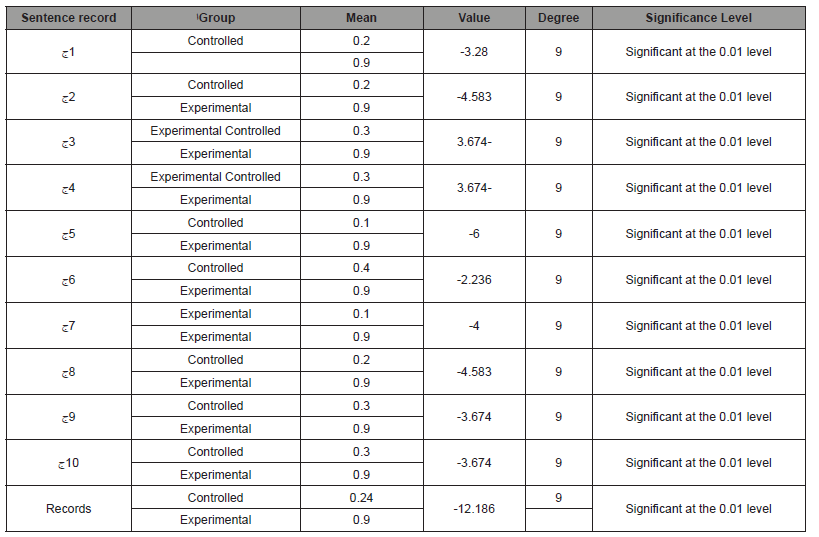
Table 2 shows that all sentences had statistically significant differences at the significance level (α ≥ 0.01) between the records of the control and experimental groups, meaning that there were statistically significant differences at the significance level (α ≥ 0.01) in favour of the experimental group. The experimental group’s averages of 0.09 were clearly higher than the control group’s averages, which ranged from 0.01 to 0.04, indicating a significant improvement in the experimental group’s performance compared to the control group in all sentences. This indicates the effectiveness of the Red Long and Microsoft Red Coach programs in developing reading skills among second-grade primary school students, compared to traditional methods and means. Based on these results, it can be said that the educational intervention using the Red Long and Microsoft Red Coach programs had a clear positive impact on improving sentence reading skills, which reinforces the idea of using innovative technologies to improve student learning outcomes.
Discussion
By reviewing the results of previous studies and the findings of the current study on the impact of artificial intelligence programs on developing reading skills, it is notable that the convergences and differences with previous studies were:
Convergence with previous studies on the effectiveness of modern methods versus traditional methods was evident: The results of the current study were consistent with the results of studies by Dalal, 2024, and Alaa, 2020, which indicated the effectiveness of innovative educational technology methods and tools in developing children’s reading skills compared to traditional methods. All of these studies showed statistically significant differences in favor of the experimental groups, reflecting the effectiveness of these methods in enhancing reading skills.
The current study also agreed with the results of studies by Amira, 2022, and Muhammad, 2023, which confirmed the effectiveness of using technology (artificial intelligence-based educational platforms) in improving students’ reading skills. The current study demonstrated that the technology-based “Read Long” and Microsoft Read Coach program contributed to improving students’ reading performance, supporting the use of technology as an effective educational tool in enhancing reading skills. In addition to studies that have examined the impact of AI applications on improving reading skills, their results agree on the effectiveness of these tools in improving fluency, reading comprehension, and increasing students’ confidence.
Daweli and Mahyoub [7] demonstrated that using Microsoft Reading Coach significantly enhanced reading fluency, while Hsiao et al. [8] emphasized the importance of personalizing learning through smart applications to increase student motivation and improve their reading comprehension through immediate feedback. Additionally, Vall and Araya [11] demonstrated how interactive AI tools helped improve reading skills and increase engagement with texts.
Additionally, the current study showed that statistical differences were at the 0.01 significance level, while some studies, such as Alaa [14], showed statistically significant differences at the 0.001 significance level, indicating a difference in the extent of the impact of the programs used. This difference may be due to the different nature of the programs, the educational methods used, and the differences in the study samples. Furthermore, a study of the use of artificial intelligence programs showed statistically significant differences in favour of the experimental groups, reflecting the effectiveness of these tools in improving language skills.
Some studies, such as Al-Talouhi [10], did not adequately analyse the interaction between the educational strategy and the educational content. The current study focused on a comprehensive analysis of reading performance, providing a deeper understanding of how the program affects various aspects of reading skills (such as comprehension and fluency). In general, the current study agrees with most previous studies in supporting the effectiveness of modern and technological methods in developing students’ reading skills compared to traditional methods. The results also support the idea that the use of programs such as Read Long and Microsoft Red Coach significantly improves students’ reading performance. However, some differences in the level of statistical differences and study design indicate the need to consider variables such as the nature of the educational content and the method of implementation when evaluating the effectiveness of educational programs.
The most important results obtained can be explained as
follows:
1. There were statistically significant differences at the
significance level (α ≥ 0.01) between the sample individuals’
averages in the records of the control and experimental groups,
in favor of the experimental records. The effectiveness of
methods for developing students’ reading skills was significantly
better with methods based on artificial intelligence techniques,
particularly the Red Longo program and Microsoft Red Coach.
2. There were statistically significant differences at the
significance level (α ≥ 0.01) between the records of the control
and experimental groups, in favor of the records associated
with the experimental group. Most of the conditions for correct
reading (fluency, control, and correct reading) were met in
the results of the records associated with the experimental
group. Most of the sample individuals met all three conditions
with an arithmetic mean exceeding 0.90, which reflects the
value and necessity of developing reading skills using artificial
intelligence reading techniques, particularly the Red Longo
program and Microsoft Red Coach [15-24].
Recommendation
The most important recommendations, based on the research
findings, can be addressed as follows:
1. Expand the development of artificial intelligence
programs that help develop the various skills required in the
educational process.
2. Adopt these programs in schools to help teachers develop
students’ reading skills.
3. Develop AI programs specifically for students who suffer
from reading difficulties due to the ineffectiveness of various
teaching methods.
4. Incorporate AI programs specialized in reading into
educational curricula to enhance students’ reading skills,
especially in the early stages of education, with a focus on
ensuring that these programs are designed to meet the diverse
needs of students.
Acknowledgment
None.
Conflict of Interest
No conflict of interest.
References
- Al-Shahrani, Fatima Muhammad, Al-Saeedi, Hanan (2024) The role of artificial intelligence applications in developing primary school students' attitudes towards learning English from the perspective of female teachers in Khamis Mushait. Journal of Arab Research in the Fields of Specific Education, No. 33.
- Ramadan, Hiam Nasr, Al-Din Abdo (2024) The Use of Artificial Intelligence in Teaching Arabic Language Skills: Insights and Expectations, Journal of Scientific Development for Studies and Research, 18.
- Al-Bayan website (2024) "Reg Along Program”.
- Hamda Ismail Muhammad, Ahmed Al-Tamimi, Rashid Muslim Al-Riyami (2022) Factors contributing to the decline in reading skills among first-cycle students from the perspective of first-cycle Arabic language teachers in the United Arab Emirates and a remedial program for it, Journal of Humanities, Social Sciences, Arts, and Literature 84,
- Al-Qadi, Hisham bin Saleh (2021) "Investing in Artificial Intelligence in Learning and Teaching Arabic as a Second Language: Prospects and Potentials," Al-Hikma Journal of Literary and Linguistic Studies, Issue 3.
- Ziyadi, Muhammad Ali Ahmad, Al-Ghamdi, Ali Abdullah Ali (2021) Artificial Intelligence and Teaching Arabic Language: Between Reality and Hope, Studies in Higher Education, Issue 1.
- Daweli M, Mahyoub R (2024) Exploring EFL Learners’ Perspectives on Using AI Tools and Their Impacts in Reading Instruction. Arab World English Journal, Special Issue on CALL (Computer-Assisted Language Learning) 10: 160-172.
- Hsiao YC, Wang L, Chen TH, Li S (2024) The Impact of Mobile AI Applications on Reading Comprehension: Personalized Learning and Student Engagement. Journal of Educational Technology & Society 27(2): 123-135.
- Goren Gordon, Cynthia Breazeal (2015) Bayesian active learning-based robot tutor for children's word-reading skills, Proceedings of the AAAI conference on artificial intelligence 29(1).
- Al-Talouhi, Raad Jamal Zahir (2023) The Impact of Artificial Intelligence Platforms on the E-Learning Environment in Teaching Arabic to Primary School Students. Journal of Curricula and Teaching Methods 2(8).
- Vall P, Araya S (2023) Interactive Learning through Artificial Intelligence: Enhancing Reading Comprehension and Cultural Exposure. Journal of Educational Technology & Innovation 18(4): 245-259.
- Muhammad Al-Mubout (2012) "The Experimental Method," (Riyadh: Imam Muhammad ibn Saud University).
- LR Gay (1992) Educational Research: Competencies for Analysis and Application, 4th Edition, (New York: Macmillan Publishing Company)
- Alaa Abdul-Hussein Shabib, Alaa Abdul-Hussein, Khalaf, Hiba Muzail (2020) Classroom Activities and Their Role in Developing Reading Skills: An Experimental Study, Arab Journal of Educational and Psychological Sciences 4: 15.
- Muhammad Yusuf Salam, Mona Taman, Adam Mudinillah (2023) Using Artificial Intelligence for Education in the Education 5.0 Era to Improve Reading Skills, Journal of Arabic Education & Arabic Studies/Jurnal Pendidikan Bahasa Arab dan Kebahasaaraban 10(2).
- Amira Abdel-Bari, Abdel-Gawad Al-Shabouli, Samir Abdel-Wahab Ahmed (2022) The Impact of Educational Platforms on Developing Creative Reading Skills among Middle School Students, Journal of the Faculty of Education in Damietta 37: 83.
- Amia Hassan Mustafa, The Impact of Readability Using the Phonics Method on Developing Reading and Writing Skills among Primary School Students, South Valley University International Journal of Educational Sciences, Issue 6.
- (2024) Read a Long Program.
- Dalal Yousef Abu Taama, Fathi Mahmoud Ahmeida (2015) The Effect of Reading Storybooks on Developing Early Reading Skills among Kindergarten Children, Educational Journal 29: 114.
- Sarah Youssef Abdel Aziz (2023) A training program based on the Wilson system to develop reading skills among visually impaired students. Journal of the Faculty of Education, Port Said University, 44.
- Al-Subaie, Qamra bint Muqbil bin Rashid (2024) The level of secondary school teachers' use of artificial intelligence applications in teaching Arabic in Riyadh. Journal of Educational and Psychological Sciences 17(2).
- Sherine Ahmed Musa Fathallah, Samir Abdel Wahab Ahmed (2023) The effectiveness of a strategy based on psycholinguistics in developing the oral reading skills of third-grade primary school students. Journal of the Faculty of Education, Damietta 38: 86.
- Saleh, Raeda Faisal Shafiq (2022) The Effectiveness of the Artificial Intelligence-Based "Read with My Family" Program in Acquiring Creative Reading Skills for Sixth-Grade Female Students in the United Arab Emirates, Arab Journal of Educational and Psychological Sciences, Issue 29.
- Atallah, Walid, Mona Al-Zaghbi, Abu Rabie, Walid (2022) The Effect of a Game-Based Learning Strategy on Developing Attitudes Towards Learning English among Primary School Students, Amman Arab University Journal of Educational and Psychological Sciences 20(2).
-

This work is licensed under a Creative Commons Attribution-NonCommercial 4.0 International License.