


 Review Article
Consumer Risk Perception and Digital Trust in E-Commerce Adoption: A Hybrid BWM–TOPSIS Decision Psychology Framework
Received Date:July 04, 2026; Published Date:July 13, 2026
Abstract
The adoption of E-commerce is strongly influenced by consumers’ perceptions of risk, digital trust, platform reliability, and confidence in online transaction systems. In emerging digital markets, these psychological and technological barriers remain critical because consumers and small businesses often face uncertainty related to cybersecurity, payment safety, regulatory protection, digital skills, infrastructure reliability, and ethical data governance. This study investigates consumer risk perception and digital trust in e-commerce adoption through a hybrid Best- Worst Method (BWM) and Technique for Order Preference by Similarity to Ideal Solution (TOPSIS) decision psychology framework. The proposed framework evaluates and prioritizes major perceived risk and trust-related factors affecting e-commerce participation, including investment and financing uncertainty, governance and ethical AI concerns, geopolitical and trade instability, digital infrastructure gaps, fragmented regulatory environments, cybersecurity and data privacy risks, and digital skill shortages. The BWM method is used to derive criterion weights from expert judgment, while TOPSIS with Manhattan distance is applied to rank the perceived adoption barriers according to their relative closeness to the ideal solution. The findings show that investment and financing barriers, governance and ethical AI concerns, and geopolitical and trade instability are the most influential perceived barriers to e-commerce adoption, while digital skill shortages rank lowest among the evaluated factors. By reframing e-commerce adoption as a psychological decision-making process shaped by perceived risk and digital trust, this study contributes to consumer psychology, psychology and technology, and decision-making research. The findings provide practical implications for designing trustworthy, inclusive, and psychologically acceptable e-commerce environments.
Keywords:Consumer risk perception; Digital trust; E-commerce adoption; Decision psychology; BWM; TOPSIS; Technology acceptance; Digital consumer behavior
Introduction
Global trade is currently experiencing a significant transformation driven by digital technologies. The traditional focus on the physical movement of goods across borders is increasingly com plemented by the digital exchange of data, services, and products through e-business platforms. The transition is primarily propelled by the emergence of e-commerce ecosystems that integrate many services, such as transportation, banking, and cloud computing. These ecosystems are reshaping international trade dynamics, with China leading as a global e-business pioneer, while West Africa is beginning to embrace digital solutions to accelerate economic development. China’s involvement in the digital revolution is founded on its extensive internet infrastructure [1], comprising over 1 billion internet users, exceptional technical capabilities, and a strong, thriving e-commerce environment. China has become a major player in global e-business, using projects like the Belt and Road Initiative (BRI) to spread its power across Africa. China’s expanding economic might is changing the way commerce works throughout the world. This gives West Africa, a region that has always been on the edge of global digital trade, a chance to work together more. The argument over global digital sovereignty has also gotten stronger in the last few years. More and more African countries, notably those in West Africa, want to be in charge of their own data and digital infrastructure so they don’t have to rely on foreign digital powers.
Another important reason for the sudden need is the region’s growing population. Mobile technology use is growing quickly in Africa, especially in West Africa, where there are a lot of young, tech-savvy people. This makes mobile-first solutions more and more possible for growing e-commerce. Mo-bile internet is spreading quickly, which is helping this change happen. In West Africa, mobile phones are becoming the main way for people to access e-commerce sites. Countries such as Ghana, Nigeria, and Côte d’Ivoire are at the forefront of digitalizing their economies, developing innovative financial services, and nurturing a new cohort of technology entrepreneurs. However, substantial obstacles persist, such as insufficient digital infrastructure, legislative fragmentation, and cybersecurity issues, which can impede the complete actualization of digital trade potential. This change in demo-graphics, together with the rise of mobile internet, makes this relationship even more important right now, giving a sense of urgency to our study. However, barriers impede the path to digital prosperity in West Africa. Issues such as inadequate digital infrastructure, uneven regulations, restricted data management capabilities, and security vulnerabilities persist. Many small enterprises continue to face challenges in accessing global digital value chains due to insufficient exposure, financial resources, or digital competencies. Chinese enterprises seeking to penetrate African digital market-places must navigate unfamiliar territories, cultural disparities, and heightened scrutiny on data security and digital sovereignty concurrently [2].
This study aims to examine how perceived risk and digital trust
shape e-commerce adoption decisions. Specifically, the study seeks
to:
a) identify the main psychological, technological, institutional,
and trust-related barriers affecting e-commerce adoption;
b) prioritize consumer risk perception and digital trust factors
using a hybrid BWM–TOPSIS framework;
c) evaluate how perceived cybersecurity risk, payment trust, governance
confidence, digital literacy, and platform reliability influence
adoption readiness;
d) provide decision-support insights for designing more trustworthy
and psychologically acceptable e-commerce ecosystems.
Although extensive studies have concentrated on China-Africa collaboration in conventional sectors such as energy and infrastructure, there exists a significant deficiency in comprehending the importance of digital trade and e-business as essential components of South-South cooperation. This research seeks to address this gap by assessing the risks, challenges, and strategic opportunities for improving e-business collaboration between China and West Africa, emphasizing the identification of sustainable solutions that adapt to local circumstances and promote creativity. Many cur-rent risk evaluation models struggle with issues such as inconsistent expert judgment and instability in rankings, which can lead to unreliable results. As a result, we propose the integration of Manhattan Distance, which calculates absolute differences, with BWM to provide consistent expert input, and TOPSIS to help in prioritizing the alternatives based on their relative closeness to ideal solutions, the study offers a more comprehensive, stable, and reliable methodology for risk assessment in digital supply chains. This paper aims to offer the necessary details through a multilevel analysis incorporating regional statistics, empirical case studies from Ghana, Nigeria, and Côte d’Ivoire, as well as comparable visual data. It contributes to the discourse on digital globalization and the potential of South– South partner-ships to enhance equity in the digital economy. The study illustrates the digital relationship between China and West Africa, demonstrating how digitally driven collaboration can transcend the conventional donor-recipient paradigm, evolving into strategic, innovation-oriented partnerships for the 21st century. The structure of the paper is as follows. Section 2 presents a review of the literature for the study. In Section 3, the BWM-TOPSIS-M method is presented. Section 4 presents the results of the proposed method. Section 5 concludes the research.
Literature Review
E-business risks China’s cooperation with West Africa has significantly evolved over the past two decades, driven by shared interests in economic development, infrastructure investment, and political alignment. However, despite its potential, the Chinese e-businesses operating in West Africa as a result of this cooperation faces challenges and risks threatening its success. Institutional risks concentrate on the uncertainties and challenges that arise due to the nature, quality, and stability of the system in which a business operates. These risks, which include the absence of coherent e-business policies, the lack of digital transaction regulations, limited data governance, and weak e-government support [3-6] for digital trade, significantly escalate transaction costs in e-business by creating an environment of uncertainty and unpredictability. TCT posits that firms seek to minimize transaction costs, particularly related to information asymmetry, monitoring, and enforcement [7]. According to Cauffman [8], in the absence of clear policies and regulations, firms face higher compliance costs, as they must invest more in legal expertise, adjust their operations to various and often changing standards, and manage the risks of opportunistic behavior. This inefficiency necessitates greater vigilance and coordination costs, ultimately inflating the overall transaction costs and hindering smooth cross-border operations in the digital economy [9,10]. Technological risks are the potential problems and threats that arise from the use, implementation, and management of technology in business operations [11,12]. These risks can disrupt an e-business’s ability to function effectively, often leading to increased costs, inefficiencies, or failures. These encompasses complexity of modern e-business technologies, lack of IT expertise, cybersecurity threats and digital infrastructure deficiencies [13,14].
According to TCT, in the e- business environment where uncertainty and unpredictability exist, these problems substantially increase transaction costs in e-business [15]. For instance, when firms face inadequate IT infrastructure or cybersecurity vulnerabilities, they incur higher costs for monitoring, protection, and technology integration, as well as potential data breaches or system failures [16,17]. Moreover, the complexity of modern technologies adds to the difficulty of efficient coordination and decision-making, raising the cost of transaction management and further complicating cross-border operations [18]. According to Nanda [19], sociocultural risks are the challenges e-businesses face when interacting with diverse cultural, social, and behavioral norms across different regions. Risks such as language barriers, consumer behavior differences, cultural misalignment in virtual work-forces, resistance to online payments, social media-induced cultural conflicts, and perceived digital neo-colonialism significantly heighten transaction costs, uncertainty and opportunism in cross-border e-business, as outlined in TCT [20-23]. Sociocultural differences create communication barriers, misaligned expectations, and customer resistance, which lead to higher negotiation and coordination costs [24,25]. Firms must invest more in adapting their marketing strategies, modifying user experiences, and overcoming cultural misunderstandings, all of which increase monitoring, contract enforcement, and relationship management costs, ultimately raising the total transaction costs [26,27].
In the legal context, risk refers to the likelihood or possibility of facing ad-verse consequences, liabilities, or legal challenges due to actions, decisions, or situations that may violate laws, regulations, or contractual obligations [28]. Legal risks can vary depending on the industry, geography, and nature of the business. In this China- West Africa e-business context, risks such as legal and regulatory frameworks, limited cybercrime legislation, intellectual property (IP) challenges, and legal culture differences, escalate transaction costs in e-business [18,29]. This is in line with TCT assumption since firms operating in cross-border economic exchanges are likely to face uncertainties and risks [30]. Weak legal frameworks increase compliance and monitoring costs as firms navigate unclear or inconsistent regulations [31,32]. The lack of cybercrime laws and IP protections raises the risk of fraud, theft, and disputes, necessitating higher investments in legal safeguards [33,34]. Cultural differences in legal practices add complexity to contract enforcement and litigation processes, further increasing transaction costs and hindering smooth operations [35-37].
In all, while the potential for China-West Africa cooperation in e-business is significant, it is negatively affected by institutional, technological, cultural and legal risks. These risks increase transaction costs by introducing complexities and uncertainties. Institutional risks, such as differing regulations, require more investment in compliance and legal strategies. Cultural differences heighten communication barriers and opportunism. Legal risks complicate contract enforcement across borders. Technological risks, like infrastructure issues and cybersecurity threats, add further complexity. Together, these risks necessitate greater vigilance, monitoring, and higher up-front investments, significantly raising the overall transaction costs for firms operating internationally.
Methodology
This study adopts a hybrid Best-Worst Method (BWM) and Technique for Order Preference by Similarity to Ideal Solution (TOPSIS) framework to examine consumer risk perception and digital trust in e-commerce adoption. Rather than treating e-commerce adoption purely as a technological or supply chain issue, the proposed framework conceptualizes adoption as a decision-making process shaped by perceived risk, trust formation, institutional confidence, digital competence, and uncertainty reduction [38-40]. In this context, the BWM is used to derive the relative importance of psychological and trust-related decision criteria, while TOPSIS is applied to rank the perceived adoption barriers according to their closeness to an ideal low-risk and high-trust e-commerce environment. The methodology is designed to support decision psychology analysis by identifying which perceived risks are most likely to discourage consumers, small businesses, and digital stakeholders from participating in e-commerce ecosystems, following a similar framework for risk mitigation from Zhao et. al. [41] and Tamimu et. al. [42] to optimize the risk evaluation through experts’ assessment. The evaluated barriers include digital infrastructure gaps, fragmented regulatory environments, cybersecurity and data privacy risks, geopolitical and trade instability, investment and financing uncertainty, digital skill and talent shortages, and governance and ethical AI concerns. These factors are interpreted as perceived adoption barriers because they influence users’ confidence, risk tolerance, trust in digital platforms, and willingness to engage in online transactions [43].
Research Design and Decision Psychology Framing
The proposed framework follows a multi-criteria decision-making design that combines expert judgment with structured ranking, similar to the re-search in [44,45]. The decision problem is formulated around the prioritization of perceived risk and trust-related factors affecting e-commerce adoption. Each factor is treated as an alternative adoption barrier, while the evaluation criteria represent psychological, technological, institutional, and trust-related dimensions influencing digital decision-making. Let the set of perceived adoption barriers be defined as:

where Ai represents the i th perceived barrier to e-commerce adoption, and m is the total number of barriers considered in the study. The set of evaluation criteria is defined as:

where Cj represents the j th decision criterion, and n is the total number of criteria. In this study, the criteria capture the perceived importance of infrastructure reliability, regulatory certainty, cybersecurity confidence, geopolitical stability, investment feasibility, digital competence, and governance trust.
Identification of Perceived Risk and Trust-Related Adoption Barriers
The first stage involves identifying the major perceived barriers that in-fluence e-commerce adoption. These barriers were selected based on the literature on consumer risk perception, digital trust, online transaction con-fidence, digital platform adoption, and technology acceptance. The selected barriers reflect the multidimensional nature of e-commerce adoption, where consumer and stakeholder decisions are shaped not only by platform avail-ability but also by psychological confidence, perceived security, institutional protection, and trust in digital systems. The perceived adoption barriers evaluated in this study are:
a) Digital infrastructure gaps;
b) Fragmented regulatory environments;
c) Cybersecurity and data privacy risks;
d) Geopolitical and trade instability;
e) Investment and financing uncertainty;
f) Digital skill and talent shortages;
g) Governance and ethical AI concerns.
These factors are interpreted as psychological and structural barriers because they affect perceived usefulness, perceived ease of use, perceived behavioral control, trust in online platforms, and willingness to adopt e-commerce technologies.
Best-Worst Method for Criteria Weighting
The Best-Worst Method is applied to determine the relative importance of the evaluation criteria. Experts first identify the most important criterion, referred to as the best criterion, and the least important criterion, referred to as the worst criterion. The best-toothers comparison vector is expressed as:

where bj indicates the preference of the best criterion over criterion j . Similarly, the others-to-worst comparison vector is expressed as:

where oj indicates the preference of criterion j over the worst criterion. The objective of BWM is to derive the optimal weight vector:

where wj represents the weight of criterion j . The optimal weights are obtained by minimizing the maximum deviation between the pairwise comparison values and the corresponding weight ratios. The optimization model is formulated as:

subjected to:

Here, wB and wW denote the weights of the best and worst criteria, respectively, while ξ represents the consistency deviation. A smaller value of ξ indicates greater consistency in expert judgment. The resulting weights are then used in the TOPSIS stage to rank the perceived adoption barriers.
TOPSIS Ranking of Perceived Adoption Barriers
After obtaining the criteria weights from BWM, the TOPSIS method is used to rank the perceived risk and trust-related barriers to e-commerce adoption. A decision matrix is constructed as follows:

where xij represents the evaluation score of perceived adoption barrier Ai with respect to criterion Cj .
The weighted decision matrix is obtained by multiplying each normalized criterion score by its corresponding BWM weight:

where vij is the weighted value of alternative Ai under criterion Cj . The positive ideal solution and negative ideal solution are defined as:

The positive ideal solution represents the most desirable condition, where perceived risk is minimized and digital trust is maximized. Conversely, the negative ideal solution represents the least desirable condition, where perceived risk is high and trust in e-commerce systems is low.
Manhattan Distance Measurement
To evaluate the distance of each perceived adoption barrier from the ideal and negative-ideal conditions, Manhattan distance is applied. This distance measure is suitable because it captures absolute differences between alternatives and ideal solutions, making it interpretable for decision psychology analysis. The distance of each alternative from the positive ideal solution is computed as:

while the distance from the negative ideal solution is computed as:

A smaller D+ i indicates that a perceived barrier is closer to the ideal decision condition, whereas a larger D− i indicates that the barrier is farther from the negative decision condition.
Relative Closeness and Barrier Ranking
The relative closeness coefficient is calculated to determine the priority of each perceived adoption barrier:

where Ri represents the relative closeness score of barriers Ai . A higher value of Ri indicates that the barrier is more influential in shaping e-commerce adoption decisions and should receive greater attention in trust-building and risk-reduction strategies. The perceived barriers are ranked in descending order of Ri . The framework for the methods is illustrated in Figure 1.

Variable Definitions
Let the variables be defined as follows:
a) Di : Digital infrastructure index in country i
b) Tij
: Trade flow (volume/value) from China ( i ) to West
African country j
c) Rij
: Risk factor in cooperation between China and country
j
d) Cij
: Investment cost from China to country j
e) Lj
: Local participation index (e.g., SME inclusion) in
country j
f) Sij
: Supply chain efficiency between i and j
g) Uj
: Utility gained by local population in country j
1.1.1. Objective Function
The primary objective is to maximize the composite benefit function:

where:
a) α1 , α2 , α3 are weights for trade, inclusion, and utility.
b) β1 , β2 , are penalty weights for risk and cost.
c) x is the decision vector, including infrastructure investment, platform choice, and regulatory measures.
1.1.2. Constraints

1.1.3. Resilience Index
We define a resilience index Rj for each West African partner j as:

where γk are normalization or priority weights. The system-wide objective is to maximize average resilience:

Interpretation of the Framework
The proposed methodology provides a structured way to examine how perceived risk and digital trust shape e-commerce adoption. The BWM stage identifies which decision criteria are most influential, while the TOPSIS stage ranks the perceived barriers that most strongly affect adoption readiness. In this sense, the framework does not merely provide a technical ranking of e-commerce risks; rather, it offers a decision psychology perspective on how consumers and stakeholders evaluate uncertainty, trust, and participation in digital commerce environments. By integrating perceived risk, trust formation, digital competence, and institutional confidence into a single ranking framework, the methodology supports the design of more trustworthy, inclusive, and psychologically acceptable e-commerce systems.
Results and Discussion
This section presents the results of the hybrid BWM–TOPSIS decision psychology framework for evaluating consumer risk perception and digital trust in e-commerce adoption. The analysis prioritizes the perceived barriers that influence adoption readiness, trust formation, and decision-making under digital uncertainty. Rather than interpreting the ranked factors only as supply chain risks, the results are discussed as psychological and structural conditions that may increase or reduce consumers’ willingness to engage with e-commerce platforms.
Prioritization of Perceived E-Commerce Adoption Barriers
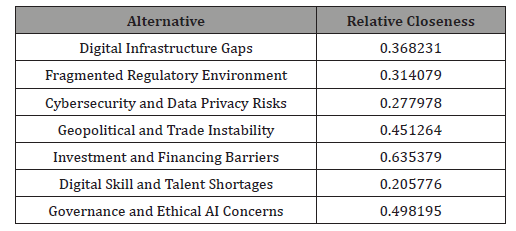
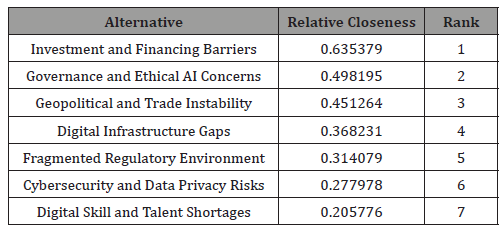
The BWM–TOPSIS results reveal that perceived economic uncertainty, institutional trust, and external instability are the most influential barriers affecting e-commerce adoption. As shown in the ranking results, investment and financing barriers obtained the highest relative closeness score of 0.635379 and ranked first among the evaluated factors. From a decision psychology perspective, this result suggests that financial uncertainty may strongly affect adoption confidence because consumers, SMEs, and platform stakeholders may perceive e-commerce participation as risky when payment systems, platform investment, logistics financing, and digital service support remain unstable.
Governance and ethical AI concerns ranked second, with a relative closeness score of 0.498195. This finding highlights the importance of institutional trust, ethical data use, platform accountability, and perceived fairness in e-commerce environments. Consumers are more likely to adopt digital commerce platforms when they believe that their data are protected, AI-based decisions are transparent, and digital transactions are governed by reliable institutions. Therefore, governance-related trust is not only a regulatory concern but also a psychological determinant of adoption behavior.
Geopolitical and trade instability ranked third, with a relative closeness score of 0.451264. This result indicates that broader uncertainty in the digital trade environment can affect consumer and stakeholder confidence. When users perceive political, economic, or cross-border digital trade conditions as unstable, their willingness to rely on online platforms may decrease. This finding reinforces the role of perceived environmental uncertainty in shaping e-commerce adoption decisions.
Psychological Interpretation of the Ranked Factors
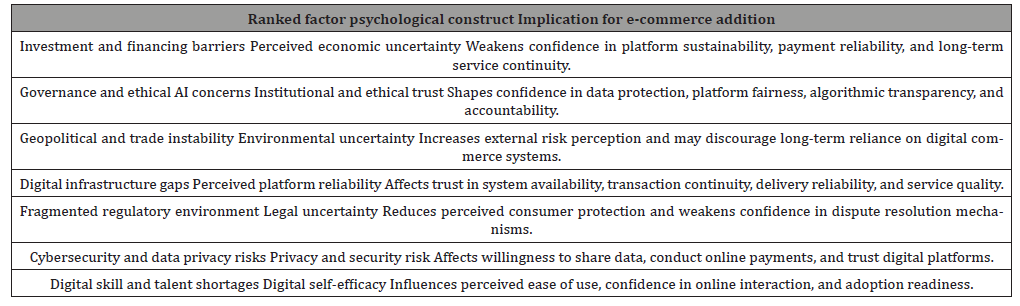
Empirical findings with the decision psychology orientation of this study, the ranked adoption barriers are reinterpreted according to their psychological implications. Table 1 summarizes how each factor evaluated relates to consumer perception of risk, digital trust, and readiness to adopt e-commerce. The results show that e-commerce adoption is shaped by a combination of perceived risk and trust-related factors. High-ranking barriers, such as investment uncertainty and governance concerns, suggest that adoption decisions depend not only on individual consumer preferences but also on the perceived stability, credibility, and ethical reliability of the broader digital ecosystem. Lower-ranking factors, such as digital skill shortages, remain important but appear less influential in the current ranking structure compared with institutional and economic trust-related concerns.
Table 1:Psychological interpretation of perceived e-commerce adoption barriers.
Digital Trust and Consumer Adoption Readiness
The ranking outcomes indicate that digital trust is a central mechanism linking structural conditions to consumer adoption behavior. Governance and ethical AI concerns, cybersecurity and data privacy risks, fragmented regulations, and infrastructure gaps all influence whether users perceive e-commerce platforms as safe, reliable, and trustworthy. When trust-related conditions are weak, consumers may hesitate to engage in online purchasing, digital payments, platform registration, or data sharing. Conversely, strengthening institutional transparency, cybersecurity protection, digital consumer rights, and platform reliability can reduce perceived risk and improve adoption readiness. These findings suggest that e-commerce adoption should be understood as a psychological decision-making process involving risk evaluation and trust formation. Users are more likely to adopt e-commerce when they perceive digital platforms as secure, regulations as protective, payment systems as reliable, and governance structures as fair. Therefore, the results support the argument that digital trust and perceived risk are key determinants of e-commerce adoption.
Comparative Data
The comparison statistics in Table 2 for China and selected West African countries and Figures 1-3 provide essential insights into the digital readiness and structural capacity for e-business collaboration between China and specific West African countries, namely Ghana, Nigeria, and Côte d’Ivoire. These insights are essential for formulating collaborative supply chain strategies that utilize regional strengths and mitigate obstacles. Table 2 highlights three principal indicators: Internet Penetration, E-Commerce Market Size, and Mobile Money Utilization. China excels in internet connectivity, with 76% of its populace online, reflecting its sophisticated infrastructure and digital economy. In West Africa, Ghana has a penetration rate of 68%, followed by Nigeria at 55% and Côte d’Ivoire at 46%. These statistics highlight the comparatively sophisticated digital land-scape in Ghana, rendering it an optimal entry point for pilot initiatives or scalable e-business frameworks. The results of the risk evaluation framework are presented below:
Table 2:Digital Readiness Indicators (2024 Estimates).



1.1.4. Decision Matrix
Table 3 shows the original decision matrix with 7 alternatives (risks) and 7 criteria:
1.1.5. Weighted Decision Matrix
After applying the criteria weights, the weighted decision matrix is as presented in Table 4:
1.1.6. Positive-Ideal and Negative-Ideal Solutions
The positive-ideal and negative-ideal solutions are computed and shown in Tables 5&6 below.
1.1.7. Manhattan Distances
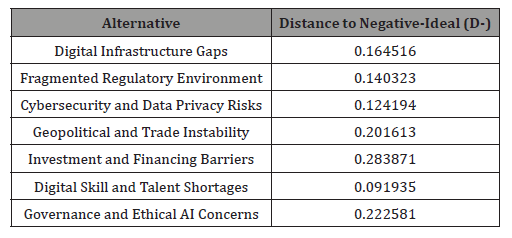
The integrated Manhattan distances to the positive-ideal and negative-ideal solutions are aggregated and presented in Tables 7&8.
Table 3:Decision Matrix for the Aggregated Criteria.
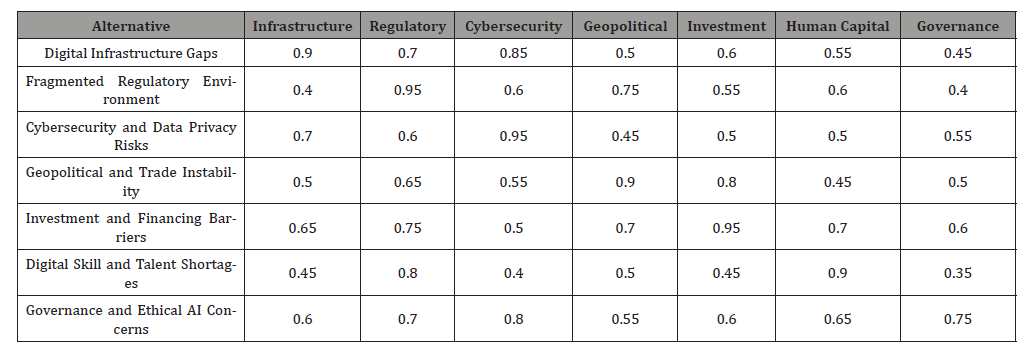
Table 4:Weighted Decision Matrix for the Aggregated Criteria.
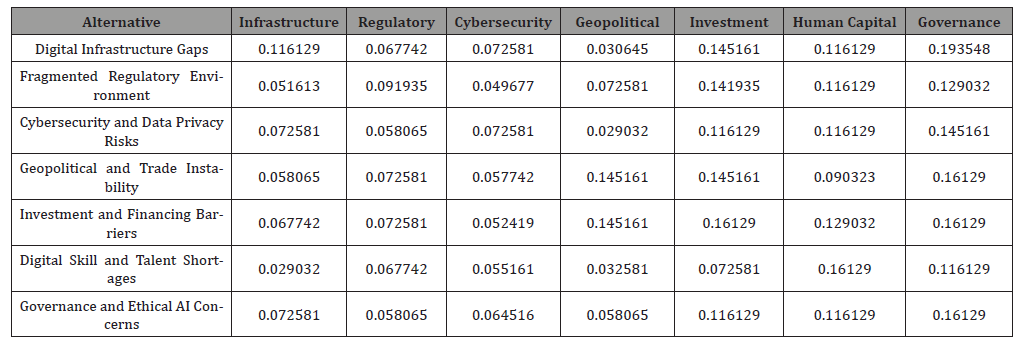
Table 5:Positive-Ideal Solution (Best Values for Each Criterion)
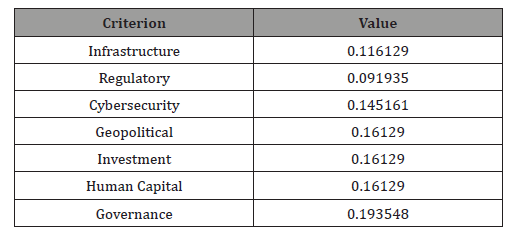
Table 6:Negative-Ideal Solution (Worst Values for Each Criterion).
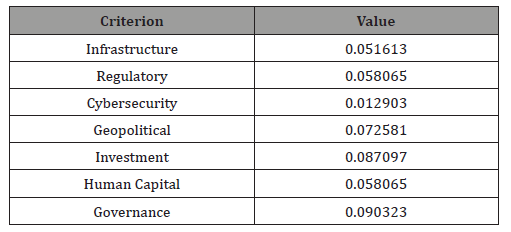
Table 7:Manhattan Distances to Positive-Ideal Solution (D+).
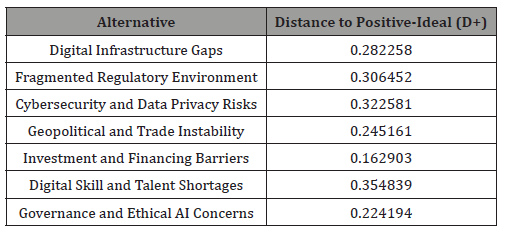
Table 8:Manhattan Distances to Negative-Ideal Solution (D-).
1.1.8. TOPSIS Scores
Table 9 illustrates the TOPSIS scores (relative closeness to the positive-ideal solution).
Table 9:Aggregated Relative Closeness.
1.1.9. Risk Evaluation and Ranking
The final ranking of risks based on the relative closeness is shown in Table 10.
Table 10:Ranking Values.
We present the results of the multi-objective optimization model to formalize the approach for establishing a resilient e-business supply chain be-tween China and West Africa. Tables 11&12 present the data inputs and the aggregated results using the objective function and the resilient index equation
Table 11:Input Data for Model Variables.
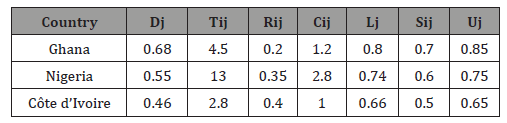
Table 12:Results of the Resilience Model.
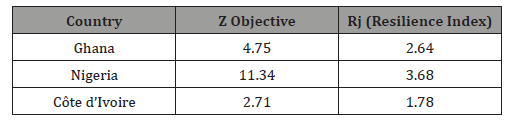
The results illustrate the model’s ability to capture and assess performance trade-offs among various countries. Nigeria demonstrates substantial trade volume and resilience, whereas Ghana excels in inclusiveness and utility. Côte d’Ivoire, despite its emergence, exhibits diminished resilience and underscores areas where investment ought to be targeted.
Visual Representation of Data
This section provides an overview of data regarding internet prevalence, E-commerce market size, and mobile money usage in the selected West African countries.
Figure 2 illustrates the discrepancy in internet access among the chosen countries. Ghana’s leadership in this domain underscores its preparedness to integrate and adjust to digital solutions, whereas Côte d’Ivoire’s inferior connectivity indicates infrastructural deficiencies that may impede the extensive use of e-business platforms. Strategic investment in digital infrastructure is essential for Côte d’Ivoire to bridge this gap and actively participate in cross-border e-commerce activities.
Figure 3 illustrates the projected dimensions of the e-commerce markets in these nations. Nigeria, characterized by its substantial population and urban areas, leads the West African e-commerce sector with a market valuation of almost $13 billion. Ghana ranks next with $4.5 billion, and Côte d’Ivoire exhibits a smaller but expanding market at $2.8 billion. While China’s e-commerce market, exceeding $2.6 trillion, is not explicitly represented here, its presence in Table 1 highlights the significant scale disparity and the potential for West African countries to benefit from China’s expertise in high-volume digital retail management. These data combined indicate that Nigeria is a high-potential partner for logistics and platform integration, but Ghana provides a robust equilibrium of infrastructure, policy support, and consumer engagement.
The analysis of mobile money usage, depicted in Figure 4, is very enlightening. Ghana once more demonstrates leadership, with 80% of its populace utilizing mobile banking services, signifying a developed and inclusive digital finance ecosystem. Côte d’Ivoire (66%) and Nigeria (74%) exhibit significant adoption, indicating the region’s need on mobile-first financial solutions owing to the constraints of traditional banking. Conversely, China’s mobile money utilization seems lower (35%) according to this particular statistic, despite the fact that platforms such as Alipay and WeChat Pay prevail in digital payments. The data indicates a significant synergy: China can supply platform knowledge and ecosystem size, whereas West Africa offers a proven, mobile-first payment landscape. This presents an opportunity for collaborative innovation in mobile commerce infrastructure, especially for engaging rural and unbanked demographics.

Implications of the Results for E-Commerce Decision Psychology
The results provide three main implications for understanding e-commerce adoption from a psychological perspective. First, perceived financial and institutional uncertainty can strongly influence adoption decisions because consumers and SMEs may avoid digital platforms when they lack confidence in payment reliability, investment continuity, and governance protection. Second, digital trust depends on more than cybersecurity alone; it also includes ethical AI use, regulatory clarity, institutional accountability, and platform transparency. Third, adoption readiness is shaped by both individual- level factors, such as digital competence, and system-level factors, such as infrastructure reliability and governance trust. In general, the findings show that e-commerce adoption is not simply a matter of technological access. It is a decision-making process shaped by perceived risk, institutional confidence, digital trust, and psychological readiness to participate in online markets. The proposed BWM–TOPSIS framework therefore offers a useful method for identifying which perceived barriers should be prioritized when designing trustworthy and psychologically acceptable e-commerce ecosystems.
Conclusion
This study examined e-commerce adoption from the perspective of consumer risk perception, digital trust, and decision-making under uncertainty. By applying a hybrid Best-Worst Method (BWM) and Technique for Order Preference by Similarity to Ideal Solution (TOPSIS) framework, the study identified and prioritized the perceived barriers that influence users’ willingness to participate in digital commerce environments. The findings demonstrate that e-commerce adoption is not determined only by technological availability or market expansion, but also by psychological factors such as perceived uncertainty, trust in institutions, confidence in online platforms, privacy concerns, and perceived competence in using digital systems.
The results show that investment and financing barriers represent the most influential perceived barrier to e-commerce adoption. From a decision psychology perspective, this finding suggests that economic uncertainty can reduce confidence in the long-term reliability of digital platforms, payment systems, logistics services, and online transaction support. Governance and ethical AI concerns ranked second, indicating that institutional trust, ethical data governance, algorithmic transparency, and platform accountability are central to consumers’ acceptance of e-commerce systems. Geopolitical and trade instability ranked third, showing that broader environmental uncertainty can also shape adoption behavior by affecting users’ perceptions of platform reliability and transactional security. The study further shows that digital infrastructure gaps, fragmented regulatory environments, cybersecurity and data privacy risks, and digital skill shortages all contribute to perceived risk and trust formation in e-commerce adoption. Although these factors ranked below investment, governance, and geopolitical concerns, they remain important because they directly affect consumers’ confidence in system availability, online payment safety, data protection, dispute resolution, and ease of use.
References
- Yuexu Zhao, Yujing Feng (2022) Research on the development and influence on the real economy of digital finance: The case of China. Sustain-ability.
- Geoffrey Bentum-Micah, Shurong Zhao, Xiangxu Wang, Xiaoyan Cao, Tamimu Mohammed Gadafi, et al. (2026) Enhancing the global reach and pedagogical diversity of online Chinese language education across cultural contexts: Evidence from anglophone west Africa. Acta psychologica 263: 106229.
- Tilman Santarius, Lina Dencik, Thomas Diez, Hugues Ferreboeuf, Patricia Jankowski, et al. (2023) Digitalization and sustainability: A call for a digital green deal. Environmental Science & Policy 147(9): 11-14.
- Dirk A Zetzsche, Linn Anker-Sørensen, Maria Lucia Passador, André Wehrli (2022) Dlt-based enhancement of cross-border payment efficiency: A legal perspective. Law and Financial Markets Review 15: 70-115.
- Zijun Mao, Jingyi Wu, Yali Qiao, Hongyun Yao (2021) Government data governance framework based on a data middle platform. Aslib Journal of Information Management 74(3): 289-310.
- Richard Heeks, Juan E Gómez-Morantes, Mark Graham, Kelle Howson, Paul Mungai, et al. (2021) Digital platforms and institutional voids in developing countries. World Development 145(3): 105528.
- M Zhang, R Cheng, J Fei, R Khanal (2024) Enhancing digital innovation ecosystem resilience. Sustainability 16(5): 1946.
- Caroline Cauffman, Catalina Goanta (2021) A new order: The digital services act and consumer protection. European Journal of Risk Regulation 12(4): 758-774.
- K Badiane, H Lin, H Lee (2022) Analysis of Differences in Business Etiquette between China and Africa: The Case of Senegal and Morocco. Journal of Educational Issues 8(1): 1.
- D Maditinos, D Chatzoudes, L Sarigiannidis (2014) Factors affecting e-business successful implementation. International Journal of Commerce and Management 24(4): 300-320.
- LD Williams (2021) Concepts of Digital Economy and Industry 4.0 in Intelligent and Information Systems. International Journal of Intelligent Networks 2(1): 122-129.
- Mohammed Gadafi Tamimu, Shurong Zhao, Qianwen Xu, Jie Zhang (2026) Attention-based deep learning hybrid model for cash crop price forecasting: Evidence from global futures markets with implications for west Africa. Applied Sciences 16(3): 1600.
- W Zhang, S Zhao, X Wang, Y Yao (2021) Digital economy and economic development. PLOS ONE 16(9): e0257365.
- K Dumor et al. (2023) Ict and economic growth in Africa. Information Technology for Development, 30(3): 452-471.
- IRP Cuypers, Jean-François Hennar, Brian Silverman, Gokhan Ertug (2021) Transaction cost theory: Progress and challenges. Academy of Management Annals 15(1): 111-150.
- S Suhartini, NA Mahbubah, M Basjir (2022) Development of sme’s business cooperation information technology system design. Eastern-European Journal of Enterprise Technologies 6(13): 120.
- Tamimu Mohammed Gadafi, Seini Toufic, Albert Awortwi Sagoe, Liang Decui, Hira Anwar (2025) Enhancing climate resilience through sustain-able agricultural intensification: An attention-based neural network for climate-smart agriculture modeling in Ghana. Proceedings of the 2025 International Conference on Smart Agriculture and Artificial Intelligence.
- S Hendricks, SD Mwapwele (2024) E-commerce adoption in developing countries. Data and Information Management 8(1): 100045.
- A Nanda, Y Xu, F Zhang (2021) How would the covid-19 pandemic reshape retail real estate and high streets through acceleration of e-commerce and digitalization?. Journal of Urban Management 10(2): 110-124.
- M Agbebi (2018) Exploring the human capital development dimensions of Chinese investments in Africa. Journal of Asian and African Studies 54(3): 002190961880138.
- W Huang, P Hu, S Tsai, XD Chen (2021) The business analysis on the home-bias of e-commerce consumer behavior. Electronic Commerce Research 21(3): 855-879.
- D Zhu, CM Gray, AL Toombs, C Liu, W Liu (2022) Building a cross-cultural UX design dual degree. In With Design: Reinventing Design Modes pp. 1128–1134.
- Wang Yue Chiang (2024) Risk Perception Disparities in E-Business: Analyzing SME Roles, Experience and Legal Compliance Challenges. Journal of Enterprise and Business Intelligence 4(3): 146-155.
- Y Sun, Y Liu, J Zhang, Jindi Fu, Feng Hu, et al. (2021) Dark side of enterprise social media usage: A literature review. International Journal of Information Management 61: 102393.
- Liu T, M Xu, X Chen (2021) social media, gendered anxiety and disease-related misinformation: discourses in contemporary China’s online anti-African sentiments. Asian Journal of Communication 31(6): 485-501.
- A Leinonen, V Roto (2023) Service design handover to user experience design. Information and Software Technology 154: 107087.
- J Putrevu, C Mertzanis (2024) Digital payments in emerging economies. Digital Policy and Governance, 26(5): 476-500.
- FH Kunju (2024) Digital Warfare: Exploring Cyber Criminality Amidst Armed Conflict in Southwest Region of Cameroon. Journal of Research in Social Science and Humanities 3(10): 31-40.
- Tamimu Mohammed Gadafi, Ibrahim Osman Adam, Liu Yawen (2025) Modeling the financial drivers of China’s digital economy: Implications for sustainable growth. Strategic Business Research 1(1): 100013.
- A Majumdar, SK Sinha, K Govindan (2021) Prioritising risk mitigation strategies for environmentally sustainable clothing supply chains: Insights from selected organizational theories. Sustainable Production and Consumption 28: 543-555.
- MA Carrai (2021) Adaptive governance along Chinese-financed BRI railroad megaprojects in East Africa. World Development 141: 105388.
- Philp Kwaku Adjei, Tamimu Mohammed Gadafi, Zhiguang Qin, Lois Tweneboa Kodua (2025) Enhancing business intelligence through digital technologies: A deep learning approach for optimizing supply chain risk management in Ghana. Proceedings of the 2nd International Conference on Image Processing, Machine Learning, and Pattern Recognition.
- II Danja, X Wang (2024) Matching comparative advantages to special economic zones for sustainable industrialization. Heliyon 10(14): e34411.
- Tamimu Mohammed Gadafi, Touray Musa, Nusrat Jahan, Abiola Azeez Azeez, Shahbub Alam (2025) Digital finance and structural trans-formation: Analyzing the influence of emerging financial indicators on retail sector expansion in China. iris journal of economics & business management 3 (3): 1-2.
- J Lu, J Wang (2021) Corporate governance and environmental performance. Journal of International Financial Markets 70: 101264.
- IO Adam, MD Alhassan (2023) Global e-readiness as a foundation for e-government and e-business development: the effect of political and regulatory environment. International Journal of Business Information Systems 44(1): 64-80.
- Philp Kwaku Adjei, Tamimu Mohammed Gadafi, Zhiguang Qin (2025) Enhancing business intelligence in Ghana through digital technologies: Optimizing management information sharing with cloud computing, big data, and ai. Proceedings of the 2025 International Conference on Artificial Intelligence and Digital Finance.
- Y Liu, MG Tamimu, J Chai (2025) Dynamic Supply Chain Decision-Making of Live E-Commerce Considering Netflix Marketing Under Different Power Structures. Journal of Theoretical and Applied Electronic Commerce Research 20: 202.
- MG Tamimu, S Zhao, Q Xu, J Zhang, X Yin (2025) Pythagorean fuzzy-ahp risk evaluation. Journal of Theoretical and Applied Electronic Commerce Research 20: 327.
- Mohammed Gadafi Tamimu, Emmanuel Antwi, Sylvester Edmond Saidu, Daisy Ofosuhene, Boateng Edward Akwasi (2026) Sustainable ai-driven predictive modeling in agricultural supply chains: Ai, iot, and blockchain integration for climate adaptation in Ghana. Iris Journal of Economics & Business Management 3(3).
- S Zhao, MG Tamimu, Ailing Luo, Tiantian Sun, Yongxing Yang (2025) Hesitant Fuzzy-BWM Risk Evaluation Framework for E-Business Supply Chain Cooperation for China–West Africa Digital Trade. Journal of Theoretical and Applied Electronic Commerce Research 20(3): 233.
- MG Tamimu, S Zhao, Yiting Wang, Yongxing Yang, Tiantian Sun, et al. (2025) Fuzzy logic-BWM-based risk assessment for E-business cooperation in China–West Africa digital trade: A path to sustainable business and policies. Global Economics Research 1(2).
- Tamimu Mohammed Gadafi, Touray Musa (2025) An integrated fuzzy-BMW-topsis with Chebyshev distance approach for risk evaluation in e-business cooperation. International Journal of Management and Fuzzy Systems.
- TM Gadafi, L Decui, AP Darko (2025) Smart irrigation system assessment in Ghana. Socio-Economic Planning Sciences.
- MG Tamimu, D Liang (2025) Sustainable mining development in Ghana: An integrated AHP-TOPSIS-Manhattan distance approach. Resources Policy 110: 105757.
-

This work is licensed under a Creative Commons Attribution-NonCommercial 4.0 International License.