

 Review Article
Germanium-on-Insulator: A Pathway to Monolithically Integrated SWIR Imaging for Future Satellite Constellations
Received Date:December 24, 2025; Published Date:December 29, 2025
Abstract
Short-wave infrared (SWIR) imaging has become an indispensable capability in modern Earth observation, enabling quantitative sensing of vegetation water content, mineral composition, and a range of dynamic environmental processes. As space-based observation paradigms evolve toward proliferated satellite constellations, sensor technologies are increasingly constrained not only by performance, but also by scalability, cost, size-weight-power (SWaP), and manufacturability. Conventional SWIR focal plane arrays (FPAs), predominantly based on InGaAs photodetectors hybrid-integrated with Si readout integrated circuits (ROICs), provide mature and high-performance solutions but face intrinsic trade-offs related to heterogeneous integration and III-V material economics. This work examines Germanium-on-Insulator (GeOI) photodetector technology as an emerging and complementary pathway aligned with the system-level requirements of future distributed satellite missions. We summarize recent progress in GeOI material development and device performance in China and critically assess its current technological status. While most stateof- the-art GeOI FPAs remain hybrid-integrated at present, advances in high-quality Ge heteroepitaxy on Si establish a credible long-term route toward monolithic CMOS integration. Rather than positioning GeOI as a universal replacement for existing technologies, this summary highlights its potential role in enabling low-SWaP, cost-sensitive, and highly integrated SWIR imaging payloads, particularly suited for large-scale satellite constellations and intelligent on-board processing architectures.
Keywords:Germanium-on-insulator (GeOI); short-wave infrared (SWIR); satellite remote sensing; focal plane array; monolithic integration
Introduction
The short-wave infrared (SWIR; ~1.5-3.0 μm) spectral band occupies a unique position in remote sensing, offering sensitivity to molecular vibrational absorption features that are inaccessible in the visible and thermal infrared regimes. This spectral capability underpins a wide range of Earth observation applications, including vegetation water stress monitoring, mineralogical mapping, atmospheric constituent analysis, biomedical, and environmental change detection [1-4]. Historically, high-performance SWIR imaging from space has been dominated by InGaAs-based FPAs, which combine excellent sensitivity, low dark current, and proven reliability. These detectors are typically integrated with Si ROICs via flip-chip bonding, forming hybrid architectures that havedemonstrated extensive flight heritage in both scientific and commercial missions. However, the rapid emergence of large-scale satellite constellations-often comprising hundreds or thousands of small satellites-has introduced new system-level constraints. In these scenarios, cost per unit, manufacturability, payload SWaP, and scalability across large production volumes become as critical as ultimate detector performance. Within this evolving landscape, alternative material and integration strategies are being explored to complement established SWIR technologies. Among them, GeOI has attracted growing interest due to its compatibility with Si processing infrastructure and its potential for tighter integration with CMOS electronics [5-12]. This work focuses on the GeOI platform, evaluating its current capabilities, development trajectory, and potential role within future satellite constellation architectures.
The GeOI Paradigm: Material Platform and System- Level Alignment
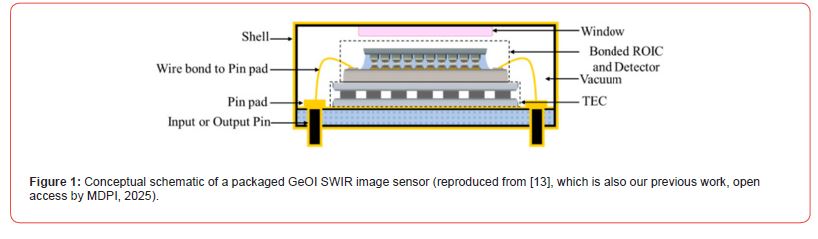
GeOI technology is based on the integration of a crystalline germanium absorption layer on an insulator substrate, typically consisting of a Si wafer, a buried oxide (BOX) layer, and a thin Ge device layer. From a system perspective, this architecture aligns SWIR photodetection with the Si microelectronics ecosystem, offering a pathway toward wafer-scale manufacturing and tighter integration with on-chip electronics. It is important to distinguish between the current implementation state of GeOI FPAs and their longer-term vision. At present, most reported GeOI imaging demonstrations employ hybrid integration with ROICs, similar to conventional InGaAs FPAs. The fundamental distinction lies in the material platform itself: high-quality heteroepitaxial growth of germanium on Si has matured to a level where device-grade Ge layers can be produced using CMOS-compatible processes. This progress effectively shifts the remaining challenges from fundamental material incompatibility toward process optimization, device engineering, and system integration. From a satellite system standpoint, GeOI is therefore best viewed not as a disruptive replacement technology, but as an enabling platform that may address specific mission profiles where integration density, cost scaling, and SWaP constraints dominate design considerations (Figure 1).
Foundational Merit: CMOS Compatibility as a System-Level Enabler
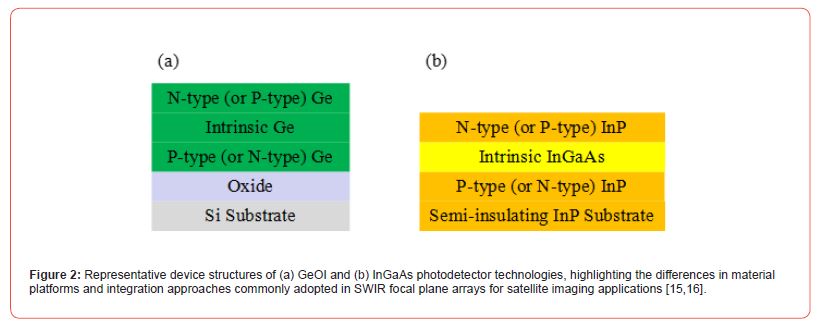
The primary advantage of the GeOI platform lies less in a singular detector performance metric and more in its alignment with CMOS manufacturing and integration paradigms. The presence of the BOX layer provides effective electrical isolation from the Si substrate, suppressing parasitic leakage paths and supporting low-noise operation. More strategically, the use of Si-compatible substrates and process flows opens a route toward co-fabrication of photodetectors and electronics within a unified technological framework. Such compatibility has important implications for future satellite payloads. Monolithic or near-monolithic integration can reduce interconnect parasitics, lower assembly complexity, and potentially improve robustness in vibration- and radiation-prone environments. At the same time, it is essential to recognize that mature InGaAs technologies continue to evolve and will remain indispensable for missions requiring maximum sensitivity and proven heritage. In this context, GeOI should be regarded as complementary, addressing application spaces where manufacturability and integration outweigh the need for absolute performance optimization (Figure 2). The Ge/GOI technology has been demonstrated in laboratory-scale SWIR imaging and smallformat array prototypes [14].
Device-Level Progress and Development Trajectory
Over the past decade, GeOI photodetector research has progressed from proof-of-concept devices to increasingly application-relevant demonstrations. Key advances include:
a) Responsivity enhancement: Resonant-cavity-enhanced and waveguide-integrated GeOI photodiodes have achieved responsivities exceeding 0.8 A/W at 1.55 μm, in resonant or waveguide-enhanced configurations, approaching those of established SWIR detectors despite thinner absorption layers.
b) Spectral range extension: The incorporation of GeSn alloys has enabled cutoff wavelength extension beyond ~2.0 μm, at the expense of increased material complexity, broadening access to longer-wavelength SWIR features relevant to geological and environmental sensing [17-19].
c) Functional integration: Demonstrations of Ge avalanche photodiodes (APDs) and waveguide-coupled devices indicate the platform’s suitability for more complex photonic and optoelectronic integration [20,21].
These developments collectively enhance the credibility of GeOI as a SWIR detector platform. Nevertheless, most demonstrations remain at the component or small-array level, and further work is required to translate these advances into large-format FPAs with uniform performance and space-grade reliability. In the foreseeable future, hybrid-integrated GeOI FPAs are likely to precede fully monolithic implementations, which represent a longer-term engineering objective. A comparative analysis of key characteristics is summarized in Table 1.
Alternative SWIR Detector Technologies for Satellite Applications
The maturation of monolithic GeOI technology could enable shifts in satellite system design aligned with the trends of constellation proliferation and intelligent payloads. The cost structure implied by wafer-scale CMOS integration may lower the barrier to incorporating SWIR sensing on small satellites, facilitating large-scale constellations for high-temporal-resolution monitoring. Beyond economics, the intimate co-location of detectors and Si electronics is transformative, paving the way for embedded on-chip processing (e.g., real-time feature extraction, compression, or decision-making) and enabling intelligent sensors that perform analysis at the edge. The reduced SWaP footprint also invites novel instrument concepts, such as compact multi-spectral imagers or SWIR-based inter-satellite links. Realizing this potential requires overcoming significant, non-trivial challenges. Material optimization for wafer-scale, low-defect Ge layers is ongoing, with the ~4% lattice mismatch between Ge and Si requiring sophisticated strain engineering to minimize threading dislocations that degrade performance [22,23]. The co-optimization of photonic and electronic process modules within a unified CMOS flow is a complex task requiring specialized PDKs. Furthermore, key detector metrics such as dark current density and quantum efficiency, particularly at wavelengths beyond 1.8 μm, still require further improvement to match the benchmark set by mature InGaAs technology. Novel technologies, such as, quantum wells, quantum dots, etc, should be well explored [24,25]. Finally, as with any new space technology, a rigorous qualification phase for radiation hardness and long-term reliability remains an essential and demanding step towards flight readiness.
Conclusion
Germanium-on-Insulator technology represents a promising and complementary pathway within the broader SWIR detector landscape, particularly aligned with the integration, scalability, and SWaP constraints of future satellite constellations. While current GeOI FPAs largely rely on hybrid integration, ongoing progress in material growth and device engineering establishes a credible roadmap toward tighter CMOS integration over the longer term. Rather than supplanting mature technologies such as InGaAs, GeOI expands the design space available to system architects by addressing application scenarios where cost scaling, integration density, and manufacturability are dominant considerations. Continued advances in materials, process integration, and space qualification will ultimately determine the extent to which GeOI-based SWIR sensors contribute to next-generation Earth observation and satellite communication systems.
Funding
This work was supported by the Guangdong S&T Programme (Grant No. 2024B0101130001), and in part by the “Pearl River Talent Plan” Innovation and Entrepreneurship Team Project of Guangdong Province (Grant No. 2021ZT09X479).
References
- Rast M, Painter TH (2019) Earth observation imaging spectroscopy for terrestrial systems: An overview of its history, techniques, and applications of its missions. Surveys in Geophysics 40(3): 303-331.
- Guanter L, Kaufmann H, Segl K, Forester S, Rogass C, et al. (2015) The EnMAP spaceborne imaging spectroscopy mission for earth observation. Remote Sensing 7(7): 8830-8857.
- Miao Y, Radamson HH (2024) Functional Near-Infrared Imaging for Biomedical Applications[M]//Recent Advances in Infrared Spectroscopy and Its Applications in Biotechnology. IntechOpen.
- Larique E, Chorier P, Aufranc S (2023) New SWIR staring arrays for Earth observation space applications at LYNRED[C]//International Conference on Space Optics—ICSO 2022. SPIE 12777: 998-1009.
- Du J, Zhao X, Miao Y (2025) Demonstration of Planar Geometry PIN Photodetectors with GeSi/Ge Multiple Quantum Wells Hybrid Intrinsic Region on a Ge-on-Insulator Platform. ACS Applied Electronic Materials.
- An Y, Jiao J, Chen G, Yao L, Wu S, et al. (2025) Hyper Self-Doping of GeIn for Cost-Effective Ge PIN Photodiodes with Record-Low Dark Current. ACS Photonics 12(5): 2868-2877.
- Yu J, Zhao X, Miao Y, Su J, Kong Z, et al. (2024) High-performance Ge PIN photodiodes on a 200 mm insulator with a resonant cavity structure and monolayer graphene absorber for SWIR detection. ACS Applied Nano Materials 7(6): 5889-5898.
- Ghosh S, Lin K C, Tsai CH, Lee KH, Chen Q, et al. (2020) Resonant-cavity-enhanced responsivity in germanium-on-insulator photodetectors. Opt Express 28(16): 23739-23747.
- Yao L, Ji R, Wu S, Jiao J, He F, et al. (2024) Low dark current lateral Ge PIN photodetector array with resonant cavity effect for short wave infrared imaging. Journal of Physics D: Applied Physics 57(16): 165103.
- Duan X, Zhao X, Su J, Lin H, Zhou Z, et al. (2025) Enhanced responsivity in GOI photodetectors with engineered SiO2/Si3N4 DBR multilayers for next-generation SWIR imaging applications. Applied Surface Science 714: 164451.
- Lin Y, Lee K H, Bao S, Guo X, Wang H, et al. (2017) High-efficiency normal-incidence vertical p-i-n photodetectors on a germanium-on-insulator platform. Photonics Research 6(1): 46.
- Xiong W, Wang G, Du Y, Lin H, Zhao X, et al. (2021) Integration of silicon nitride waveguide in Ge-on-insulator substrates for monolithic solutions in optoelectronics. Journal of Materials Science: Materials in Electronics 32(5): 6133-6140.
- Du J, Zhao X, Su J (2025) Review of short-wavelength infrared flip-chip bump bonding process technology. Sensors (Basel, Switzerland) 25(1): 263.
- https://sdxw.iqilu.com/share/YS0yMS0xMzkzNzMzMQ==.html
- Seyedein Ardebili SB, Zeinalvand Farzin B, Kim JS, Lee D, Kang T, et al. (2024) Analyzing extended wavelength InGaAs photodetectors: the effects of window and active layer thickness on optical characteristics. Optical and Quantum Electronics 56(4): 675.
- Dong T, Li B, Zhao X (2026) Boosting the performance of In0. 53Ga0. 47As/InP photodetectors with Al2O3/SiNx bilayer passivation technology. Materials Science in Semiconductor Processing 202: 110150.
- Tran H, Pham T, Margetis J, Zhou Y, Dou W, et al. (2019) Si-based GeSn photodetectors toward mid-infrared imaging applications. Acs Photonics 6(11): 2807-2815.
- Wang L, Zhang Y, Wu Y, Liu T, Miao Y, et al. (2020) Effects of annealing on the behavior of Sn in GeSn alloy and GeSn-based photodetectors. IEEE Transactions on Electron Devices 67(8): 3229-3234.
- Radamson HH, Noroozi M, Jamshidi A, Ostling M (2013) Strain engineering in GeSnSi materials. ECS transactions 50(9): 527.
- Vines P, Kuzmenko K, Kirdoda J, Dumas D, Mirza M, et al. (2019) High-performance planar germanium-on-silicon single-photon avalanche diode detectors. Nat commun 10(1): 1086.
- Na N, Lu YC, Liu YH, Chen PW, Lai YC, et al. (2024) Room temperature operation of germanium–silicon single-photon avalanche diode. Nature 627(8003): 295-300.
- Du Y, Wang G, Miao Y, Xu B, Li B, et al. (2021) Strain modulation of selectively and/or globally grown Ge layers. Nanomaterials 11(6): 1421.
- Xie C, Li Y, Xu C, Wang Y, Cong H, et al. (2023) Epitaxial growth of high-quality Ge layers on Si with Ge2H6 under UHV-CVD conditions. Semiconductor Science and Technology 39(1): 015008.
- Kolahdouz M, Farniya A A, Di Benedetto L (2010) Improvement of infrared detection using Ge quantum dots multilayer structure. Applied Physics Letters 96(21).
- Wang H, Kong Z, Tan X, Su J, Du J, et al. (2024) High-performance GeSi/Ge multi-quantum well photodetector on a Ge-buffered Si substrate. Opt Lett 49(10): 2793-2796.
-

This work is licensed under a Creative Commons Attribution-NonCommercial 4.0 International License.