




 Case Report
Plasmaspheric Dipolarization Driven Local Transport in The Heart of Van-Allen Radiation Belts Leading to Super Intense Third Radiation Belt
Received Date: August 25, 2026; Published Date: September 01, 2026
Abstract
A recent study [1] concluded that local energization in the heart of Van-Allen radiation belts is a main cause of the relativistic electrons flux enhancement in the slot region of Earth’s magnetosphere. This work reports a very contrasting event. It is found that local transport in the heart of Van-Allen radiation belts resulted in the formation of a super-intense third radiation belt in the slot region of Earth’s magnetosphere. In super-intense third radiation belt peak cumulative fluxes of relativistic electrons were thousand times greater than those in the first study about third radiation belt formation [2]. Therefore, it is concluded that local energization in the heart of Van-Allen radiation belts can be dominated by local transport resulting from plasmaspheric dipolarization. This indicates that local energization is not always a sole and dominant source of flux enhancements in the slot region.
Keywords:Van-Allen radiation belts; super intense third radiation belt formation; plasmaspheric dipolarization; local transport; local energization
Introduction
Earth’s magnetic field behaves as a natural magnetic mirror due to magnetic gradients and can trap energetic radiations. Early observations [3,4] discovered two radiation belts known as Van- Allen radiation belts. These are separated by a gape termed as slot region, where negligibly small fluxes of relativistic electrons have been predominantly observed [5]. Data from twin radiation belt storm probes revolutionized the situation by an unexpected discovery of a temporary third radiation belt in the slot region [2]. A recent study emphasized that the local energization by very low frequency waves is a main source of flux enhancement in the slot region [1]. During 2013-2019 many studies [6-26] have explained the relativistic electrons flux enhancements in slot region but before this work there is no study about the role of plasmaspheric dipolarization in the super intense third radiation belt formation. Dipolarization is a phenomenon when Earth’s magnetosphere recovers from a stretched elongated configuration to dipole like structure. Earlier studies observed dipolarization of geomagnetic field near geosynchronous orbit at L = 6.6 [27,28]. The large inductive electric fields due to dipolarization [29], leads to earthward injection of particles [30,31]. Very recently Magnetospheric Multiscale (MMS) spacecraft observed dipolarization at L = 3.8 inside plasmasphere [32]. This work provides evidence that plasmaspheric dipolarization driven local transport can dominate the local energization in the heart of Van-Allen radiation belts. The paper is organized as follows. The section 2 deals with data and methods. The section 3 presents results based on the observations of RBSP-A in slot region (L = 3- 3.5). The results are explained and discussed in section 4. The section 5 is devoted to the summary and conclusions.
Data and Methods
This study uses the multi-satellites OMNI solar wind data at 1 AU and 2 MeV 45 degrees pitch angle relativistic electrons flux data based on the measurements of relativistic electron proton telescope (REPT), onboard radiation storm probe A (RBSP-A). The RBSP-A electric field and wave instrument (EFW) provided ultralow- frequency waves and dipolarization electric fields data. The amplitudes data for HF band (10- 487 kHz) are from electric and magnetic field instrument suit (EMFISIS). We have selected the March 2015 intense storm. It is found that a super intense (thousand times greater cumulative peak fluxes of relativistic electrons in slot region) third radiation belt was formed during storm. Intense storm means one with a main phase Dst dip < -100 nT. The third radiation belt formation is studied. The event in [2] is considered as standard for detection of third radiation belt in slot region. That work had reported third belt for the first time. For that event, we found that 2 MeV 45 degrees pitch angle electrons cumulative flux attained a threshold value 105. When cumulative flux in region L = 3-3.5 is less than threshold (105) the third belt is considered to be absent. Based on the intensity of peak cumulative flux in region L = 3-3.5 during March 2015, we report a super intense third radiation belt (when cumulative flux peak attains 108) formation. The electron cumulative fluxes in this work are in units of cm-2 s-1 sr -1 MeV-1. The L is McIlwain L-shell, and shows geocentric distance to geomagnetic equatorial crossing point of Earth’s magnetic line of force [33].
Results
Figure 1 shows the L-shell vs flux profiles for the super intense third radiation belt considered in this study. Panel (a) is for reference case and is for 23 January-23 February 2013 when third radiation belt was absent. The time intervals for other panels read as (b) 1-18 March (c) 19-25 March (d) 26-31 March (e) 1-6 April (f) 7-17 April (g) 17-26 April (h) 27 April-10 May (I) 11-26 May 2015. In panel (a) the third belt is absent as the flux between L = 3-3.5 is negligibly small as compared with peak flux in the vicinity of L = 5. But in panel (b) the flux has stronger bursts in slot region and super intense third belt is formed. The formed third belt existed during 18 march (as obvious in panel a) – 10 May 2015 (panel h). That gives an existence time of 53 days. These plots are using instantaneous values of flux and L-shell. The collective fluxes of electrons for this third belt in region L = 3-3.5 were 1000 times greater than collective fluxes in same region for the first reported third radiation belt [2]. The flux measurements are based on the relativistic electron proton telescope (REPT) onboard RBSP-A. L-shell represents the distance from center of Earth to the intersection point of equator and field line.
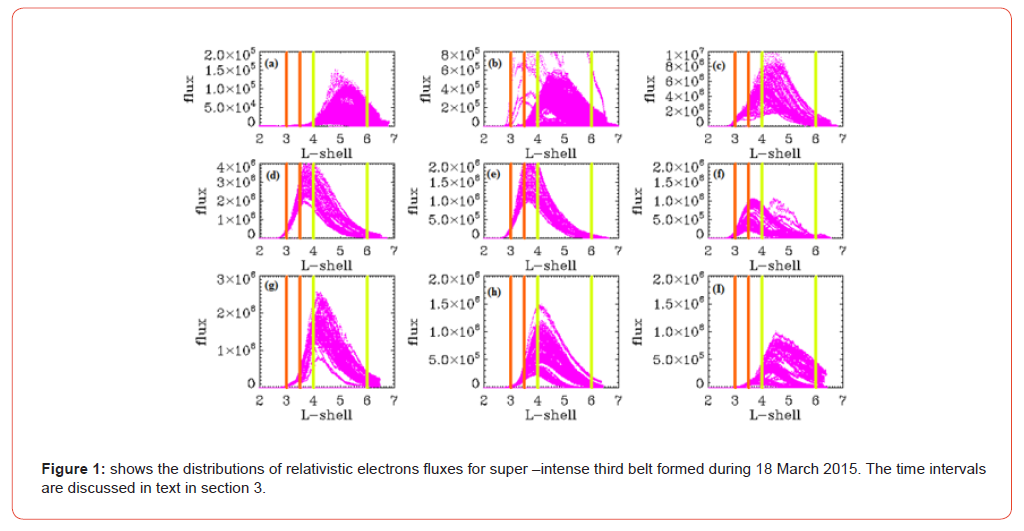
Figure 2a presents the L-shell distribution of magnetospheric east-west electric field (Ey). It shows very high electric fields in the heart of Van-Allen radiation belts. Such field can give same radial velocities as due to small wave fields outward of the outer radiation belt. Such fields can act as source of third radiation belt formation. The Figure 2b exhibits Ey fields for the absence of third belt during (23 Jan-23 Feb 2013). These were much smaller than those in Figure 2a.
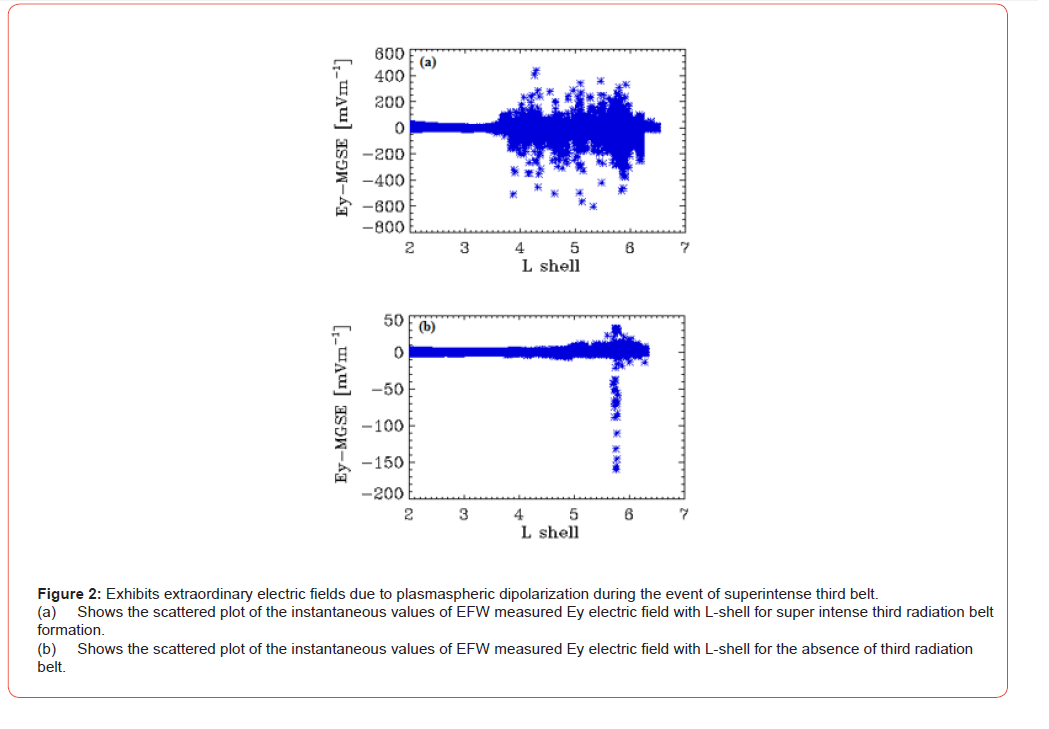
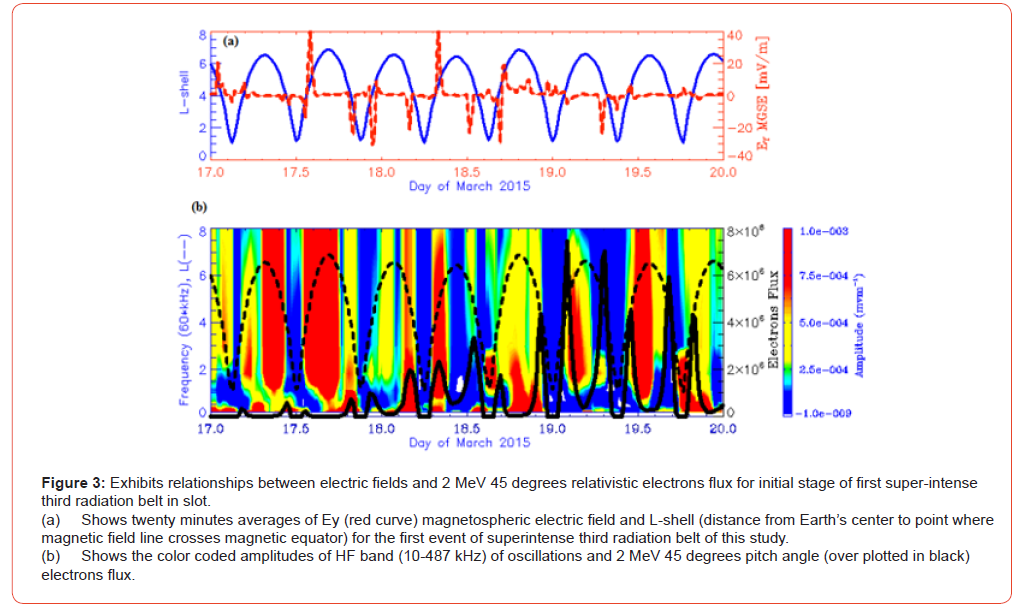
Figure 3a shows L-shell vs temporal variations of Ey field. The eastward peaks (negative peaks) are followed by flux enhancements as shown in Figure 3b. The Figure 3b also shows the variations of high frequency (HF) band with time. The decay in the amplitude of HF band is followed by the flux enhancement in slot region. This indicates that one cannot ignore the role of HF band. However, dipolarization fields (Figure 2a) were several orders of magnitude greater than electric fields in HF band.
Discussion of results
This section compares the roles of high frequency (HF) wave band (which includes very low frequency waves and high frequency oscillations) and plasmaspheric dipolarization generated electric fields. The peaks of twenty minute averages of HF band electric fields were several orders of magnitude smaller than peaks of dipolarization electric fields in the heart (locations with L < 4) of Van-Allen radiation belts. Therefore, dipolarization played a critical role in the generation of super intense third radiation belt.
Summary and Conclusions
During March 2015 intense storm event occurred and a super intense third radiation belt formed in the slot region of Earth’s magnetosphere. It is found that HF band amplitude decay was directly followed by relativistic electrons flux enhancement in the slot region. But the peak powers of waves in HF band were several orders of magnitude smaller than highest power of plasmaspheric dipolarization electric fields. Therefore, we conclude that plasmaspheric dipolarization generated electric fields played a primary role in the generation of super-intense third radiation belt. It also indicates that local transport dominated local energization in the heart of Van-Allen radiation belts.
Acknowledgements
We are thankful to J.H. King, N. Papitashvili (for solar wind data), and C. Kletzing (for the EMFISIS data) and D. Baker and M. G. Henderson (for REPT data).
Data availability statement
The used data is available upon request at masifkf@gmail.com
Financial statement
There is no funding for this work.
Ethics declaration
Not applicable.
References
- Reeves GD, Spence HE, Henderson MG, Morley SK, Friedel RHW, et al. (2013) Electron acceleration in the heart of the Van Allen radiation belts. Science 341 (6149): 991-994.
- Baker DN, Kanekal SG, Hoxie VC, Henderson MG, Li X, et al. (2013) A long-lived relativistic electron storage ring embedded in Earth’s outer Van Allen belt. Science 340(6129): 186-190.
- Van Allen JA (1959) Radiation belts around the Earth. Scientific American 200: 39-47.
- Van Allen JA, Frank LA (1959) Radiation Around the Earth to a Radial Distance of 107,400 km. Nature 183: 430-434.
- Friedel RHW, Reeves GD, Obara T (2002) Relativistic electron dynamics in the inner magnetosphere—A review. Journal of Atmospheric and Solar-Terrestrial Physics 64: 265-282.
- Mann IR, Ian Robert, Ozeke LG, Murphy KR, Claudepierre SG, et al. (2016) Explaining the dynamics of the ultra-relativistic third Van Allen radiation belt. Nature Physics 12: 978-983.
- Mann IR, Ozeke LG, Morley SK, Murphy KR, Claudepierre SG, et al. (2018) Reply to the dynamics of Van Allen belts revisited. Nature Physics 14: 103-104.
- Shprits YY, Horne RB, Kellerman AC, Drozdov AY (2018) The dynamics of Van Allen belts revisited. Nature Physics 14(2): 102-103.
- Shprits YY, Drozdov AY, Spasojevic M, Kellerman AC, Usanova ME, et al. (2016) Wave-induced loss of ultra-relativistic electrons in the Van Allen radiation belts. Nature communications 7(1): 1-7.
- Thorne RM, Li W, Ni B, Ma Q, Bortnik J, et al. (2013) Rapid local acceleration of relativistic radiation-belt electrons by magnetospheric chorus. Nature 504(7480): 411-414.
- Zhenpeng Su, Zhu H, Xiao F, Zong QG, Zhou XZ, et al. (2015) Ultra-low-frequency wave-driven diffusion of radiation belt relativistic electrons. Nature communications 6: 1-8.
- Li W, Ma Q, Thorne RM, Bortnik J, Zhang XJ, et al. (2016) Radiation belt electron acceleration during the 17 March 2015 geomagnetic storm: Observations and simulations. J Geophys Res Space Phys 121: 5520-5536.
- Foster JC, Erickson PJ, Omura Y, Baker DN, Kletzing CA, et al. (2017) Van Allen Probes observations of prompt MeV radiation belt electron acceleration in nonlinear interactions with VLF chorus. J Geophys Res Space Phys 122: 324-339.
- Ma Q, Li W, Bortnik J, Thorne RM, Chu X, et al. (2018) Quantitative evaluation of radial diffusion and local acceleration processes during GEM challenge events. J Geophys Res Space Phys 123: 1938-1952.
- Shi R, Mourenas D, Artemyev A, Li W, Ma Q (2018) Highly Oblique Lower‐Band Chorus Statistics: Dependencies of Wave Power on Refractive Index and Geomagnetic Activity. J Geophys Res Space Phys 123(6): 4767-4784.
- Baker DN, Erickson PJ, Fennell JF, Foster JC, Jaynes AN, et al. (2018) Space weather effects in the Earth’s radiation belts. Space Science Reviews 214: 1-7.
- Baker DN, Hoxie V, Zhao H, Jaynes AN, Kanekal S, et al. (2019) Multiyear measurements of radiation belt electrons: Acceleration, transport, and loss. J Geophys Res Space Phys 124(4): 2588-2602.
- Boyd AJ, Turner DL, Reeves GD, Spence HE, Baker DN, et al. (2018) What causes radiation belt enhancements: A survey of the Van Allen Probes Era. Geophys Res Lett 45(11): 5253-5259.
- Georgiou M, Daglis IA, Rae IJ, Zesta E, Sibeck DG, et al. (2018) Ultralow frequency waves as an intermediary for solar wind energy input into the radiation belts. J Geophys Res Space Phys 123(8): 10,090-10,108.
- Ozeke LG, Mann IR, Claudepierre SG, Henderson M, Morley SK, et al. (2019) The March 2015 superstorm revisited: Phase space density profiles and fast ULF wave diffusive transport. J Geophys Res Space Phys 124(2): 1143-1156.
- Ozeke LG, Mann IR, Olifer L, Dufresne KY, Morley SK, et al. (2020) Rapid Outer Radiation Belt Flux Dropouts and Fast Acceleration During the March 2015 and 2013 Storms: The Role of Ultra‐Low Frequency Wave Transport From a Dynamic Outer Boundary. J Geophys Res Space Phys 125(2): e2019JA027179.
- Ripoll JF, Claudepierre SG, Ukhorskiy AY, Colpitts C, Li X, et al. (2020) Particle Dynamics in the Earth's Radiation Belts: Review of Current Research and Open Questions. J Geophys Res Space Phys 125(5): e2019JA026735.
- Daglis IA, Katsavrias C, Georgiou M (2019) From solar sneezing to killer electrons: outer radiation belt response to solar eruptions. Philosophical Transactions of the Royal Society 377(2148): 20180097.
- Katsavrias C, Daglis IA, Li W (2019a) On the statistics of acceleration and loss of relativistic electrons in the outer radiation belt: a superposed epoch analysis. J Geophys Res Space Phys 124(4): 2755-2768.
- Katsavrias Ch, Sandberg I, Li W, Podladchikova O, Daglis IA, et al. (2019b) Highly relativistic electron flux enhancement during the weak geomagnetic storm of April–May 2017. J Geophys Res Space Phys 124(6): 4402-4413.
- Li W, Hudson MK (2019) Earth's Van Allen Radiation Belts: From Discovery to the Van Allen Probes Era. J Geophys Res Space Phys 124 (11): 8319-8351.
- Cummings WD, Barfield JN, Coleman PJ (1968) J Geophys Res 73: 6687-6698.
- McPherron RL, Russell CT, Aubry MP (1973) J Geophys Res 78: 3131-3149.
- Aggson TL, Heppner JP, Maynard NC (1983) J Geophys Res 88: 3981-3990.
- Walker RJ, Erickson KN, Swanson RL (1976) Winckler JR J Geophys Res 81: 5541-5550.
- Gabrielse C, Angelopoulos V, Runov A, Turner DL (2014) Statistical characteristics of particle injections throughout the equatorial magnetotail. J Geophys Res Space Physics 119(4): 2512-2535.
- Matsui H, Erickson PJ, Foster JC, Torbert RB, Argall MR, et al. (2016) Dipolarization in the inner magnetosphere during a geomagnetic storm on 7 October 2015: DIPOLARIZATION DURING A STORM. Geophys Res Lett 43(18): 9397-9405.
- Summers D, Mann IR, Baker DN, Schulz MG (2013) Dynamics of the Earth's radiation belts and inner magnetosphere. John Wiley & Sons PP. 199.
-

This work is licensed under a Creative Commons Attribution-NonCommercial 4.0 International License.




