



 Research Article
Evaluating User Experience and Simulator Sickness with Varied Peripheral Vision During Satellite Ground Control Operations Training Using Game-Based Virtual Reality
Received Date: January 24, 2026; Published Date: February 26, 2026
Abstract
Instructional approaches that utilize gamified and immersive virtual reality can be beneficial in complex disciplines, including science, technology, engineering, mathematics, and aerospace. The purpose of this study was to assess the effectiveness of this advanced instructional method when applied to ground control space operations education and training. As society expands to include space-based resources, an increasing number of trained satellite operators will be required. Satellite operator training scenarios, immersed in a gamified virtual reality environment, were designed and distributed to 19 university student participants using two different types of virtual reality headsets, one with peripheral vision and one without. The game-based virtual reality system was evaluated using two validated scales, which revealed two main attributes: simulator sickness and user experience. The results of this study demonstrated that the user experience scores of the game-based virtual reality scenario were similar to those of popular video games on the Game User Experience Satisfaction Scale (GUESS-18). Secondly, the results indicated that regardless of the type of headset used by the participants, simulator sickness had no significant effect on the outcome. The findings, despite a moderate sample size (N = 19), suggest that game-based virtual reality is a viable instructional method in complex aerospace disciplines such as satellite operations training.
Keywords:Simulation sickness questionnaire (SSQ); game user experience satisfaction scale (GUESS-18); game-based virtual reality (GBVR); ground control satellite operations; spaceflight education and training; virtual reality
Introduction
Satellites provide the basis for many critical services used in modern society. Some examples include satellite-based weather monitoring, navigation, and communication, such as internet service. As society continues to utilize space-based assets, effective training practices for satellite operators become increasingly important. Satellite operations is a distinctly challenging educational domain given the need to manage remote and physically inaccessible systems. Minor errors could lead to significant mission failures with substantial financial and operational consequences, as space is an inherently unforgiving operational environment. Ground control operators must master technical concepts, often without ever physically accessing the spacecraft they operate. Traditional training methods may not address the disconnect between the spacecraft and its operator. This creates a need for enhanced approaches to operator training to mitigate this detachment and more effectively prepare future satellite operators.
The current study investigated the application of game-based virtual reality (GBVR) as an educational tool for the complex task of training satellite operators. Gamification, characterized by the inclusion of game mechanics into contexts beyond entertainment, has demonstrated effectiveness in strengthening engagement among learners [1]. Additionally, virtual reality provides educators with controlled, cost-effective, reliable, and repeatable environments to teach technical concepts without accessing actual spacecraft systems [2]. Satellite operator trainees can engage with full-scale representations of spacecraft hardware via virtual environments. The research presented in this paper, tested and measured the viability of utilizing GBVR as a method of training. The study examined how the documented benefits of GBVR impacted user experience in technically demanding scenarios. The feasibility of this methodology was assessed by measuring simulator sickness effects and user experience across two different virtual reality (VR) devices with varying peripheral vision. The first head-mounted VR device blocked all peripheral vision of the participant. The second VR headset allowed for peripheral vision along the lower and lateral edges of the participant’s field of view. The insights gained from examining GBVR in this demanding context may contribute to the furthering of instructional and educational practices throughout the space industry.
Theoretical Foundation
Gamification
Gamification refers to the strategic incorporation of game design elements and mechanics into non-game contexts with the purpose of enhancing user engagement, motivation, and behavioral outcomes [1]. This approach involved integrating elements such as points, badges, leaderboards, challenges, and immediate feedback systems into educational environments to promote active participation and motivate learners. These rewards contribute to a sense of satisfaction and motivation that encourages the user to continue with the tasks at hand [3]. While gamified environments can be usefulness in training environments, trainers and instructional designers should work to minimize any negative impacts of gamification for students who might not respond well to these features. Negative impacts could stem from frustration for not achieving goals or embarrassment from leaderboard ranking, leading to disengagement [4].
There are several foundational theories and frameworks that support gamification design. First, the Mechanics, Dynamics, and Aesthetics (MDA) framework breaks down gamification into three key elements: mechanics, the rules and systems of the game, dynamics, how the user interacts with those rules, and aesthetics, the emotional response users have [5]. Secondly, the Fogg Behavior Model shows that, in order for behavior to change, three things must happen: the user needs motivation to change their behavior, the ability to change their behavior, and a trigger to change their behavior [6]. Next, the SCARF model identifies five societal factors that influence motivation: status, certainty, autonomy, relatedness, and fairness [7]. When these factors align with the user’s desires, engagement can be prolonged. Lastly, the RAMP model uses rewards, achievements, missions, and progression to connect with the user’s intrinsic motivation, providing the user with a sense of accomplishment [8]. Initially, game elements interest users, and over time, the elements gradually help them become more selfmotivated throughout the experience [8,9]. By combining these approaches, gamification can improve learning outcomes and prolong user engagement.
Game-Based Virtual Reality
Game-Based Virtual Reality (GBVR) represents a special category of VR technology that incorporates interactive game mechanics with three-dimensional virtual environments to enhance education and training outcomes [2]. Unlike purely immersive VR systems or desktop-based games, GBVR emphasizes the integration of game elements, such as task completion, challenge progression, and goal-oriented scenarios. Integration of gamification and virtual reality in education transforms traditional education by leveraging technology to enhance the overall teaching and learning experience [10]. Immersive VR and game-based approaches improve engagement and knowledge retention by providing realistic, interactive learning environments that support deeper cognitive processing.
Simulator Sickness & Peripheral Vision
Simulator sickness is a well-documented phenomenon in immersive virtual environments, and it is commonly attributed to a sensory conflict between visual, vestibular, and proprioceptive inputs [11,12]. In head-mounted displays (HMDs), peripheral vision plays a critical role in both immersion and simulator sickness symptom onset. Fully immersive VR headsets block all real-world peripheral visual cues, placing the user’s entire visual field of view within the simulated environment. This configuration enhances presence and immersion by reducing competing sensory information from the real world. However, it may also amplify simulator sickness symptoms when visual motion cues do not match physical motion, particularly in scenarios involving navigation and translation [13]. In contrast, partially immersive headsets allow users to retain some real-world peripheral vision, typically along the lower and lateral edges of the visual field of view, which can provide stable visual references that reduce sensory conflict and aid postural stability [12].
Research suggests that access to real-world peripheral cues can mitigate simulator sickness symptoms by anchoring the visual system to a stationary reference frame, therefore reducing visualvestibular mismatch [13]. However, this benefit may come at the cost of reduced immersion, since external visual stimuli can disrupt presence and diminish the sense of being “inside” the virtual environment. Blocking peripheral vision has also been shown to influence user attention and cognitive load, with fully immersive displays promoting task focus but increasing susceptibility to oculomotor strain and disorientation in some users [13,14]. As a result, modern VR headsets available on the market span in variety from full peripheral immersion to partial immersion designs, reflecting the tradeoff between maximizing presence and minimize simulator-induced symptoms. Understanding how peripheral vision is managed within an HMD is therefore essential when selecting VR hardware for instructional settings, as it directly influences both user comfort and the effectiveness of immersive learning experiences [13].
Current Study
Throughout various educational and training environments, GBVR has developed as a useful instructional method. Some of the applications of this research include textiles, medicine, safety, and archeology [15-18]. Each of these studies demonstrates the positive benefits of incorporating GBVR into education. There is, however, more research to be done regarding GBVR simulation as a training method for satellite ground operators. Thus, the current study examined the use of GBVR as a training method for satellite ground operators. The training techniques for ground operators may benefit from the use of virtual immersion and game-based learning.
The focus of the study was university student participants, as they represent potential entry-level trainees for satellite mission ground control operators [19]. The study took place in a controlled laboratory setting to restrict confounding variables. The research design employed a quantitative approach, with data derived from participants’ perceptions of the GBVR scenarios. Participants were surveyed using validated scales. The study assessed the GBVR system across two dimensions: simulator-induced symptoms and overall user experience. Simulator sickness was measured to observe the physical effects of the GBVR simulation scenario, across two different VR devices (with and without peripheral vision). User experience was also measured to investigate the engagement of the participants in the GBVR scenario.
Method
Participants
Participants included 19 university students. The participants’ ages ranged from 19 to 26 years (M = 21.5, SD = 1.5). All participants were within six months of graduating with either a Minor in Space Operations or a Bachelor of Science degree in Spaceflight Operations during the study. All participants were enrolled in the senior capstone course at the university where the study was held, which covered space mission control operations. Participants were assigned to two groups. Group 1 was assigned to use the VR headmounted display with no peripheral vision. Group 2 was assigned to use the VR head-mounted display that allowed for some peripheral vision along the lower and lateral edges of the user’s field of view.
Materials
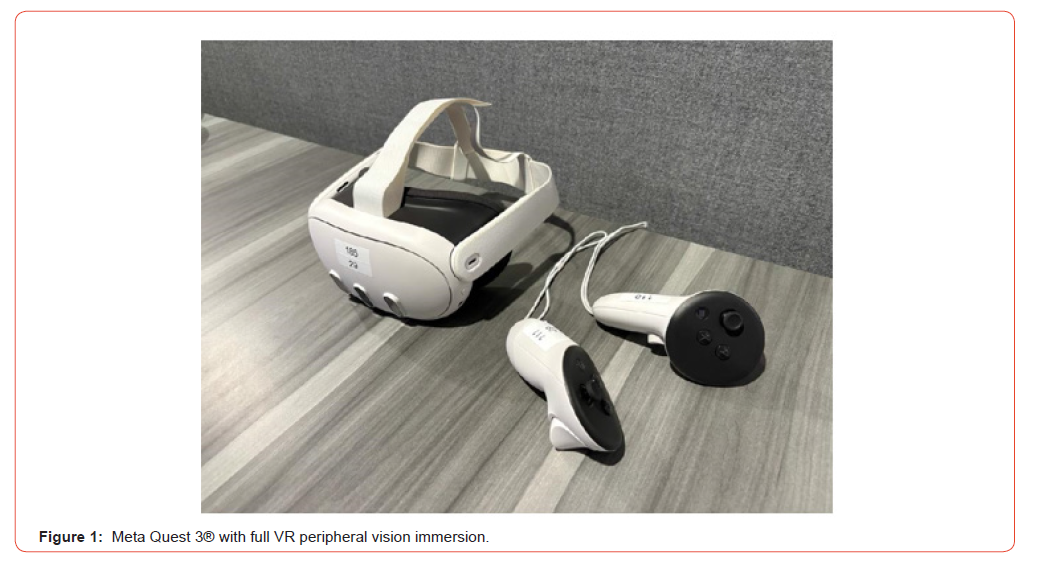
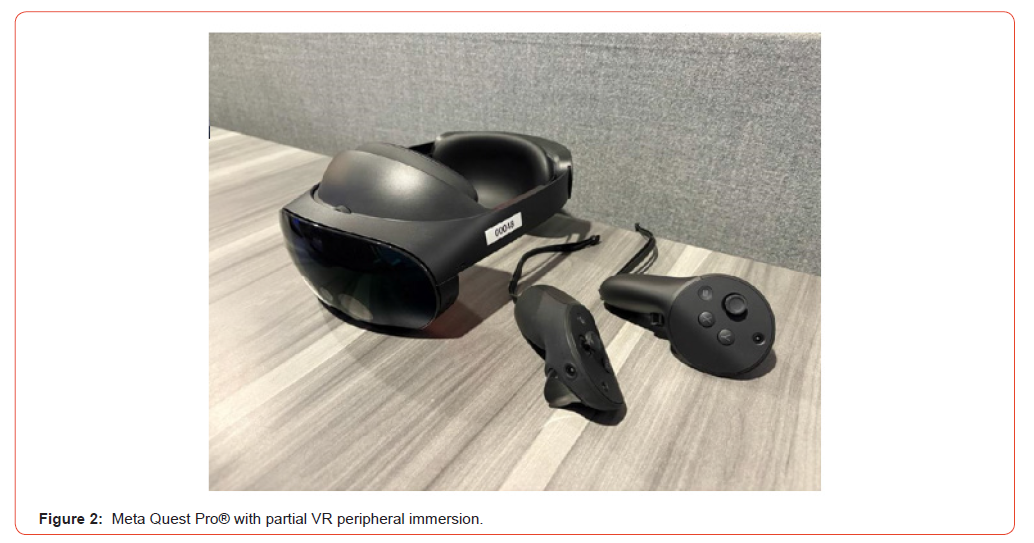
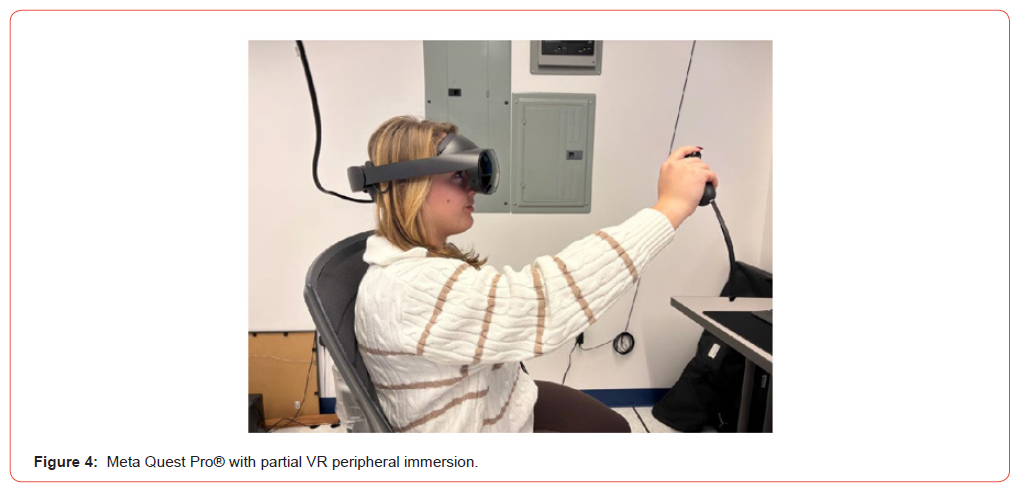
The materials used in this study included VR equipment, computers, and survey instruments. The study was conducted in a controlled classroom laboratory. The study included participants wearing one of two full-color passthrough VR head-mounted displays with associated hand control equipment. Group 1 (n = 9) participated using Meta Quest 3® with full VR peripheral vision immersion, and group 2 (n = 10) participated using Meta Quest Pro® with only partial VR peripheral immersion [20,21] (Figures 1&2). After all activities were completed, participants were surveyed using two validated scales, including the Simulator Sickness Questionnaire (SSQ), and the Game User Experience Satisfaction Scale (GUESS-18).
Procedure
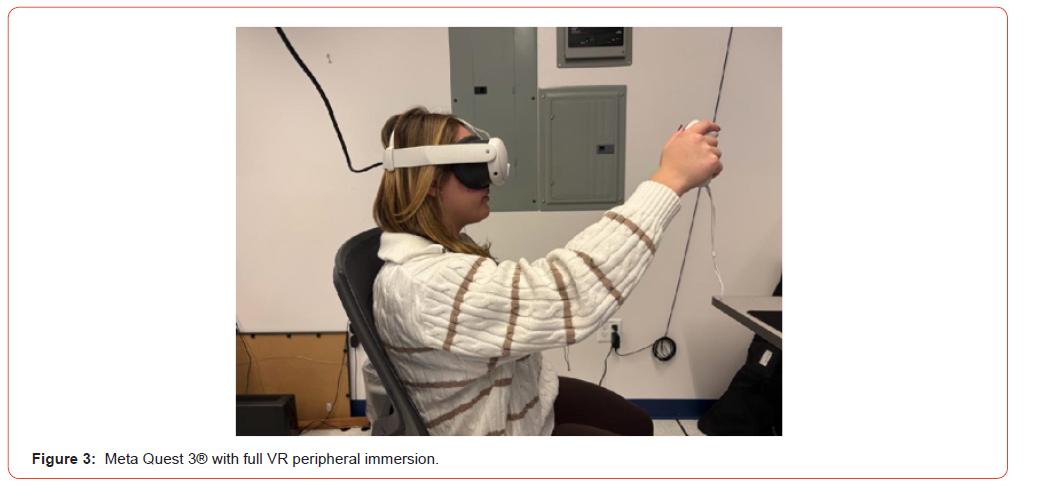
First, participants experienced three 75-minute lectures over the three weeks preceding the simulation activity. The lectures covered material related to the satellite systems necessary for standard mission operations. Second, the participants underwent a 5-minute tutorial with the lab assistant explaining the handheld controls and VR navigation concepts. The activity took place in a VR laboratory from a seated position, using handheld remotes and wearing one of two types of head-mounted devices while operating the GBVR scenario. The study was designed to provide the user with a scenario that would take approximately 10 minutes to complete. Participants (N = 19) were then divided into two groups (n = 9, n = 10) based on which head-mounted display was utilized during testing. Group 1 (n = 9) participated using Meta Quest 3® with full VR peripheral vision immersion, and group 2 (n = 10) participated using Meta Quest Pro® with only partial VR peripheral immersion [20,21] (Figures 3&4). The GBVR scenario was developed by the authors and the Embry-Riddle Aeronautical University Extended Reality Lab team using Unity® software [22].
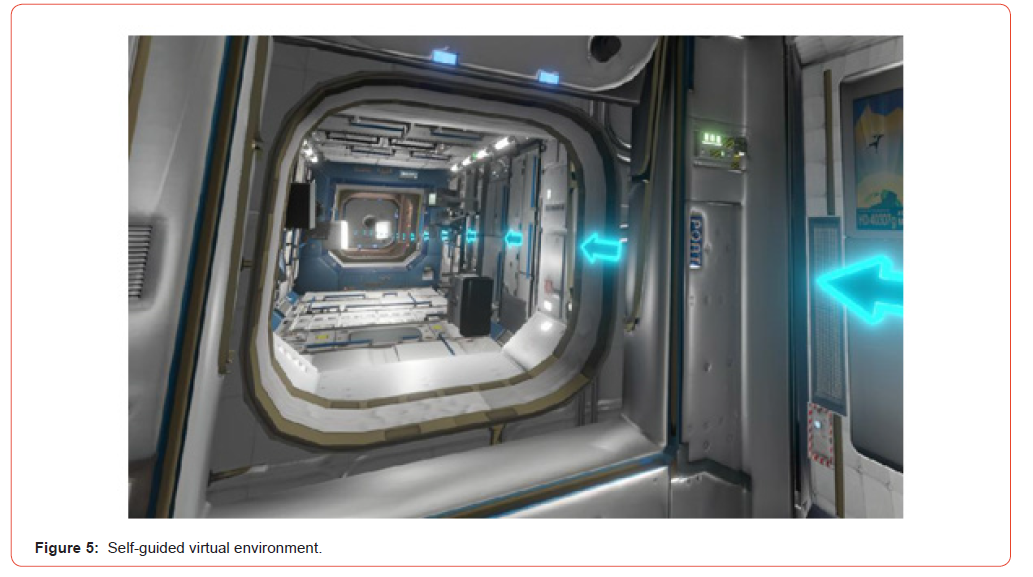
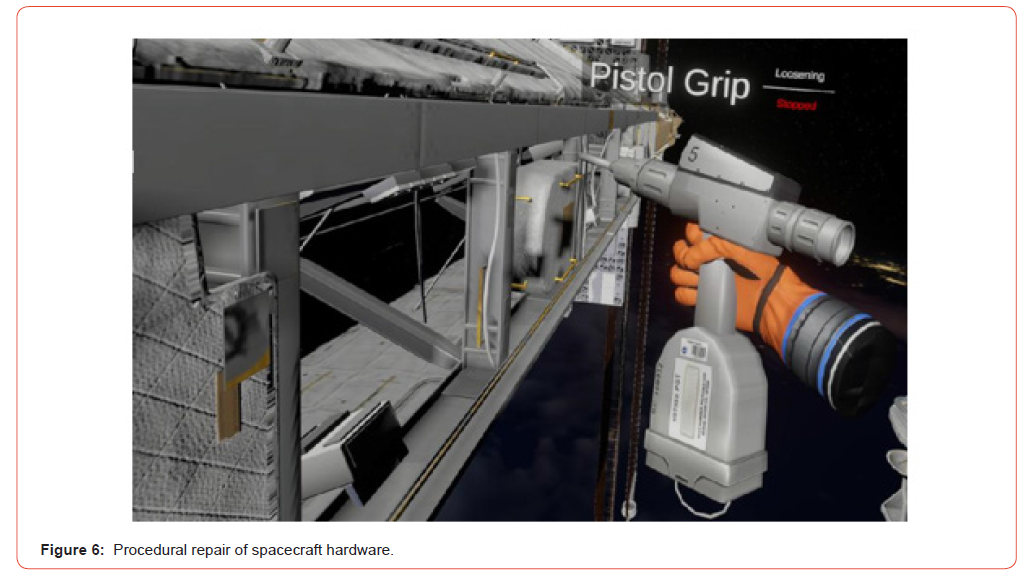
Once inside the headset, the GBVR activity was self-guided via audiovisual cues that prompted the user to navigate and translate throughout the virtual environment (Figure 5). Participants were prompted to physically investigate components of the spacecraft and complete a procedural repair of spacecraft hardware (Figure 6). The simulation provided physical interaction with a virtual space station, allowing participants to interact with spacecraft hardware as deployed in the low earth orbital setting. Finally, after completing the simulation activities, participants were given post-test surveys to measure participant perception of the GBVR simulation activities.
Measures
Survey instruments were constructed using two validated scales examining participant perception of GBVR simulator sickness and user experience.
Simulator Sickness
The Simulator Sickness Questionnaire (SSQ) was developed by Kennedy [14]. The tool seeks to measure nausea, oculomotor eye strain, and disorientation induced by simulator use. The SSQ is a 16-question survey which rates each symptom on a 4-point Likert scale (0 = none, 1 = slight, 2 = moderate, 3 = severe). Scores were rated on a scale of 0 (no symptoms) to 236 (severest symptoms). Additionally, post-test symptom severity can be influenced by the duration of exposure to the simulated environment, as noted by Jaeger and Mourant. Based on an expected average exposure duration of 10 minutes in the current study, the established maximum symptom severity score is M = 9.52 [23].
User Experience
The Game User Experience Satisfaction Scale (GUESS) was originally developed as a 55-question survey [24] and subsequently revised to an 18-question survey [25]. The instrument seeks to assess user experience and satisfaction across nine key constructs during gameplay, including audio aesthetics, visual aesthetics, creative freedom, enjoyment, narratives, personal gratification, play engrossment (engagement), social connectivity, and usability/ playability [25]. Each question in the GUESS-18 scale is rated using a 7-point Likert scale (1 = Strongly Disagree, 7 = Strongly Agree). Scores were calculated by averaging each of the nine subscales and summing the values. The sum was then divided by the maximum score of the scale (63), with final composite scores tabulated as percentages on a scale from 0 to 100% (0 = lowest score, 100 = highest score). According to a study by Shelstad et al., six popular entertainment video games were examined using the GUESS-24 scale. The result was an average score of 49.6 (raw score). When tabulated as a percentage, by dividing by the maximum possible raw score of 63, this converts to 78.7%. This score (M = 78.7) was used as a comparable standard for the user experience scores found in this study.
Results
Achieving established benchmark levels for SSQ and GUESS-18 scores is important for determining whether the GBVR training system provided an acceptable user experience while minimizing threats of simulator sickness. For the SSQ scores, maintaining ratings below the accepted maximum symptom severity level (M = 9.52) was vital for ensuring tolerable levels of simulator sickness. The average time spent in the GBVR scenario was 8.69 minutes. Neither Group 1 (M = 6.65) nor Group 2 (M = 7.11) exceeded this threshold. These results indicate that participants generally experienced low levels of simulator sickness symptom severity in both VR headset conditions, unaffected by the varying levels of peripheral vision. Regarding the GUESS-18 results, both Group 1 (M = 51.11) and Group 2 (M = 53.85) scored similarly to the popular game benchmark score (M = 49.64). These values demonstrate that participants using either VR headset reported engagement and satisfaction levels that met or exceeded those commonly observed in popular mainstream video games. Independent-samples t-tests were conducted to compare Group 1 and Group 2 across the SSQ and GUESS-18 variables. The analyses indicated no significant differences between groups on either measure, demonstrating that both VR methods resulted in comparable levels of simulator sickness (SSQ) and user experience (GUESS-18). This equivalence suggests that either VR headset is acceptable for use in training environments.
Discussion
The purpose of this study was to evaluate the viability of GBVR as an instructional method for satellite ground control training, regardless of the VR peripheral setting employed. Specifically, the study examined user experience and simulator sickness while participants operated a GBVR satellite maintenance scenario with varying levels of peripheral vision. The findings demonstrate that GBVR consistently provided a positive educational experience, with participants reporting high user satisfaction and low symptom severity across both headset types. This consistency across devices strengthens the case for GBVR as a scalable, practical training tool for satellite operators. A primary goal of the study was to determine whether simulator sickness posed a barrier to GBVR adoption. The SSQ scores for both headset groups remained well below the established simulator sickness severity threshold for the exposure duration, indicating that participants tolerated the simulation with minimal discomfort among the symptoms measured. This is an important outcome for instructional design, as physical tolerability is a prerequisite for repeated or prolonged use in academic and training environments. The similarity in SSQ scores across the two VR headsets suggests that peripheral differences did not meaningfully influence symptom severity, reinforcing the idea that GBVR can be implemented without requiring a specific device.
The second major outcome was the consistently high user experience ratings measured using the GUESS-18. Both groups reported user experience scores exceeding the benchmark observed in popular games meant for entertainment. Although the GBVR activity was meant for educational purpose, participants still found the GBVR activity engaging, enjoyable, and easy to use. Because user engagement strongly influences learning effectiveness, particularly in complex technical domains, these results support the value of incorporating game mechanics and immersive visualization into satellite operations education. The comparable GUESS-18 scores between groups further indicates that student enjoyment and interaction quality were maintained across both VR devices. This positions GBVR as a robust instructional approach independent of hardware and peripheral constraints. When considered together, the low simulator sickness scores and high user satisfaction scores provide compelling evidence that GBVR is a viable and effective training method for satellite operations. The ability to deliver a comfortable and motivating experience across different VR devices suggests that GBVR can be integrated into instructional programs without significant equipment limitations. Furthermore, the immersive environment supports conceptual understanding by allowing users to visualize and interact with spacecraft components typically inaccessible to ground operators. This offers an engaging approach to preparing future satellite operators for the technical demands of mission control environments.
Conclusion
The results of this study indicate that GBVR is a feasible instructional method for satellite ground control training. First, both VR headset peripheral vision conditions yielded simulator sickness scores well below the established symptom severity threshold, demonstrating that the GBVR scenario was physically tolerable and suitable for continued use in either condition. Secondly, user experience ratings exceeded the benchmark scores reported for popular entertainment video games, suggesting that the participants found the training engaging, enjoyable, and motivating. Lastly, the similarity of results across both VR devices shows that the instructional value of the GBVR system remains consistent regardless of hardware or peripheral differences, supporting flexible and scalable implementation in educational environments.
Together, these outcomes demonstrate that GBVR may provide an engaging, comfortable, and reliable training environment suitable for preparing future satellite operators.
Although the results are promising, certain limitations must be noted. The sample consists of students nearing graduation in space operations-related academic programs, which may limit the generalizability to novice learners or professional operators. The study also focused on user perceptions rather than performance outcomes; therefore, this study establishes the acceptance of GBVR, instead of measurable learning gains or operational proficiency. Further research should include performance-based assessments, longitudinal evaluation of knowledge retention, and comparisons with traditional instruction methods to determine the full educational impact of GBVR. Expanding the participant pool to include varying experience levels would also provide insight into how GBVR supports learners at different stages of training.
Acknowledgment
The authors gratefully acknowledge Mahmoud R. Mohamed, Joseph G. Demartini, and Cole Montrose of the Embry-Riddle Aeronautical University - Extended Reality Lab for their valuable assistance in VR development, technical support, and system testing. Their contributions were instrumental to the successful completion of this project.
References
- Deterding S, Dixon D, Khaled R, Nacke L (2011) From game design elements to gamefulness: Defining gamification. MindTrek 11: Proceedings of the 15th International Academic MindTrek Conference: Envisioning Future Media Environments PP. 9-15.
- Wang P, Wu P, Wang J, Hung-Lin C, Wang X (2018) A critical review of the use of virtual reality in construction engineering education and training. Int J of Environ Res Public Health 15(6):1204.
- Hyzy M, Wardle B, Zichermann G (2023) Gamification for product excellence: Make your product stand out with higher user engagement, retention, and innovation (First edition.). Packt Publishing.
- Lister MC (2015) Gamification: The effect on student motivation and performance at the post-secondary level. Issues and Trends in Learning Technologies 3(2).
- Hunicke R, Leblanc M, Zubek R (2004) MDA: A formal approach to game design and game research.
- Fogg BJ (2002) Persuasive technology: Using computers to change what we think and do. Ubiquity 90-120.
- Rock D (2008) SCARF: A brain-based model for collaborating with and influencing others. NeuroLeadership Journal 1(1): 44-52.
- Marczewski A (2015) Even ninja monkeys like to play: Gamification, game thinking and motivational design. CreateSpace Independent Publishing Platform.
- Zichermann G, Cunningham C (2011) Gamification by design: Implementing game mechanics in web and mobile apps. O'Reilly Media.
- Lampropoulos G, Kinshuk (2024) Virtual reality and gamification in education: a systematic review. Education Tech Research Dev 72(3): 1691-1785.
- Reason JT (1978) Motion sickness adaptation: A neural mismatch model. J R Soc Med 71(11): 819-829.
- Stanney KM, Kennedy RS (1997) The psychometrics of cybersickness. Communications of the ACM 40(8): 66-68.
- Saredakis D, Szpak A, Birckhead B, Keage HAD, Rizzo A, et al. (2020) Factors associated with virtual reality sickness in head-mounted displays: A systematic review and meta-analysis. Front Hum Neurosci 14: 96.
- Kennedy RS, Lane NE, Berbaum KS, Lilienthal MG (1993) Simulator sickness questionnaire: An enhanced method for quantifying simulator sickness. The International Journal of Aviation Psychology 3(3): 203–220.
- Lau KW, Kan CW, Lee PY (2017) Doing textiles experiments in game-based virtual reality: A design of the Stereoscopic Chemical Laboratory (SCL) for textiles education. The International Journal of Information and Learning Technology 34(3): 242-258.
- Lee MM, Lee KJ, Song CH (2018) Game-Based Virtual Reality Canoe Paddling Training to Improve Postural Balance and Upper Extremity Function: A Preliminary Randomized Controlled Study of 30 Patients with Subacute Stroke. Med Sci Monit 24: 2590-2598.
- Smith S, Ericson E (2009) Using immersive game-based virtual reality to teach fire-safety skills to children. Virtual Reality: The Journal of the Virtual Reality Society 13(2): 87-99.
- Shackelford L, David Huang W, Craig A, Merrill C, Chen D (2019) Relationships between motivational support and game features in a game-based virtual reality learning environment for teaching introductory archaeology. Educational Media International 56(1): 1-18.
- Laskey L (2025) Experimental Analysis of Satellite Operator Training Using Game-Based Virtual Reality Simulation. Doctoral Dissertations and Master's Theses.
- Meta (2024) Meta Quest Pro®.
- Meta (2025) Meta Quest 3.
- Unity Technologies (2024) Unity Real-Time Development Platform: 3D, 2D, VR & AR Engine.
- Jaeger BK, Mourant RR (2001) Comparison of simulator sickness using static and dynamic walking simulators. Proceedings of the Human Factors and Ergonomics Society Annual Meeting 45(27).
- Phan MH, Keebler JR, Chaparro BS (2016) The development and validation of the game user experience satisfaction scale (GUESS). Human Factors 58(8): 1217-1247.
- Keebler JR, Shelstad WJ, Smith DC, Chaparro BS, Phan MH (2020) Validation of the GUESS-18: A short version of the game user experience satisfaction scale (GUESS). Journal of Usability Studies 16(1): 49-62.
-

This work is licensed under a Creative Commons Attribution-NonCommercial 4.0 International License.




