




 Mini Review
Vertical Structure of Ocean Ecosystems: A Particle and Dissolved Organic View
Received Date: January 15, 2024; Published Date: February 01, 2024
Abstract
Recent trends in understanding ocean ecosystems have brought new appreciation of poorly understood components such as microbial processes and remarkable questions about the overall balances such as Redfield equilibria and time scales involved with biological and physical carbon pumps. While new theoretical and observational progress is crucial to sorting out issues from climate change to sustainable fisheries, the focus in this short essay is on processes themselves and how they vary in a vertical slice through the ocean. In a reductionist sense the discussion begins with a consideration of dissolved versus particulate matter. Here particles may be living or dead. The simple model is meant to highlight the issues involved in the time scales of particulate and dissolved carbon in the deep ocean. The goal then is to use simple two-phase models to motivate the importance of recent measurements of the carbon age of these components in the deep ocean. The phases of concern are the overall dissolved material involved in biogeochemical processes (DOC plus nutrients) and particles (bacteria, phytoplankton, zooplankton, and detritus). The overall ideas behind the biological pump can be found in recent reviews. Here the discussion starts with production in the surface layer.
Keywords: Ocean ecosystems; dissolved carbon; linear particle loss term; global thermohaline circulation
Introduction
Recent trends in understanding ocean ecosystems have brought new appreciation of poorly understood components such as microbial processes and remarkable questions about the overall balances such as Redfield equilibria and time scales involved with biological and physical carbon pumps. While new theoretical and observational progress is crucial to sorting out issues from climate change to sustainable fisheries, the focus in this short essay is on processes themselves and how they vary in a vertical slice through the ocean. In a reductionist sense the discussion begins with a consideration of dissolved versus particulate matter. Here particles may be living or dead. The simple model is meant to highlight the issues involved in the time scales of particulate and dissolved carbon [1] in the deep ocean. The goal then is to use simple twophase models to motivate the importance of recent measurements of the carbon age of these components in the deep ocean by [2,3]. The phases of concern are the overall dissolved material involved in biogeochemical processes (DOC plus nutrients) and particles (bacteria, phytoplankton, zooplankton, and detritus). The overall ideas behind the biological pump can be found in recent reviews by [4,5]. Here the discussion starts with production in the surface layer.
Consider a very simple model of particles (P; phytoplankton, zooplankton and detritus) in a light field (I (z)= I 0 exp(k z), z =0 at sea surface and z<0 with depth) and a dissolved component (N) that includes dissolved carbon and nutrients. The dissolved material is assumed to have a concentration N0 below the photic zone and uptake by P is replaced by diffusion (K d 2N / d z2sup> ) and upwelling (−wdN / dz) . It is also remineralized by adding a fraction, ε, of P lost to a linear mortality (m P). The remainder of the dead P, (1−ε ) m P, are lost to the deep ocean. While it is not important to the discussion here, these models are typically written in terms of the content of N in the fluid and P. The model equations are then
dN / dt = − u I (z) NP / (Kn + N) +ε mP − wdN / dz + Kd 2N / dz2 dP / dt = u I (z) N P / (Kn + N) −mP
where u is the nutrient uptake by P as governed by Michaelis- Menton dynamics with a half-saturation constant Kn. Analysis of this dynamical system proceeds by evaluating the steady, equilibrium states where dN / dt = dP / dt = 0 . From the dP / dt equation, the equilibrium for the nutrient is
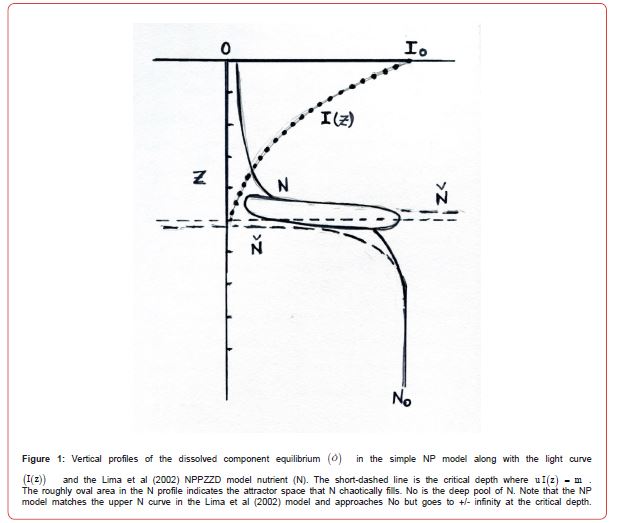
N = mKn/(uI(z)-m)Substitution of this into the dN / dt = 0 yields a rather complicated equation for the P equilibrium. The equation, however, is sufficient for the present discussion as shown in Figure 1. This simple model has a critical depth where both equilibria (N and P) behave in a way that is not possible. In a dynamical system context, the first assumption is that the dynamics become timedependent and in this case exhibit limit-cycles. The linear particle loss term (mP) is oversimplified but justified in the simple model given the heterogenous nature of P and its vertical behavior. Adding a zooplankton grazing component [6] only complicates the issue by allowing full chaos even without allowing vertical migration. More complex models [7-10] all suggest complex time dependence at the zone in the water column where light becomes limiting to P. In Lima et al. models involving NPZD and NPPZZD, where D is detritus and the double entries denote multiple P and Z, steady states lack the infinities but are still unstable at the bottom of the photic zone. The onset of chaos is set by increasing N0. This outcome is the classical paradox of enrichment [11]. Observations [12,13] are also consistent with the conclusion that this important boundary to the major productive zone in the ocean is fundamentally time dependent. This conclusion is also manifest in the variability seen in most fluorometer profiles near the 1% light level.
The notion of chaotic behavior in ecosystems has produced many studies including the classic food chain model of Hastings and Powell [14]. Chaotic systems exhibit properties that seem at odds with the overall structure of the ocean such as paradox of enrichment and extinctions. Olson and Hood [15] for example show that a H-P model of the Gulf Stream produces an unreasonable north-south productivity gradient. To avoid chaos Steele and Henderson [16] suggest using quadratic mortality, such as μ P² in the model above. While this inclusion does make models more stable and can be rationalized [17], it does not eliminate the transition to chaos. Extension of an H-P type model to include age-structured Z and a microbial web by the author and Glenn Flierl also produces enhanced stability but still exhibits chaos in a full parameter space. The question becomes one of understanding the dynamics of the ocean becomes even more daunting when one considers the large number of species that play a role. The complexity of modeling the 300 or so species described by Venrick [18] in Hawaiian water columns is beyond current capabilities.
The question is whether this system is stabilized by this complexity and the coupling to microbial and a grazing community also consisting of a very high number of players. Steele’s rationale for suppressing chaos in models is that ecosystems should evolve to minimize chaos and its tendency to reduce net production and drive extinction. Independent of the question of chaos, the evidence of relationships such as Redfield ratios imply that there is strong adaptive forces at the ecosystem scale. It also seems that trying to increase the number of players is not feasible. Instead, an explicit treatment of particle size, i.e. P(ψ )where ψ is 2π / l and l are the particle size, could provide further insight. The goal is then to describe the spectrum of particle sizes produced in the photic zone. It is also important to include the spatial-temporal distributions of N and P, the horizontal flows with their associated turbulence and the temporal variations on time scales from the diurnal cycle, weather, seasons, and climate change at various scales.
Ocean physics ranging from fronts and mesoscale eddies to small-scale turbulence produces strong time-dependent patchiness in the ocean [19]. These physical factors can mask intrinsic or even stabilize inherent time-dependent biological interactions. Temporal issues such as the Gran-Sverdrup mismatch hypothesis of blooms [20,21] also lead to variable production and particle loss to depth. Various works are now embedding these biological models into physical models to understand dynamics of upper ocean ecosystems for biogeochemical and fisheries studies. The coupling in the vertical of the photic zone to the deeper aphotic layers, however, demands more investigation. At this point the hypothesis is that strong temporal variability in photic zone P leads to a spectrum of particles that contribute additional carbon to the deep ocean carbon pool added by the coupled biophysical dissolved pump. Moving from the photic zone with its net-production of organic matter into the deep ocean, again consider the balance of particulate material (living or dead) and dissolved components.
These components in the very large-scale ocean circulation make up the physical and biological pumping of carbon into the undersaturated deep sea. The physical transport of surface layer carbon involves currents that carry dissolved inorganic carbon (DIC; CO2, HCO3, CO3) and dissolved organic matter (DOM; proteins, lipids…) into the waters below the photic zone. The biological pump involves both the contribution to the DOC by DOM carried into the deep ocean by the physical pump and the sinking of particle matter (POC, living and dead). One might speculate that the correlation between DOM and flow into the world’s thermoclines and deep waters dominates. Understanding each component of carbon flux needs to be re-examined both in relationship to the carbon problem and in the understanding of the time scale of the global thermohaline circulation. The time scale of the global “conveyorbelt” circulation first described by Defant and Wüst is currently measured by 14C in DIC. The estimated thousand-year time scale [22,23] assumes an imprint of pre-bomb radiocarbon in waters off Greenland without any modifications other than mixing during their transport to the deep Pacific.
Recent measurements of DOC 14C by [2,3] raise significant questions both about the carbon pump and the time scale of the thermohaline circulation. These observations show that DOC is much older than the DIC in the deep ocean (2-6 X 10³ vs 103 years). Their explanation involves “dead” carbon (14C = 0) from mid-ocean ridge (MOR) bio-production. The flux of carbon from MOR requires more investigation, but it seems that MOR probably produce more dead DIC than DOM. As an alternative think about the interaction between the deep-sea particle field, DIC, and DOC. Here again specific treatment of a particle size spectrum and the associated variation in particle sinking rate [24]. Measurements of sinking are provided by analysis of thorium and other insoluble elements [25,26]. Again, consider a particle-dissolved fraction model of vertical fluxes in the deep Pacific as shown in Figure 2. Without writing the equations, the model suggests a balance between upwelling of deep Pacific water that carry DIC and DOM upward and bacteria incorporation of DOM into POC.
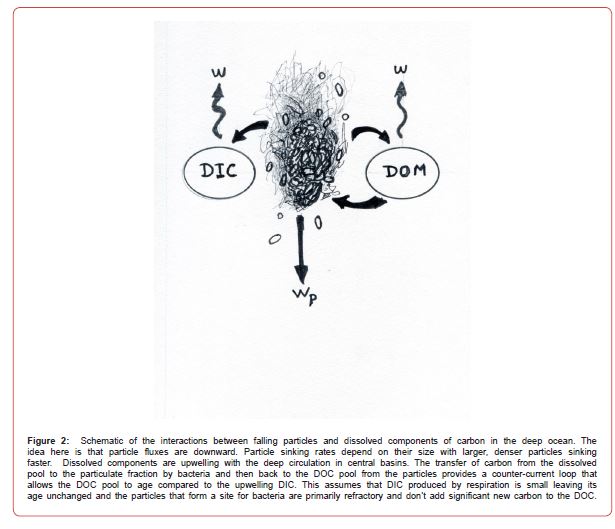
The surface-initiated particle flux is sinking, moving against the slowly upwelling waters. This counter-flow of carbon components is coupled with the action of microbes that exchange carbon between pools of DIC, DOC, and POC. The model can produce the age differences, but at the same time modifies the understanding of the upward water flux that is measured by ¹⁴C among other means. The exchanges involved with M-M uptakes are also essentially unknown. The model can be formulated with or without an explicit bacteria component (B). In the simple models a broad range of possible parameters allows the model to achieve the age difference observed by Druffel, but the model is very poorly constrained in terms of its parameters. One means of closing this problem is to introduce other tracers. An obvious choice of ¹³C does not seem to provide a constraint. A coupling of the model and the photic zone model to include multiple currencies, i.e. nitrogen, carbon…., is suggested. This allows an explicit consideration of the Redfield ratio and its variation [27,28]. Finally, the eventual contribution of organic matter (P or N) to DIC suggests that the age estimates of the deep Pacific and timescale of the conveyor belt should be re-examined. The conclusion is that vertical particle fluxes have a bearing not only on the biological pump, but on the biophysical portion of it and the global deep circulation itself.
References
- Hansell DA, Carlson CA (2015) Biogeochemistry of Dissolved Organic Matter. 2nd edition, Elsevier.
- Druffel ERM, Griffin S (2015) Radiocarbon in Dissolved Organic Carbon of the South Pacific Ocean. Geophys Res Let 42(10): 4095-4701.
- Druffel ERM, Griffin S, Lewis C, Megha R, Garcia N, et al. (2021) Dissolved Organic Radiocarbon in the Eastern Pacific and Southern Oceans. Geophys Res Let 48(10): e202GL092904.
- Siegel DA, DeVries T, Cetinić I, Bisson KM (2023) Quantifying the Ocean’s Biological Pump and its Carbon Cycle Impacts on Global Scales. Ann Rev Mar Sci 15: 329-356.
- Burd AB (2024) Modeling the Vertical Flux of Organic Carbon in the Global Ocean. Ann Rev Mar Sci 16: 135-161.
- Turner JT (2015) Zooplankton Fecal Pellets, Marine Snow, Phytodetritus and the Ocean’s Biological Pump. Prog Oceanogr 130: 205-248.
- Fasham JJR, Ducklow HW, McKelvie SM (1990) A Nitrogen-Based Model of Plankton Dynamics in the Oceanic Missed Layer. J Mar Res 48(3): 591-639.
- Olson DB, Hood RR (1994) Modeling Pelagic Biogeography. Prog Oceanogr 34: 161-205.
- Lima ID, Olson DB, Doney SC (2002) Intrinsic Dynamics and Stability Properties of Size-Structured Pelagic Ecosystem Models. J Plankton Research 24(6): 533-556.
- Kenitz KRG, Willams J, Sharples VN, Biktashev (2013) The Paradox of The Plankton: Species Competition and Nutrient Feedback Sustain Phytoplankton Diversity. Mar Eco Prog Ser 490: 107-119.
- Rosenzeig ML (1971) Paradox of Enrichment: Destabilization of Exploitation Ecosystems in Ecological Time. Science 171(3969): 385-387.
- H Huisman J, Pham Thi NN, Karl DM, Sommeijer B (2006) Reduced Mixing Generates Oscillations and Chaos in the Oceanic Deep Chlorophyll Maximum. Nature 439(7074): 322-325.
- Cullen J (2015) Subsurface Chlorophyll Maximum Layers: Enduring Enigma or Mystery Solved? Ann Rev Mar Sci 7: 207-239.
- Hastings A, Powell T (1991) Chaos in a Three-Species Food Chain. Ecology 72(3): 896-903.
- Hood RR, Bates NR, Capone DG, Olson DB (2001) Modeling the Effect of Nitrogen Fixation on Carbon and Nitrogen Fluxes at BATS. Deep-Sea Res 48(8-9): 1609-1648.
- Steele JH, Henderson EW (1992) The Role of Predation in Plankton Models. J Planton Res 14(1): 157-172.
- McCreary JP, Kohler KE, Hood RR, Olson DB (1996) A Four-Component Ecosystem Model of Biological Activity in the Arabian Sea. Prog Oceanogr 37(3-4): 193-240.
- Venrick EL (1990) Phytoplankton in an Oligotrophic Ocean: Species Structure and Interannual Variability. Ecology 71(4): 1547-1563.
- Robinson AR, McCarthy JJ, Rothschild BJ (2002) The Sea Vol.12Biological-Physical Interactions in the Sea. Academic Press.
- Mann K H, Lazier JRN (1996) Dynamics of Marine Ecosystems: Biological-Physical Interactions in the Oceans. Journal of the Marine Biological Association of the United Kingdom77(2): 571.
- Chiswell SM, Calil PHR, Boyd PW (2015) Spring Blooms and Annual Cycle of Phytoplankton: A Unified Perspective. J Plank Res 37(3): 500-508.
- Stuiver M, Quay PD, Ostlund HG (1983) Abyssal Water 14C Distribution and the Age of the World Ocean. Science 219(4586): 849-851.
- Broecker W (1991) The Great Ocean Conveyor Belt. Oceanogr 4: 79-89.
- Boyd PW, Claustre H, Levy M, Siegel DA, Weber T (2019) Multi-Faceted Particle Pumps Drive Carbon Sequestration in the Ocean. Nature 568(7752): 327-335.
- McDonnell AMP, Buesseler KO (2010) Variability in the Average Sinking Velocity of Marine Particles. Liminol Oceanogr 55(5): 2085-2096.
- Roca-Mari M, Puigeorbe V (2023) Combined use of Short-Lived Radionuclides as Tracers of Sinking Particles in the Ocean. Ann Eve Mar Sci 16(1): 21-25.
- Michaels AF, Olson DB, Sarmiento JL, Ammerman JW, Fanning K, et al. (1996) Inputs, Losses and Transformations of Nitrogen and phosphorus in the pelagic North Atlantic Ocean. Biogeochem 35(1): 181-226.
- Hansell DA, Bates NR, Olson DB (2004) Excess Nitrate and Nitrogen Fixation in the North Atlantic. Marine Chemistry 84(3-4): 243-265.
-

This work is licensed under a Creative Commons Attribution-NonCommercial 4.0 International License.




