

 Case Report
Vibration- Acoustic Stimulation a New Approach for the Treatment of Hearing Loss
Received Date: March 30, 2022; Published Date: April 11, 2022
Abstracts
Bone Conduction Hearing aids are used mainly for the treatment of patients who suffer from Single Sided deafness and/or patients who suffer from Conductive/ mixed hearing loss but not patients who suffer from Bilateral Sensorineural hearing loss. Vibration Acoustic Stimulation is a combination of both air and bone conduction hearing aids at the same time, four hearing aids, two air conduction and two bone conduction for both ears for patients who suffer from bilateral hearing loss and one bone and one air conduction hearing aid, two hearing aids on defective ear for patients who suffer from single sided deafness (SSD) and/or Unilateral Hearing Loss. We have tried this approach to see if the patients could hear better the speech in noise compared to air conduction stimulation only.
Keywords:Sensorineural hearing loss; Bone conduction hearing aids; Baha; Piezoelectric stimulation; Mixed hearing loss; Single side deafness; Tinnitus
Abbreviations:Backward Auditory Input pathways of Sound Hypothesis; Forward Auditory Input pathway of sound; Melanin; Melanocytes; Neuromelanin; QuickSIN test; Vibration Acoustic Stimulation; Optogenetic Cochlear Implant; Pupil dilation
Methods
Seven patients have been selected for the study, 5 patients with bilateral sensorineural and/or mixed hearing loss. One patient with Single sided deafness (SSD) and normal hearing in the contralateral side and one patient with unilateral sensorineural hearing loss on the right side and normal hearing on the left side. All patients fitted with each stimulation separately, First we have done the fitting process for each patient with air conduction stimulation and then we have done the fitting with bone conduction stimulation after the fitting was completed for both stimulation we have done a Quick SIN test with air conduction stimulation only (two hearing aids, one for each ear) and then we have done a QuickSIN test with VAS approach, two air conduction hearing aids and two bone conduction hearing aids (4 hearing aids at the same time) for 5 patients with bilateral hearing loss. For the two patients with Unilateral hearing loss, we have done the QuickSIN test with air conduction stimulation (only one air conduction hearing aid on the defective side) and then we have done a QuickSIN test with two hearing aids on defective side at the same time, one air conduction and one bone conduction. For the patient with SSD we have tried the Transcranial Cros approach for the air conduction stimulation as the patient did not want to be fitted with Bicros. For all patients we used Ponto 3 Superpower bone conduction hearing aids (Oticon) with the Test band for the bone conduction stimulation. For the air conduction stimulation we have tried different brands such as Oticon, Starkey, Signia, Phonak. We have done the Quick SIN test in free field mode.
Result
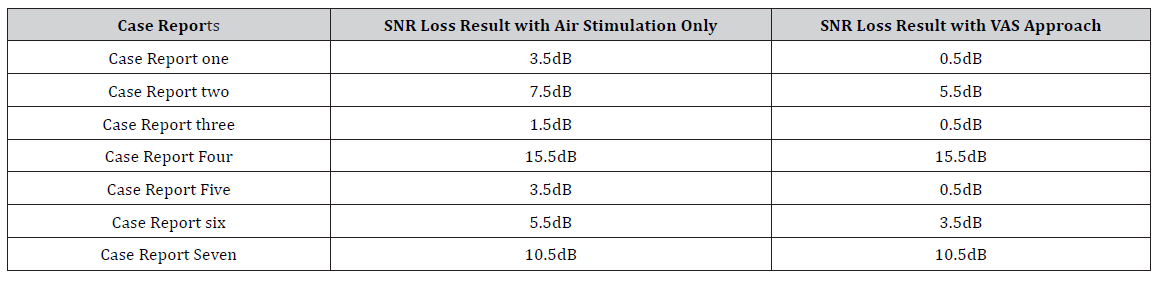
Improvement in SNR loss was observed by VAS approach for 5 of 7 patients compared to Air stimulation only (Table A1 & Figures 1-3).
Table A1:Reported nonparametric variables and light exposure determined by actigraphy.
Case Report One
Patient male 68-year-old with the history of Recurrent Otitis Media with Effusion and Chronic Otitis Media during childhood. The Otoscopy indicated Intact Tympanic Membrane (TM) in both ears. Calcification was observed on the left TM. Tympanometry was Type A in both ears and the Acoustic Reflex was absent in both ears. Pure Tone Audiometry (PTA) revealed Mild to Moderate Sensorineural Hearing Loss (S.N.H.L) on the right ear and Mixed Hearing loss on the left ear with the word Recognition score of 100% for the right ear and 96 % with masking for the left ear. The patient has been fitted with Signia 7 x RIC R hearing aids on both ears. We have done the QuickSIN test with the Aided air stimulation first and then we have fitted the patient with Bone hearing aids and then try both stimulation at the same time, 4 hearing aids, two air and two bone conduction and then we have done the QuickSIN test again with both stimulation (VAS). Improvement of SNR Loss was observed by VAS approach compared to the Air Stimulation alone.
Case Report Two
Patient male 64-year-old with a history of Stress and Anxiety and using medications for these disorders. The Otoscopy indicated Intact Tympanic Membrane (TM) in both ears. Tympanometry was Type A in both ears and the Acoustic Reflex was present on the right ear and absent on the left ear. Pure Tone Audiometry (PTA) revealed Mild to severe Sensorineural Hearing Loss (S.N.H.L) on the Right ear and Mild to Moderate S.N.HL on the Left ear with the word Recognition score of 100% (unaided) for both ears. The patient has been fitted with Oticon More Two RIC R hearing aids on both ears. We have done the QuickSIN test with the Aided air stimulation first and then we have fitted the patient with Bone Conduction hearing aids and then try both stimulation at the same time, 4 hearing aids, two air and two bone conduction and then we have done the QuickSIN test again with both stimulation (VAS). Improvement of SNR Loss was observed by VAS approach compared to the Air Stimulation alone.
Case Report Three
Patient, 50-year-old female with the history of Right ear Idiopathic Sudden Deafness for the second time and the hearing loss did not fully recover after Intratympanic Steroid Injection. The Brain MRI was Normal. The Otoscopy indicated Intact Tympanic Membrane (TM) on both ears. Tympanometry was Type A in both ears and the Acoustic Reflex was absent in both ears. Pure Tone Audiometry (PTA) revealed normal hearing on Left ear and Moderate to Severe SNHL hearing loss on the Right ear with the word Recognition score of 100% Left Ear and 90% with masking on the Right ear. We have fitted the patient with a monaural fitting, Oticon More one R RIC hearing aid on the right ear only. The patient was looking for Bicros hearing aids but we found that there is a significant residual hearing on the right ear of the patient and explained to her that she can get more benefits from amplification compared to the Bicros or Cros. We have done the QuickSIN test with the Aided air stimulation first and then we have fitted the patient with Bone Conduction hearing aid and then try both stimulation at the same time, two hearing aids, one air and one bone conduction on the right ear only and then we have done the QuickSIN test again with both stimulation (VAS). Improvement of SNR Loss was observed by VAS approach compared to the Air Stimulation alone.
Case Report Four
Patient female, 80 years old and suffered from Multiple Sclerosis (MS). The Otoscopy indicated Intact Tympanic Membrane (TM) in both ears. Tympanometry was Type A in both ears and the Acoustic Reflex was absent in both ears. Pure Tone Audiometry (PTA) revealed severe to profound Sensorineural Hearing Loss (S.N.H.L) on both ears with the poor word Recognition score for both ears. The patient has been fitted with Naida Marvel 70 SP hearing aids on both ears with the occluded ear molds. We have done the QuickSIN test with the Aided air stimulation first and then we have fitted the patient with Bone hearing aids and then try both stimulation at the same time, 4 hearing aids, two air and two bone conduction and then we have done the QuickSIN test again with both stimulation (VAS). There was no Improvement in SNR Loss in VAS approach compared to air stimulation alone.
Case Report Five
Patient female 68 year old with the history of Right ear Acoustic Neuroma/ Vestibular Schwannoma resection. The Otoscopy indicated Intact Tympanic Membrane (TM) in both ears .Tympanometry was Type A in both ears and the Acoustic Reflex was absent in both ears. Pure Tone Audiometry (PTA) revealed near normal hearing on Left ear and no response in all frequencies on the right ear with Masking with the word Recognition score of 100% Left Ear and 0% with masking on the Right ear. We have explained to the patient about Transcranial Cros and Bicros Hearing aids and she decided to go with Transcranial Cros as she did not to wear a transmitter on the Right ear and the hearing aid on the left ear so we have fitted the patient with one hearing aid on the right ear, Starkey In The Ear Livio 1600 R With the super Power receiver. The patient was happy with the result although she could not hear with the hearing aid on defective ear but when she put her cellphone on the right ear then she could understand the caller from the left ear .We have done the QuickSIN test with the Aided air stimulation first and then we have fitted the patient with Bone conduction hearing aid and then try both stimulation at the same time, two hearing aids, one air and one bone conduction on the right ear only and then we have done the QuickSIN test again with both stimulation (VAS). Improvement of SNR Loss was observed by VAS approach compared to the Air Stimulation alone.
Case Report Six
Patient female 55 year old with the history of Recurrent Otitis Media with Effusion and Chronic Otitis Media during childhood. The Otoscopy indicated Intact Tympanic Membrane (TM) in both ears. Calcification was observed on the Right TM. Tympanometry was Type A in both ears and the Acoustic Reflex was absent in both ears. Pure Tone Audiometry (PTA) revealed Mild to severe Sensorineural Hearing Loss (S.N.H.L) on the Left ear and Mild to Severe mixed Hearing loss on the Right ear with the word Recognition score of 100% for both ears. The patient has been fitted with Oticon Ruby One R RIC hearing aids on both ears. We have done the QuickSIN test with the Aided air stimulation first and then we have fitted the patient with Bone hearing aids and then try both stimulation at the same time, 4 hearing aids, two air and two bone conduction and then we have done the QuickSIN test again with both stimulation (VAS). Improvement of SNR Loss was observed by VAS approach compared to the Air Stimulation alone.
Case Report Seven
Patient male, 65 years old and with no history of any pathologies or exposure to the loud noises. The Otoscopy indicated Intact Tympanic Membrane (TM) in both ears. Tympanometry was Type A in both ears and the Acoustic Reflex was absent in both ears. Pure Tone Audiometry (PTA) revealed Moderate to severe flat Sensorineural Hearing Loss (S.N.H.L) on both ears with a word Recognition score of 50% unaided for both ears. The patient has been fitted with Starkey Livio 1600 in the Canal R Hearing Aids for both ears.
We have done the QuickSIN test with the Aided air stimulation first and then we have fitted the patient with Bone hearing aids and then try both stimulation at the same time, 4 hearing aids, two air and two bone conduction and then we have done the QuickSIN test again with both stimulation (VAS). There was no Improvement in SNR Loss in VAS approach compared to air stimulation alone.
Discussion
It is possible to detect the site of the lesion in patients who suffer from Vestibular dysfunctions with recent advancement in vestibular assessment instruments. Video Head Impulse test (VHIT) could assess the function of all semicircular canals. A caloric test could detect the function of horizontal semicircular Canals. Cervical and Ocular Vestibular Evoked Myogenic Potentials (VEMPs), Subjective Visual Vertical (SVV), Ocular counter rolling tests could detect the function of vestibular end organs, Utricle and Saccule and these tests showed that most of the patients with various degrees of hearing loss also suffer from Vestibular dysfunction as well with or without dizziness [1-12]. The Vestibular system is completely attached to the Cochlea, so it is unlikely that the Vestibular system is not involved in the hearing system. According to the Backward Auditory Input pathways of sound hypothesis, we do not only hear with our ears, we hear with the whole of our body [13]. Melanocytes are placed all over the body including epidermis of the Skin, Heart, Kidneys, Retina, Vestibular and Cochlea of the inner ear and they are possibly involved in the hearing system [14,15]. The Vestibular’s Melanocytes are likely in link with Neuromelanin, and Central Nervous System (CNS) Melanocytes and the vestibular system enact as a secondary middle ear and collects some of the auditory information which are received and synchronized by Neuromelanin and CNS melanocytes from the Skin and eyes and impart these information to the cochlea [16-17]. The cochlea encounters the auditory information from both the forward auditory input pathway of Sound which are the information approach to the cochlea from outer and middle ear and backward Auditory input pathways which are the auditory signals approach to the cochlea from the Neuromelanin and/or CNS melanocytes to the Vestibular system and finally the cochlea. The cochlea incorporated the information from both pathways and sent them to the brain for further processing [18-20].
Involvement of the Visual and tactile system in the Auditory system is observed in some studies [21]. Optogenetics Cochlear Implant and Cochlear implant combined with the haptic and/ or mechanical stimulation and pupil dilation following Auditory signals are some of the examples and demonstration of the involvement and connection of these senses together [22-25].
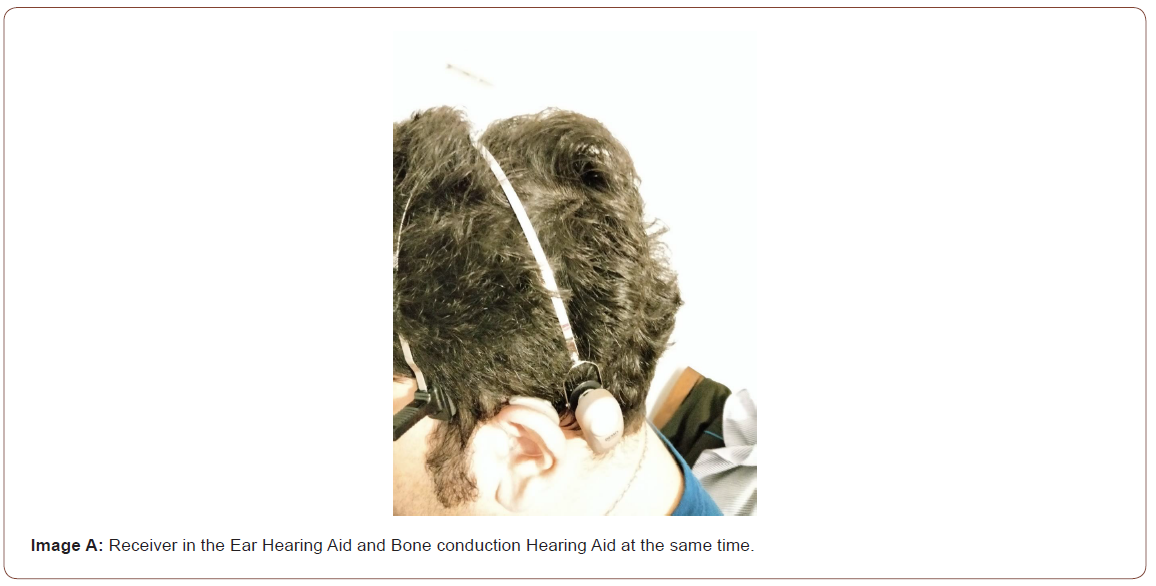
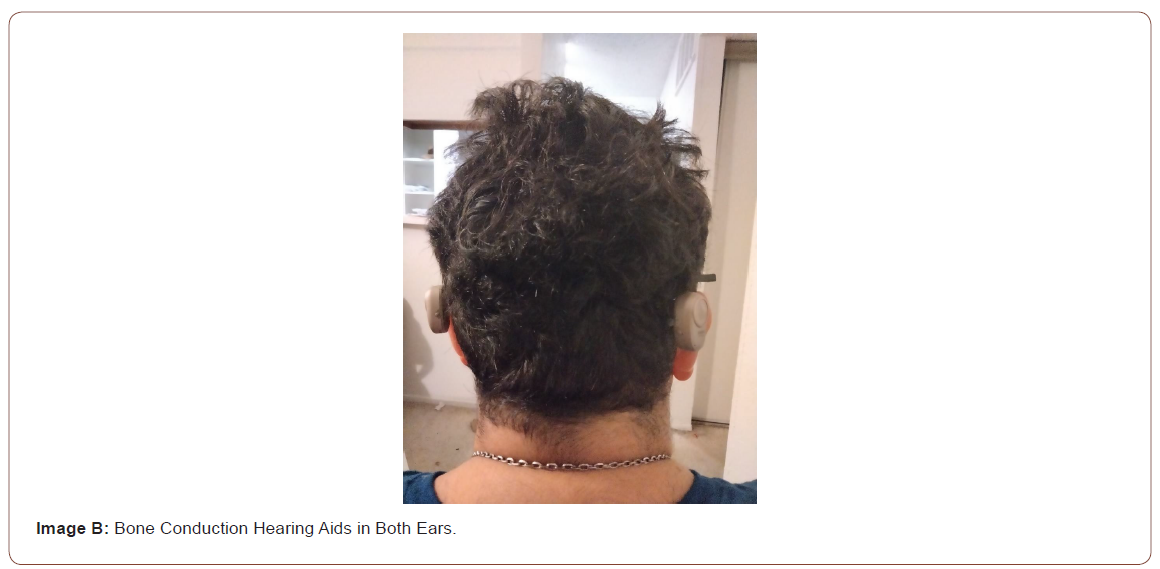
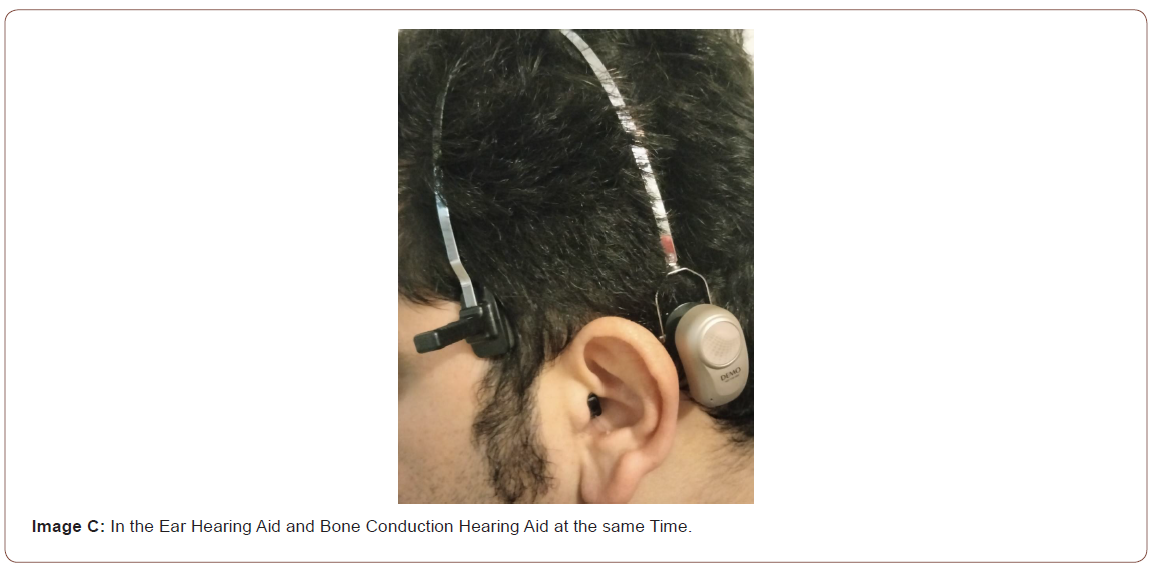
In one study showed that the patients who suffer from hearing loss could have more benefits with the combination of both electrical, optical stimulation in a cochlear Implant [26]. Perhaps the Auditory system is an electrical- Optical stimulation system. It is likely that the Vestibular system receives the auditory information from the skin and visual systems through the connection and link between the Neuromelanin/ CNS Melanocytes and inner ear melanocytes as a light because there are some studies which indicated that Neuromelanin and/or Melanin possibly have the ability to convert the sound to the light and vice versa and the sense of hearing happens through the combination of both genetic engineering following the optical stimulation and the electrical stimulation . In agreement with Backward Auditory Input pathways of sound hypothesis, we have tried Vibration Acoustic stimulation (VAS) approach which is a combination of two air conduction hearing aids for two ears and two bone conduction hearing aids for two ears ( 4 hearing aids) at the same time to see if the patients with bilateral Sensorineural or mixed hearing loss could hear better the speech in noise compared to air stimulation only(two hearing aids). We also examined the VAS approach for one patient with Single sided deafness and one patient with unilateral hearing loss to see if they can hear better the speech in noise compared to air conduction stimulation only. (Image A, B, C) We have tried superpower bone conduction hearing aids to bypass the backward auditory input pathways of sound and to facilitate reaching out the sound to the vestibular system and the cochlea at the same time with air conduction stimulation.
Conclusion
None of the patients in this study complained about the quality of sound such as echoing or fullness with the VAS approach. According to our study, the VAS approach is useful for some patients with bilateral hearing loss as well as Unilateral hearing loss and SSD typically with better hearing on the contralateral side to hear better in noisy situations as well as better localization. We have not seen any improvement in Tinnitus by VAS approach compared to air stimulation only. Patients with poor word recognition score may not benefit from VAS however we have tried this approach for a short period of time in a small population and we strongly believe that the result would be better with using this approach over the time and by adaptation and neuroplasticity. We also believe that the result would be much better with implantable bone conduction hearing aids such as BAHA, the Osia System (Piezoelectric stimulation), Bone Bridge, as those prostheses provide better stimulation, less distortion and no feedback compared to non- implanted bone conduction hearing aids. Patients with severe to profound bilateral hearing loss and poor word recognition score may benefit from Vibration Electrical/Optical Stimulation which is a combination of implantable Bone conduction hearing aids and a hybrid Cochlear Implant, further studies need to be done to see the effectiveness of this approach for these patients. Further studies also needed to determine the efficiency of Cros and/or Bicros approach along with VAS approach (A Transmitter and Bone Conduction Hearing aid on defective ear and hearing aid on better ear).
Acknowledgement
None
Conflict of Interest
No conflict of interest.
References
- Youn Ho Kim, Dong Kuck Lee, Jung Im Seok (2011) Sudden Deafness Concurrent with Ipsilateral Benign Paroxysmal Positional Vertigo. Research in Vestibular Science 10(2): 74-76.
- Byun H, Chung JH, Lee SH (2020) Clinical implications of posterior semicircular canal function in idiopathic sudden sensorineural hearing loss. Sci Rep 10(1): 8313.
- Yao Q, Xu C, Wang H, Shi H, Yu D (2018) Video head impulse test results suggest that different pathomechanisms underlie sudden sensorineural hearing loss with vertigo and vestibular neuritis: Our experience in fifty-two patients. Clin Otolaryngol 43(6): 1621-1624.
- Sazgar AA, Dortaj V, Akrami K, Akrami S, Karimi Yazdi AR (2006) Saccular damage in patients with high-frequency sensorineural hearing loss. Eur Arch Otorhinolaryngol 263(7):608-613.
- Xu XD, Zhang Q, Hu J, Zhang Y, Chen YF, et al. (2015) The hidden loss of otolithic function in children with profound sensorineural hearing loss. Int J Pediatr Otorhinolaryngol 79(6): 852-857.
- Tseng CC, Young YH (2013) Sequence of vestibular deficits in patients with noise-induced hearing loss. Eur Arch Otorhinolaryngol 270(7): 2021-2026.
- Cushing SL, Gordon KA, Rutka JA, James AL, Papsin BC (2013) Vestibular end-organ dysfunction in children with sensorineural hearing loss and cochlear implants: an expanded cohort and etiologic assessment. Otol Neurotol 34(3): 422-428.
- Zhou G, Kenna MA, Stevens K, Licameli G (2009) Assessment of saccular function in children with sensorineural hearing loss. Arch Otolaryngol Head Neck Surg 135(1): 40-44.
- Lin BY, Young YH (2016) Assessing residual vestibular function in adults with congenital hearing loss. Eur Arch Otorhinolaryngol 273(12):4209-4214.
- Zhou Y, Wu Y, Wang J (2016) Otolithic organ function in patients with profound sensorineural hearing loss J Otol 11(2):73-77.
- Chang TP, Newman-Toker DE (2019) The Link Between Bppv and Sudden Hearing Loss in Administrative Data-Biological Basis or Diagnostic Deception? Otol Neurotol 40(6): 843-844.
- Reschke, MF, Wood SJ, Clément G (2018) Ocular Counter Rolling in Astronauts After Short- and Long-Duration Spaceflight. Sci Rep 8: 7747.
- Alireza Bina (2018) The Link between Brain and Auditory System and Possible Role of Vestibular System in Hearing System as a Second Middle Ear and the Role of Melanocytes and/or Neuromelanin in this Process. Arch Neurol & Neurosci 10(1): 2021.
- Plonka PM, Passeron T, Brenner M, Tobin DJ, Shibahara S, et al. (2009) What are melanocytes really doing all day long...? Exp Dermatol. 18(9):799-819. Erratum in: Exp Dermatol 18(12): 1096.
- Barnett-Cowan M, Harris LR (2009) Perceived timing of vestibular stimulation relative to touch, light and sound. Exp Brain Res 198(2-3): 221-31.
- Do-Hyoung Kim, Chan-Young Choi, Chae-Heuck Lee, Mee Joo (2015) Primary Intracranial Leptomeningeal Melanomatosis. J Korean Neurosurg Soc 58(6): 554-556.
- Sara SJ, Bouret S (2012) Orienting and reorienting: the locus coeruleus mediates cognition through arousal. Neuron 76(1): 130-141.
- Eddie Perkins, Susan Warren, Paul J May (2009) The Mesencephalic Reticular Formation as a Conduit for Primate Collicular Gaze Control: Tectal Inputs to Neurons Targeting the Spinal Cord and Medulla. Anat Rec (Hoboken) 292(8): 1162-1181.
- Manzoni D, Pompeiano O, Barnes CD, et al. (1989) Convergence and interaction of neck and macular vestibular inputs on locus coeruleus and subcoeruleus neurons. Pflugers Arch. 413: 580.
- Bernard R Ortiz De Montellano (1993) Melanin, Afrocentricity, and pseudoscience. American Journal of Physical Anthropology.
- Gick B, Derrick D (2009) Aero-tactile integration in speech perception. Nature 462: 502-504.
- Mueller M, Salcher R, Majdani O, Lenarz T, Maier H (2015) Electro-Mechanical Stimulation of the Cochlea by Vibrating Cochlear Implant Electrodes. Otol Neurotol 36(10): 1753-1758.
- Fletcher MD, Verschuur CA (2021) Electro-Haptic Stimulation: A New Approach for Improving Cochlear-Implant Listening. Front Neurosci 15: 581414.
- Dieter A, Keppeler D, Moser T (2020) Towards the optical cochlear implant: optogenetic approaches for hearing restoration. EMBO Mol Med 12(4): e11618.
- Zekveld AA, Koelewijn T, Kramer SE (2018) The Pupil Dilation Response to Auditory Stimuli: Current State of Knowledge. Trends Hear 22: 2331216518777174.
- Thompson AC, Wise AK, Hart WL, Needham K, Fallon JB, et al. (2020) Hybrid optogenetic and electrical stimulation for greater spatial resolution and temporal fidelity of cochlear activation. J Neural Eng 17(5):056046.
-

This work is licensed under a Creative Commons Attribution-NonCommercial 4.0 International License.