
 Review Article
Paradigm Shift from Human Weather Forecaster to Artificial Intelligence Weather Forecaster
Received Date: September 22, 2025; Published Date: October 23, 2025
Abstract
This review article summarizes the key evolution in weather forecast from Empirical Forecast to Artificial Intelligence (AI) Forecast over the years and discuss some opportunities and challenges of AI for effective applications over the next generations. While AI offers clear benefits in weather forecasting, challenges remain in data quality, interpretability, and integrations with operational systems. The paper highlights the importance of international collaboration through organizations such as the World Meteorological Organization (WMO) and Typhoon Committee (TC) to strengthen cooperative research in AI applications. Moreover, the role of human forecasters remains indispensable, particularly in interpreting AI outputs, ensuring reliability, and communicating forecasts effectively to decision-makers and the public. Together, human expertise and AI innovations promise a more resilient and adaptive forecasting framework for reducing disaster risks in the era of climate change. Recent advances in AI have transformed tropical cyclone forecasting by enabling faster, more accurate predictions based on vast datasets.
Keywords: Empirical Forecast; Meteorological Instruments; Numerical Weather Predictions; Human Forecaster; AI Forecaster; Nonlinearity; Uncertainty of Weather Forecast; Opportunities and Challenges of AI
Watersheds of Weather Forecast
Era of Astral Bodies Observation and Empirical Forecast
People have attempted to predict the weather for thousands of years. Ancient weather forecasting methods usually relied on observed patterns of events, also termed pattern recognition. The Sun, Moon, stars and shape of clouds are essential indicator for weather forecast. For example, it was observed that if the sunset was particularly red, the following day often brought fair weather. This empirical experience accumulated from generations to generations. Aristotle described weather patterns in ‘Meteorologica’ about 350 B.C [1].
Era of Meteorological Instruments and Modern Weather Forecast
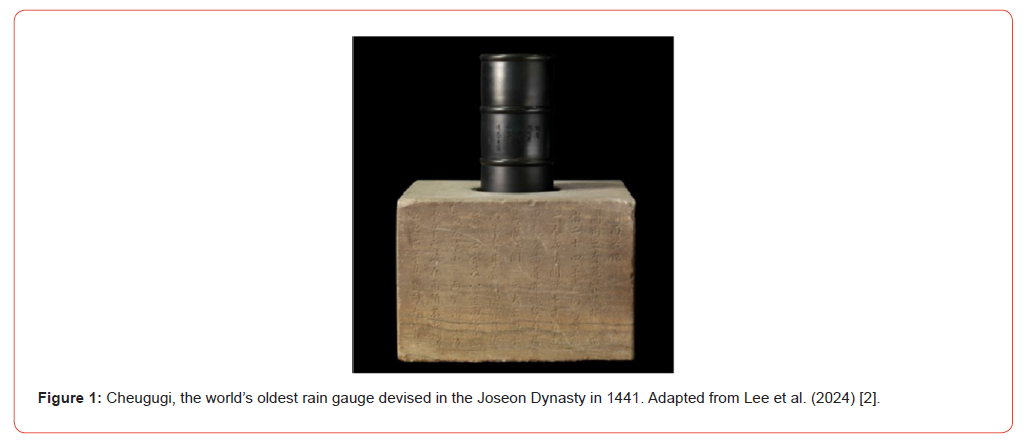
The accurate measurement of rainfall was important for ancient agricultural society. In this background, the Great King Sejong in the Joseon Dynasty (1392-1910, Korea) and a group of scientists invented the rainfall gauge, known as “Cheugugi (prototype of modern rain gauge)” in 1441 [2, 3] [Figure 1]. From 16th to 17th centuries, several European scientists developed various type of meteorological instruments. Galileo Galilei (Italy) in 1603 developed “Galileo thermoscope” known as the first type of thermometer [4]. Furthermore, the “mercury barometer” known as the earliest barometer, was created by Evangelista Torricelli (Italy) in1643. The three main observational instruments are used for measuring key factors of weather forecast - rain gauge (water), thermometer (air temperature), barometer (air pressure), respectively [5]. In 1854, Le Verrier, he produced the first weather chart using a network of meteorological observations and the telegraph, playing a key role in advancing the transition from the era of meteorological instruments – rain gauge, thermometer, barometer, etc – the era modern weather forecasting [6].
Era of Numerical Weather Prediction
The evolution of weather forecasting has been closely tied to advances in science and technology. During the World WarIand II, the strategic necessity of accurate forecasts highlighted the value of systematically collecting meteorological observations across Europe, facilitated by emerging telecommunication networks. This context gave rise to the idea that machines, and later computers, could be employed to process observational data for predictive purposes. In 1922, English scientist Lewis Fry Richardson published “Weather Prediction by Numerical Process” [7]. The joint team composed of meteorologists and applied mathematician from America and Norway, performed the first computerized weather forecast in 1950 [8]. Practical use of numerical weather predictions (NWPs) began in 1955 [9] spurred by the development of programmable electronic computers. Building upon this idea, successive innovations – including radar, satellite observations, and high performance supercomputing – have progressively extended the scope and accuracy of forecasting. Today, these developments enable predictions on a global scale, ranging from very short range forecast (VSRF, approximately 3~6 hours) of a few days to longterm climate projections.
A Summary of AI History and Recent Extraordinary Progress in AI Weather Forecast
The concept of AI had born since 1940s. The scientists from a variety of fields, for example mathematics, physics and engineering, investigate the theoretical possibility of “machine intelligence”. The term “Artificial Intelligence (AI)” was firstly introduced by John McCarthy at the Dartmouth workshop in 1956 [10]. However, the AI research field experienced the “First AI winter (1974–1980) and Second AI winter (1990s)”. The AI researcher’s contribution had underestimated and wane that periods [11]. The DeepMind Challenge Match in 2016, was a pivotal event in history of AI. This match was known as the “Go match between Top class Go player Lee Sedol (Korea) and AlphaGo, a computer Go AI program” developed by DeepMind, played in Seoul, Korea between the 9th and 15th of March 2016. The Go is a kind of board game. Finally, Lee Sedol won one game but AlphaGo won four games. This match was broadcast in four language (Korean, Chinese, Japanese, and English) and was watched millions of people worldwide. With this match, AI became very popular and proved to be a breakthrough technology in the world [12]. This match was known as the advent of AI for public use.
One year after, the transformer architecture developed Google DeepMind widely adopted generative AI applications such as high impact weather forecast, biology and disaster risk reduction, etc. In 2017, the transformer architecture was proposed by Google researchers in a paper titled “Attention Is All You Need”. It exploits a self-attention mechanism and became widely used in large language models [13]. The new AI era began since 2020, with the public release of scaled large language models (LLMs) such as ChatGPT developed by OpenAI [14]. The Royal Swedish Academy of Sciences awarded Nobel Prizes in recognition of ground breaking contributions to AI both Physics (John J. Hopfield, Princeton University and Geoffrey Hinton, University of Toronto) and Chemistry (David Baker, University of Washington, and Demis Hassabis, John M. Jumper, Google DeepMind) in 2024 [15]. Initial attempts of AI to apply for weather forecast began in the 2010s. Global Big Technology and NMHS (National Meteorological and Hydrological Service) agencies are developing AI within the past two to three years [16].
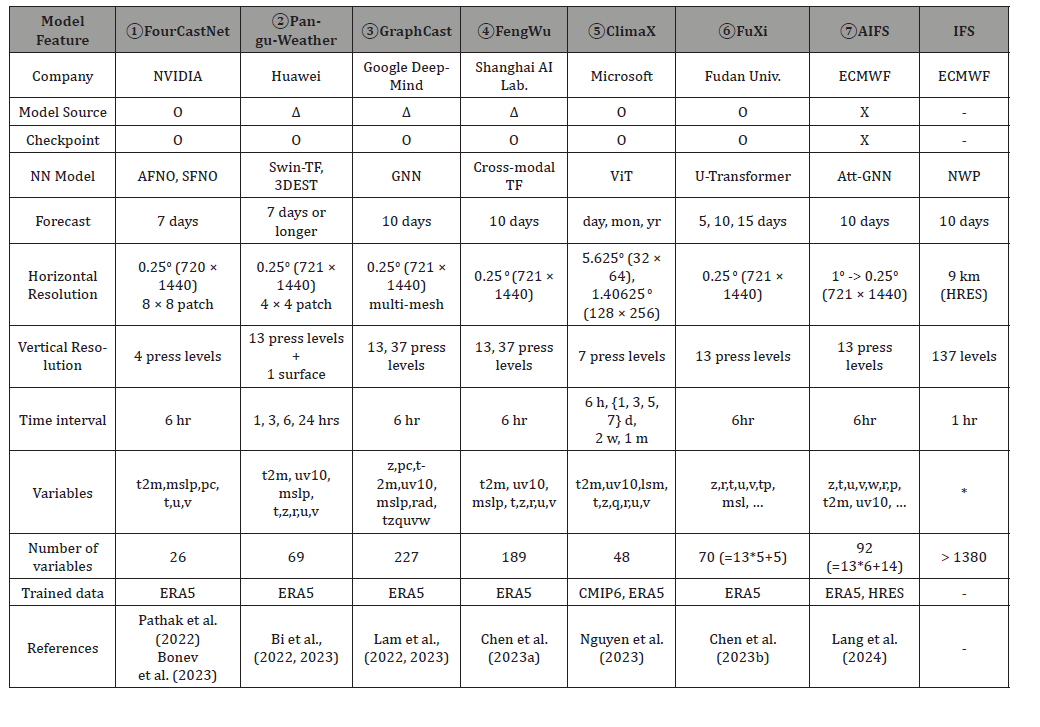
a. NVIDIA’s FourCastNet introduced Operator Learning
techniques, leveraging Physics -Machine Learning [17,18],
while
b. Huawei Cloud’s Pangu-Weather presented a conceptually
robust approach with 3D Earth-specific transformer (3DEST)
capable of processing three-dimensional data directly [19,20],
c. Google DeepMind’s GraphCast, employing the Graph
Neural Network (GNN), maintained spatial and vertical
resolution parity with ERA5 [21,22],
d. the Shanghai AI Laboratory’s FengWu model enhanced
long-term prediction performance through variable-specific
independent processing tailored to atmospheric variable
characteristics [23],
e. Microsoft’s ClimaX stands as an integrated model capable
of both short- and long-term forecasting as well as climate
prediction, with applications spanning global, regional, and
high-resolution domains [24],
f. FuXi, developed by Fudan University in China, achieved
leading performance in extended-range forecasting, reaching
up to 15 days, by independently handling prediction in three
segments: 0~5, 5~10, and 10~15 days [25], and
g. European Centre for Medium-Range Weather Forecasts’
Artificial Intelligence/Integrated Forecasting System (ECMWF’s
AIFS) incorporates an attention-based GNN by merging the
characteristics of GraphCast’s GNN with Transformers [26].
Table 1 summarize the key characteristics of AI.
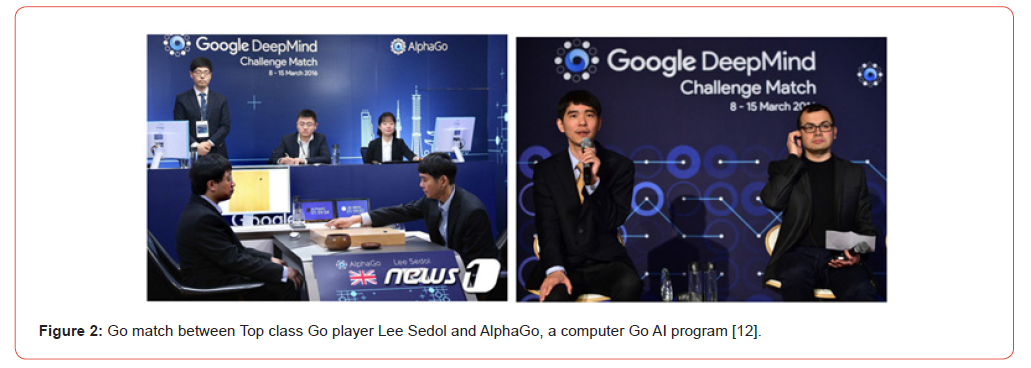
Table 1: Characteristics of global AI models. Adapted from Table 1 in Kim et al. (2025) [16].
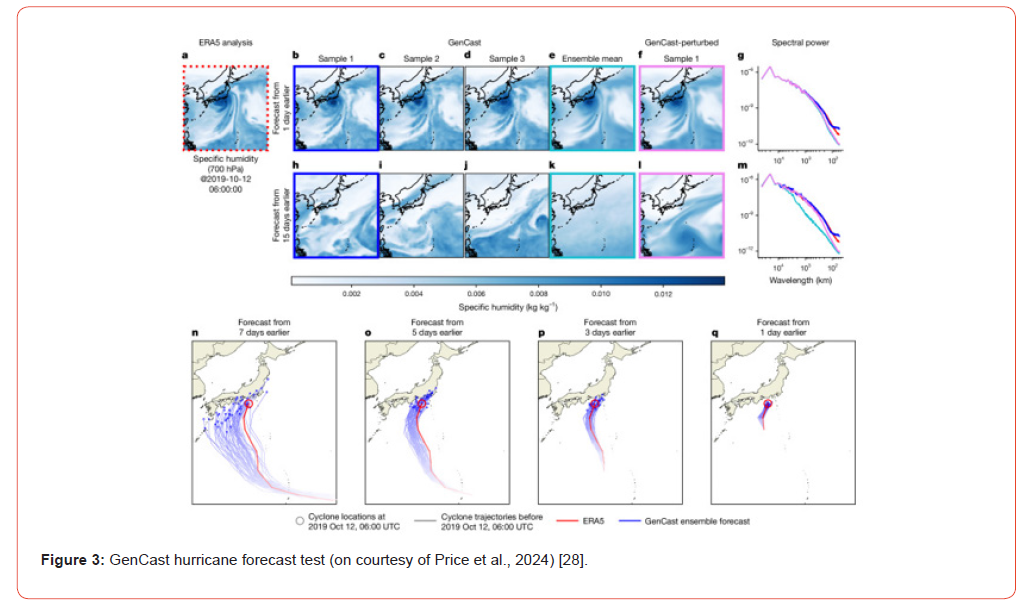
Such models use no physics-based atmosphere modeling or large language models. Instead, they learn purely from data such as the ECMWF re-analysis ERA5 [27]. These models typically require far less compute than physics-based models [16]. Results showed [Figure 3] that Google’s GraphCast, called GenCast, provided the most accurate 7-day track forecasts, while model ECMWF Integrated Forecast System (IFS) most accurate of intensity, indicating a need for improvement in 2024 [28]. Many studies have reported that AI models can perform as well as, or in some cases outperform, conventional NWPs for medium-range forecasts of up to five days. Nevertheless, AI continue to reveal weakness in predicting extreme phenomena that the relatively rare and rapidly intensify, for example, Rapid Intensification (RI) of tropical cyclone and highly localized mesoscale deep convection clouds (DCCs). The limitation arises because AI largely depend on historical statistics. When extreme events are underestimated in the training data, the resulting forecasts often fail to capture them accurately. In order to supplement the lack of training data for AI, target observational field campaign offers a path toward more accurate AI forecast [29,30]. Many low orbit and Geostationary Satellite data have been applied tropical cyclone intensity analysis, although further progress of intensity prediction based on satellite remains necessary [31].
Opportunities and Challenges of AI
Recent advancement in AI weather forecast have demonstrated the potential to complement, and in some cases even substitute, traditional physics-based grid NWPs and human forecast. AI-based forecasting systems provide several notable advantages.
a. Speed and efficiency
AI models can issue forecasts rapidly, enabling more frequent
updates in response to fast evolving weather conditions.
b. Enhanced decision support
Certain AI models exhibit accuracy comparable to NWP,
improving timely decision-making for weather.
c. Error reduction
Automated forecasts reduce reliance on subjective human
interpretation and minimize operational error.
d. Continuous availability
Unlike human forecasters, AI forecaster can operate without
interruption, offering particular appeal in minimizing the burden
overnight shifts forecasting duties in NMHS and private weather
companies in the world.
Prof. Hinton expressed concerns about the dangers and risk of AI in several interviews [32, 33, 34]. AI weather forecast also present significant challenges. In the field of weather forecasting, several critical issues warrant close consideration:
a. Lack of interpretability
Unlike human forecast and NWPs, which provide forecasts
accompanied by physical explanations. AI often lack sufficient
interpretability to explain why a given prediction was made.
b. Extreme events and long-term prediction
Extreme weather events, for example, RI and DCCs and forecast
on long-term times scales such as, seasonal prediction of tropical
cyclone remain particularly challenging, requiring substantial
further research.
c. Fundamental scientific concerns
Since weather forecasting is fundamentally based on the fluid
dynamics, it remains uncertain whether AI can fully capture the
inherent uncertainties and irreversibility of atmospheric and
oceanic flows.
d. Accountability
Finally, questions of accountability arise when AI-driven
forecast errors lead to significant loss of life or property damage –
responsibility in such cases remains unclear.
Future Direction and Recommendation
AI has shown remarkable promise in advancing the science and practice of weather forecasting. While it offers advantages - speed, efficiency, and operational flexibility but critical limitations remain in interpretability, extreme event prediction, and accountability. To solve these problems
a. Research into explainable AI (XAI) aims to provide
physical insights into AI predictions, bridging the gap between
statistical accuracy and scientific understanding.
b. The inclusion of synthetic data, extreme event
augmentation, and coupled climate model simulations could
help improve AI performance in predicting rare or unexpected
phenomena.
c. Integrating AI with NWP – such as using AI for bias
correction, data assimilation, or parameterization – offers a
pathway to robust, physically consistent forecasts.
d. Clear guidelines on accountability, transparency, and
operational use of AI forecasts are essential before full scale
adoption. Collaboration among meteorological agencies, AI
developers, and policymakers will be critical.
e. As Climate Change intensifies the frequency of
unprecedented extremes, AI models must adapt to nonstationary
conditions. Developing models that remain reliable
under shifting climate regimes will be a central challenge.
Future progress will likely rely on hybrid approaches that combine physical understanding with data-driven AI. With further research and careful integration into operational systems, AI may not only complement but also transform the future of meteorological forecasting. Furthermore, the development and application of AI forecasting systems can be pursued supporting with international collaboration is essential, particularly given the global nature of weather and climate systems. WMO and UN ESCAP/WMO Typhoon Committee provide established frameworks for cooperation. Their leadership in data sharing, standardized evaluation protocols, and joint capacity-building can ensure that AI-driven forecasting benefits are equitably distributed across both developed and developing countries. Such coordinated efforts are crucial for tackling transboundary weather hazards, where collective preparedness, shard expertise, and cooperative decisionmaking can significantly reduce societal and economic risks. By embedding AI development within a framework of international collaboration, the global meteorological community can accelerate innovation while ensuring fairness, resilience, and sustainability in weather and climate services.
Finally, AI forecast provides powerful new technology and it should be regarded as complement rather than a replacement for human forecasters. Human meteorologists bring critical expertise in interpreting AI outputs, integrating local knowledge, communicating uncertainty, and making context-sensitive decisions- particularly during extreme and unprecedented events. The future of weather forecasting will therefore depend not on AI alone, but on a synergistic partnership between advanced AI systems and skilled human forecasters, supported by international collaboration. Such as integrated and harmonized approach will enhance both the scientific robustness and the societal value of forecasting in an era of growing climate risks.
Acknowledgement
This research was supported by Korea Institute of Marine Science & Technology Promotion (KIMST) funded by the Korea Coast Guard (RS-2023-00238652, Integrated Satellite-based Applications Development for Korea Coast Guard).
The author acknowledges the grateful discussion with Prof. C.H. Ho (Ehwa Woman’s University, Republic of Korea), Dr. D.H. Kim (Jeju National University, Republic of Korea), Prof. J.H. Im (Ulsan National Institute of Science and Technology, Republic of Korea), Dr. Y.H. Duan (Secretary, UN ESCAP/WMO Typhoon Committee) and Prof. H. Fudeyasu (Yokohama National University, Japan) to reviewing the specific topics cited in this paper. Emeritus Prof. S.D. Lee and Dr. Y.S. Chun have always encouraged my research activity.
Conflicts of Interest
No conflicts of interest
References
- Frisinger H Howard (1972) Aristotle and his "Meteorologica". Bulletin of the American Meteorological Society 53 (7): 634–638.
- Lee Jae Won, Ho Jeong Shin, Jinkyu Hong (2024) A historical Review on the Introduction of Chugugi and the Rainfall Observation Network during the Joseon Dynasty. Scientific Data 11: 1-8.
- Kwag Nohbong et al. (2025) Cheugugi & Cheugudae, Celebrating the 5th Anniversary of its National Treasure Designation & the Opening of the National Meteorological Museum in Korea. Korea Meteorological Administration, Seoul, Republic of Korea pp.136.
- Aleksandr Khristoforovich Khrgian (1970) Meteorology: a historical survey, Volume 1, Israel Program for Scientific Translations pp. 25.
- (2010) Brief History of the Barometer. Barometer.ws. Archived from the original on 14 January 2010. Retrieved 2010-02-04.
- (2015) BBC. The birth of the weather forecast. BBC News. April 30, 2015. Retrieved April 30.
- Richardson Lewis Fry (1922) Weather Prediction by Numerical Process. Cambridge University Press, Cambridge, England.
- Charney JG, Fjörtoft R, von Neumann J (1950) Numerical Integration of the Barotropic Vorticity Equation. Tellus 2(4): 237–254.
- Paul N Edwards (2007) Atmospheric General Circulation Modeling. Wayback Machine Retrieved February 16, 2007.
- Moor J (2006) The Dartmouth College Artificial Intelligence Conference: The Next Fifty years. AI Magazine 27(4): 87–89.
- Solomonoff RJ (1985) The Time Scale of Artificial Intelligence: Reflections on Social Effects. Human Systems Management 5(2): 149–153.
- BBC (2016) Go master Lee Se-dol wins against AlphaGo program (2016). BBC News Online. 13 March 2016. Retrieved 13 March 2016.
- Vaswani Ashish, Noam Shazeer, Niki Parmar, Jakob Uszkoreit, Llion Jones, et al. (2017) Attention is All you Need. 31st Conference on Neural Information Processing Systems (NIPS). Advances in Neural Information Processing Systems. Vol. 30. Curran Associates, Inc. arXiv:1706.03762.
- (2022) OpenAI – Introducing ChatGPT. Retrieved November 30, 2022.
- Nobel Prizes (2024) (https://www.nobelprize.org/all-nobel-prizes-2024/) official Nobel website.
- Kim Dong-Hoon, Il-Ju Moon, and Minsu Joh (2025) Recent advances in AI-based atmospheric general circulation Models. Atmosphere. Korean with English Abstract pp. 263-276
- Pathak J, Shashank Subramanian, Peter Harrington, Sanjeev Raja, Ashesh Chattopadhyay, et al. (2022) Fourcastnet: A global data-driven high-resolution weather model using adaptive fourier neural operators. arXiv:2202.11214, pp. 28.
- Bonev B, T Kurth, C Hundt, J Pathak, M Baust, et al. (2023) Spherical fourier neural operators: learning stable dynamics on the sphere. Proceedings of the 40th International Conference on Machine Learning, in Proceedings of Machine Learning Research 202: 2806-2823.
- Bi K, L Xie, H Zhang, X Chen, X Gu, et al. (2022) Pangu-Weather: A 3D high-resolution model for fast and accurate global weather forecast. arXiv:2211.02556, 19.
- Kaifeng Bi, Lingxi Xie, Hengheng Zhang, Xin Chen, Xiaotao Gu, et al. (2023) Accurate medium-range global weather forecasting with 3D neural networks. Nature 619(7970): 533- 538.
- Lam R, Alvaro Sanchez Gonzalez, Matthew Willson, Peter Wirnsberger, Meire Fortunato, et al. (2022) GraphCast: Learning skillful medium-range global weather forecasting. arXiv: 2212.12794 pp. 102.
- Remi Lam, Alvaro Sanchez-Gonzalez, Matthew Willson, Peter Wirnsberger, Meire Fortunato, et al. (2023) Learning skillful medium range global weather forecasting. Science 382(6677): 1416-1421.
- Chen K, Tao Han, Junchao Gong, Lei Bai, Fenghua Ling (2023) Fengwu: Pushing the skillful global medium-range weather forecast beyond 10 days lead. arXiv:2304.02948, 12.
- Nguyen T, J Brandstetter, A Kapoor, JK Gupta, AG rover (2023) ClimaX: A foundation m odel f or weather and climate. Proceedings of the 40th International Conference on Machine Learning 202: 25904-25938.
- Chen L, X Zhong, F Zhang, Y Cheng, Y Xu, et al. (2023) FuXi: A cascade machine learning forecasting system for 15-day global weather forecast. npj Clim Atmos Sci 6(1): 190.
- Lang S, Mihai Alexe, Matthew Chantry, Jesper Dramsch, Florian Pinault, et al. (2024) AIFS-ECMWF's data driven forecasting system. arXiv:2406.01465, pp. 13.
- Hersbach, H, Bill Bell, Paul Berrisford, Shoji Hirahara, András Horányi, et al. (2020) The ERA5 global reanalysis. Quart J Roy Meteor Soc 146(730): 1999–2049.
- Price Ilan, Alvaro Sanchez Gonzalez, Ferran Alet, Tom R Andersson, Andrew El Kadi, et al. (2024) Probabilistic weather forecasting with machine learning. Nature 637 (8044): 84–90.
- Cha Eun Jeong (2023) Korea Precipitation Observation Program (KPOP) International collaborative experiments for mesoscale convective system in Seoul Metropolitan area. ESCAP/WMO Typhoon Committee 18th Integrated Workshop/4th TRCG Forum, Bangkok, Thailand.
- Xiaotu Lei, Waikin Wong, Clarence Fong (2017) A challenge of the Experiment on Typhoon intensity change in coastal area. Tropical Cyclone Research Review 6(3-4): 94-96.
- Minki Choo, Yejin Kim, Juhyun Lee, Jungho Im, Il Ju Moon (2024) Bridging satellite missions: deep transfer learning for enhanced tropical cyclone intensity estimation. Giscience & Remote Sensing 61(1): 2325720.
- Taylor Josh, Hern Alex (2023) Godfather of AI Geoffrey Hinton quits Google and warns over dangers of misinformation. The Guardian. Retrieved 8 October 2024.
- Metz, Cade (2023) The Godfather of A.I.' Leaves Google and Warns of Danger Ahead. The New York Times. Retrieved 1 May 2023.
- Jacobson, Dana (host); Silva-Braga, Brook (reporter); Frost, Nick; Hinton, Geoffrey (guests) (2023) Godfather of artificial intelligence talks impact and potential of new AI. CBS Saturday Morning. Season 12. Episode 12. New York City: CBS News. Retrieved 28 March 2023.
-

This work is licensed under a Creative Commons Attribution-NonCommercial 4.0 International License.