
 Review Article
EURI – UR EIB/BIE Design and Preliminary Implementation of a Rainwater Harvesting System for Automated Cleaning of Photovoltaic Panels at the Bilbao School of Engineering
Received Date: June 24, 2026; Published Date: September 01, 2026
Abstract
Society is increasingly aware of the importance of water as an essential global resource, although its value is often fully recognized only during periods of scarcity. Consequently, the reuse of rainwater for non-potable applications—such as irrigation, outdoor cleaning, and maintenance—has become a key strategy for sustainable water management. Within this context, the EURI-UR project, developed at the Bilbao School of Engineering under the Campus Bizia Lab (CBL) initiative, aims to assess the potential of rainwater harvesting and to design systems that facilitate its efficient use. At the same time, the widespread deployment of photovoltaic facilities has highlighted the need for effective cleaning systems to maintain energy production and reduce maintenance costs. Dust, atmospheric deposition, and other contaminants accumulating on photovoltaic surfaces can significantly reduce panel efficiency. This work presents the design, implementation, and preliminary evaluation of a pilot rainwater harvesting system. The system collects rainwater directly from photovoltaic panel surfaces using customized 3D-printed gutters, stores it in intermediate and main tanks, and redistributes it through an automated pumping system. Several technical challenges were identified, including insufficient gutter slope, structural constraints, and electrical issues affecting float-switch operation. A relay-based control system was successfully implemented to ensure reliable pump performance. Preliminary results confirm successful rainwater collection and transfer, demonstrating the technical feasibility of the proposed solution. This approach highlights the potential integration of rainwater harvesting with photovoltaic systems in urban and educational environments, contributing to water conservation and improved renewable energy maintenance.
Keywords: Rainwater harvesting; photovoltaic panels; water reuse; sustainable infrastructure; automated cleaning; urban hydrology
Introduction
Water conservation and sustainable resource management have become key priorities in urban environments due to climate change, increasing water demand, and the need to improve infrastructure resilience. Rainwater harvesting systems offer an attractive solution for reducing potable water consumption while promoting circular water management strategies and supporting the sustainable use of available water resources. The Bilbao School of Engineering [1], part of the University of the Basque Country (EHU) [2], comprises three buildings serving approximately 6,000 users and, consequently, significant water consumption. As part of its commitment to sustainability, the University has promoted several initiatives through the Campus Bizia Lab (CBL) [3] programme, developed within the framework of the EHU agenda 2030 and aligned with the Sustainable Development Goals (SDGs) [4]. One of these initiatives is the EURI-UR project [5], which aims to promote circular water management practices by assessing the potential for rainwater harvesting and reuse on campus. Figure 1 shows the identification of the project.
Previous work by Natalia Alegría et al. (2025) [6] analyzed local precipitation patterns, estimated the volume of rainwater that could be recovered from building rooftops, and evaluated several nonpotable applications for the collected water within the Bilbao School of Engineering, demonstrating both the technical and environmental feasibility of rainwater reuse and establishing a methodology that could be replicated across other EHU facilities. Furthermore, rainwater storage tanks were installed in the newest building of the School and successfully integrated into the supply system for toilet cisterns, demonstrating the viability of alternative water sources for non-potable applications. Building upon these findings, the present study focuses on the implementation phase of the EURI-UR project through the development and testing of a pilot-scale rainwater harvesting system integrated with a rooftop photovoltaic facility. By collecting rainwater directly from photovoltaic surfaces and reusing it for automated cleaning operations, the proposed system extends the circular economy approach previously developed by Alegría et al. (2025) while contributing simultaneously to water conservation, improved photovoltaic performance, and sustainable infrastructure management.
At the same time, photovoltaic facilities have become increasingly common in educational, industrial, and residential buildings. However, the accumulation of dust, atmospheric particles, and biological deposits on photovoltaic surfaces can reduce energy production, making periodic cleaning necessary to maintain system efficiency. Traditionally, these cleaning operations require the use of potable water, which conflicts with sustainable water management objectives [7]. The combination of rainwater harvesting and photovoltaic panel cleaning therefore represents a promising strategy for simultaneously reducing potable water consumption, lowering maintenance costs, and improving the sustainability of renewable energy infrastructures. In this context, the EURI-UR project was developed at the Bilbao School of Engineering to extend the existing rainwater reuse initiatives by designing and implementing a pilot-scale system capable of collecting rainwater directly from photovoltaic panel surfaces and reusing it for the automated cleaning of the same facility. The proposed system integrates customized gutter structures, intermediate and main storage tanks, automated pumping devices, and control systems to recover, store, and redistribute rainwater. This approach contributes not only to water conservation but also to the efficient operation of photovoltaic systems, demonstrating the potential of integrating circular water management practices with renewable energy infrastructure in educational and urban environments.
Materials and Methods
Project Framework
The present work was developed within the EURI-UR project at the Bilbao School of Engineering (University of the Basque Country, EHU), whose main objective is to promote sustainable rainwater management in accordance with the Sustainable Development Goals (SDGs), particularly SDG 6 (Clean Water and Sanitation), SDG 9 (Industry, Innovation and Infrastructure), SDG 12 (Responsible Consumption and Production), and SDG 5 (Gender Equality).
The project was structured into five main tasks:
a. analysis of local precipitation data,
b. assessment of rainwater harvesting potential,
c. identification of feasible applications for collected rainwater,
d. implementation of selected applications, and
e. dissemination of the obtained results.
The work presented in this paper corresponds primarily to Task 4, namely the design and implementation of a pilot rainwater harvesting system for the cleaning of photovoltaic panels installed on the rooftop of the Bilbao School of Engineering.
Study Site
The pilot facility was implemented on the rooftop photovoltaic facility of the Bilbao School of Engineering, located in Bilbao (northern Spain). The city is characterized by an oceanic climate with abundant and relatively well-distributed rainfall throughout the year, making it particularly suitable for rainwater harvesting applications. Previous analyses carried out within the EURIUR project demonstrated the potential availability of rainwater resources on campus buildings and identified photovoltaic panel cleaning as a suitable non-potable application for the recovered water [6].
System Design and Components
The implemented system was designed to collect rainwater directly from the surface of photovoltaic modules, temporarily store the collected water, and subsequently redistribute it through an automated cleaning system.
The facility consists of the following elements:
a. Photovoltaic panels acting as rainwater catchment surfaces.
b. Customized gutters located beneath the panel edges.
c. An intermediate storage tank (approximately 30 L).
d. A main storage tank (210 L).
e. Water transfer pumps.
f. Float switches for level monitoring.
g. Relay-based control circuitry.
h. Programmable timers.
i. Sprinklers for photovoltaic panel cleaning.
Table 1: Summarizes the main components of the system.

Collection System Development
During the initial facility phase, field inspections revealed that commercially available gutters could not be directly installed beneath the photovoltaic panels due to limited clearance between the modules and their supporting structure. To solve this issue, customized mounting supports were designed and manufactured using additive manufacturing (3D printing) with PLA material. These components allowed the gutters to be securely fixed beneath the photovoltaic panels while maximizing the available hydraulic head and facilitating water flow towards the collection point. Several facility tests were conducted to verify the structural feasibility of the proposed solution and to determine the minimum slope required for effective rainwater drainage.
Storage and Transfer System
A two-stage storage strategy was adopted to improve operational flexibility and facilitate automated water management. Rainwater collected by the gutters is first directed into an intermediate storage tank. Once the water level reaches a predefined threshold, a float switch activates a transfer pump that transports the collected water to the main storage reservoir. Initial testing showed that direct control of the pump using the float switches resulted in malfunction of the reed-switch mechanism due to transient currents generated during pump startup. To overcome this limitation, a relay-based control system was incorporated between the float switch and the pump.
The final operating sequence is as follows:
a. Rainwater accumulates in the intermediate tank.
b. The upper-level float switch activates a relay.
c. The relay energizes the transfer pump.
d. Water is transferred to the main storage tank.
e. When the water level decreases below the predefined
threshold, the float switch changes state.
f. The relay deactivates the pump automatically.
This control strategy provided reliable operation during preliminary testing and ensured automatic management of the harvested rainwater without continuous operator intervention.
Final Application
The water stored in the main reservoir is intended for use in an automated sprinkler system designed to clean the photovoltaic panels. This application was selected because it simultaneously contributes to water conservation by replacing potable water and improves the operational efficiency of the photovoltaic facility by reducing dirt accumulation on the panel surfaces.
Results
Structural Evaluation
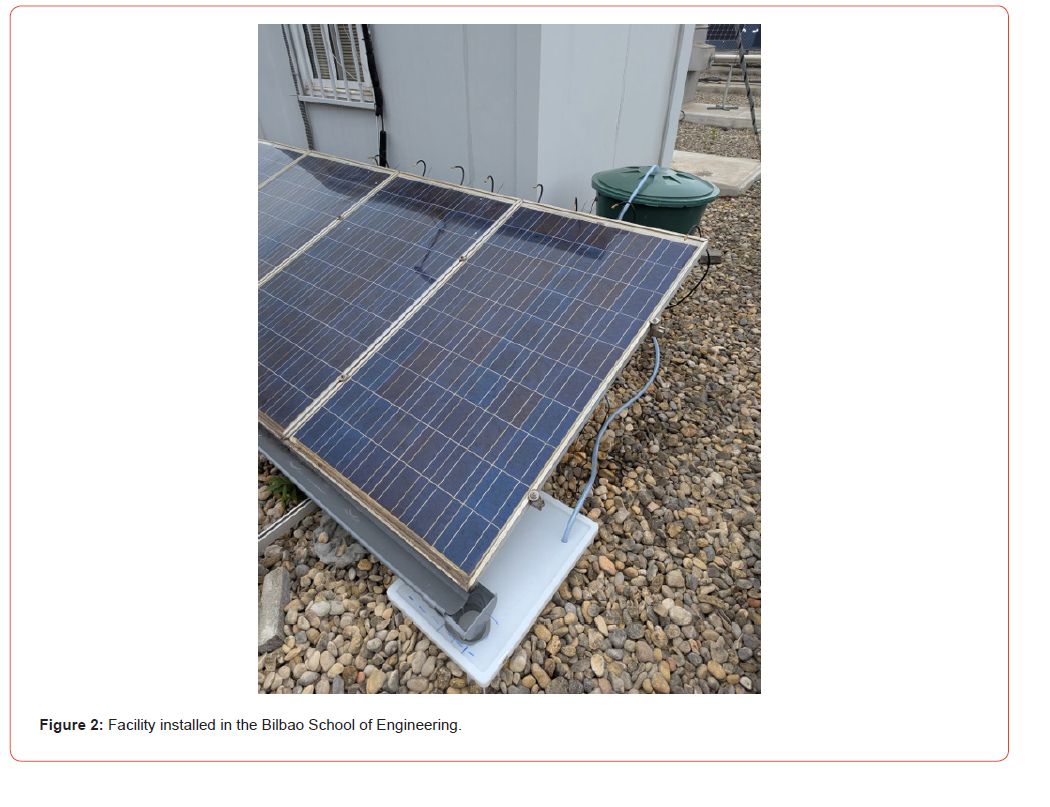
The initial gutter facility, Figure 2, confirmed the mechanical feasibility of the proposed support design.
However, the available slope was insufficient to guarantee efficient water drainage. To address this issue, elevation spacers based on M8 threaded supports were proposed to raise the photovoltaic panels several centimeters.
Rainwater Collection Performance
During inspections performed in late May 2026, the intermediate storage tank was found completely full after rainfall events. Although no continuous monitoring system was available at this stage, the complete filling of the intermediate tank after rainfall events confirmed the functionality of the collection system. This observation confirmed:
a. Successful rainwater capture.
b. Adequate gutter operation.
c. Effective water transport toward the collection point.
The main tank remained empty due to the incomplete transfer system at that stage of implementation.
Pump Control Validation
Two different float switches were tested. Both exhibited failure when directly controlling the pump load, remaining permanently closed after activation. Electrical inspection suggested contact welding of the reed-switch caused by pump inrush currents. The incorporation of an intermediate relay completely solved the problem.
Subsequent tests confirmed:
a. Reliable automatic activation.
b. Reliable automatic deactivation.
c. Stable water transfer operation.
Discussion
The pilot facility demonstrates the technical feasibility of
harvesting rainwater directly from photovoltaic modules and
reusing it for automated cleaning purposes.
Several practical engineering challenges were identified during
implementation:
a. Structural limitations imposed by existing panel supports.
b. Hydraulic constraints associated with gutter slope.
c. Electrical reliability issues in low-cost float switches.
The use of 3D-printed customized supports proved particularly valuable because it enabled rapid adaptation of commercial components to site-specific constraints. The relay-based control architecture also improved system reliability and may be considered a recommended solution for similar small-scale facilities. In summary, challenges related to hydraulic design and control reliability have been observed in small-scale rainwater harvesting systems. But the present work confirms that simple design modifications, such as customized supports and relaybased control architectures, can substantially improve system performance under real operating conditions. An additional advantage of the proposed system is that all its components were selected following a low-cost design philosophy. The gutters, storage tanks, float switches, relay-based control system, pumps, and 3D-printed supports were chosen to minimize implementation costs while maintaining adequate operational performance. This approach enhances the replicability of the system in educational buildings, small-scale photovoltaic facilities, and other urban environments where budget constraints may limit the adoption of more sophisticated solutions.
Nevertheless, several aspects require further optimization before large-scale deployment. Future developments should address the management of overflow events during periods of intense rainfall, improving the hydraulic efficiency of the collection and storage system to maximize water recovery. In addition, the cleaning strategy should be optimized to increase water-use efficiency and enhance the overall productivity of the photovoltaic installation. Finally, the potential use of harvested rainwater for panel cooling should be investigated, as reducing panel operating temperature may contribute to improving photovoltaic conversion efficiency, particularly during periods of high solar irradiance and elevated ambient temperatures
Future work should focus on:
a. Quantifying harvested water volumes.
b. Evaluating annual water savings.
c. Assessing photovoltaic efficiency improvements after cleaning.
d. Developing IoT-based monitoring systems using Arduinocompatible
sensors.
e. Integrating rainfall sensors and predictive control algorithms.
Conclusions
A pilot rainwater harvesting system for photovoltaic panel
cleaning was successfully designed and implemented at the Bilbao
School of Engineering.
The study demonstrates that:
a. Photovoltaic panels can effectively function as rainwater
collection surfaces.
b. Customized 3D-printed supports provide an effective solution
for gutter facility under existing panel structures.
c. Intermediate storage and relay-controlled pumping allow
reliable automated water transfer.
d. Preliminary results confirm the feasibility of rainwater
collection under the climatic conditions of Bilbao.
The proposed solution contributes to sustainable water management, reduces dependence on potable water for maintenance activities, and supports the integration of circular economy principles into urban renewable-energy infrastructures. Future developments will focus on optimizing overflow management, increasing water recovery and cleaning efficiency, and evaluating the potential use of harvested rainwater as a cooling medium to further enhance photovoltaic performance.
Acknowledgement
The authors would like to thank the Water Hall “CABB” (The Bilbao Bizkaia Water Consortium (CABB, in Spanish), a Business Hall located at the Bilbao School of Engineering, where data to make this revision related to energetic generation along the water supply system of Greater Bilbao were available.
Conflict of Interest
No Conflict of Interest.
References
- Escuela de Ingeniería de Bilbao – EHU.
- Inicio – EHU.
- Campus Bizia Lab - Sostenibilidad – EHU.
- Objetivos de Desarrollo Sostenible | Programa De Las Naciones Unidas Para El Desarrollo.
- EURI-UR EIB/BIE. Proyecto Campus Bizia Lab - Sostenibilidad – EHU.
- Natalia Alegría, Igor Peñalva, Charles Pinto, María Urrestizala (2025) EURI-UR: Circular Economy of Rainwater at the Bilbao School of Engineering. Adv in Hydro & Meteorol 3(2): 1-4.
- Raed Nahar Mayyas, Mohammad Al Dabbasa, Marcos Tostado Véliz, Francisco Jurado Improving Performance & Harvesting Rainwater, by Cooling and Cleaning Solar Panel Intelligent System. Universidad de Jaén pp. 1-29.
-

This work is licensed under a Creative Commons Attribution-NonCommercial 4.0 International License.