


 Review Article
Impact of Missing Data on Quadratic Trend-Cycle and Seasonal Indices in Time Series Analysis: Additive Case
Received Date: December 15, 2025; Published Date: February 16, 2026
Abstract
This paper discusses impact of missing data on quadratic trend cycle and seasonal indices in time series. The method adopted in this study is the Buys-Ballot procedure developed to, among other things, choice of appropriate model for decomposition of any study series, estimation of trend parameters and seasonal indices based on row, column and overall means and variances. The estimated trend parameters and seasonal indices in the presence and absence of missing data are compared. Results indicate that difference between seasonal indices in the presence and absence of missing data has significant effect. The significant differences existed on the points in which there are missing data in the column of the Buys-Ballot table. But insignificant in the trend parameters. trending curves and increasing the number of missing values.
Keywords:Missing Data, Additive Model, Trend Parameter, Seasonal Indices, Buys-Ballot table
Introduction
A common problem that is frequently encountered in time series data is missing observations. This so since data are records taken through time. Missing data occurred because of several problems, such as technical fault or human errors (the object of observation did not give sufficient data to the observer) Pratama, et al. [1]. Brockwell and Davis [2] stated that missing data at the beginning or the end of the time series are simply ignored while intermediate missing data are considered serious flaws in the input time series. Missing observations in the time series data are very common [3]. This happens when an observation may not be made at a particu lar time, due to faulty equipment, cost records or a mistake, which cannot be rectified until later. When this happens, it is necessary to obtain estimate of the missing value for better understanding of the nature of the data and make possible a more accurate forecast [4]. Pratama, et al. [1], in a study on a review of missing observations handling methods on time series data observed that estimation method is probably the best option of missing data handling, since to accomplish certain work, the complete dataset is needed and some dataset have dependent variable which is impossible to delete the missing values as it can disrupt the data itself.
Cheema [5] compared different missing data handling methods (listwise deletion, mean imputation, regression imputation, maximum likelihood imputation and multiple imputation) using different methods of analysis (one sample t-test, two-sample t-test, twoway ANOVA and multiple regression). These methods, according to him are the four analytical methods that are frequently employed in educational research. However, his result did not cover handling missing values in time series data. IS Iwueze, et al. [6] recommended that the Decomposition Without Missing Value (DWMV) method be used in estimating missing values in time series analysis, this is because DWMV yielded best (in terms of the accuracy measures) estimates of the missing values when compared with both the existing methods and the two other new proposed methods (Row Mean Imputation and Column Mean Imputation). Also, DWMV combines the effects of both the trending curves and the seasonal indices unlike the other methods. This study considers the impact of missing data on Buys-Ballot estimates when trend cycle component of time series is quadratic. The Buys-Ballot is primarily used for the decomposition of a relatively short-term period such that the trend and cyclical components are jointly estimated Chatfield [7]. This estimation procedure based on the Buys-Ballot table is particularly useful since it only involves computing the column and row totals and averages of the table.
Buys-Ballot decomposition models are Additive Model: Xt = Mt + St + ut (1) Multiplicative Model: Xt = Mt × St × ut (2) Mixed Model: Xt = Mt × St + ut (3)
It is always assumed that the seasonal effect, when it exists, has a period that is, it repeats after time periods.
S t+S =S t for all t (4)
For equation (1), it is convenient to make assumption that the sum of the seasonal components over a complete period is zero, ie,

Similarly, for equations (2) and (3), the convenient variant assumption
is that the sum of the seasonal components over a complete
period is s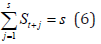
Iwueze, et al. [6] summarized the Buys-Ballot procedure called
the Buys-Ballot table. A Buys-Ballot table summarizes data to show
seasonal variations. Each line in the table is one period (usually a
year) and each column is a season of the period/year (4 quarters,
12 months, etc). A cell (i,j), of this table contain the mean value of
all observations made during the period i at the season j. To analyse
the data, it is helpful to include the period and seasonal totals
(Ti and Tj) , period and seasonal average  . period and
seasonal standard deviations
. period and
seasonal standard deviations  as part of the Buys-Ballot
table. Also included for purposes of analysis are the grand total (T. ),
grand mean.
as part of the Buys-Ballot
table. Also included for purposes of analysis are the grand total (T. ),
grand mean.  .
and pooled standard deviation
.
and pooled standard deviation  (see Table 1).
According to Wei [8], the arrangement of data in this manner
in table is credited to Buys-Ballot; hence, the table has been called
the Buys-Ballot table in the literature. Buys-Ballot is used to estimate
the trend component and seasonal indices from the chosen
descriptive time series model. According to Dozie [9], Buys Ballot
procedure is computationally simple when compared with other
descriptive methods. The values of the estimated trend parameters
and seasonal indices are easily computed in the mixed model in
time series. Iwueze and Nwogu [10] proposed the Buys-Ballot estimation
procedure and for the periodic means 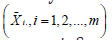 and
the overall mean
and
the overall mean  .
to estimate the trend component. Seasonal
means
.
to estimate the trend component. Seasonal
means 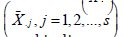 and the overall mean are used to estimate
the seasonal indices.
and the overall mean are used to estimate
the seasonal indices.
This research is restricted to time series with quadratic trend that admits the additive model using registered number of reported marriages over a period January, 2008 to December 2024. The use of Buys-Ballot table in estimation of trend parameters and seasonal indices in the presence of missing data using the methods of Iwueze and Nwogu [10] will be stated. The missing data will be estimated using the decomposition method of Iwueze, et al. [6] and the entire process of estimation will be repeated in the absence of the missing data. The impact on the Buys-Ballot estimation of quadratic trend parameters and seasonal indices in the presence and absences of the missing data will be established. The, ultimate objective of this study is to identify the impact of missing data on quadratic trend parameters and seasonal indices. The specific objectives are to: (a) estimate the missing data (b) estimate the trend parameter and seasonal indices of the data in the presence of missing observations (c) estimate the trend parameter and seasonal indices of the data in the absence of missing observations (d) compare estimates trend parameters and seasonal indices in the presence and absence of missing data. Based on the results and recommendations are made. This work contributes to the many existing solution of the problem of imputing missing data to a time series data.
Methodology
The methods adopted in this study is the Buys-Ballot procedure developed for choice of model for decomposition of any study series, estimation of trend parameters and seasonal indices and choice of appropriate transformation based on the row, column and overall means and variances, For details of Buys-Ballot procedure for time series decomposition see Wei [8], Iwueze and Nwogu [10], Nwogu, et al. [11], Dozie [9], Dozie and Uwaezuoke [12], Dozie, et al. [13], Dozie and Ijeoma [14], Dozie and Nwanya [15], Dozie and Ihekuna [16], Dozie and Ibebuogu [17], Dozie and Ibebuogu [18], Dozie and Uwaezuoke [19], Dozie and Ihekuna [20], Dozie and Ihekuna [21], Dozie [22], Dozie and Uwaezuoke [23] and Dozie [24] (Table 1).
Table 1: Buys-Ballot Table for Seasonal Time Series.

Estimation of Missing Observation
Decomposing Without the Missing Value (DWMV)
This is one of the estimation methods for missing observations proposed by I.S. Iwueze, et al. [6]. In this method, estimates of the trend parameters and seasonal indices obtained from the remaining observations using any of the methods of time series decomposition are substituted into the expression for the missing value.
Hence, the estimates of the missing values by this method are given by:
For Additive model 
For multiplicative model 

Hence, the estimates of the missing values for additive model are given by;

Estimation of Trend Parameters
To access the trend of the entire series, the plot of the transformed period/row means is considered. The expression of the quadratic trend is given by

Iwueze and Nwogu [10] stated the estimation of the trend parameters for an additive model when trend-cycle component is quadratic as;


Estimation of Seasonal Indices
Iwueze and Nwogu [10] gave the estimation of the seasonal indices for an additive model when trend-cycle component is quadratic as;

where

Hence,

Real Life Example
The real-life example is based on monthly time series data on
number of Marriages from St. Molumba’s Catholic Church Owerri
in Imo State for a period of seventeen (17) years (2008-2024)
shown in appendix A. The 189 observations are transformed using the power transformation  and arranged in a Buys-Ballot
table as monthly data (S=12) and for 17years (m=17). The
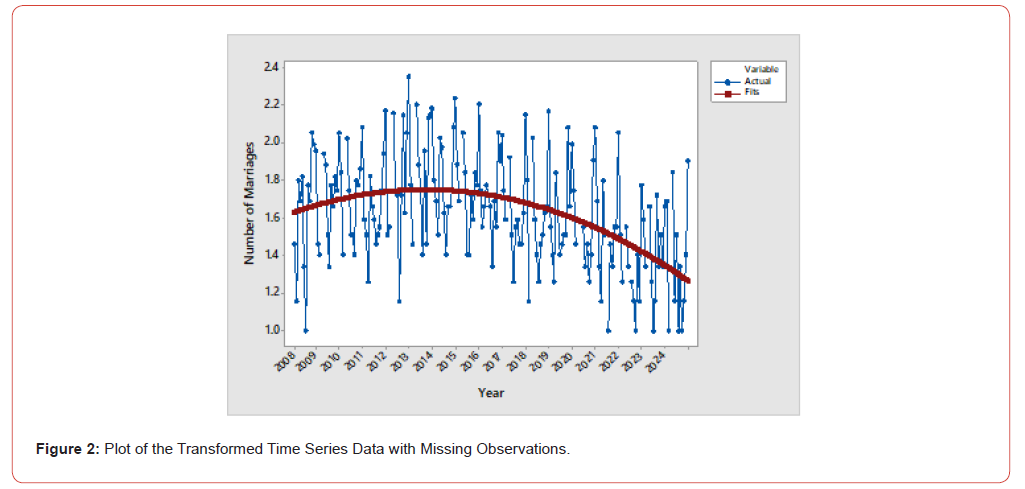
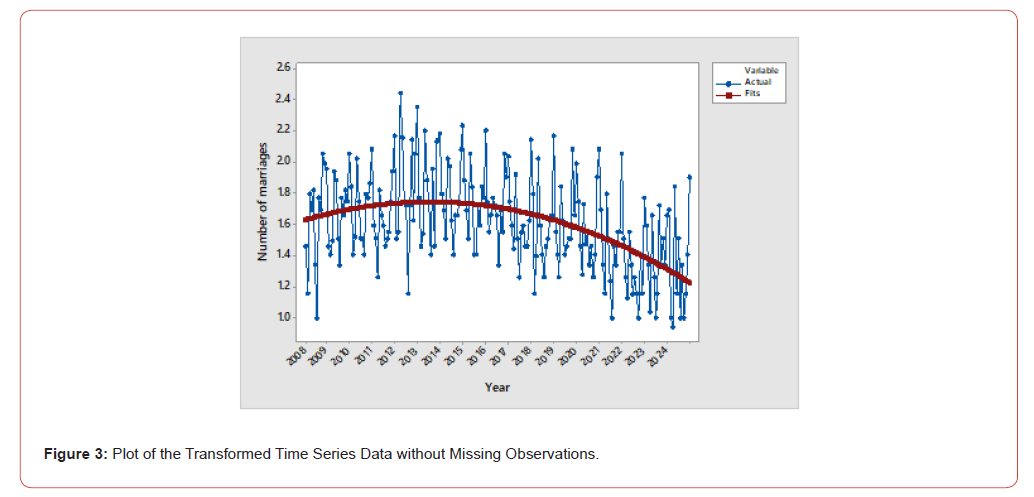
trend-cycle component Mt used the quadratic:
Mt = a + bt + ct2 with
aˆ =1.6454, bˆ = 0.0032 and cˆ = −0.00003for the transformed data
with the missing values and aˆ = 2.1234, bˆ = 0.0153 and cˆ = −0.0001
for the transformed data without the missing values (Figure 1&2).
and arranged in a Buys-Ballot
table as monthly data (S=12) and for 17years (m=17). The
trend-cycle component Mt used the quadratic:
Mt = a + bt + ct2 with
aˆ =1.6454, bˆ = 0.0032 and cˆ = −0.00003for the transformed data
with the missing values and aˆ = 2.1234, bˆ = 0.0153 and cˆ = −0.0001
for the transformed data without the missing values (Figure 1&2).
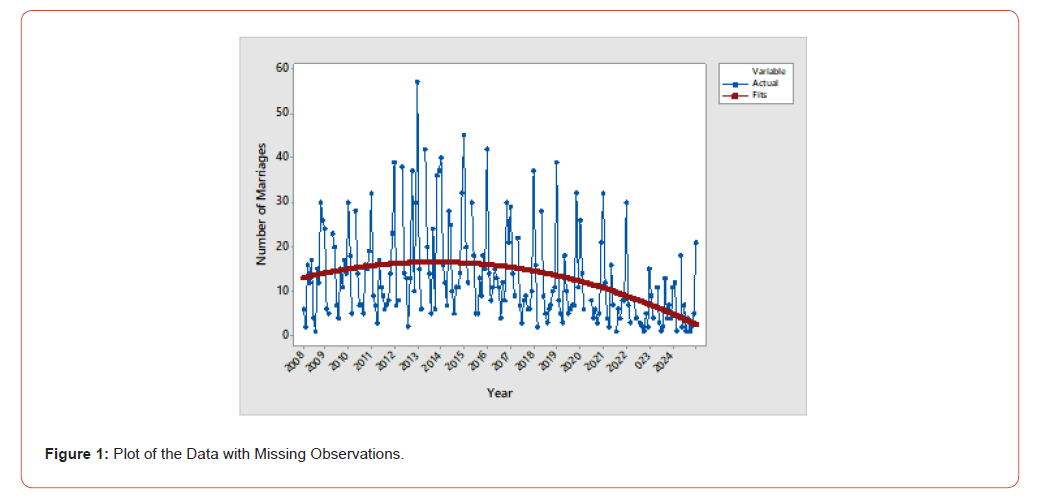
Estimation of Trend Parameters and Seasonal Indices of the Transformed Data with Missing Observations
Using (11)
 Using (12), (13) and (14)


Using (16) and (17)

Table 2: Seasonal Indices of the Transformed Data with the Missing Values.

Estimation of Missing Values of the Transformed Data
The estimates of the missing values for a quadratic trend with an additive model are given by;


Since the data was transformed using power transformation,  .
.
Where,
β = 0.7885
Hence we have,

Then the untransformed missing observations becomes;

Estimation of Trend Parameters and Seasonal Indices of the Transformed Data Without Missing Values.


Using (16) and (17)


Results show that, there is no significant effect between the trend parameters with missing observations and without missing observations but there is a significant effect in the seasonal indices only at the seasons points (season three) where missing observations occurred the most in the Buys-Ballot table (Table 3&4).
Table 3: Seasonal Indices of the Transformed Data Without Missing Values.

Table 4: Comparing the Parameters of Trend and Seasonal Indices of the Transformed Data with and without the Missing Values.

Concluding Remarks
This work has discussed impact of missing data on quadratic trend cycle and seasonal indices in time series analysis and admits additive model. The methods adopted are Buys-Ballot Procedure and Decomposing Without Missing Value. The estimated trend parameters and seasonal indices in the presence and absence of missing data are compared. Results indicate that difference between seasonal indices in the presence and absence of missing data has significant impact. The significant differences existed on the points in which there are missing data in the column of the Buys-Ballot table. In the case of corresponding trend parameters, the presence and absence of missing data have no much differences, therefore, they are approximately the same. This shows that the missing data has no impact on trend parameter. This estimates for unobserved number of registered marriages are: (1.4987) in March 2009, (1.5219) 2010, (1.5426) 2012, (1.5399) 2013, (1.5087) 2015, (1.4430) 2017, (1.3971) 2018, (1.2795) 2020, (1.1274) 2022, (1.0383) 2023, (0.9407) 2014, (1.7305) in April 2020, (1.4741) in May 2020, (1.2373) in June 2021 and (1.1547) in June 2022.
Appendix
Appendix A: Actual Data with Missing Data.

Appendix B: Transformed Data with Missing Data.

Appendix C: Actual Data without Missing Data.

Appendix D: Transformed Data without Missing Data.

References
- Pratama I, Permanasar AE, Ardiyato I, Indrayani R (2016) International Conference on Information Technology System and Innovation (ICITSI). Banding-Bali PP: 24-27.
- Brockwell PJ, Davis RA (1991) Time Series: Theory and Methods. New York, USA.
- David SCF (2006) Methods for The Estimation of Missing Values in Time Series. Cowan University press Western Australia.
- Howell DC (2007) The Analysis of Missing Data in Outhwaite, W. and Turner, S., Eds, Handbook of Social Science Methodology, Sage, London.
- Cheema JR (2014) Some General Guidelines for Choosing Missing Data Handling Methods in Educational Research. Journal of Modern Applied Statistical Methods 13(2).
- Iwueze IS, Nwogu EC, Nlebedim VU, Nwosu UJ, Chinyem UE (2018) Comparison of Method of Estimating Missing Values in Time Series. Open Journal of Statistics 8(2): 390-399.
- Chatfield C (2004) The Analysis of Time Series: An Introduction 6th Edition, Chapman and Hall London.
- Wei WWS (1989) Time Series Analysis: Univariate and Multivariate Methods, Addison-Wesley, Redwood City.
- Dozie Kelechukwu CN (2020) Buys-Ballot Estimates for Mixed Model in Descriptive Time Series. International Journal of Theoretical and Mathematical Physics 10(1): 22-27.
- Iwueze IS, Nwogu EC (2014) Frame Work for Choice of Models and Detection of Seasonal Effect in Time Series. Far East Journal of Theoretical Statistics 48(1): 45-66.
- Nwogu EC, Iwueze IS, Dozie KCN, Mbachu HI (2019) Choice between Mixed and Multiplicative Models in Time Series Decomposition. Asian Journal of Statistics and Application 9(5): 153-159.
- Dozie KCN, Uwaezuoke MU (2020) Properties of Buys-Ballot Estimates for Mixed Model in Time Series Decomposition. Galore International Journal of Applied Sciences and Humanities 4(2): 35-40.
- Dozie KCN, Nwogu EC, Ijomah MA (2020) Effect of Missing Observations on Buys-Ballot Estimates of Time Series Components. Asian Journal of Probability and Statistics 6(3): 13-24.
- Dozie KCN, Ijomah MA (2020) A Comparative Study on Additive and Mixed Models in Descriptive Time Series. American Journal of Mathematical and Computer Modelling 5(1): 12-17.
- Dozie KCN, Nwanya JCN (2020) Comparison of Mixed and Multiplicative Models when Trend-Cycle Component is Linear. Asian Journal of Advanced Research and Reports 12(4): 32-42.
- Dozie KCN, Ihekuna SO (2020) Buys-Ballot Estimates of Quadratic Trend Component and Seasonal Indices and Effect of Incomplete Data in Time Series. International Journal of Science and Healthcare Research 5(2): 341-34.
- Dozie KCN, Ibebuogu CC (2020) Estimates of Time Series Components of Road Traffic Accidents and Effect of Incomplete Observations: Mixed Model CASE. International Journal of Research and Review 7(6): 343-351.
- Dozie KCN, Ibebuogu CC (2021) Road Traffic Offences in Nigeria: An Empirical Analysis using Buys-Ballot Approach. Asian Journal of Probability and Statistics 12(1): 68-78.
- Dozie KCN, Uwaezuoke MU (2021) Seasonal Analysis of Average Monthly Exchange Rate of Central Bank of Nigeria (CBN) when Trend Cycle Component is Quadratic. International Journal of Research and Innovation in Applied Science (IJRIAS) 4(2): 201-205.
- Dozie KCN, Ihekuna SO (2022) Additive Seasonality in Time Series using Row and Overall Sample Variances of the Buys-Ballot Table. Asian Journal of Probability and Statistics 18(3): 1-9.
- Dozie KCN, Ihekuna SO (2023) The Effect of Missing Data on Estimates of Exponential Trend-Cycle and Seasonal Components in Time Series: Additive Case. Asian Journal Probability and Statistics 24(1): 22-36.
- Dozie KCN (2023) Buys-Ballot Estimates for Overall Sample Variances and Their Statistical Properties. Asian Journal of Advanced Research and Reports 17(10): 213-223.
- Dozie KCN, Uwaezuoke MU (2023) The Proposed Buys-Ballot Estimates for Multiplicative Model with Error Variances. Journal of Engineering Research and Reports 25(8): 94-106.
- Dozie KCN (2024) Assessing Performance of Estimation Techniques in Time Series Analysis when Trend-Cycle Component is Linear. Asian Journal of Research in Computer Science 17(12): 18-29.
-

This work is licensed under a Creative Commons Attribution-NonCommercial 4.0 International License.