




 Opinion
Thoughts on AI’s Future in Ophthalmology
Received Date:March 06, 2026; Published Date:March 16, 2026
Opinion
Andrew Ng, cofounder and head of Google Brain and was the former Chief Scientist at Baidu, building the company’s Artificial Intelligence Group into a team of several thousand people: “When anyone goes to see a doctor, I want AI to help that doctor provide higher quality and lower cost medical service. I want every fiveyear-old to have a personalized tutor” [1].
At this point in time in ophthalmology, AI, which can analyze fundus photos and OCT images and can uncover early disease patterns that may escape human’s notice, is poised to become a near expert diagnostic medical tool [2,3].
By automating complex and redundant tasks that may incur human error, AI will have a streamlining effect on medical diagnosis and treatments. That is not to say that there will be no errors in the system. There will be a need for critical guardrails in the AI systems to ensure high quality and accuracy.
Table 1: illustrates some AI methods, their definitions, and their accuracy in making the diagnosis of glaucoma.
Table 1:AI methods, definitions, and accuracy.
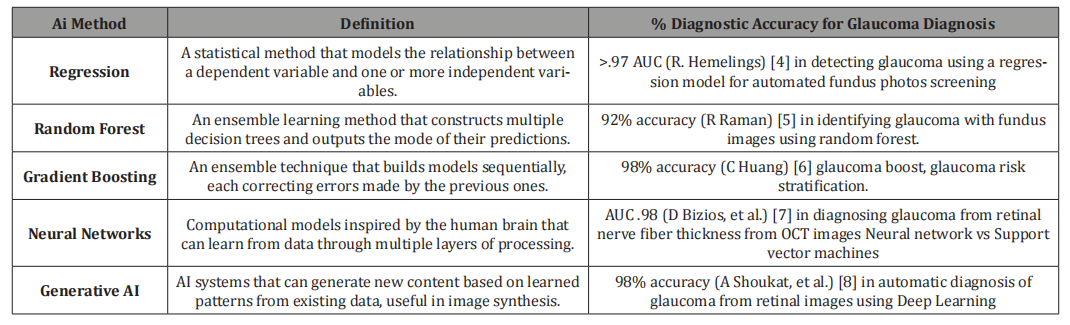
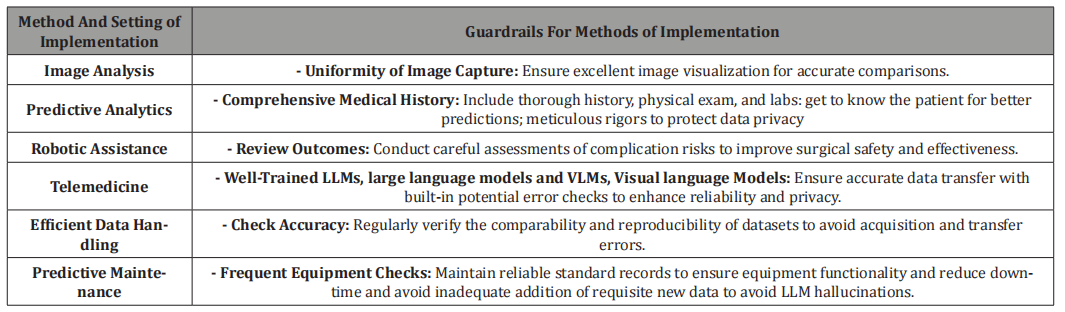
Table 2: illustrates the method of implementation of the AI tool and its setting as well as the necessary guardrails to ensure image analysis, patient privacy, meticulous data pick up and transfer
Table 2: AI method and setting for Implementation.
From keratoconus, in which AI models have detected with accuracy of 98%, to corneal biomechanics to cataract surgery, IOL formulas, to diabetic retinopathy, detected above 95%, to age related macular degeneration, AUC >,.90, to strabismus detection, amblyopia risk, myopia progression risk, to facial analysis, the richness of images tied to texts has catapulted ophthalmology into a vaulted place for AI applications [9-11].
Moving through entry level image/text analysis of these and other subcategories of ophthalmology will require careful applications of privacy guards, both for in house clinical work and items shared between centers that share clinical trial data sets [12].
Agentic AI, systems capable of autonomously executing tasks formerly performed by human researchers and office workers, non-human computer groups carrying out medical office and patient care initiatives, LLMs providing rapid generation of educational materials, computer opinion analysis of resident’s and attending’s level of care and suggested adjustments are either all in the works or have begun to see real time applications [11,13].
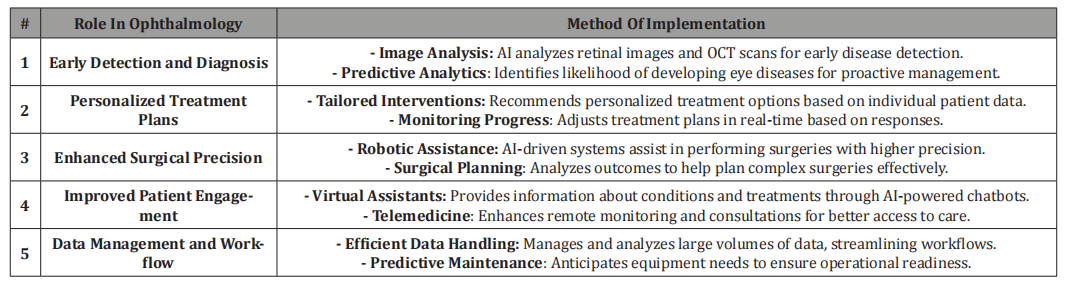
Table 3:AI Role in Ophthalmology and Method of Implementation.
Conflict of Interest
None.
Acknowledgments
None.
References
- https://en.wikiquote.org/wiki/Andrew_Yan-Tak_Ng
- H Takita, D Kabata, S Walston, H Tatekawa, K Saito, (2025) A systematic review and meta analysis of diagnostic performance comparison between generative AI and physicians. npj digital medicine 8: 175.
- JW Eichenbaum, Convoluted neural Networks, AI Deep Learning Models and their role in the diagnosis of Glaucoma, World J Ophthalmology and Vision Research DOI: 10.33552/WJOVR.2025.05.000617.
- R Hemelings, B Elen, AK Shuster, MB Blatchko, J Barbosa Breda, et al. (2023) A generalizable deep learning regression model for automated glaucoma screening from fundus images. npj digital medicine DOI: 10.1038/s41746-023-00857-0.
- R Raman, V Kumar, BJ Pillai, D Rabadiya, PK boyar, (2024) Diagnosing from retinal fundus images with random forest. Technique, IEEE Xplore, Second International Conference.
- C Huang, W Xie, K Kooner, T Lee, Jui Kai Wang, (2025) GlaBoost: A multimodal structured framework for glaucoma risk stratification. arXiv, cs, arXiv: 2508.03750
- D Bizios, A Heijl, JL Hougaard, B Bengtssson, Machine Learning classifiers for glaucoma diagnosis base on classification of retinal nerve fiber layer thickness parameters measured by Stratus OCT. Acta Ophthalmologica 88: (1)44-52.
- A Shoukat, S Akbar, SA Hassan, S Igbal, A Mehmood, (2023) Automatic diagnosis of glaucoma from retinal images using deep learning approach. Diagn ostics (Basel) 13(10): 1738.
- K Kazemzadeh (2025) AI in ophthalmology: opportunities, challenges, and ethical considerations, Med Hypothesis Discov Innov Ophthalmol 14(1): 255-272.
- MM Vandevenne, E Favuzza, M Veta, E Lucentiforte, TT Berendschot, et al. (2023) AI for detecting keratoconus, Cochrane Database Syst Rev 11(11): CD01491.
- K Jin, T Yu, A Grzybowski (2026) Multimodal AI in ophthalmology: applications, challenges, and future directions. Survey of Ophthalmology 71: (1)158-167.
- S Pati, S Kumar, A Varma, B Edwards, C Lu, et al. (2024) Privacy preservation for federated learning in health care 5(7): 100974.
- BT Soetikno, CS Nielsen, A Pollreis (2026) DSW Ting, Toward autonomous discovery: agentic AI and the future of ophthalmic research. Curr Opin Ophthalmol 37(1): 60-65.




