




 Research Article
The prevalence of different eye diseases in patients at a tertiary care hospital’s ophthalmology clinic: a three-year retrospective analysis study
Received Date:November 14, 2025; Published Date:December 04, 2025
Abstract
Background and aim: Social and environmental variables influence the incidence and prevalence of eye illnesses. The current study sought to determine the prevalence of several eye conditions at a tertiary Saudi hospital in Sana’a, Yemen.
Keywords: Eye diseases; Refractive errors; Optimizing Health Care Services, Sana’a city, Yemen
Introduction
Social and environmental variables influence the prevalence of various eye disorders in any given community or region. However, when a society has endured a decade-long armed conflict with high rates of poverty and starvation, as Yemen has, the prevalence of eye illness shifts. As a result, medical facilities need to be modified to accommodate the region’s disease prevalence. Region-specific intervention techniques are crucial for every community because of the epidemiological complexity of visual impairment and the vast array of affecting factors. Therefore, one of the first actions in these communities is to provide relevant data. At least in developed nations with regular and accurate public health data collection, the incidence of common diseases is well recognized [1].
Population-based epidemiological studies of eye illnesses during the past ten years have produced a wealth of useful information. The detrimental effects that even a relatively slight decrease in visual acuity (<6/12) has on a person’s quality of life and capacity to operate are among the most significant findings [2]. The rapid rise in eye conditions and visual loss with ageing has also been validated by these research [3]. In order to help clinicians identify at-risk patients for the early detection of any ongoing disease process, our research has brought attention to the importance of routine eye exams. In certain situations, a community’s high frequency of a certain disease may motivate medical professionals to create a flexible screening program in order to support the adoption of a novel treatment approach. This seeks to lower the prevalence of illnesses and the corresponding expenses. In each of these situations, educating individuals who are at risk or have a family history of eye conditions can result in early discovery, which lowers the expense of treating the disease at an advanced stage [4].
Preventing eye sight loss-the most vital sense for all living things-is the main objective, in addition to all the other situations listed above. Since many eye disorders can begin and deteriorate gradually without the patient realizing the issue until severe vision loss has occurred, routine eye exams are crucial for maintaining good eye health [5]. One well-known example of this is glaucoma, which can be identified early with routine testing and observation [6]. Visual impairment can have a significant impact on illness rates, as demonstrated by our study’s incidental ophthalmological findings in community members. Information about eye protection, the value of early glaucoma screening, and the necessity of observing any visual signs are all provided by our study. The prevalence of cholera, hepatitis, malaria, and skin illnesses in Yemen has been the subject of numerous studies in the past; however, there aren’t many studies on eye disorders, despite the fact that some have been done [7-15]. Numerous research [16-27] have also been carried out in the past to calculate the prevalence of blindness and visual impairment in various Yemeni regions. Accurate community-based data on the frequency of eye conditions in Yemen’s Sana’a metropolis is still desperately needed, though. In order to plan for the delivery of efficient eye health services, this study was designed to examine the patterns of distribution of various eye diseases among the general population of Sana’a city, given the significance of the issue of eye diseases and the dearth of precise information on their prevalence among Yemenis. As a result, community members will be able to receive efficient eye care services to preserve their visual health.
Subjects and Methods
All new patients who visited the eye OPD were included in this retrospective analysis. The patients received a comprehensive routine eye examination that included visual acuity using Snellen’s chart both unaided (UCVA) and best corrected visual acuity (BCVA) , color vision testing on Ishihara isochromatic test plates, slit lamp examination of the anterior segment, which included the cornea, anterior chamber, iris, lens, and fundus evaluation using direct and indirect ophthalmoscope .In addition, cases were treated according to normal protocol and, if deemed necessary, underwent automated perimetry, laboratory, and radiographic investigations.
Ethical approval: With reference number 2025-55, the Medical Ethics Committee of Sana’a University’s Faculty of Medicine and Health Sciences formally approved the proposal on May 12, 2025. A consent form was signed by each research participant. All of the information was kept confidential, including the patient’s identify and clinical details.
Result
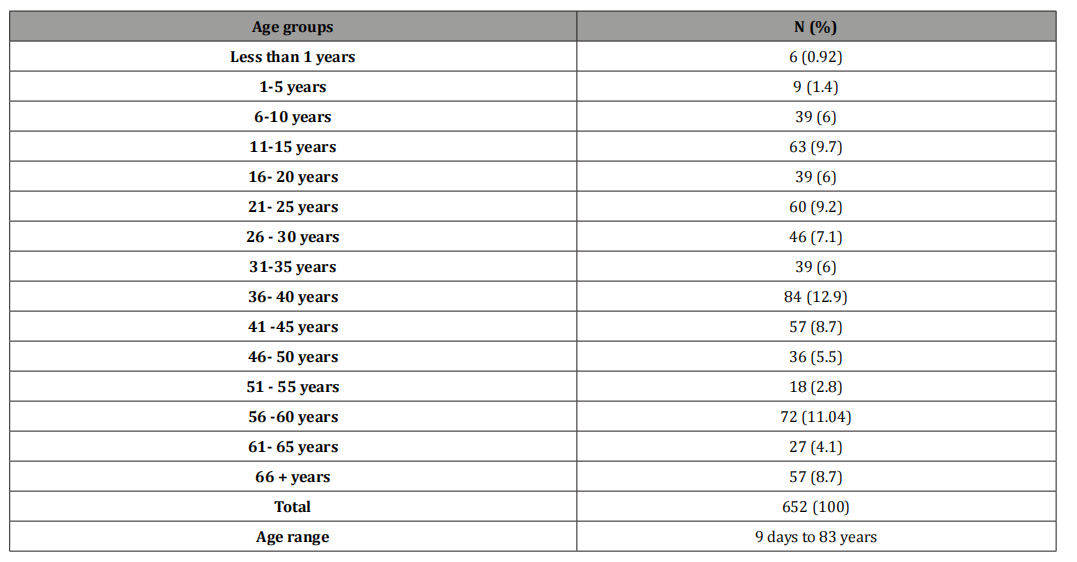
Table 1 shows the gender distribution of patients attending the ophthalmology clinic at the Saudi Hospital in Sana’a over a threeyear period (2022-2024). The percentage of male patients was 56.6%, while the percentage of female patients was 43.4%. Table 2 shows the age distribution of patients attending the ophthalmology clinic at the Saudi Hospital in Sana’a over a three-year period (2022-2024). We found that the percentage of patients under one year of age was only 0.92% of the total, while those aged 1-5 years accounted for 1.4%, 6-10 years 6%, 11-15 years 9.7%, 16-20 years 6%, 21-25 years 9.2%, 26-30 years 7.1%, 31-35 years 12.9%, 36- 40 years 12.9%, 41-45 years 8.7%, 46-50 years 5.5%, 51-55 years 2.8%, 56-60 years 11.04%, and 61-65 years 4.1%. Patients over 66 years of age accounted for 8.7%.
Table 1:Gender distribution of patients attending the ophthalmology clinic at the Saudi Hospital in Sana’a city over a three-year period (2022-2024).

Table 2:Age distribution of patients attending the ophthalmology clinic at the Saudi Hospital in Sana’a city over a three-year period (2022-2024).
The eight most common causes of eye disorders were dry eye (17.02%), myopia (refractive error) (13.3%), allergic conjunctivitis (9.2%), astigmatism (refractive error) (9.2%), mucopurulent conjunctivitis (8.7%), presbyopia (refractive error) (6.9%), cataracts (6.4%), and eye strain (5.1%), followed by corneal opacity (3.2%), diabetic retinopathy (3.1%), corneal foreign body (2.1%), diabetes mellitus with cataracts (2.1%), and uveitis (Behçet’s disease) (2.1%). Less common eye diseases were also diagnosed, including acute dacryocystitis (1.7%), angular conjunctivitis (1.7%), blepharitis (1.7%), diabetes mellitus with dry eye (1.7%), and keratoconus (1.5%). Dry eye with allergic conjunctivitis accounted for 1.5%, congenital cataracts with strabismus 1.1%, and chalazion 0.92%. There were 5 cases (0.77%) of post-surgical cataracts, 5 cases (0.77%) of optic nerve atrophy, 5 cases (0.77%) of glaucoma, chronic dacryocystitis at 0.46%, and 3 cases (0.46%) of post-traumatic endophthalmitis.
Discussion
Effective screening can identify a wide range of ocular conditions. The luxury of efficient screening procedures is typically absent from developing or low-income nations. The frequency of diseases in various groups is also influenced by racial and cultural factors [27]. With community health services (government) as the study participants, the majority of published research on the prevalence of eye illnesses in a certain geographic area have stable conditions. The incidence of ocular diseases in war zones without government health services, where the majority of people live in poverty and find it impossible to access eye clinics for treatment, was the focus of the current study
A study in Gujarat in India [28] in a rural hospital in 2015 on adults also revealed that many suffer from ocular issues such as meibomitis and allergies. However, they are not given enough time to visit an eye clinic and receive professional guidance. Refractive error (42%), cataract (23.8%), pterygium (6.34%), dry eye (3.17%), MGD (3.17%), allergic conjunctivitis (1.58%), colour blindness (4.76%), retinopathy from systemic disorders such as diabetes mellitus, hypertension (12.69%), and chalazion (1.58%) were the eye diseases that were more common than those in our study. Myopia (refractive error) (13.3%), dry eye (17.02%), astigmatism (refractive error) (9.2%), allergic conjunctivitis (9.2%), mucopurulent conjunctivitis (8.7%), presbyopia (refractive error) (6.9%), cataracts (6.4%), and eye strain (5.1%) were the eight most frequent causes of eye problems (Table 3). Allergic conjunctivitis is an inclusive term that encompasses seasonal allergic conjunctivitis (SAC), perennial allergic conjunctivitis (PAC), vernal keratoconjunctivitis (VKC), and atopic keratoconjunctivitis (AKC) [29].
Table 3: Eye diseases distribution of patients attending the ophthalmology clinic at the Saudi Hospital in Sana’a city over a three-year period (2022-2024).
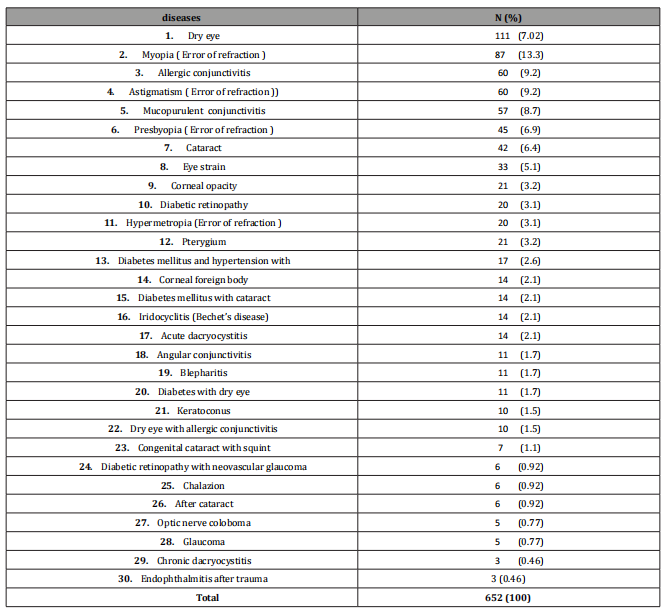
In our study, myopia (error of refraction) was the second most common eye condition (13.3%). In contrast to our study, where cataract is extremely uncommon and only accounts for 1.1% of cases, another study by Bhardwaj M [30] found that myopia (error of refraction) (20.97%) was the most common ocular morbidity, followed by cataract (20.02%), follow-ups of cataract surgeries, and allergic conjunctivitis. According to Omotoye, et al. [31], the most common diagnoses were glaucoma (10.9%), allergic conjunctivitis (12.4%), cataract (26.0%), and refractive error (18.5%). According to Haq, et al. [32], the prevalence of refractive errors was 25.0% and cataracts were 21.7%. In a study conducted in a rural area, Singh et al. [33] found that the refractive error might reach 40.8%. According to a hospital-based study by Olukorede et al. [34], allergic conjunctivitis was the most frequent cause. The main causes of eye problems were shown to be similar across all of this research.
Male and female patients in the current study had approximately identical disease incidences, suggesting that females were equally mindful of their health (male patient percentage was 56.6%, while female patient percentage was 43.4%; Table 1). Similar findings were also found in a cross-sectional study conducted at the Eye OPD at GMCH, Udaipur [35], Rajasthan. 56.17% of 600 patients participated in the study
Only 0.92% of the patients in the current study were younger than one year old. Patients aged 1–5 years made up 1.4% of the total, followed by those aged 6–10 years, 11–15 years, 9.7%, 16–20 years, 6%, 21–25 years, 9.2%, 26–30 years, 31–35 years, 12.9%, 36–40 years, 41–45 years, 8.7%, 46–50 years, 5.5%, 51–55 years, 2.8%, 56–60 years, 11.04%, and 61-65 years, which indicates that the majority of the patients are adults. This finding is consistent with a big study that was carried out in 2015 on 64,529 patients at Makah Eye Hospital in Sudan [36]. The study found that the majority of the patients who attended the eye clinic were adults over the age of 20 (76.32%), with 47.21% of the cases being male. In this Sudan study [37] most common eye disorder was refractive error (33%), followed by cataract (26.66%), and allergic conjunctivitis (23.77%). Refractive error (26.8%), squint (0.9%), conjunctivitis (20.6%), lid abnormality (3.9%), and cataract (11.8%) were the patterns of eye diseases in a different study from Nepal [38] that included 915 cases and provided a similar incidence pattern of patient age distribution to our study. In their study of a suburban population, Murad et al. [39] found that the incidence of eye illnesses was 48% in men and 52% in women. Conjunctivitis (21.4%), cataract (9.2%), refractive error (15.2%), dacryocystitis (6.51%), and blepharitis (3.2%) were among the several eye conditions.
Planning and managing an eye care facility is made easier with knowledge of the epidemiology of eye illnesses in a given area, which lessens the burden of blindness. The prevalence of the main eye conditions found in this study was similar to that found in numerous previous studies conducted throughout the world. However, it should also be remembered that the causes of blindness varied in various cultures and geographical areas because of the impact of environmental variables as well as local customs and lifestyles. Certain illnesses arise and/or spread as a result of environmental variables, group living, occupational activities, and stress related to one’s job. Physicians are more equipped to implement preventive measures and plan treatment modalities when they are aware of the disease profile.
Limitations of the Study
This study’s single-center design means that its findings cannot be extended to the national level, which is one of its weaknesses. Furthermore, a bigger population size might have produced more accurate results because the current study’s sample size was insufficient. Not every demographic characteristic of the patientschildren, adults, and their families-was connected to eye disorders.
Conclusion
In any particular group or location, the frequency of various eye disorders varies based on social, environmental, and economic factors. We now have a better understanding of the prevalent patterns of eye issues in a particular Yemeni population segment thanks to this study, which will also help with infrastructure planning and the provision of ophthalmology-specific medical professionals to provide efficient eye care services in Yemen. Since the study population was made up of young adults, primarily in the pre-senile age range, and presbyopia was a less common complaint among them, the prevalence of cataracts was lower in our study than in previous research.
Authors contribution
The study was planned and carried out by all authors, who also helped with data analysis, paper draughting and review, and study approval.
Acknowledgments
The authors would like to thank Sana’a University, Sana’a, Yemen, for funding this work.
Conflict of Interest
None.
References
- Dobbelsteyn D, McKee K, Bearnes RD, Jayanetti SN, Persaud DD, et al. (2015) What percentage of patients presenting for routine eye examinations require referral for secondary care? A study of referrals from optometrists to ophthalmologists. Clin Exp Optom. 98(3): 214-217.
- Wong TY, Hyman L (2008) Population-based studies in ophthalmology. Am J Ophthalmol. 146(5): 656-663.
- Umfress AC, Brantley MA Jr (2016) Eye Care Disparities and Health-Related Consequences in Elderly Patients with Age- Related Eye Disease. Semin Ophthalmol 31(4): 432-438.
- Baranwal VK, Avinash M, Vivek S, Sandeep G, Shyam S, et al. (2019) The Prevalence of Various Eye Diseases Among Patients of Different Nationalities attending the Ophthalmology Clinic at a Tertiary Care United Nations Hospital: A 5 Year Retrospective Analysis. Int J Contemp Med Res 6(9): 17-20.
- Yadav S, Tandon R (2019) Comprehensive eye examination: what does it mean? Community Eye Health 32(107): S1-S4.
- Weinreb RN, Aung T, Medeiros FA (2014) The pathophysiology & treatment of glaucoma: A review. JAMA 311: 1901-1911.
- Al Mohanadi, E M A, A S S Moharem, K A K A Al Moyed, H A Al Shamahy, et al. (2022) “Cholera in Sana’a, Yemen: Clinical Features, Risk Factors and Antibiotic Sensitivity of Vibrio Cholerae”. Universal Journal of Pharmaceutical Research: 7(3).
- Sheiban A A, H A Al Shamahy, N M Alattab, A K M A Abbas (2018) “Epidemicity of vibrio cholera in Sana’a city, Yemen: prevalence and potential determinants”. Universal Journal of Pharmaceutical Research: 2(6).
- Ogaili MA O, EA Al gunaid, HA Al Shamahy, B M Jaadan (2020) “Survey of safety practices in diarrheal treatment centers: cholera treatment centers in Yemen”. Universal Journal of Pharmaceutical Research: 5(4).
- Al Shami H Z, Z A M Al Mutawakal, A I M Al Kholani, M A Al Haimi, A M Al Haddad, et al. (2022) “Prevalence of hepatitis A virus, hepatitis B virus, and hepatitis C virus, among patients with hepatic jaundice in Sana’a city, Yemen: a hospital based study”. Universal Journal of Pharmaceutical Research: 6 (6): 1-8.
- Al Shawkany E M, A A R M AlShawkany, S S Bahaj, A M Othman, HA Al Shamahy, et al. (2021) “Prevalence of different hepatitis B virus genotypes and risk factors associated among selected Yemeni patients with chronic hepatitis b infection”. Universal Journal of Pharmaceutical Research: 6(3).
- El Zine M A Y, Y A S Dawood, M A A Ali, KA Al Moyed, EA Al gunaid, et al. (2024) “Hepatitis C virus and leukemia patients: prevalence and risk factors associated with infection among leukemia patients who achieve long-term remission after chemotherapy”. Universal Journal of Pharmaceutical Research: 9(4).
- Almohya G A M, M A Y El Zine, HA Al Shamahy, A G Al Madhaji, R. M Assayaghi (2025) “Prevalence and risk factors associated with hepatitis B virus infection among oncology patients”. Universal Journal of Pharmaceutical Research: 9(6).
- Al Shamahy H A, A A Ishak (2021) “Trends and causes of morbidity in part of children in the city of Sana’a, Yemen 1978-2018: Findings of single children’s health center”. Universal Journal of Pharmaceutical Research: 5(6).
- Mutahar D J A, K S A Al Khamesy, K A K A Al Moyed, HA Al Shamahy, M M Al Shehari (2022) “Pattern of liver disease admissions at a tertiary government hospital in Sana’a, Yemen”. Universal Journal of Pharmaceutical Research: 7(4).
- Al Shamahi EY, Al Shamahi EH, Al Hababi NM, Al Shamahi NYA, Al Shamahy HA (2025) Photic retinopathy caused by excessive use of smartphone: Review and cases series report. Universal Journal of Pharmaceutical Research 10(2): 104-110.
- Al shamahi EY, Al Eryani SA, Al Shamahy HA (2024) Posterior scleritis: Review of literature and first case report from Yemen. Universal J Pharm Res 9(6): 90-95.
- Al Shamahi EY, Muhsin NM, Al Shamahi EH, Al Shamahy HA (2022) Patterns of uveitis at a tertiary referral center in Yemen: One central retrospective study. Universal J Pharm Res 7(2):1-6.
- Al Eryani SA, Alshamahi EYA, Al Shamahy HA, Alfalahi GHA, Al Rafiq AA (2021) Bacterial conjunctivitis of adults: causes and ophthalmic antibiotic resistance patterns for the common bacterial isolates. Universal J Pharm Res 6(1): 25-28.
- Alshamahi EYA, Al Shamahy HA, Al Nahary AA (2019) Epidemiology and aetiological diagnosis of corneal ulceration in Sana’a City, Yemen. W J Opthalmol Vision Res 2(5): 1-6.
- Alshamahi EYA, Al Eryani SA, Al Shamahy HA (2021) Prevalence and risk factors for Trachoma among primary school children in Sana’a city, Yemen. Universal J Pharm Res 6(4): 19-25.
- Alshamahi EYA, Al Shamahy HA, Musawa YA (2020) Bacterial causes and antimicrobial sensitivity pattern of external ocular infections in selected ophthalmology clinics in Sana’a city. Universal J Pharm Res 5(3): 12-16.
- Alshamahi EYA, AlShami HZA, Al Shamahy HA (2020) Prevalence of Staphylococcus aureusin external ocular infection and the occurrence of MRSA in isolates. Rabat Clin Ophthalmol J 2(1): 1010.
- Alshamahi EYA (2021) Comparison between limbal and combined limbal and pars plana approaches using vitrectomy to remove congenital cataracts with primary intraocular lens implantation in Yemen. Clin Surg 4(8): 1-7.
- Alshamahi EYA, IshaK AA, Aljayfey NH, Al Shamahy HA (2020) Prevalence and risk factors for trachoma among primary school children in Bajjil District, Al Hudaydah, Western Yemen. Clin Ophthalmol J 1(3): 1014.
- Al Arosi SAH, Al shamahi EY, Al Kholani AIM (2021) Neonatal bacterial conjunctivitis in tertiary hospitals in Sana'a city, Yemen. Universal J Pharm Res: 6(6): 36-42.
- Nehal M, Samy El Gendy, Ahmed A Abdel Kader (2018) Journal of Ophthalmology 8049475: (6).
- A study of prevalence of various ophthalmic Problems in policemen and their family Members of Vadodara, Gujarat (2015). National Journal of Medical Research: 5(4).
- Bielory L, Frohman L (1992) Allergic and immunologic disorders of the eye. J Allergy Clin Immunol 86: 1–20.
- Bhardwaj M (2017) A hospital based eye health survey to see the pattern of eye diseases in Uttarakhand, India; International Journal of Research In Medical Sciences: 5(2).
- Adeoye AO, Omotoye OJ (2007) Eye disease in Wesley Guild Hospital, Ilesa, Nigeria. Afr J Med Med Sci. 36: 377-380.
- Mohanty L, Tahasildar JB (2016) A Cross-sectional study to assess the morbidity pattern of ocular diseases in out-patient department of ophthalmology at a tertiary care hospital; International Journal of Research in Medical Sciences 4: 3797
- Singh MM, Murthy GV, Venkatraman R, Rao SP, Nayar S (1997) A study of ocular morbidity among elderly population in a rural area of central India. Indian J Ophthalmol 45: 61-65.
- Olukorede O Adenuga, Oluyinka J (2012) Samuel Pak J Ophthalmol: 28(3).
- Mohanty L, Tahasildar JB (2016) A Cross-sectional study to assess the morbidity pattern of ocular diseases in out-patient department of ophthalmology at a tertiary care hospital; International Journal of Research in Medical Sciences 4: 3797.
- Kalil, Atif B Mohammad Ali (2015) Pattern of Eye Diseases at a Tertiary Eye hospital in Sudan (Makah Eye Hospital, Khartoum); 3: 15-18.
- Tuladhar S, Dhaka S A pattern of ocular morbidity in patients attending an ophthalmic clinic in a rural part of west Nepal; Eye Diseases isn a Rural Ophthalmic Clinic; Journal of Nobel Medical College: 2(1).
- Murad M, Alam MS, Miah A, Akter MS, Kabir MH (2007) Pattern of eye diseases in a tertiary hospital in a suburban area: A retrospective study; The ORION: 28.
- Olukorede O Adenuga, Oluyinka J Samuel Pak (2012) J Ophthalmol 28(3).
-

This work is licensed under a Creative Commons Attribution-NonCommercial 4.0 International License.




