



 Research Article
School Eye Screening Initiative of Al-Basar International Foundation to Combat Childhood Blindness in Bangladesh
Received Date: July 01, 2024; Published Date: July 15, 2024
Abstract
Background: Childhood blindness poses a significant public health challenge worldwide, with various causative factors including congenital disorders, infections, trauma, and untreated refractive errors. Bangladesh, like many developing nations, faces a substantial burden of childhood visual impairment, affecting educational experiences and overall well-being. Early detection and intervention are crucial in preventing childhood blindness, making school-based screening programs imperative. This study sought to offer understandings into the role of Al-Basar International Foundation, Bangladesh, in addressing childhood blindness through the outcomes of its school-based vision screening camps.
Methodology: This cross-sectional study examined data from the Al-Basar International Foundation’s school eye screening camp in Dhaka, Bangladesh, conducted in 2016. A total of 81,226 students from 115 schools were screened by a multidisciplinary team comprising school teachers, optometrists, and ophthalmologists. Data collection included socio-demographic information, visual assessments, and actions taken by school teachers and healthcare professionals.
Results: The study revealed insights into the socio-demographic profile of surveyed students, with a slightly higher representation of girls (52.9%) and a majority were from primary school (69.2%). Visual assessments by school teachers and optometrists identified varying degrees of visual impairment and eye conditions, with refractive errors being predominant. Optometrists prescribed glasses for a majority of cases, while a proportion required medication or referrals for specialized care. Ophthalmologists diagnosed a range of eye conditions, with glaucoma and nystagmus being notable.
Conclusion: The Al-Basar International Foundation’s school eye camp emerges as a vital initiative in combating childhood blindness in Bangladesh. Collaborative efforts among school teachers, optometrists, and ophthalmologists have facilitated early detection and intervention, addressing a spectrum of eye conditions prevalent among school children. The camp’s proactive approach, comprehensive assessments, and tailored interventions underscore its effectiveness in promoting optimal eye health and well-being.
Keywords: Childhood Blindness; School-Based Eye Screening; Vision Screening Camp; Visual impairment; Bangladesh
Introduction
Childhood blindness can result from any causation of the visual impairment including congenital disorders, infections, trauma, and untreated refractive errors. Congenital disorders such as retinopathy of prematurity (ROP), congenital cataracts, or congenital glaucoma can affect vision from birth if not promptly diagnosed and managed [1]. Additionally, infectious diseases like measles, rubella, and meningitis can cause vision loss if they affect the eyes or optic nerve during childhood [1]. Trauma, such as injuries from accidents or physical abuse, can also result in visual impairment or blindness in children. Furthermore, untreated refractive errors like myopia, hyperopia, or astigmatism can lead to significant visual impairment if corrective measures such as glasses or contact lenses are not provided [1].
Globally, around 1.4 million children aged 0-14 years are currently living with blindness [2], whereas approximately 19 million children below 15 years of age are estimated to be visually impaired (VI) worldwide according to the World Health Organization (WHO) 2010 report [3]. The prevalence of VI is higher in developing countries and has been estimated to be 0.52% among the population below 15 years of age in Bangladesh [4]. Childhood visual impairment among school-going children in Bangladesh can be influenced by various associated factors. According to a previous study, key factors contributing to visual impairment in Bangladeshi children include uncorrected refractive errors, congenital cataracts, vitamin A deficiency, and infectious diseases such as measles and rubella [4]. Additionally, factors like socioeconomic status, access to healthcare services, and parental education levels can impact the likelihood of early detection and appropriate management of visual disorders in children [5].
Visual impairment significantly impacts school-going children, affecting various aspects of their educational experience and overall well-being. Children with visual impairment often encounter challenges in accessing educational materials and participating fully in classroom activities. The inability to see clearly can hinder their academic performance, leading to difficulties in reading, writing, and engaging with visual learning materials [6]. Visual impairment can also affect social interactions and peer relationships, as children may face obstacles in recognizing facial expressions or participating in visual group activities [7]. Furthermore, untreated or uncorrected visual impairment can contribute to feelings of frustration, low selfesteem, and decreased motivation in educational settings [6].
According to WHO, about 80% of visual impairments such as loss of central and side vision, blurred vision, generalized haze, light sensitivity of eye, night blindness and blindness cases can be prevented with adequate and timely eye care which may not be the case for many chronic diseases [8]. Early detection and access to vision correction services, such as eyeglasses or low vision aids, can significantly improve a child’s ability to engage in learning and social interactions [9]. School eye health screening programs shows positive impacts around the world through improving the well-being and academic performance of students [10]. Schoolbased screening programs bring eye care directly to students, increasing access for those who may not otherwise receive it due to financial or geographical barriers. Screening programs detect vision problems early, allowing for timely intervention and prevent more serious eye conditions from developing and minimize the risk of permanent vision impairment [11].
The prevention of childhood blindness was one of the major agendas in the operational plan of National Eye Care (NEC) program formulated by the government of Bangladesh under the 2nd Health, Population, and Nutrition Sector Program (4th HPNSP) from 2011 to 2016 [12]. In addition, the plan called for international nongovernmental organizations (INGOs), national non-governmental organizations (NGOs) and the private sector to work together to control eye diseases in addition to the Bangladesh government. In response to this call, the international non-governmental organization Al-Basar International Foundation started school eye screening camps under the School Eye Health Program in Bangladesh from 2014 [13]. Therefore, the study aimed to provide some insights into the contribution of addressing childhood blindness by Al-Basar International Foundation, Bangladesh through the findings of its school vision screening camps.
Methodology
This cross-sectional study was conducted based on data which was collected from the vision screening camp among school children in Dhaka, Bangladesh operating by the Al-Basar International Foundation in 2016. In this program, 81,226 pupils form 115 schools situated in Dhaka city were screened with a team comprising of schoolteachers, optometrists, opticians, and ophthalmologists. This screening program was administered by a tool that was developed and validated by a group of ophthalmologists. This tool had 12 sections and had to be filled in by a schoolteacher, optometrist and ophthalmologist.
The first 5 sections namely general information, vision information, screening result, eye conditions and action taken were completed by respective schoolteacher. In this vision screening program, the schoolteacher acted as the main actor in detecting the presence of possible eye diseases or disorders among the students. Keeping this in mind, the schoolteachers basically the class teachers of each grade were given a 3-day long training on this tool which was conducted by the ophthalmologist in the school premises. In addition, a-day long demonstration program was arranged among the teachers in avoiding false positive or false negative results.
Once all the children were screened and those identified with visual impairments, then the day of the camp was set and parents were asked to visit schools with their child for visual screening. At the camp, these identified children were further investigated by ophthalmic assistants/ optometrists. After screening, the optometrists filled out the next section which comprises of students’ vision information, type of correction, type of error, other eye conditions and actions taken. In addition, the optometrist had to fill the designated part of the tools only for students who showed negative screening results. The ophthalmologist was responsible for administering the final 2 categories and filling in the relevant boxes of the tool. By these two sections, students were diagnosed with eye diseases and they were given prescriptions accordingly.
Approval for the study was obtained from the Research and Ethical Committee of Al-basar international foundation. Informed consent from the parents of students was obtained with the assistance of school heads through their class teachers before conducting the study. Teachers were trained and tested by the research department to obtain demographic data and perform visual acuity testing on the students. Information obtained included name of school, region, age, gender, religion, class, and father’s ‘occupation.
All data were checked for completeness using checklists on each format and then coded, entered into SPSS for windows version 26.0 and analyzed according to objectives of the study. Descriptive and inferential statistic was used for all variables. Values were expressed as frequencies and percentage.
Results
This section provides an idea of the socio-demographic profile of school students who went through school eye screening camps and portrays their screening results step by step which was carried out by schoolteachers, optometrists and ophthalmologists.
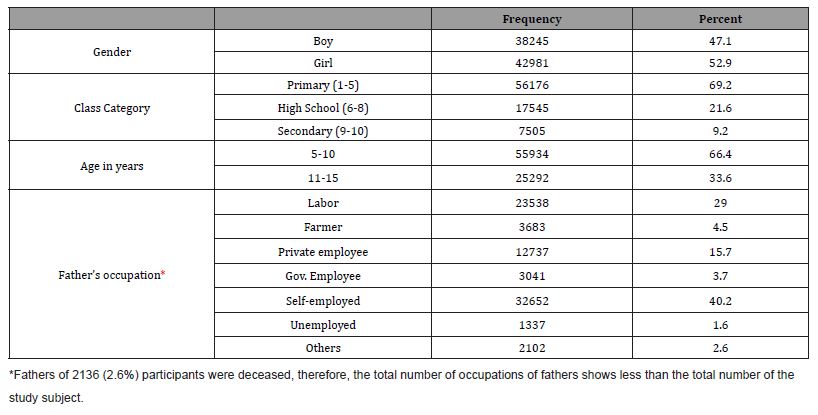
The socio-demographic profile of the surveyed students, as depicted in Table 1, illustrates several key insights. The gender distribution indicates a slightly higher representation of girls (52.9%) compared to boys (47.1%). Regarding the educational stages, a significant majority of students (69.2%) were enrolled in primary education (grades 1-5), followed by high school (21.6%) and secondary (9.2%) levels. The age distribution shows a majority of younger (5-10 years, 66.4%) students than older (11-15 years, 33.6%) students. In terms of paternal occupation, the majority of fathers were self-employed (40.2%), followed by laborers (29.0%) and private employees (15.7%). A small percentage of fathers were farmers (4.5%), government employees (3.7%), unemployed (1.6%), or categorized under other occupations (2.6%).
Figure 1 portrays the action which was taken by the schoolteachers after completing eye screening of the student. Most of the pupils (89%) were disposed without treatment whereas about 11% were referred to the optometrist for medical intervention.

Table 1: Distribution of students according to socio-demographic profile (N= 81226).
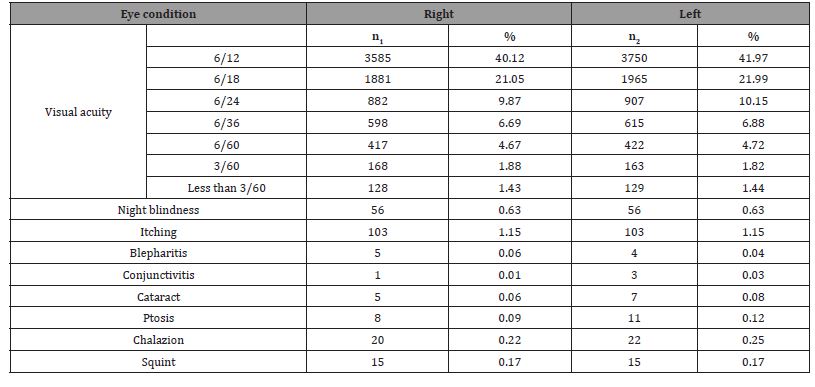
The findings from the teachers’ screening provide crucial insights into their eye conditions and related symptoms in table 2. Visual acuity assessments reveal varying degrees of impairment, with a notable portion exhibiting 6/12 vision in the right eye (40.12%) and left eye (41.97%), followed by 6/18 (21.05% right, 21.99% left) and 6/24 (9.87% right, 10.15% left). A declining trend is observed in visual acuity, with fewer individuals recording 6/36, 6/60, 3/60, and less than 3/60 vision. Night blindness and eye discomfort symptoms such as itching, blepharitis, conjunctivitis, and cataracts are reported in relatively small proportions.
Table 2: Teachers’ screening findings (n=8935).
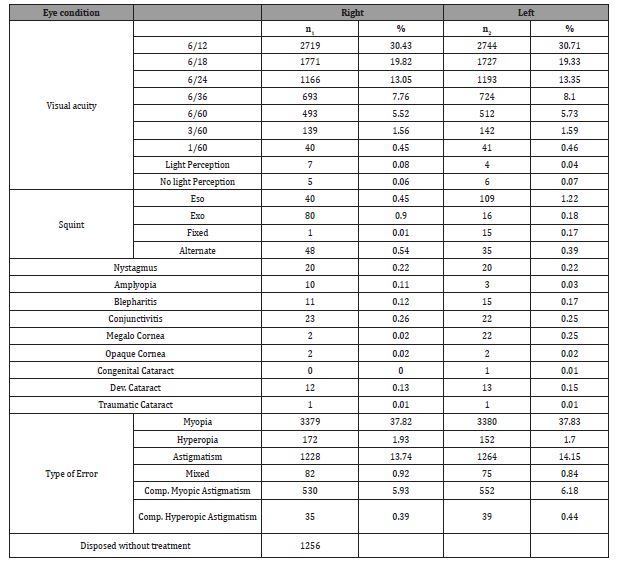
In table 3, the optometrist’s assessment findings provide valuable information into the eye conditions and visual abnormalities within the surveyed population. The visual acuity assessments reveal varying levels of impairment, with a significant proportion of individuals exhibiting 6/12 vision in both the right (30.43%) and left eyes (30.71%), followed by 6/18 and 6/24 vision. Moreover, a decline in visual acuity is observed with fewer individuals reporting 6/36, 6/60, 3/60, 1/60 vision, and even light or no light perception. Squint, though less prevalent, is present in different forms such as eso, exo, fixed, and alternate. Other eye conditions such as nystagmus, amblyopia, blepharitis, conjunctivitis, and various types of cataracts are reported in small proportions. The assessment also identifies refractive errors like myopia, hyperopia, and astigmatism, with myopia being the most common type of error observed. A large proportion of surveyed population were disposed without treatment because of this assessment.
Table 3: Optometrist’ assessment findings (n=8935).
The statistics from Table 4 shed light on the actions taken by optometrists following their assessments, offering key recommendation into the management of various eye conditions within the surveyed population. The data indicates that a significant portion of individuals, constituting 14.06%, were disposed of, suggesting either minimal or no intervention was deemed necessary for their eye health. Among those who required intervention, 7.83% received medication, indicating the need for pharmacological treatment to address specific eye conditions. A substantial proportion, accounting for 63.00%, were prescribed glasses, highlighting the prevalence of refractive errors that can be corrected through optical aids. Additionally, 15.11% of individuals were referred to hospitals, indicating the presence of more severe eye conditions requiring specialized medical attention beyond the scope of optometry.
Table 4: Actions taken by optometrist (n=8935).

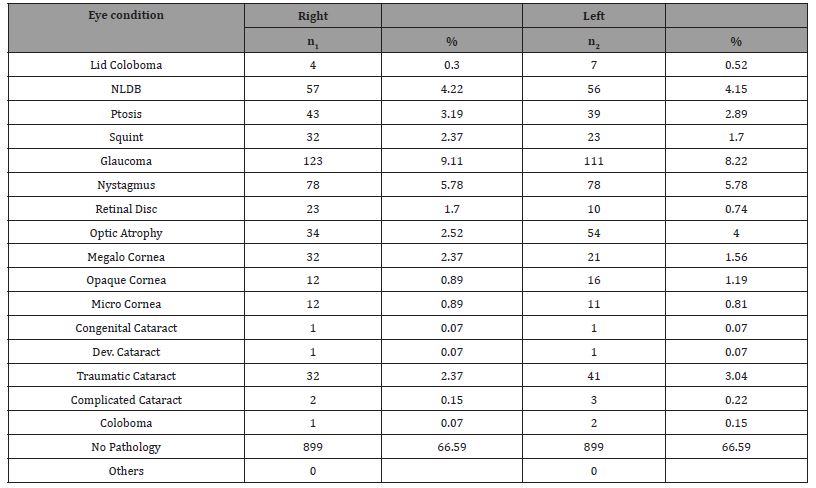
The diagnosis provided by ophthalmologists, as depicted in Table 5, offers critical notes into the prevalence of various eye conditions within the examined population. The data reveals a spectrum of ocular pathologies, with conditions such as glaucoma, nystagmus, and optic atrophy presenting relatively higher prevalence rates. Glaucoma, a chronic and potentially sight-threatening condition, was identified in 9.11% and 8.22% of individuals in their right and left eyes, respectively. Nystagmus, characterized by involuntary eye movements, was noted in 5.78% of cases. Additionally, optic atrophy, a marker of optic nerve damage, was diagnosed in 2.52% and 4.00% of individuals. While several other conditions like lid coloboma, ptosis, and cataracts were observed, a significant proportion of individuals (66.59%) exhibited no pathology in either eye.
Table 5: Diagnosis by Ophthalmologist (n=1350).
The statistics from Table 6 delineate the actions undertaken by ophthalmologists following their assessments, revealing a comprehensive approach to managing various eye conditions within the surveyed population. A notable proportion, constituting 9.34%, provided medication, whereas 2.66% of individuals underwent surgical procedures. Additionally, a significant majority, accounting for 88%, received medication along with prescription glasses, underscoring the prevalence of refractive errors and the importance of corrective lenses in optimizing visual acuity and comfort.
Table 6: Actions taken by Ophthalmologist (n=451).

Discussion
The findings from the school eye screening camp in Dhaka, Bangladesh, provide valuable insights into the socio-demographic profile of the surveyed students. The gender distribution among the students shows a slight predominance of girls (52.9%) over boys (47.1%). This gender balance reflects the overall school enrollment dynamics in the region [14]. Secondly, the educational stages attended by the students highlight a significant majority (69.2%) from primary education (grades 1-5), followed by those from high school (21.6%) and secondary levels (9.2%). Furthermore, the age breakdown shows a notable prevalence of younger students (5-10 years, 66.4%) compared to older students (11-15 years, 33.6%) which supports the class wise statistics of this study participants. This underscores the importance of proactive eye health measures, particularly among the younger age group.
Furthermore, the paternal occupation data reveals that a significant proportion of fathers were self-employed (40.2%), followed by laborers (29.0%) and private employees (15.7%). A smaller percentage were engaged in farming (4.5%), government employment (3.7%), or were unemployed (1.6%), with a further 2.6% classified under other occupations. This diversity in paternal occupations underscores the varied socio-economic backgrounds of the students surveyed. Therefore, these findings highlight a concrete information on the diverse demographic and socioeconomic characteristics of the students participating in the eye screening camp, providing a foundation for targeted and effective eye health initiatives within the school setting in Dhaka, Bangladesh.
The Al-Basar International Foundation’s school eye camp in Bangladesh has been a cornerstone in combating childhood blindness with the collaborative efforts of various stakeholders including school teachers, optometrists, and ophthalmologists. The contributions of school teachers in conducting initial screenings have been invaluable, with the majority of pupils (89%) receiving immediate attention and approximately 11% being referred to optometrists for further evaluation. These screenings have provided crucial insights into the prevalence of eye conditions and associated symptoms among students, emphasizing the importance of early detection and intervention in preventing childhood blindness.
Following the initial screenings, the comprehensive assessments conducted by optometrists during the Al-Basar International Foundation’s school eye camp have significantly enriched our understanding of visual abnormalities prevalent among the surveyed population. The data revealed varying levels of impairment, with a notable proportion exhibiting 6/12 vision, along with the presence of conditions such as squint, nystagmus, and refractive errors. Similarly, a population-based study in Bangladesh identified refractive errors as the most prevalent eye condition among children under 15 years [15]. This study emphasized the need to improve service delivery through implementing community-based screening programs comprising community mobilization, awareness, and early detection of childhood eye diseases, with effective referral mechanisms.
In accordance with this, the optometrists of Al-Basar International foundation, Bangladesh had taken some strategic actions following assessment, including medication, prescription of glasses, and referrals to hospitals for specialized care, underscore the camp’s commitment to addressing a wide range of eye conditions and ensuring optimal eye health outcomes for all individuals. While both initiatives aim to address childhood eye health, the Al-Basar International Foundation’s school eye camp stands out for its proactive approach, providing immediate assessments and tailored interventions to ensure optimal eye health outcomes for children in need, thereby making significant contributions to combating childhood blindness in Bangladesh.
The contribution of ophthalmologists within the Al-Basar International Foundation’s school eye camp in Bangladesh has been indispensable in the fight against childhood blindness. Their expertise had facilitated detailed diagnoses and management plans for a range of complex eye conditions prevalent among children, including glaucoma, nystagmus, and optic atrophy. These conditions were identified as treatable in prior studies conducted in Bangladesh [5], emphasizing the importance of targeted interventions. Ophthalmologists had adopted a comprehensive approach to address these conditions, incorporating various interventions such as medication, surgical procedures, and prescription glasses.
This commitment reflects the camp’s dedication to combating childhood blindness comprehensively and effectively. By providing tailored treatments and addressing a spectrum of ocular pathologies, the camp ensures that children with complex eye conditions receive the necessary care to preserve their vision and overall well-being. The involvement of ophthalmologists underscores the importance of specialized expertise in the provision of eye care services, further enhancing the impact of the school eye camp in Bangladesh. In a nutshell, the Al-Basar International Foundation’s school eye camp serves as a beacon of hope in Bangladesh’s fight against childhood blindness with the concerted efforts of school teachers, optometrists, and ophthalmologists. By combining early detection, comprehensive assessments, and tailored interventions, the camp continues to make significant strides in promoting optimal eye health and well-being among the country’s youth.
Conclusion
The Al-Basar International Foundation’s school eye camp in Bangladesh emerges as a vital initiative in addressing childhood blindness through the collaborative efforts of various stakeholders, including school teachers, optometrists, and ophthalmologists. The camp’s impact is evident in the comprehensive insights provided by initial screenings and subsequent assessments. These assessments have enriched the understanding of visual abnormalities prevalent among surveyed students, shedding light on conditions like refractive errors, squint, and nystagmus. Moreover, the camp’s proactive approach, exemplified by immediate attention and tailored interventions, highlights its commitment to early detection and intervention, crucial in preventing childhood blindness.
Comparing with other studies, the camp’s efforts align with the broader goal of improving eye health in Bangladesh. While refractive errors emerge as a prevalent concern, the camp’s interventions extend beyond mere identification, encompassing medication, prescription of glasses, and referrals for specialized care. This comprehensive approach mirrors global recommendations for addressing childhood blindness and underscores the camp’s effectiveness in providing targeted and accessible eye care services.
Furthermore, the involvement of ophthalmologists adds specialized expertise to the camp’s operations, facilitating detailed diagnoses and management plans for complex eye conditions. Their contributions, including medication, surgical procedures, and prescription glasses, demonstrate a commitment to holistic eye care and the preservation of children’s vision and overall wellbeing. Through its cooperative endeavors and thorough strategy, the camp persistently advances in advocating for excellent eye health and overall well-being among the nation’s young population, thereby leaving a deep and enduring impression on the lives of school children in Bangladesh.
Acknowledgement
The authors would like to express their gratitude to the authorities of Al-Basar International Foundation, Bangladesh for their sincere support during the study.
References
- World Health Organization. Blindness and vision impairment.
- Hussain AHME, Ferdoush J, Mashreky SR, Rahman AKMF, et al. (2019) Epidemiology of childhood blindness: A community-based study in Bangladesh. PLoS One 14(6): e0211991.
- Ferede AT, Alemu DS, Gudeta AD, Alemu HW, Melese MA (2020) Visual impairment among primary school children in Gondar town, Northwest Ethiopia. J Ophthalmol 2020: 6934013.
- Muhit MA, Shah SP, Gilbert CE (2007) The prevalence of childhood blindness in Bangladesh. Invest Ophthalmol Vis Sci 48(13): 4846-4846.
- Muhit MA, Shah SP, Gilbert CE, Foster A (2007) Causes of severe visual impairment and blindness in Bangladesh: a study of 1935 children. Br J Ophthalmol 91(8): 1000-1004.
- Kapur R (2018) Challenges Experienced by Visually Impaired Students in Education. Researchgate.net.
- Klauke S, Sondocie C, Fine I (2023) The impact of low vision on social function: The potential importance of lost visual social cues. J Optom 16(1): 3-11.
- Hasan MM, Chowdhury IH, Hamid SAT, Alamgir HM (2023) Financial and Geographic Barriers in Seeking and Utilizing Eye Healthcare in Bangladesh. J Ophthalmic Clin Res 10: 0109.
- Perrault MA, Lauer G, Voss S, Seitz B, Käsmann-Kellner B (2023) Visual impairment and low vision aids-A comparison between children and adults. J Pers Med 13(11): 1608.
- Ambrosino C, Dai X, Antonio Aguirre B, Collins ME (2023) Pediatric and school-age vision screening in the United States: Rationale, components, and future directions. Children (Basel) 10(3): 490.
- (2022) Vision Screening for Infants and Children. American Academy of Ophthalmology.
- Bangladesh Government. Gov.bd.
- Al Noor (2023) Eye Hospital Home.
- (2023) Survey on children’s Education in Bangladesh 2021 - survey findings report. ReliefWeb.
- Hussain AHME, Roy T, Ferdausi N, Sen U (2019) Prevalence of childhood ocular morbidity in a peri-urban setting in Bangladesh: a community-based study. Public Health 170: 103-112.
-

This work is licensed under a Creative Commons Attribution-NonCommercial 4.0 International License.




