



 Review Article
Love Your Eyes, Kids: Addressing Eye Problems in Children on World Sight Day 2024
Received Date: October 02, 2024; Published Date: October 10, 2024
Introduction
World Sight Day and Its Importance
World Sight Day (WSD) is an annual global event held on the second Thursday of October to raise awareness about blindness and visual impairment. It is organized by the International Agency for the Prevention of Blindness (IAPB) and supported by organizations and individuals worldwide. In 2024, World Sight Day falls on October 10, with the theme “Love Your Eyes, Kids.” This theme highlights the growing concern over childhood eye problems and the need for preventive measures to safeguard children’s vision [1-10].
Children are the future, and ensuring their good vision is essential for their education, development, and quality of life. Studies show that untreated eye conditions in childhood can lead to long-term visual impairments, affecting everything from academic performance to social development. [1-10] On this World Sight Day, the focus is on combating these issues through early detection, preventive care, and awareness.
The Growing Prevalence of Eye Problems in Children
According to the World Health Organization (WHO), an estimated 19 million children worldwide are visually impaired, with refractive errors (such as myopia, hyperopia, and astigmatism) being the most common cause. Of these, around 12 million cases are due to refractive errors that could be corrected with glasses, but often go undiagnosed, particularly in low and middle-income countries.
Vision problems in children are not only a public health concern but also a developmental one. Poor vision in childhood can lead to difficulties in learning, delays in reaching developmental milestones, and a reduced quality of life. Early identification and treatment of vision problems can significantly enhance a child’s chances of succeeding in school and in life.
Common Eye Problems in Children
Several vision conditions commonly affect children and understanding them is critical to addressing the problem.
Refractive Errors: Myopia, Hyperopia, and Astigmatism
Myopia (Nearsightedness)
Myopia, also known as nearsightedness, is a condition where distant objects appear blurry while near objects remain clear. It is the most common refractive error among children, and its prevalence is rising globally. Research suggests that environmental factors, such as prolonged near work (e.g., reading or screen use), and reduced outdoor time, contribute significantly to the increase in myopia.
In 2020, the World Health Organization estimated that by 2050, half of the global population would be myopic if current trends continue. Untreated myopia can lead to high myopia, which increases the risk of serious conditions like retinal detachment and glaucoma.
Hyperopia (Farsightedness)
Hyperopia is the opposite of myopia. Children with hyperopia can see distant objects more clearly than near objects. Mild hyperopia often resolves as children grow older, but moderate to severe hyperopia requires correction with glasses. If left untreated, hyperopia can cause eye strain, headaches, and learning difficulties.
Astigmatism
Astigmatism occurs when the cornea’s shape is irregular, causing blurred vision at all distances. Children with astigmatism may experience headaches, eye strain, and difficulty reading. Like myopia and hyperopia, it can be easily corrected with glasses or contact lenses.
Strabismus (Crossed Eyes) and Amblyopia (Lazy Eye)
Strabismus (Crossed Eyes)
Strabismus occurs when the eyes do not align properly, causing one or both eyes to turn inward, outward, upward, or downward. This condition can affect depth perception and coordination. Strabismus can lead to amblyopia, a condition where the brain favors one eye, causing the vision in the other eye to diminish.
Strabismus can be treated with glasses, vision therapy, or surgery, depending on the severity. Early detection is critical, as treatment is more effective when initiated during childhood.
Amblyopia (Lazy Eye)
Amblyopia, commonly known as lazy eye, occurs when one eye is weaker than the other. It typically develops in early childhood and can result from untreated refractive errors or strabismus. Without early intervention, amblyopia can lead to permanent vision impairment in the affected eye.
The primary treatment for amblyopia is patching the stronger eye to force the weaker eye to work harder. Corrective lenses and vision therapy are also used to improve vision.
Pediatric Cataracts and Other Less Common Eye Conditions
Pediatric Cataracts
Although cataracts are more commonly associated with aging, they can also affect children. Pediatric cataracts may be congenital or acquired due to trauma or infection. Cataracts cloud the lens of the eye, leading to vision impairment. If left untreated, they can result in blindness.
Treatment for pediatric cataracts usually involves surgery to remove the cloudy lens, followed by the use of intraocular lenses or contact lenses to restore vision.
Other Conditions
Conditions like ptosis (drooping eyelids) and nystagmus (involuntary eye movement) can also affect children’s vision. Ptosis can obstruct vision, and nystagmus often reduces visual acuity. These conditions require prompt medical attention, and in some cases, surgery.
Digital Vision Syndrome (DVS) In the Digital Age
The rise of digital devices has brought new challenges for children’s eye health. Prolonged exposure to screens from smartphones, tablets, and computers can lead to Digital Vision Syndrome (DVS), also known as Computer Vision Syndrome. This condition is characterized by eye strain, dry eyes, headaches, blurred vision, and neck or shoulder pain. Children are particularly vulnerable because their visual systems are still developing, and they often spend hours using digital devices, especially for learning and entertainment.
A study by the American Optometric Association found that children who use screens for more than two hours a day are at higher risk of developing digital eye strain and myopia. As digital device usage continues to rise, it is vital to educate parents, teachers, and children about the importance of limiting screen time and incorporating preventive measures.
Preventive Care: Safeguarding Children’s Vision
Preventing childhood eye problems is a shared responsibility that involves parents, educators, healthcare providers, and public health agencies. Here are some key strategies that can help protect children’s vision.
Regular Eye Checkups
Early detection is critical in preventing long-term vision problems. Pediatricians and ophthalmologists recommend comprehensive eye exams starting from infancy. According to the American Optometric Association, children should have their first eye exam between six months and one year of age, followed by additional exams at age three and before starting school. Regular checkups can help detect and treat refractive errors, strabismus, amblyopia, and other conditions before they worsen.
Encourage Outdoor Play
Research shows that spending time outdoors can help reduce the risk of developing myopia. Natural light stimulates healthy eye growth and prevents the elongation of the eyeball, which leads to myopia. A 2015 study published in the Journal of the American Medical Association (JAMA) found that children who spent more time outdoors were less likely to develop myopia. [9] Experts recommend that children spend at least 1-2 hours outdoors every day to protect their vision.
Limit Screen Time
Limiting screen time is essential in preventing Digital Vision Syndrome and reducing the risk of myopia. The American Academy of Pediatrics advises that children under two years old should not have any screen time, and older children should limit their screen use to less than two hours per day. Additionally, the 20-20-20 rule is an effective strategy to reduce eye strain: after 20 minutes of screen use, take a 20-second break to look at something 20 feet away.
Promote a Healthy Diet for Eye Health
A balanced diet rich in vitamins and nutrients is crucial for maintaining good vision. Foods high in omega-3 fatty acids, vitamins A, C, and E, and zinc-such as leafy greens, fish, and citrus fruits-support eye health and help prevent conditions like cataracts and macular degeneration. Encouraging children to eat a healthy diet can significantly benefit their long-term vision.
Ensure Adequate Sleep
Proper sleep is essential for overall health, including eye health. Children who get enough rest are less likely to suffer from eye fatigue and strain. According to sleep experts, school-aged children need between [8-10] hours of sleep per night. Establishing a consistent sleep routine and creating a sleep-friendly environment can help rejuvenate their eyes and improve overall health.
Conclusion
A Collective Call to Action on World Sight Day 2024
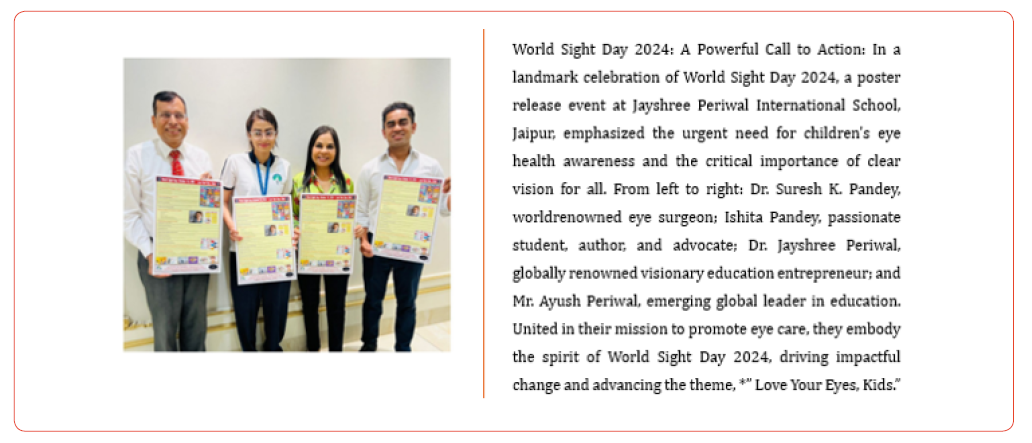
World Sight Day 2024, with the theme “Love Your Eyes, Kids,” emphasizes the importance of protecting children’s vision through awareness, early intervention, and preventive care. Childhood eye problems, such as myopia, hyperopia, and amblyopia, are increasingly prevalent and can have lifelong consequences if not addressed. By taking simple steps like regular eye checkups, encouraging outdoor play, limiting screen time, promoting a healthy diet, and ensuring adequate sleep, parents and caregivers can significantly reduce the risk of vision problems in children.
On this World Sight Day, let’s commit to making children’s eye health a priority. Every child deserves to see the world clearly and achieve their full potential, unimpeded by avoidable eye problems. By raising awareness and taking preventive actions today, we can safeguard the vision of future generations.
Acknowledgement
None.
Conflict of Interest
None.
References
- IAPB (2023) Global Data on Visual Impairment.
- World Health Organization (2022) Vision Screening in Children: Myopia and Hyperopia Statistics.
- National Eye Institute (2021) Myopia in Children: Causes and Prevention.
- American Academy of Ophthalmology (2022) Hyperopia in Pediatric Patients.
- Optometry and Vision Science Journal (2020) Astigmatism in Children: A Review.
- NHS (2022) Strabismus in Children: Diagnosis and Treatment.
- American Association for Pediatric Ophthalmology and Strabismus (2022) Amblyopia: Current Treatment Approaches.
- World Health Organization (2022) Pediatric Cataracts: Causes and Global Prevention.
- He M, Xiang F, Zeng Y, Mai J, Chen Q ,et al. (2015) Effect of Time Spent Outdoors at School on the Development of Myopia Among Children in China: A Randomized Clinical Trial. JAMA 314(11): 1142-1148.
- Journal of Digital Health (2021) Digital Vision Syndrome in Children: A Growing Concern.
-

This work is licensed under a Creative Commons Attribution-NonCommercial 4.0 International License.




