

 Research Article
Global Prevalence and Determinants of Vision Care Needs in Adolescents: A Sociodemographic and Environmental Perspective
Received Date: March 07, 2025; Published Date: March 21, 2025
Summary
Introduction: Vision impairment due to uncorrected refractive error (VI-RE) is a health burden affecting adolescents globally, necessitating the resolution of modifiable barriers to accessing the appropriate vision care resources among this cohort. This is fundamental, as VI-RE can lead to an increase in disability adjusted life years (DALYs), delayed cognitive advancement, reduced academic success, and lower quality of life, all of which have profound effects on the transition from adolescence into adulthood.
Methods: This review aimed to synthesize the literature on the global prevalence and determinants of health care needs in relation to VIRE among school-aged adolescents (13-18 years). A search of PubMed, Ovid Cochrane, and Web of Science were conducted, focusing on articles published between 2012 and 2022, and reporting on the prevalence, determinants and self-reported health outcomes related to VI-RE needs, defined as the inability to see well enough to read without corrective lenses.
Results: Our search identified 159 articles, 91 of which were removed before screening based on duplication and nonrelevance. A total of 68 abstracts and 24 full text articles were screened. Overall, findings from 10 articles formed the basis of this review.
Conclusion: The findings underscore a deficiency in healthcare resources for the VI-RE needs of adolescents. Sociodemographic and environmental disparities may affect their accessibility to utilizing appropriate services, impacting their vision-dependent activities. There is a need for more research assessing self-reported health outcomes and determinants of VI-RE among adolescents globally. The implementation of schoolbased screening programs for early detection and management is recommended.
Keywords: Adolescence; Determinants; Globally; Refractive error; Vision impairment
Introduction
Vision function and vision care play a pivotal role in fostering independence and enhancing overall quality of life. Accordingly, the onset of vision loss presents a substantial disruption to daily activities Berger & Porell, (2008), Smith, et al. (2009) [1, 2]. One of the primary contributors to vision impairment (VI) is uncorrected refractive error (URE), a pervasive issue that affects a significant portion of the global population Flaxman, et al. (2017) [3]. URE stands out as the foremost ocular problem affecting individuals across all age groups, although it is considered the most preventable cause of disability Hashemi, et al. (2018) [4]; Holden (2007) [5]; Lou, et al., (2016) [6]; Pascolini & Mariotti, 2012 [7]. Refractive error occurs when the eye cannot clearly focus on images, resulting in blurred vision. There are four commonly considered REs: myopia (near-sightedness), hyperopia (farsightedness), astigmatism, and presbyopia. These errors arise when the eye’s optical system fails to effectively converge parallel rays of light onto the fovea Sherwin, et al. (2011) [8]. The severity of these errors is contingent upon biometric factors such as axial length, anterior chamber depth, and corneal curvature, where discrepancies may emerge due to incongruities between the eye’s biometric components and structural integrity Warrier (2008) [9].
Among adolescents, VI is a major cause of concern that can lead to reduced cognitive and motor development, educational performance, and socialization, as their ability to progress with increasing visual tasks in parallel to academic and life demands are hindered Rudnicka, et al. (2008) [10]; World Health Organization, 2000 [11]. Globally, an estimated 12.8 million children aged 5-15 years suffer from vision impairment due to uncorrected refractive error (VI-RE), constituting 0.97% of this age group Alomair, et al. (2021) [12]. Few studies have focused on the prevalence and relative contributory role of various demographic, socioeconomic, and environmental factors related to child development of VI requiring vision correction. For instance, geographic differences in the prevalence of various types of VI-RE suggest myopia to be higher among participants from East Asia Hashemi, et al. (2017) [4]; Powell (2004) [13], and hyperopia and astigmatism to be highest among participants from the Americas Hashemi, et al. (2017) [4]. While few studies showed significant ethnic differences due to relative homogeneity in the sample population, there were trends of higher prevalence of myopia in children of East Asian, South Asian, and African American ethnicity Kodjebacheva, et al. (2011) [14]; Rudnicka, et al. (2010) [15]; Wen, et al. (2013) [16]. Socioeconomic status (SES) was positively associated with prevalence of VI Robaei, et al. (2005) [17]. Specifically, children of parents who were employed, had higher education, high income, and/or had home ownership, had a higher prevalence of VI compared to their counterparts Chong, et al. (2005) [18]; Ehrlich, et al. (2019) [19]; Rudnicka, et al., (2008) [10]; Xiang, et al. (2012) [20].
While existing literature has not definitively established an association between biological sex and VI, some studies have found a higher prevalence of VI among females than their counterparts Canadian Health Measures Survey (2018, 2019) [21]; Ebri, et al. (2019) [22]; Teran, et al. (2021) [23]; Robaei, et al. (2005) [17]; Zhao, et al. (2000) [24]. Environmental factors considered to impact VI have been explored in relation to partaking in nearwork activities. Near work includes activities pursued in short eye-to-working distances such as near reading and academic work (studying, writing), computer use and/or playing video games, and watching television Mutti, et al. (2002) [25]. Pursuing such activities at near distance have been positively linked with VI (specific to astigmatism and myopia) Buehren, et al. (2003) [26]; Yasuda & Yamaguchi (2005) [41], though associations with different forms of near work, duration, and associations with RE as a whole or VI are yet to be determined. On the other hand, studies exploring exposure to outdoor environments through outdoor physical activity found a protective role for outdoor activity in myopia (He, et al. (2015) [28]; Buch (2005) [29].
Overall, VI-RE has been evaluated predominantly through objective measures and screening. The scarcity of studies that comprehensively assess self-reported healthcare needs for vision correction presents a critical limitation in discerning those individuals who rely on visual aids to navigate both their daily personal activities and academic pursuits. This review aims to bridge these knowledge gaps by conducting a comprehensive analysis of demographic, socioeconomic, behavioral, and lifestyle factors associated with the demand for vision correction among adolescents globally. Considering the nascent evidence, and limited awareness of determinants and self-reported health outcomes of VI-RE among adolescents, our main research objectives are to review the evidence on the prevalence and determinants of health care needs in relation to vision correction among school-aged adolescents globally, and to review the evidence in relation to selfreported outcomes of vision correction needs among school-aged adolescents globally.
Methods
The study selection process is documented using a modified Preferred Reporting Items for Systematic reviews and Meta- Analyses (PRISMA) 2020 flow diagram Page, et al. (2021) [30] (Figure 1).
Search procedure and criteria
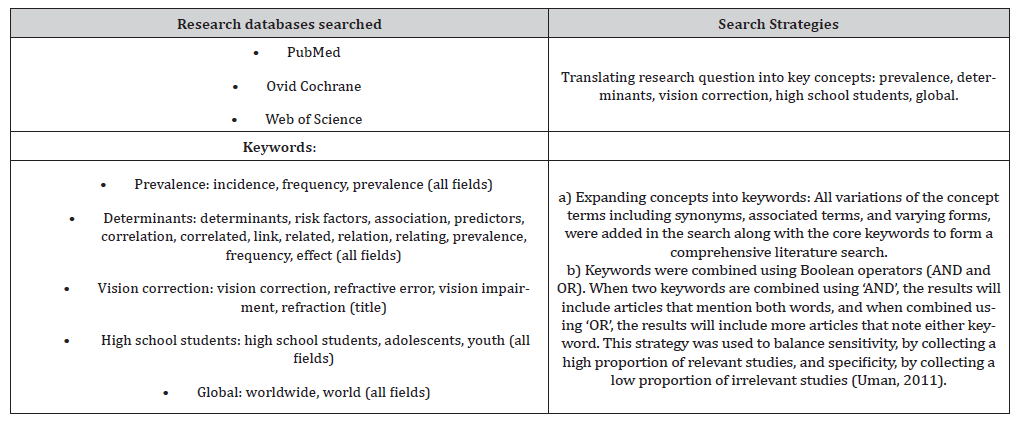
To comprehensively review the literature on VI-RE among adolescents, a search was conducted in accordance with guidelines from the Cochrane Collaboration. The search was organized using the PECOS method, which categorizes articles based on Population, Exposure, Comparison, Outcome, and Study Design Morgan, et al. (2018) [31]. The criteria for inclusion encompassed high school students and adolescents aged 13 to 18 years as the target population, and whether the study examined determinants of VI-RE. The primary outcome of interest was the prevalence, determinants, and self-reported health outcomes of VI-RE needs, defined as the inability to see well enough to read without corrective lenses. All study designs were considered. Articles were excluded if they reported on VI resulting from systemic disease or trauma, those focusing on specific vulnerable populations or disease-based analyses, and studies involving genetic/genomic aspects or animalbased research. The scope was limited to articles published in the English language within the past decade (2012 to 2022) to ensure the inclusion of current information in the review. A search strategy was developed according to Uman (2011) [32] and implemented using three scientific databases (Table 1).
Table 1: Search strategies and sources utilized to review evidence on the prevalence and determinants of vision impairment due to uncorrected refractive error (VI-RE).
Article screening

The databases of PubMed, Ovid Cochrane, and Web of Sciences were searched leading to a total of 159 articles. Prior to screening, the articles were reviewed by title and 91 articles were excluded due to duplication (7) and non-relevance to the review (such as animal based (1)), interventional (16), genetic/genome (7), and non-VI based (60). The remaining 68 articles were screened by title and/or abstract. Studies involving vulnerable/diseased population or having surgery (6), excluding the adolescent age group (33), and VI that was not due to RE (5) were excluded, resulting in 44 articles that were excluded. The remaining 24 articles were screened through full text for eligibility, where studies were excluded for having lack of or limited information on risk factors (6), the adolescent group (6), refractive error (1), and reviews having outof- date range of adolescent study references (1). There were 10 studies that were included for this research.
Results
Description of study designs
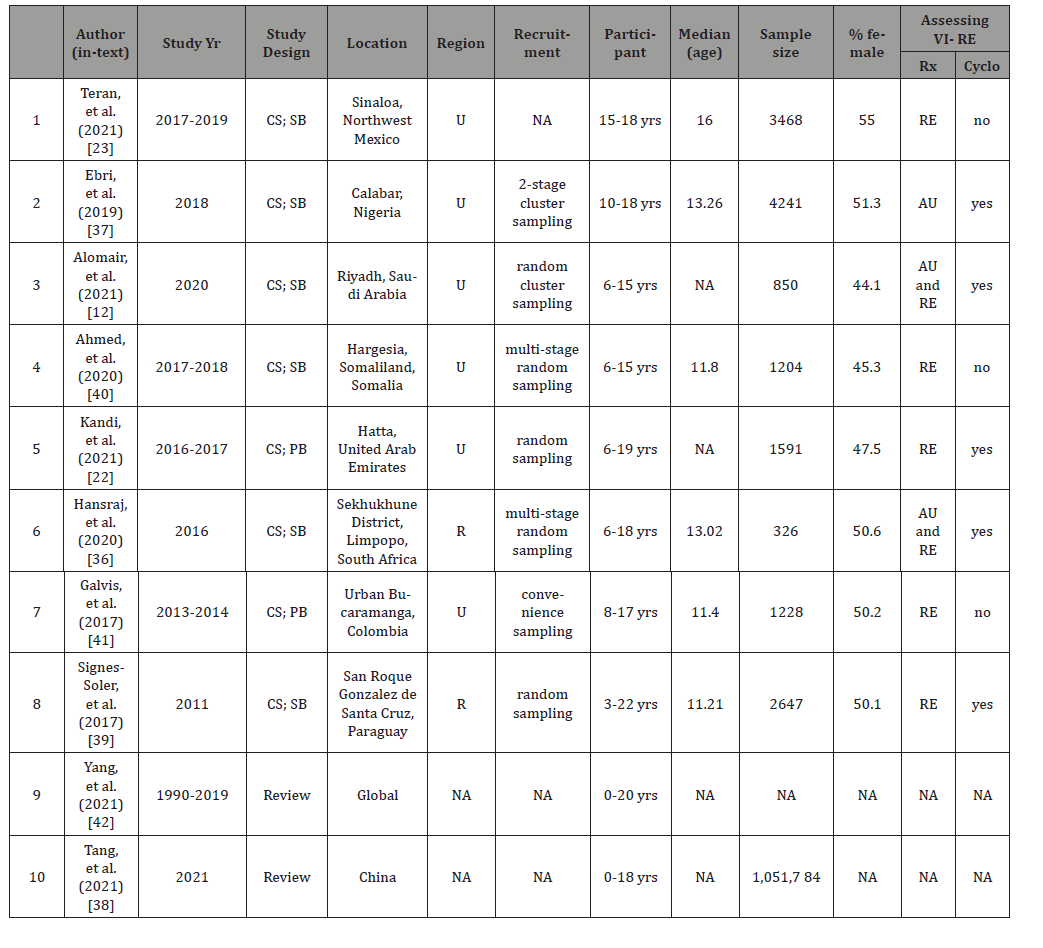
Out of the 10 included articles, there were 2 systematic reviews, and 8 cross-sectional studies (7 prospective, 1 retrospective). Out of the 8 cross-sectional studies, 6 studies were school-based, and 2 studies were population-based. There were 3 studies that were conducted in Latin America nations (Mexico, Paraguay, and Colombia), 3 studies were conducted in Africa (Nigeria, Somalia, and South Africa), 1 study was conducted in China, 2 studies were conducted in the Middle East (Saudi Arabia and United Arab Emirates), and 1 study was a multicenter global systematic review. From the 8 cross-sectional studies, 7 studies reported the sampling strategy, where 5 studies conducted random or random cluster sampling, 1 study conducted 2-stage cluster sampling, and 1 study conducted convenience sampling.
In terms of assessing VI-RE, the refraction methods varied among studies, where 5 studies included retinoscopy (an objective technique to determine the refractive error of the eye using handheld retinoscope observing the movement of reflected light from the eye). Another study included autorefraction (automated, objective, instrument-based screening of refractive error), and 2 studies included both methods Corboy (2003) [33]; Di Wang, et al. (2020) [34]. Only 5 studies included a cycloplegic refraction (a procedure of instilling eye drops known as cycloplegic agents to inhibit accommodation during objective vision assessment, to allow estimation of true refractive error) Yoo, et al. (2017) [35]. Main features of these studies are shown in Table 2.
Participants
The sample size ranged from 326 to 4241 participants for crosssectional studies, and 1,051,784 from the systematic review pooling 41 studies Hansraj, et al. (2020) [36]; Ebri, et al. (2019) [37], Tang, et al. (2021) [38]. The age groups, while including the adolescent group of 13-18 years, had varying criteria for participant age range. For example, one study included participants aged 15-18 years, while another study included participants aged 3-22 years Teran, et al., (2021) [23]; Signes-Soler, et al. (2017) [39]. However, most studies included an approximate equal distribution of biological sex in the sample size, ranging from 44.1% to 55% female Alomair, et al. (2021) [12]; Teran, et al. (2021) [23] (Table 2).
Table 2: Basic characteristic of study design of included studies.
Prevalence of refractive error and visual impairment due to refractive error
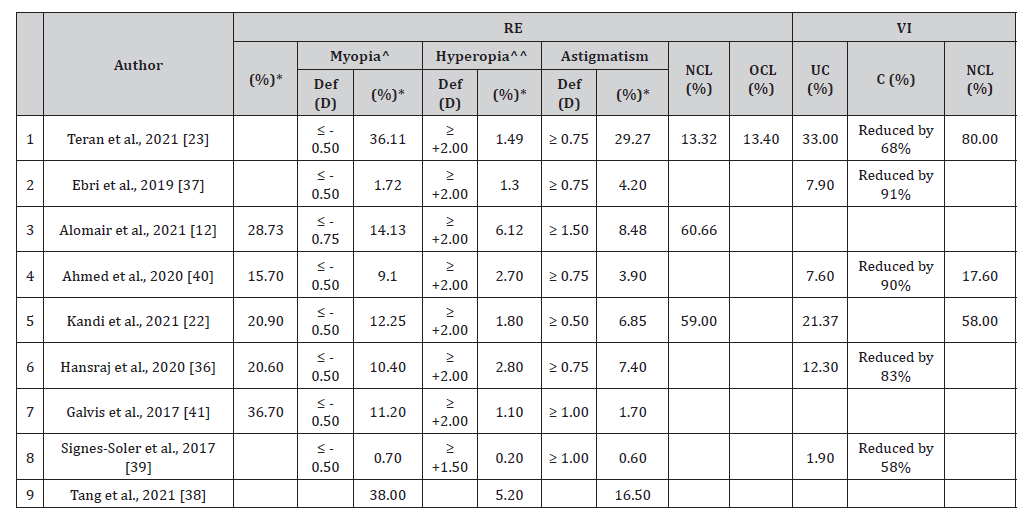
The prevalence of RE was reported in 9 studies. The proportion of the distribution of refractive errors were categorized into its subtypes of myopia, hyperopia, and astigmatism. Myopia was defined as less than or equal to -0.5 D to -0.75 D of RE, hyperopia was defined as greater or equal to +1.50 D to +2.00 D of RE, and astigmatism was defined as greater or equal to 0.75 D to 1.50 D of RE. There were 5 studies noting a general prevalence of RE ranging from 15.70% to 36.70% Ahmed, et al. (2020) [40]; Galvis, et al. (2017) [41]. Among the total participants in each study, the prevalence of subjects with myopia was highest among participants in the China-based study, with 38.00% Tang, et al. (2021) [38], followed by 36.11% among participants in the Mexico-based study Teran, et al. (2021) [23]. The lowest prevalence was found among participants in the study from Paraguay with 0.70% Signes-Soler, et al. (2017) [39], followed by participants in the Nigeria-based study with 1.72% Ebri, et al. (2019) [37].
The prevalence of hyperopia among participants with RE was highest among participants in the Saudi Arabia-based study with 6.12%, followed by participants in the China- based study with 5.20% Alomair, et al. (2021) [12]; Tang, et al. (2021) [38]. The lowest prevalence of hyperopia was found among participants in the Paraguay-based study with 0.20%, followed by participants in the Columbia-based study with 1.10% Signes-Soler, et al. (2017) [39]; Galvis, et al. (2017) [41]. The prevalence of astigmatism was highest among participants in the Mexico- based study with 29.27% Teran, et al. (2021) [23]) followed by those from the Chinabased study (16.50%) Tang, et al. 2021 [38] and Saudi Arabia-based (16.13%) study Alomair, et al. (2021) [12]. The lowest prevalence was found to be among participants from Paraguay 0.6%, followed by those from the Colombia-based study (1.7%) Signes-Soler, et al. (2017) [39]; Galvis, et al. (2017) [41].
With regards to prevalence of VI, defined as a visual acuity (VA) of less than 20/40 (or 6/12 based on the chart used), there were 6 studies that noted the prevalence of VI. The highest prevalence of uncorrected VI was among participants of the Mexico-based study with 33%, which upon provision of corrective lenses for those categorized with VI, decreased to normal vision by 68% among the population with VI (greater than VA of 20/25), and lowest among participants from the Paraguay-based study with 1.9% which upon provision of corrective lenses decreased to normal vision by 58% among the population with VI Teran, et al. (2021) [23]; Signes- Soler, et al. (2017) [39]. The decrease in VI due to vision correction indicates that a large percentage of this group had VI due to URE.
There were 4 studies that reported the use of corrective lenses among participants with RE. For participants of the Mexico-based study, the proportion of subjects who did not have corrective lenses but needed them for myopia was 13.32%, and for those who had outdated corrective lenses was 13.40% Teran, et al. (2021) [23]. Among those with VI, only 20% wore corrective lenses and achieved normal vision, whereas among the remaining participants, 85% achieved normal vision with correction provided. For students sampled in the study based in the UAE, 59% of those with RE did not wear corrective lenses, and 58% of those with VI did not wear corrective lenses Kandi, et al. (2021) [22]. Among students sampled in the Somalia-based study, only 17.60% of participants with VI wore corrective lenses Ahmed, et al. (2020) [40]. In the Saudi Arabia-based study, the majority of participants with RE did not wear corrective lenses (60.66%) Alomair, et al. (2021) [12]. The results describe a high percentage of school-aged children who did not have corrective lenses but needed them, as summarized in Table 3.
Self-reported health outcomes related to vision correction needs
From the 10 articles, only one study assessed self-reported health outcomes of vision correction needs Ahmed, et al. (2020) [12]. Among students in the study based in Somalia conducted by Ahmed, et al. (2020) [40], 12.7% complained of blurred vision, where prevalence of RE was 15.70% and VI was 7.60%. To estimate the global disease burden of URE among adolescents, Yang, et al. (2021) [42] retrieved data from the open-database of the Global Burden of Disease 2019 Study which compiled disabilityadjusted life years (DALYs) due to 369 diseases and injuries for 204 countries and territories from 1990-2019 Yang, et al. (2021) [42]. The latter study found that the number of DALYs due to URE increased by 8% between 1990-2019, however the DALY rate showed a downward trend, decreasing by 4.8% between those years. Overall, the numbers and rates of URE prevalence have remained high and stable in the past 30 years.
Table 3: Estimated global prevalence of refractive error (RE), vision impairment (VI), and use of corrective lenses among school children (13 to 22 years).
Determinants of VI-RE
All 10 reviewed studies assessed at least one determinant of VI-RE, including demographic factors (biological sex, age, race), socioeconomic factors, environmental factors, and lifestyle factors (exposure to near work and outdoor activities). Table 4 summarizes these findings.
• Biological sex
There were 7 articles that assessed biological sex differences in VI-RE. In the study by Teran, et al. (2021) [23], there was a significant effect of refractive status and biological sex with more females showcasing a higher refractive error than males on the visual acuity tests for both left (p=0.03, z-test) and right eye (p=0.001, z-test). In the study by Ebri, et al. (2019) [37], more female participants presented with higher prevalence of myopia (p<0.033), myopic astigmatism (p=0.012), and mild astigmatism (p<0.03). Among students assessed by Kandi, et al. (2021) [22], a significant increase in myopia with age was more pronounced in females, and a higher percentage of females wore spectacles (58%) than males (30%). In the study by Galvis, et al. (2017) [41], there was a statistically significant difference in the frequency of refractive errors by biological sex, where females presented with higher rates of myopic and hyperopic refractive errors (p=0.026). In the review by Yang, et al. (2021) [42] assessing severity of disease burden due to URE, total DALYs for females were significantly higher than males when comparing the findings from 2019 to year 1990 (p<0.001). The other 2 articles assessing this factor did not find any significant biological sex differences Alomair, et al. (2021) [12]; Tang, et al. (2021) [38]. Of the 5 articles that found a significant association between biological sex and VI- RE, female participants appeared to have a higher association with RE resulting in VI and poor visual acuity.
• Age
There were 9 articles that assessed the association of age with VI-RE, where 4 articles noted significant differences in age. Among a sample of adolescents 10 to 18 years, older participants between the age of 15 to 18 presented with hyperopic astigmatism (p<0.0004), while the rate of myopia was higher in children aged 13-16 years, with a spike at age 11 (6.5%; 95% CI: 4.6%-8.9%). On the other hand, Galvis, et al. (2017) [41], found that while the rate of myopia increased with age, the rate of hyperopia decreased with age (p<0.001), among adolescents 8-17 years. Similarly, Kandi, et al. (2021) [22], found a gradual increase in myopia with increasing age in both biological sexes. In the study by Yang, et al. (2021) [42], both biological sexes showed a similar trend of global DALY rates with age, with a sharp rise from 5-9 years of age, a slower rise thereafter, and reaching a plateau before 20 years of age. Among the findings, there has been a suggested increase in refractive error, especially myopia, and the disease burden with age among adolescents of the sample populations studied.
• National differences in the prevalence of refractive error
While only 1 article assessed the country-level associations, the 10 articles in the review are based in different countries and include sample populations of various nationalities. In the review by Yang, et al. (2021) [42], the countries with the largest populations had the highest DALYs number for URE, including India. Upon correction for multiple comparisons, the Eastern Mediterranean region had the highest disease burden for URE over the past 30 years (p<0.001), compared to other WHO regions, followed by Americas, and the lowest in the African region. Furthermore, in the same review, Yang, et al. (2021) [42], found that around 80% of adolescents in high schools in urban areas of East Asian countries are myopic with hyperopia and astigmatism of 4.6% and 14.9% respectively. Teran, et al. (2021) [23] showed a prevalence of 36.11% of myopia, consistent with the study by Galvis, et al. (2017) [41] with a prevalence of RE of 36.7%, however contrasting with the study by Signes-Solar, et al. (2017) [39] (based in rural Paraguay), with the lowest prevalence of myopia, hyperopia, and astigmatism. Among the African countries reviewed, the prevalence rate of RE varied. The study by Ebri, et al. (2019) [37] found relatively low prevalence in Nigeria, the study by Ahmed et al. (2020 [40] found moderate prevalence in Somalia, and the study by Hansraj, et al. (2020) [36] revealed relatively higher prevalence in South Africa (Table 3).
Socioeconomic factors
• Socioeconomic status and urbanization
The review by Yang, et al. (2021) [42] assessed socioeconomic status, in relation to global disease burden of URE in adolescents. This was done by analyzing the income-level and sustainable development index (SDI)-level regions. The DALY rates were highest in high-income regions and lowest in low-income regions. A linear trend was observed between the disease burden of URE and SDI, human development index (HDI), primary school dropout rate, and urbanization rate. However, primary school dropout rates were inversely associated with DALY rates. Ebri, et al. (2019) [37] found that myopia was higher in urban than in semi-urban schools. Tang, et al. (2021) [38] found that urban children had a significantly higher prevalence of myopia, hyperopia, and astigmatism than rural children (p<0.001). The study by Signes-Soler, et al. (2017) [39], conducted in the rural area of Paraguay, showed the lowest prevalence of all types of RE among all 10 articles reviewed, which predominantly were set in urban regions.
Environmental and lifestyle factors
• Near work
The study by Alomair, et al. (2021) [12] assessed near work and outdoor activities through a questionnaire to the parents. There was no significant association found between how often children did their homework, how many hours spent on homework, and having a RE (p=0.17 and p=0.75 respectively). Furthermore, no association was found between using electronic devices and RE (p=0.26).
• Outdoor activity
In relation to outdoor activity, Alomair, et al. (2021) [12] reported that doing outdoor activities was associated with RE (p<0.01). From the total sample of children, 69.21% pursued outdoor activities. Of these children, 72.16% (n=425) did not have RE. Of the children who had RE (n=236), 38.14% did not do outdoor activities. Upon logistic regression modelling and adjusting for age and biological sex, the study findings suggested that children who pursued outdoor activities had 52% lower odds of having an RE than those who did not pursue outdoor activities.
Table 4: Assessed Determinants of Prevalence of VI-RE.
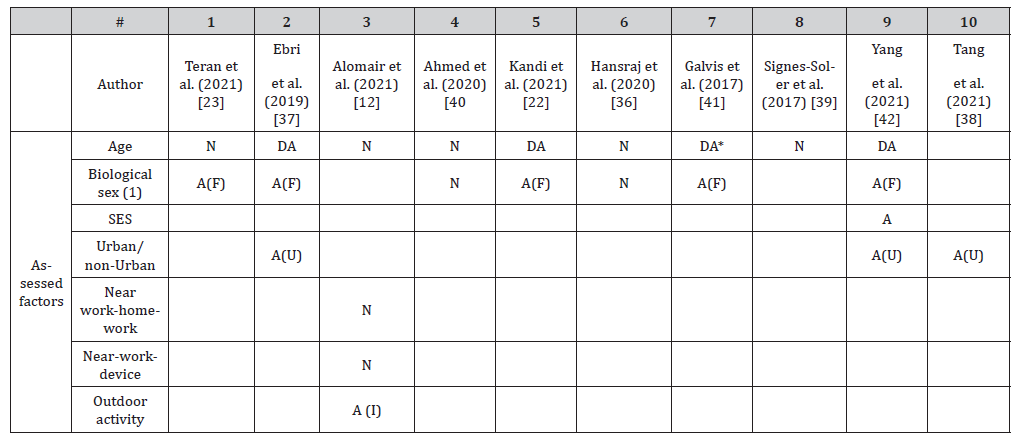
N = no statistically significant association
A = statistically significant association
D=direct
(*) = increased rate of myopia and decreased rate of hyperopia with age
(1) = the biological sex that has higher prevalence
F = females
U = urban with higher prevalence
I = inversely associated
Discussion
The prevalence of myopia, as indicated in various nationalbased studies, aligns with global reports showing an increase in myopia prevalence Teran, et al. (2021) [23]. Nonetheless, the consistency of using cycloplegic refraction in these studies varies. The inclusion of cycloplegia during refraction conceals the impact of accommodation, thereby aiding in the reduction of errors related to overestimating myopia and underestimating hyperopia and is seen in some instances as gold standard for research reporting refractive outcomes of myopia control treatments Al-Thawabieh, et al. (2023) [43].
Moreover, age appears to be an associating factor of RE, with an increase in myopia with age. Eye growth is known to be completed at age 13 years, while axial length growth may continue, where the progression initially increases after 13 years before stabilizing during late adolescence Kandi, et al. (2021) [22]. The increased study burden and access to electronic devices among school-aged children with each year may play a role in the increasing prevalence rate of VI-RE.
Biological sex appears to be a relatively consistent determinant of VI-RE, noting higher prevalence of females with VI-RE than males. Ahmed, et al. (2020) [40] suggests that this may be linked to socioeconomic factors that contributed to better health care services for males. Indeed, biological sex inequality in the global burden of URE exists among adolescents since 1990 Kandi, et al. 2021 [22]. The findings in the review are consistent with the trend of many other studies revealing higher prevalence of females with refractive disorders than males. Suggested reasoning included differing environmental factors, such as a potential tendency of females to spend less time outdoors than males. Also, the inequality of social, cultural, and economic status between men and women may lead to reduced access to eye care services and refractive correction for women.
Socioeconomic status was found to be positively associated with higher levels of VI-RE. The connection between higher levels of myopia and VI in the context of schooling has been previously established. Consequently, it was observed that primary school dropout rates displayed an inverse correlation with DALY rates attributed to URE Yang, et al. (2021) [42]. In terms of urbanization as a factor, living in an urban environment has been suggested to be a risk factor, where regions with middle to high income and SDI have higher DALY rates, and HDI and SDI were significantly positively associated with VI due to URE Yang, et al. (2021) [42]. Evidence suggests that less outdoor activities and high academic stress in urban areas may be reasons for higher prevalence of myopia Tang, et al. (2021) [42].
In this review, near work was not significantly associated with VI-RE. While most studies focused on the relationship between myopia and near work, the study by Alomair, et al. (2021) [38] assessed all types of RE and near work, yet no associations were found. However, it is worth noting that some studies found associations between myopia and near work, resulting in a strength of Level 2 (data providing substantial evidence in support of the recommendation), and the recommendation of decreasing near work activities as Level B (moderately important) Hansraj, et al. (2020) [36]. Outdoor activity, on the other hand, was found to have an inverse association with VI-RE. Outdoor activities are known as prophylactic measures of progression of myopia, where higher levels of time spent outdoors were associated with less myopia, suggesting outdoor activities can help lower the risk of developing RE Alomair, et al. (2021) [12].
This review was subject to limitations based on the features of the reviewed studies. First, the ranges of age groups assessed vary greatly between studies, while including the adolescent group. This does not provide an accurate measure of the prevalence of VI-RE in the adolescent population. As some were school-based rather than population-based, the results were not generalizable to the whole population of that age group. Lack of cycloplegia in refraction to assess for RE may have accounted for overestimating prevalence of myopia and underestimating prevalence of hyperopia due to accommodation of the eye. Some studies were based in rural settings, where a large percentage of adolescents did not attend school due to poverty, and the distribution of children’s ages in school was not uniform. Moreover, any questionnaire provided were given to the parents and not to the children, where only one study inquired on the participant’s self-reported symptoms of blurriness and needing corrective lenses. There was only one recent publication regarding RE among schoolchildren in the Hatta region of the UAE Kandi, et al. (2021) [22].
Furthermore, while numerous studies have proposed environmental factors to increase the risk of developing VI-RE, including aspects like urban surroundings, near-work activities, outdoor engagement, limited access to eye care, academic stress, and socioeconomic variables such as income, education, and adequate healthcare, there is a notable scarcity of research that has specifically examined these potential risk factors within the adolescent population.
Conclusion
This review corroborates the increasing prevalence of VI-RE across the globe and the high percentage of those with RE not having appropriate correction, suggesting the pressing need for a more adequate screening program for schoolchildren with a standardized protocol and bridging barriers to accessing eye care and correction. Associations of age and biological sex suggest further research in assessing the prevalence and risk factors of the older adolescent group and for females specifically, to help mitigate the health outcomes and impact on academic performance due to VI. Socioeconomic status including income and education status warrant further research on how to help reduce the likelihood of VI-RE in underserved and vulnerable populations. Near work and outdoor activity as positive and negative determinants of VI-RE need to be further explored to guide health policies regarding the recommendation of reducing near work and increasing outdoor activity through evidence-informed methods. Finally, the use of selfreported data from students about their healthcare needs related to vision, as well as any environmental and lifestyle obstacles, can offer valuable insights for developing grassroots solutions to optimize and streamline the treatment of VI-RE. This, in turn, can pave the way for a brighter academic, social, and personal future for adolescents.
Acknowledgement
None.
Conflict of Interest
The authors declare no conflict of interest.
Data Availability Statement
Data sharing not applicable to this article as no data sets were generated or analyzed during the current study.
References
- Berger S, Porell F (2008) The association between low vision and function. J Aging Health 20(5): 504-525.
- Smith TST, Frick KD, Holden BA, Fricke TR, Naidoo KS (2009) Potential lost productivity resulting from the global burden of uncorrected refractive error. Bull World Health Organ 87: 431-437.
- Flaxman SR, Bourne RR, Resnikoff S, Ackland P, Braithwaite T, et al, (2017) Global causes of blindness and distance vision impairment 1990-2020: a systematic review and meta-analysis. Lancet Glob Health 5(12): 1221-1234.
- He M, XHashemi H, Fotouhi A, Yekta A, Pakzad R, Ostadimoghaddam H et al (2017) Global and regional estimates of prevalence of refractive errors: Systematic review and meta-analysis. J Curr Ophthalmol 30(1): 3-22.
- Holden BA (2007) Uncorrected refractive error: the major and most easily avoidable cause of vision loss. Community Eye Health 20(63): 37-39.
- Lou L, Yao C, Jin Y, Perez V, Ye J (2016) Global patterns in health burden of uncorrected refractive error. Invest Ophthalmol vis Sci 57(14): 6271-6277.
- Pascolini D, Mariotti SP (2012) Global estimates of visual impairment: 2010. Br J Ophthalmol 96(5): 614-618.
- Sherwin JC, Kelly J, Hewitt AW, Kearns LS, Griffiths LR, et al. (2011) Prevalence and predictors of refractive error in a genetically isolated population: the Norfolk Island Eye Study. Clin Exp Ophthalmol 39(8): 734-742.
- Warrier SK, Wu HM, Newland HS, Muecke JS, Selva D, et al. (2008) Ocular biometry and determinants of refractive error in rural Myanmar: the Meiktila Eye Study. Br J Ophthalmol.
- Rudnicka AR, Owen CG, Richards M, Wadsworth ME, Strachan DP (2008) Effect of breastfeeding and sociodemographic factors on visual outcome in childhood and adolescence. Am J Clin Nutr 87(5): 1392-1399.
- World Health Organization (2000) Elimination of avoidable visual disability due to refractive 34 errors: report of an informal planning meeting Geneva: 3-5.
- Alomair R, Alghnam SA, Alnasser BN, Almuhawas HA, Alhoshan SA, et al. (2021). The prevalence and predictors of refractive error among school children in Riyadh, Saudi Arabia. Saudi J Ophthalmol 34(4): 273-277.
- Powell C, Wedner, S, Hatt SR (2004) Vision screening for correctable visual acuity deficits in school‐age children and adolescents. Cochrane Database of Syst Rev 2(2).
- Kodjebacheva G, Brown ER, Estrada L, Yu F, Coleman AL (2011) Uncorrected refractive error among first-grade students of different racial/ethnic groups in southern California: results a year after school-mandated vision screening. J Public Health Manag Pract 17(6): 499-505.
- Rudnicka AR, Owen CG, Nightingale CM, Cook DG, Whincup PH (2010) Ethnic differences in the prevalence of myopia and ocular biometry in 10-and 11-year-old children: the Child Heart and Health Study in England (CHASE). Invest Ophthalmol Vis Sci 51(12): 6270-6276.
- Wen G, Tarczy Hornoch K, McKean Cowdin R, Cotter SA, Borchert M, et al. (2013) Multi Ethnic Pediatric Eye Disease Study Group. Prevalence of myopia, hyperopia, and astigmatism in non-Hispanic white and Asian children: multi- ethnic pediatric eye disease study. Ophthalmology 120(10): 2109-2116.
- Robaei D, Rose K, Ojaimi E, Kifley A, Huynh S, et al. (2005) Visual acuity and the causes of visual loss in a population-based sample of 6-year-old Australian children. Ophthalmology 112(7): 1275-1282.
- Chong YS, Liang Y, Tan D, Gazzard G, Stone RA, Saw SM (2005) Association between breastfeeding and likelihood of myopia in children. JAMA 293(24): 2999-3002.
- Ehrlich JR, Stagg BC, Andrews C, Kumagai A, Musch DC (2019) Vision impairment and receipt of eye care among older adults in low-and middle-income countries. JAMA Ophthalmol 137(2): 146-158.
- Xiang F, He M, Morgan IG (2012) The impact of parental myopia on myopia in Chinese children: population-based evidence. Optom Vis Sci 89(10): 1487-1496.
- Canadian Health Measures Survey 2018-2019.
- Kandi SC, Khan HA (2021) Epidemiological Findings of Refractive Errors and Amblyopia among the Schoolchildren in Hatta Region of the United Arab Emirates. Dubai Medical Journal 4(1): 3-9.
- Teran E, Ramírez Jaime R, Martínez Gaytán C, Romo García E, Costela FM (2021) Refractive Error of Students (15-to 18-year-olds) in Northwest Mexico. Optom Vis Sci 98(10): 1127-1131.
- Zhao J, Pan X, Sui R, Munoz SR, Sperduto RD, et al. (2000) Refractive error study in children: results from Shunyi District, China. Am J Ophthalmol 129(4): 427-435.
- Mutti DO, Mitchell GL, Moeschberger ML, Jones LA, Zadnik K (2002) Parental myopia, near work, school achievement, and children’s refractive error. Invest Ophthalmol Vis Sci 43(12): 3633-3640.
- Buehren T, Collins MJ, Loughridge J, Carney LG, Iskander DR (2003) Corneal topography and accommodation. Cornea 22(4): 311-316.
- Yasuda A, Yamaguchi T (2005) Steepening of corneal curvature with contraction of the ciliary muscle. J Cataract Refract Surg 31(6): 1177-1181.
- He M, Xiang F, Zeng Y, Mai J, Chen Q et al (2015) Effect of time spent outdoors at school on the development of myopia among children in China: a randomized clinical trial. JAMA 314(11): 1142-1148.
- Buch H (2005) Fourteen‐year incidence of age‐related maculopathy and cause‐specific prevalence of visual impairment and blindness in a Caucasian population: the Copenhagen City Eye Study. Acta Ophthalmol Scand 83(3): 5-32.
- Page MJ, McKenzie JE, Bossuyt PM, Boutron I, Hoffmann TC, Mulrow CD, Moher D (2021) The PRISMA 2020 statement: an updated guideline for reporting systematic reviews. International Journal of Surgery 88: 105906.
- Morgan RL, Whaley P, Thayer KA, Schünemann HJ (2018) Identifying the PECO: A framework for formulating good questions to explore the association of environmental and other exposures with health outcomes. Environment international, 121(1): 1027-1031.
- Uman LS (2011) Systematic reviews and meta-analyses. J Can Acad Child and Adolesc Psychiatry 20(1): 57-59.
- Corboy JM (2003) The retinoscopy book: An introductory manual for eye care professionals. Slack.
- Di Wang NJ, Pei RX, Zhao LQ, Du B, Liu GH, et al. (2020) Comparison between two autorefractor performances in large scale vision screening in Chinese school age children. Int J Ophthalmol 13(10): 1660.
- Yoo SG, Cho MJ, Kim US, Baek SH (2017) Cycloplegic refraction in hyperopic children: effectiveness of a 0.5% tropicamide and 0.5% phenylephrine addition to 1% cyclopentolate regimen. Korean J Ophthalmol 31(3): 249-256.
- Hansraj R, Xulu Kasaba ZN, Magakwe TS (2020) Visual impairment and refractive error amongst school-going children aged 6-18 years in Sekhukhune District (Limpopo, South Africa). African Vision and Eye Health 79(1): 1-8.
- Ebri AE, Govender P, Naidoo KS (2019) Prevalence of vision impairment and refractive error in school learners in Calabar, Nigeria. African Vision and Eye Health 78(1): 1-8.
- Tang Y, Chen A, Zou M, Liu Z, Young CA, et al. (2021) Prevalence and time trends of refractive error in Chinese children: a systematic review and meta-analysis. J Global Health: 11.
- Signes Soler I, Hernández Verdejo JL, Lumeras MAE, Verduras ET, Piñero DP (2017) Refractive error study in young subjects: results from a rural area in Paraguay. Int J Ophthalmol 10(3): 467.
- Ahmed ZA, Alrasheed SH, Alghamdi W (2020) Prevalence of refractive error and visual impairment among school-age children of Hargesia, Somaliland, Somalia. East Mediterr Health J 26(11): 1362-1370.
- Galvis V, Tello A, Otero J, Serrano AA, Gómez LM, et al. (2017) Refractive errors in children and adolescents in Bucaramanga (Colombia). Arq Bras Oftalmol 80(6): 359-363.
- Yang Z, Jin G, Li Z, Liao Y, Gao X et al (2021) Global disease burden of uncorrected refractive error among adolescents from 1990 to 2019. BMC Public Health 21(1): 1-10.
- Al Thawabieh W, Al Omari R, Abu Hassan DW, Abuawwad MT, Al Awadhi A, et al. (2023) Tropicamide Versus Cyclopentolate for Cycloplegic Refraction in Pediatric Patients with Brown Irides: A Randomized Clinical Trial. Am J Ophthalmol 257: 218-226.
-

This work is licensed under a Creative Commons Attribution-NonCommercial 4.0 International License.