



 Research Article
Exploring the Correlation Between Eye Movement Patterns and Reading Proficiency in Undergraduate Students Using ReadAlyzer
Received Date: January 24, 2024; Published Date: March 19, 2024
Abstract
Objective: This study aimed to explore the relationship between eye movements and reading proficiency in students within the Health Area at ENES Unit Leon, UNAM.
Background: Reading, a multifaceted cognitive process, heavily relies on coordinated eye movements, crucial for academic performance. Dysfunctions in eye movements can impact attention, memory, and reading abilities, manifesting in fixation loss, omissions, slower pace, and compromised comprehension.
Methods: Employing a cross-sectional, descriptive, and observational approach, the study involved a reading habits questionnaire, preliminary tests, and DEM and ReadAlyzer assessments for eye movements, comprehension, and reading skills. Among 78 students, 42% reported oculomotor dysfunction. ReadAlyzer analysis revealed 47% with adequate fixation duration, 44% achieving a reading speed of 220 words per minute or higher, and 50% meeting expected comprehension levels. Correlation analysis (Chi-square value of 3.97, p-value of 0.046) indicated a significant association between eye movements and reading skills.
Conclusion: Proficient reading ability is intricately linked to appropriate eye movements, emphasizing their crucial role among students in the health area. These findings underscore the importance of understanding and addressing eye movement issues to enhance reading skills in academic settings.
Introduction
The sense of sight is fundamental in perceiving the environment as it provides a significant portion of the information we receive. Eye movements play a crucial role in this process, requiring smooth, precise, extensive, and comprehensive movements. When focusing our gaze on an object, it stimulates the fovea of both retinas, activating corresponding areas in the cerebral cortex where the encoding of the surrounding world takes place [1,2]. Due to eye movements, our gaze rapidly changes at a rate of approximately 2 to 3 times per second. While concentrating on a visual scene, saccadic movements stereotypically act to achieve precise retinal stimulation, essential for processing finer details. All eye movements convert a spatial scene into a space-temporal input signal to the retina [3,4]. Interpretation at the cerebral level depends on the correct functioning of eye movements, and during the reading process, they play an indispensable role in learning [5].
Reading involves the simultaneous execution of various skills. Initially, it requires recognition of the necessary visual information to extract text information [6]. Reading is an automatic process that relies on proper functioning of visual skills: eye movements, visual acuity, accommodation, and convergence [7]. Reading is a skill requiring two fundamental components: decoding graphic symbols and understanding the written message [8]. Reading comprehension refers to the result obtained by an individual’s effort to decode a text [9]. This integration stems from the interaction between the text content and the cognitive process of readers, described as the capacity for inference, working memory, vocabulary knowledge, and multiple abilities working in combination to produce text comprehension [10,11].
Various subjective methods are available to evaluate the quality of eye movements. One of these methods is the indirect test DEM (Developmental Eye Movement), which was introduced in 1990. This method was devised to distinguish between the automaticity of eye movements and saccadic dysfunctions, operating on the assumption that inadequate control of eye movement could result in reading difficulties [12]. Currently, different measurement methods are available to assess eye movements, including reading, such as the ReadAlyzerTM equipment (Compevo, AB, Sweden). This device, provides direct and objective assessments by using goggles with infrared sensors that record eye movements during reading, allowing for a quantitative analysis of fixation movements, regression movements, reading speed in words per minute, and reading comprehension [13].
Eye movements play a significant role in students academic and reading performance. During reading, multiple cognitive processes such as attention, memory, and the integration of perceptual information take place. Issues with eye movements may lead to alterations, affecting attention, memory, and reading. Symptoms related to eye movement problems include loss of fixations, omission of words or letters, slow reading speed, and failures in reading comprehension [14]. Given the above, the research question to be answered is whether there is a relationship between the proper functioning of eye movements and the performance, capacity, and reading comprehension in undergraduate students. The objective is: to assess the correlation between eye movements and reading ability in students from the Health Area at ENES Unit Leon, UNAM.
Materials and Methods
Study design
A cross-sectional, descriptive, observational, and comparative study was conducted. A questionnaire was used to collect information on reading habits. Preliminary tests and DEM and ReadAlyzer test were employed to assess eye movements, comprehension, and reading ability.
Population selection
The study involved a total sample of 78 Health Area students from ENES Leon Unit, UNAM, comprising 36 optometry, 9 physiotherapy, and 33 dentistry students. Non-parametric convenience consecutive recruitment was used. Selection criteria included: regardless of gender, students aged between 18 and 23 years, emmetropes or corrected ametropia, no visual or pathological alterations, achieving near visual acuity of 20/25 or better, meeting inclusion criteria, signing informed consent, and completing the questionnaire [Table 1]. Exclusion criteria consisted of near visual acuity worse than 20/25, any visual or pathological alteration such as strabismus, amblyopia, retinopathies, glaucoma, keratoconus, leukoma, cataract.
Table 1: Reading habits results questionnaire.

Tests performed
To assess distant vision, the Reichert optotype screen was used monocularly and binocularly (Snellen value), and near visual acuity using the Rosenbaum chart was assessed monocularly and binocularly (Snellen value).
The ocular motility test was conducted to evaluate extraocular muscles in the nine diagnostic gaze positions using the Wolf rod as a fixation point. Evaluations included ductions (right eye/left eye) and versions (both eyes). Results were categorized as: (Inaccurate Movements), (Movements with Restriction), (Smooth, Precise, Extensive, Complete (SPEC)).
The Near Point of Convergence (NPC) test was performed to detect the closest point where a student could see an image adequately without experiencing double vision. The Krimsky rule and a near vision optotype were used for the assessment of recovery and break point, with results averaged according to the students ages (values in centimeters). The Developmental Eye Movement (DEM) test, consisting of three charts (A, B, and C), evaluated fixation and saccadic eye movements. Time in seconds was recorded after each chart completion to obtain an overall average. Charts (A-B) evaluated vertical eye movements, while (C) assessed horizontal movements (values in seconds).
The ReadAlyzer device precisely measured eye movements during reading. For students using optical lenses, the goggles were adapted without requiring removal for the test. Students were instructed to hold a notebook at a 30-centimeter distance and read a 12-line, 150-word paragraph. Measurements derived from the ReadAlyzer recordings included reading rate (words per minute), forward fixation count (per 100 words), regression count (per 100 words), average fixation duration (seconds), and reading comprehension (0 to 100%).
Operational definitions for reading skills and eye movements
Reading Skills: The development gap in reading, commonly observed in children aged 6 to 8 without any pathology.
Variable: Independent / Quantitative Indicators: ReadAlyzer
Eye Movements
Rapid, intermittent eye movements performed separately, encompassing functions like saccades, fixation, pursuit.
Variable: Dependent / Quantitative Indicators: DEM Test
Good Eye Movements
DEM Test (speed = time, saccadic movements, and fixation) results equal to or above average.
Deficient Eye Movements: DEM Test (speed = time, saccadic movements, and fixation) results below average.
Good Reading Skills: ReadAlyzer Test, expected results. Deficient Reading Skills: ReadAlyzer Test, unexpected results.
Statistical Analysis
A Chi-squared test was employed to compare associations between categorical variables within the same population to determine if a relationship exists between eye movements and reading skills. A two-tailed z-test with a 95% confidence interval was used. A Chi-squared value equal to or greater than 3.84 was considered a positive relationship, and a p-value <0.05 was deemed statistically significant. All analyses were performed using R (RCore Team (2019). Austria. URL https://www.R-project.org/).
Ethical considerations
The study adhered to a protocol of minimal risk, in accordance with all Mexican health research regulations and the Helsinki Treaty. The diagnostic techniques did not physically or psychologically harm the patient’s integrity. Prior informed consent was required, approved by the Ethics Committee of the National School of Higher Studies, ENES Leon Unit, UNAM, complying with all its statutes and the general law on personal data protection.
Results
This study aimed to determine the relationship between eye movements and reading skills. The number of participants recruited was 78 students, of whom 58% were eyeglass users. Gender distribution was 26.9% males and 73.1% females, with a ratio of 1:2.7 M-F. Concerning age, the minimum was 18 years, the maximum 23 years, with an average of 21.43 ± 1.40. Table 2 presents the results from the binocular distant visual acuity test, where 96.15% of students displayed a visual acuity of 20/20. In the evaluation of binocular near visual acuity, 97.43% achieved a visual acuity of 20/20. After concluding the tests for distant and near vision, the extraocular muscles were evaluated in the nine diagnostic gaze positions using the ocular motility test. It was observed that 81% and 78% of students obtained SPEC results in right and left eye ductions, respectively. For versions, 77% reported SPEC [Table 3]. Graphs 2 and 3 display the results from the Near Point of Convergence test, showing a break of 10.88 ± 2.85 (A) and a recovery of 13.48 ± 2.96 (B). Among the 78 students, 45 exhibited break values (>) according to their age, and 56 demonstrated recovery values (>) according to their age.
Table 2: Results of the far and near visual acuity test (monocular and binocular).

Table 3: Obtained in the ocular motility test (ductions and versions).

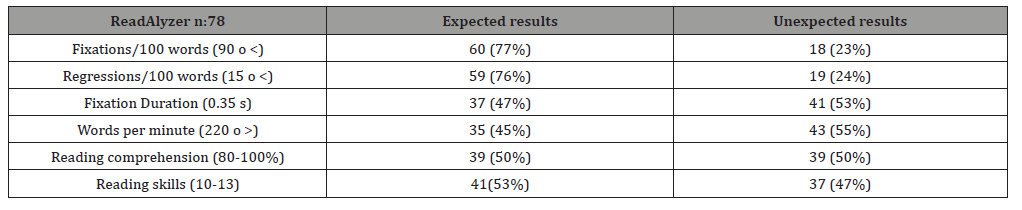
Graph 4 exhibits the results from the DEM test, evaluating fixation and saccadic eye movements. In test A, a result of 14.98 ± 2.51 was obtained. Subsequently, using the test B chart, a value of 14.65 ± 2.23 was recorded. Finally, after assessing vertical eye movements, test C analyzed horizontal movements, producing a result of 32.83 ± 5.91. The overall average for the three charts was 62.62 ± 11.04, with 45 out of 78 students displaying adequate speed and eye movements. Table 4 displays the ReadAlyzer test results. Expected values for fixation movements were: 60 students with values of 69.14 ± 27.93. For regressions, 59 students recorded results of 10.75 ± 7.99. Regarding fixation duration, 37 students showed a value of 0.45 ± 0.21. The word per minute results were: 35 students with 231.1 ± 61.10. After completing the text, students answered ten questions assessing reading comprehension, where 39 students obtained values of 74 ± 0.15. Averages were calculated for each ReadAlyzer test analyzed for reading skills, and 41 students achieved values of 10.13 ± 2.2.
Table 4: Test ReadAlyzer results.
Eye Movements and Reading Skills
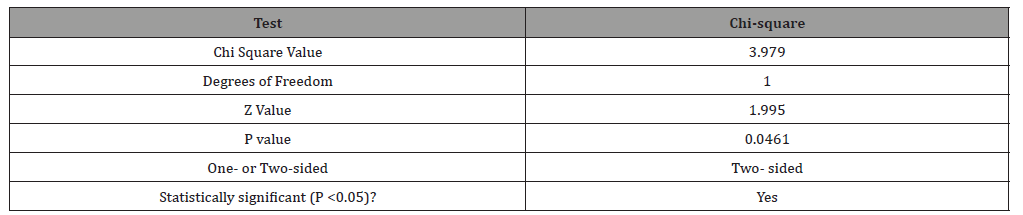
A 2x2 table was constructed to compare the two primary study variables (eye movements and reading skills). DEM test results determined eye movements for each student, considering speed, fixations, and saccades. The ReadAlyzer device was used to evaluate reading skills. The following results were observed: n:78, Good eye movements + good reading skills (28); Good eye movements + deficient reading skills (17); Deficient eye movements + good reading skills (13); Deficient eye movements + deficient reading skills (20). Utilizing epi info TM software yielded a value of 3.97 (Chi-squared test) and a p-value of 0.046 (Table 5 & 6).
Table 5: Reading skills/Ocular movements.

Table 6: Statistical analysis. The results obtained are seen in the 2x2 table, the results of the DEM and ReadAlyzer tests were placed to compare the relationship between eye movements and reading skills. The correlation analysis showed a value of 3.97 (X2 test) and a p value = 0.046.
Discussion
Before conducting the tests, a section was included in the medical history with questions related to reading skills, aiming to identify potential reading issues among students. The main findings of this study are as follows: 1) Students with dysfunctional eye movements are at higher risk of presenting reading skill problems;
2) A decrease in reading speed and fixation duration is observed; 3) Students with reduced reading speed show lower reading comprehension.
The Near Point of Convergence was evaluated using the Krimsky rule and a near vision optotype, based on the student’s near visual acuity, resulting in an average of 10.88 in break points. In a study involving 1357 individuals aged 18 to 39, PPC measurements were taken using the Astron accommodative rule, yielding an average of 7.25 for break values. Notably, this study performed the PPC test three times to obtain the result, focusing solely on break values [15]. Eye movements were assessed using the Developmental Eye Movement (DEM) test, comprising three charts that measured speed, fixation, and saccadic movements. It was found that 42% of students displayed dysfunction in their eye movements, potentially affecting their reading skills. In a study involving 533 subjects, 7 to 9-year-old students using the DEM test, 22% were diagnosed with oculomotor dysfunction. This study indicated that the DEM test helps detect problems in reading skills. Importantly, an adult oriented DEM test is currently under development, making direct comparisons with this research’s values challenging [16].
When assessing reading speed using the ReadAlyzer, 55% of students read more than 220 words per minute. In a study with 77 patients aged 18 to 36 using standardized optometric charts such as the International Reading Speed Text (IReST) and Radner Reading Charts, varied reading rates were observed, ranging between 150 to 220 words per minute. It was mentioned that visual acuity is not a significant influencing factor on reading performance. Our results confirm those reported by Brussee et al., 2017, where reading speed determination was similar, considering the time students took to complete the text [17]. On the other hand, fixation duration is crucial for decoding words correctly and achieving greater reading speed. Using the ReadAlyzer, fixation durations were precisely evaluated, revealing that 47% of students had a fixation duration of 0.35 seconds, indicating good fixation durations. Results obtained in a study involving 51 students, 16 to 18 year-old students utilizing a 120 Hz eye tracker recording ocular movement while watching a video from a distance of 43.18 cm showed fixation duration of 0.30-0.35 seconds. These findings are comparable to the present research. It is noteworthy that the distance between the eye and ReadAlyzer sensors is 55mm, not 43.18cm, potentially allowing for a more precise response when evaluating fixation duration [18].
During reading, ocular regressions often occur, aiding in better text comprehension. In this research, when evaluating regressions, it was observed that 75% of students had fewer than 15 regressions during reading. In a review article, it was noted that readers who frequently perform multiple regressions tend to have lower text comprehension. However, it was also mentioned that skilled readers or those with more practice in reading make short regressions, which benefit the reader in recognizing words correctly and achieving higher comprehension scores [19]. Finally, a correlation between eye movement patterns and reading skills was demonstrated, resulting in a value of 3.97 (Chi-squared test) and a p-value of 0.046.
Students with deficiencies in their eye movements may exhibit problems in their academic performance. In the field of visual therapy, optometrists specialize in vision and learning, performing exercises to improve visual skills and thereby enhance reading and academic performance. It is important to note the lack of studies related to eye movements and reading skills in the adult population. With the results obtained in the research, future lines of investigation related to vision and learning may be explored.
Conclusion
This study reveals an association between appropriate eye movement patterns and reading ability. It is crucial to establish the normal parameters of the Developmental Eye Movement (DEM) Test for the adult population, considering its current application primarily in children aged 6 to 13. While the ReadAlyzer device focuses on assessing eye movements during reading and is not specifically designed to measure reading comprehension, its use in this research highlighted how comprehension was affected in students with difficulties in reading speed. These findings suggest the need to broaden the assessment and design of tools allowing a more comprehensive evaluation of reading skills in relation to eye movements, especially in the adult population, to understand their influence on academic performance and develop effective interventions to enhance reading and comprehension skills. However, students encounter numerous challenges when it comes to assessing their reading skills. Therefore, it is essential to offer students various opportunities to enhance their reading comprehension abilities through diverse reading strategies.
Acknowledgement
This research did not receive any specific grant from funding agencies in the public, commercial, or not-for-profit sectors.
Conflict of Interest
Authors declare no conflict of interest.
References
- Wynn J, Shen K, Ryan J (2019) Eye movements actively reinstate spatiotemporal mnemonic content. Vision (Switzerland) 3(2): 1-19.
- Verghese P, Vullings C, Shanidze N (2021) Eye Movements in Macular Degeneration. Annu Rev Vis Sci 15(7): 773-791.
- Rucci M, Poletti M (2015) Control and Functions of Fixational Eye Movements p: 499-518.
- Goettker A, Gegenfurtner KR (2021) A change in perspective: The interaction of saccadic and pursuit eye movements in oculomotor control and perception. Vision Res 188: 283-296.
- Laamerad P, Guitton D, Pack CC (2020) Eye movements shape visual learning. Proc Natl Acad Sci U S A 117(14): 8203-8211.
- Vanova M, Aldridge Waddon L, Jennings B, Puzzo I, Kumari V (2021) Reading skills deficits in people with mental illness: A systematic review and meta-analysis. European Psychiatry 64(1): 1-3.
- Silvestri V, Sasso P, Piscopo P, Amore F, Rizzo S, et al. (2020) Reading with central vision loss: binocular summation and inhibition. Ophthalmic Physiol 40(6): 778-789.
- Franchi VM, Guerra MES, Novaes BCAC, Favero ML, Pirana S (2023) Reading and comprehension: phoniatric assessment in students with reading difficulties. Braz J Otorhinolaryngol 89(1): 3-13.
- Prahl A, Schuele CM (2022) Reading and Listening Comprehension in Individuals With Down Syndrome and Word Reading-Matched Typically Developing Children. Am J Speech Lang Pathol 31(1): 359-374.
- Dong Y, Peng SN, Sun YK, Sammy Xiao-Ying Wu, Wang,WS (2020) Reading Comprehension and Metalinguistic Knowledge in Chinese Readers: A Meta- Analysis. Frontiers in Psychology 10: 1-15.
- Garzia P, Richman E, Nicholson B, Gaines S (1990) A new visual-verbal saccade test: the development eye movement test (DEM).Journal of the American Optometric Association 61(2): 124-135.
- Medland C, Walter H, Woodhouse J (2010) Eye movements and poor reading: does the developmental eye movement test measure cause or effect? Ophthalmic and Physiological Optics 30: 740-747.
- Webber A, Wood J, Gole G, Brown B (2011) DEM test, rovisuc eye movement recordings, and reading ability in children. Optometry and Vision Science 88(2): 295-302.
- González Mejía J (2020) Evaluación de los movimientos oculares sacádicos con la prueba DEM en niñ ImagenÓptica. Periodismo con Visión p: 52-55.
- Hashemi H, Pakbin M, Ali B, Yekta A, Ostadimoghaddam H, et al. (2019) Near Point of Convergence and Accommodation in a Population of University Students in Iran. Journal Ophtalmic & Vision Research 14(3): 306-314.
- Rodríguez Barrera MA, López Villamil M, Sánchez Lugo M (2006) Diagnóstico sobre alteraciones de los movimientos oculomotores (M.O.M.), con pruebas de medición subjetiva en niños entre 7 a 9 años con problemas de lectura y bajo rendimiento escolar en dos colegios de Bogotá. Ciencia & Tecnología Para La Salud Visualy Ocular (6): 13-22.
- Brussee T, Van Nispen RM, Van Rens GH (2017) Visual and personal characteristics are associated with reading performance in normally sighted adults. Clin Exp Optom 100(3): 270-277.
- Negi S, Mitra R (2020) Fixation duration and the learning process: an eye tracking study with subtitled videos. Journal of Eye Movement Research 13(6): 1-14.
- Inhoff AW, Kim A, Radach R (2019) Regressions during reading. Vision (Switzerland) 3(3): 82-84.
-

This work is licensed under a Creative Commons Attribution-NonCommercial 4.0 International License.




