

 Research Article
Concerns and Challenges of Women about Reproductive Health During Pandemic
Received Date: March 05, 2024; Published Date: April 26, 2024
Abstract
Introduction: Women experience disruptions in reproductive health services, issues, challenges, and worries in this setting as they attempt to manage the Covid-19 epidemic.
Objective: The aim of this study was to determine women’s concerns and difficulties encountered regarding reproductive health during the pandemic process.
Materials and Methods: The study has a descriptive, cross-sectional design. This study was carried out among 237 women between the ages of 18-49. A survey form consisting of 26 structured questions was used to collect the data. The data were analyzed using the Statistical Package for the Social Sciences Version (SPSS) 22.00 program.
Result: Women had experienced reproductive health problems were 33.1%, those who needed reproductive health services were 34.5%, and those who had difficulty accessing health services were 30.0%. The use of contraceptive methods was 26.0%, the rate of pregnancy experience was 1.6% and 97.0% of the women stated they did not want to get pregnant during pandemic period. Women’s fear/avoidance of pregnancy level was 4.8±3.4 and the level of fear/avoidance of pregnancy was significantly increasing as anxiety of getting sick with the coronavirus and that this virus would harm their and their partner’s fertility increased (p<0.01).
Conclusion: It can be said that coronavirus and the pandemic process negatively affect women’s desire for pregnancy, thoughts about their and their partner’s fertility, increase problems/concerns about reproductive health, and their need for services has increased in this period, but they’ve had difficulties.
Keywords: Covid-19; Pandemic; Woman; Reproductive health; Challenges; Concerns
Introduction
Due to the coronavirus (SARS-CoV-2) which emerged as a novel coronavirus in December 2019 in Wuhan, China, World Health Organization (WHO) considered this pandemic a public health emergency of international concern in March 2020 and declared it as a global pandemic [1-3]. The covid-19 pandemic caused a devastating change all around the world, which led to changes and isolation in every part of life to prevent the spread of the virus [1,4]. The vast majority of the resources allocated to health services were devoted to fighting the pandemic, many clinics of some hospitals were shut down or provided limited services, and some clinics were turned into pandemic treatment services. Non-urgent surgical operations were postponed, and there were interruptions in the supply chain, diagnostic and treatment services [4,5]. This impact also caused significant disruptions in Sexual and Reproductive Health (SRH) services and access to services almost came to a standstill during periods of complete lockdowns [6,7].
WHO announced that the SRH needs of the people continued during the pandemic and that these services were required to be considered a high-priority and basic health service [8,9]. In the research published by WHO in 2022, it was reported that one-third of countries encountered disruptions in primary health services such as prenatal and postnatal care services and safe abortion services [8]. Accordingly, it was stated that there were disruptions in family planning and birth control services in approximately 40% of countries [8]. In a guide prepared by the Sexual and Reproductive Health Rights Platform in Turkey, it was reported that there were disruptions/decreases in gynecology and infertility services, pregnant and baby follow-ups, birth and postpartum medical support and vaccination services during the pandemic period [9].
In a systematic review study, it was reported that the Covid-19 pandemic significantly reduced the idea of pregnancy, sexual behaviors, abortion, access to contraceptive methods and their use in women [10]. In a study conducted by Yüksel and Özgür, it was stated that the Covid-19 pandemic is associated with an increase in menstrual disorders, a decrease in voluntary pregnancies and a decrease in contraception in women [11]. The study by Johnson et al. reported that the reporting of STD cases decreased during the Covid-19 pandemic, but this did not reflect the reality and the reason could be the decrease in STD, but the disruptions/delays in diagnosis, treatment and access to service [12]. It is obvious that the pandemic period itself and all the negativities that can be experienced in accessing and receiving health services will also increase women’s concerns about issues related to reproductive health.
Reproductive health (RH) services during pandemics and other such extraordinary conditions are believed to require improvement, as is the value of these studies for women’s health in particular as well as for families and society at large. In this study, it was aimed to determine the concerns and challenges of women regarding reproductive health during the Covid-19 pandemic period.
1. Do women have concerns about reproductive health during the Covid-19 pandemic period? If yes, what concerns?
2. Are there any challenges that women faced in receiving reproductive health services during the Covid-19 pandemic period? If yes, what challenges?
Materials and Methods
The study has a descriptive and cross-sectional design. The study sample, between May and July in 2021 and meeting inclusion criteria for the study. The study was carried out with women aged 18-49 years (Inclusion criteria for the research: women who are of reproductive age (18-49), open to communication and use online social networks to enable the continuation of the snowball sampling method, have no mental problem that requires treatment, no disability physically, mentally and of five sense, speak, read and write Turkish, and volunteer to participate in the study). Since it was difficult to reach a sample group to represent the women of this age group in Istanbul, a metropolitan city, the determination of women to be included in the sample group was made according to the criteria of suitability for objective and heterogeneity. Therefore, the snowball sampling method which is adopted when it is hard to reach a desired universe and sample in quantitative studies and is one of the non-random sampling types was preferred in the determination of women to be included in the sample group of this study [13].
Data collection took place between May and July 2021. Research data were collected through the snowball method by using a survey link from an online platform. Firstly, the survey link of the research was sent via WhatsApp or e-mail to the women who met the inclusion criteria and verbally agreed to participate within the sample group. It was systematically ensured that the women provided written consent when they clicked the link. In the written informed consent, it was stated that participation in the research was based on a voluntary basis, identification information was not requested from the participants, it could take 8-10 minutes to answer the questions in the form sent by link, the data would be kept confidential and used only for scientific purposes. The women were able to start to answer the questions after reading the consent form on the first page and selecting the confirmation option that they agreed to participate in the study. The inclusion criteria of the sample group were sent to each woman that the link was sent and volunteered to participate in the study. Each woman who gave their consent to the study and filled out the form was asked to send the survey link to another woman that she knew and met the sample criteria so that the circulation was maintained. The bias of the researchers was prevented by using the snowball sampling method during the data collection process in order to select the sample group impartially and collect the data independently. As a result, 237 women were reached between the stated dates and the study was conducted with these women.
A data collection form of 26 structured questions was used to collect the data. In the first section of the two-part survey, 7 questions were included in which the socio-demographic and obstetric characteristics of women were questioned. In the second section, there were 19 questions evaluating their concerns/ anxiety and problems related to Covid-19, the pandemic period, reproductive functions, and health services.
Statistical Package for the Social Sciences (SPSS) Version 22.00 program was used to evaluate the data obtained from the research. Frequency and mean values were used for numerical data. Mann Whitney U and Kruskal-Wallis tests were used in the comparison of variables and the Spearman correlation test was used in the relation. The statistical significance value was considered p<0.05.
Ethical approval from the Human Research Ethics Committee of XXXX institution (Date: 26.04.2021; No:21-36) and permission from the Scientific Research Platform of the Ministry of Health of Türkiye (2021-04-09T120514) was obtained. It was ensured that each woman who reached the study link read and approved the consent text on the first page before answering the questions. They were systematically allowed to answer the questions following their approval of participation.
Results
The average age of women in the study was 25.6±6.6. Among the women included in the study, 82.8% were university graduates and 30.4% were working at an income-generating job. In their obstetrics history, 18.5% (n=44) experienced pregnancy, 18.5% (n=44) birth, 1.7% (n=4) abortion and 4.4% (n=8) miscarriage. There were no women who experienced miscarriage or abortion during the pandemic period.
In terms of catching coronavirus, 23.0% of the women had caught Covid-19, 18.6% thought coronavirus would negatively affect their own fertility, while 27.4% thought it would adversely affect the fertility of their spouse. The rate of women who experienced pregnancy during the pandemic was 1.6% and of the women who reported they did not want to get pregnant was 97.0%. The use rate of any contraceptive methods to prevent pregnancy was 26.0% (n=62). Of the women who stated they used a method, 79.0% (n=49) stated they used an effective/modern method (condom was the first used in the effective methods with 48.9% (n=24), the total rate was 10.1%). A total of 33.1% of women reported that they had reproductive health problems, 34.5% reported that they needed reproductive health services, and 30.0% reported that they had difficulty in accessing health services during the pandemic period (Table 1).
Table 1: Women’s thoughts and experiences regarding the reproductive health and services during the Covid-19 pandemic.
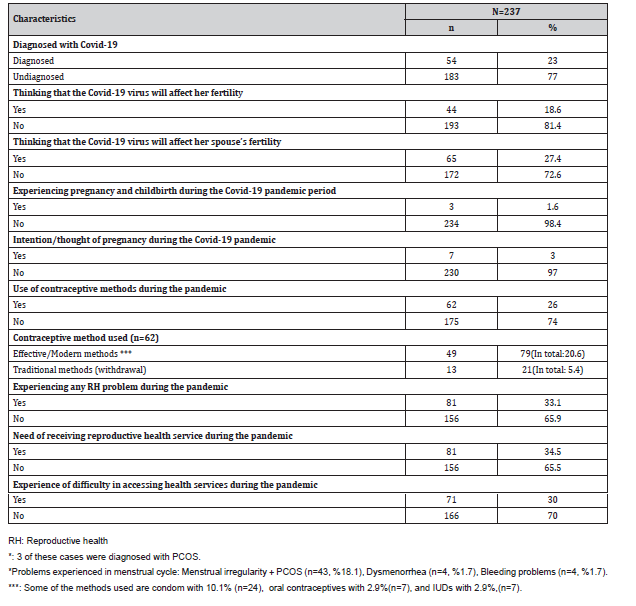
The concerns of women about Covid-19 and reproductive functions were rated on a scale of 0 to 10 (0=Never, 10=Too much). The level of anxiety about Covid-19 was 6.0±2.5, the level of concern about catching coronavirus was 5.9±2.5, the level of fear/avoidance of pregnancy was 4.8±3.4, the level of concern that coronavirus would harm her own fertility was 4.2±2.8 and the level of concern that coronavirus would harm her spouse’s fertility was 4.2±2.9. The anxiety level of women who had difficulty in accessing health services during the pandemic that the coronavirus would harm their fertility was significantly higher (average score for those who had difficulties: 5.0±3.2, for those who had not: 4.0±2.6) (p<0.001).
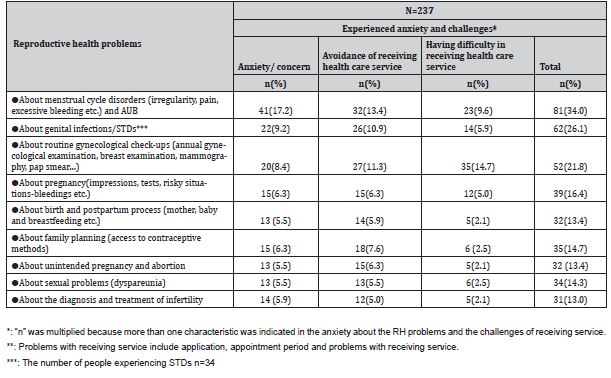
During the pandemic, women reported that they were primarily concerned about menstrual cycle disorders and abnormal uterine bleeding (AUB) or that they had problems getting services with a total rate of 34.0%. This was followed by genital infections-sexually transmitted diseases (STDs) with 26.1% and anxiety and problems regarding routine gynecological check-ups with 21.8% (Table 2).
Table 2: Anxiety and challenges experienced by women on issues related to reproductive health during the Covid-19 pandemic.
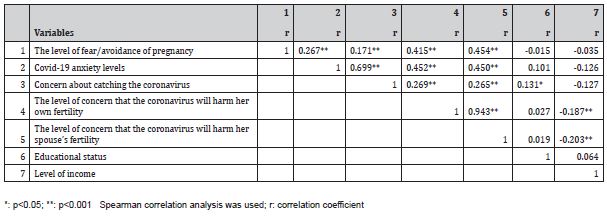
In the correlation analysis conducted on the factors affecting the avoidance/fear of pregnancy during the pandemic, there was a positively significant relationship between the level of anxiety for Covid-19, concern about catching coronavirus, level of anxiety that the coronavirus would affect her and her spouse’s fertility and the level of fear/avoidance of pregnancy (p<0.01). As their income levels decreased, the level of anxiety of women that Covid-19 would harm their own and their spouse’s fertility increased (p<0.01) (Table 3).
Table 3: Correlation analysis results
Discussion
There are limited studies on the problems and concerns of women about the issues related to reproductive health during the Covid-19 pandemic. Although the results of this study represent a cross-sectional population, it is thought that they are considered important and will contribute to the literature in terms of demonstrating the concerns of women about reproductive health and the difficulties in accessing services during the Covid-19 pandemic and providing ideas about the topic and the services to be given within this scope.
In the WHO 2021 report, it was reported that prenatal care was partially disrupted in 53% of the countries and birth services were partially disrupted in 32% during Covid-19 [14]. In the study, it was observed that one-third of the women had reproductive health problems, 34.5% needed reproductive health services, and 30.0% had difficulty in accessing health services during the Covid-19 pandemic (Table 1). Many studies reported that reproductive health services were disrupted and there were problems with receiving services during the pandemic period [15,16]. The results of this study support the literature and the emphasis that reproductive health services should be among the priority services during the pandemic and similar emergency situations. Although almost all women stated that they did not want to get pregnant during the pandemic and avoided pregnancy in the study, it was determined that only 26% (n=62) used any method and 49 of these women who used the method preferred condoms, which were an effective method and easy to access in the first place (Table 1). It is stated in Turkey Demographic and Health Survey (TDHS) 2018 data that overall, the rate of contraceptive prevalence of currently married women aged 15-49 years is 70%, with 49% using modern contraceptive methods and 21% using traditional methods [17]. Considering the data obtained from TDHS 2018 which reflects the country as a whole and the current study, it was thought that women had serious difficulties in accessing family planning (FP) services during the pandemic, that it especially affected the use of modern contraceptives and couples generally preferred condoms due to its accessibility. Some studies in the literature reported that unintended pregnancies increased during the pandemic period [16,18]. Although almost all of the women in this study did not want pregnancy, it was also questionable that the use of the method was minimal. Even though these results are suggestive of unintended pregnancy increase at first, the rate of pregnancy and abortion was very low in the women in the study group, which did not support the literature data and our thoughts on this. WHO has reported that women experience reproductive health problems and have a high need to receive services during the Covid-19 pandemic and that priority should be given to these services [8]. In addition, there are studies reporting that individuals are worried that they may experience losses in terms of their reproductive functions, that is, their fertility, during the pandemic period [19,20]. In the current study, approximately a fifth of women thought that the coronavirus would negatively affect their own fertility, and a quarter thought that it would negatively affect their spouse’s fertility (Table 1), and these anxiety levels were moderate in the rating between 1-10. The women’s levels of fear/avoidance of pregnancy were also moderate. These results made us think that the unknown issues about the coronavirus and its effects, the difficulties it brings in all areas of life and reproductive health services, and the troubles experienced during the Covid-19 pandemic period may be effective in these thoughts and concerns. Additionally, the levels of experienced anxiety and difficulties regarding unintended pregnancies in the study were lower than the studies conducted in Ethiopia (36.5%), Southern Ethiopia (19.5%) and the USA (25%) [21-23]. While it was found to be higher (20%) than in another study conducted in America [15]. It was thought that these variations in the results may be due to differences between countries related to conditions such as socio-economic, health service policy and pandemic management.
In the study, it was detected that women were most concerned about issues regarding menstrual cycle disorders and abnormal uterine bleeding (AUB) or had problems getting services during the pandemic (Table 2). It has been emphasized in studies conducted in Turkey with different sample groups that anxiety and stress caused by the Covid-19 pandemic lead to menstrual cycle disorders [24,25]. These data support the facts about the effects of stress/ anxiety on the reproductive cycle in particular.
In many studies, it has been reported that women could not go to routine check-ups during the pandemic period and their concerns about genital infections increased [26-28]. It was observed in the study that 26% of women were concerned about genital infections, 21.8% were concerned about routine gynecological check-ups and avoided receiving health care/had problems (Table 2). It is considered important that a quarter of women experience these conditions, and the results support the literature. On the other hand, some studies in the literature reported that the pandemic period negatively affects the psychology of couples undergoing infertility treatment [29,30]. Besides, in studies conducted during the pandemic period, it was reported that women experience anxiety during pregnancy, birth and the postpartum period [31,32]. Of the women in the study, 13.0% experienced anxiety, avoidance/ challenge of receiving service due to infertility and its treatment, 16.4% due to pregnancy, and 13.4% due to birth-postpartum (Table 2). Considering the women included within the scope of the study, this rate of infertility diagnosis and treatment is not low and considered significant. The anxiety of women about the pregnancybirth- postpartum period, and avoidance of receiving services/ experiencing problems at a significant rate also explains their avoidance of pregnancy during the pandemic period at a high rate. Additionally, it was observed that the level of anxiety, avoidance of receiving service/experiencing problems due to FP services (14.7%), and unintended pregnancy/abortion (13.4%) was significant. The increase in women’s anxiety and concerns during the pandemic period may be due to the effects of coronavirus, restrictions during the pandemic, challenges in access to health services, and unknown issues that occur in the management of the diagnosis and treatment process. Besides, this study shows that the women experienced avoidance of receiving services/ experiencing problems in every field regarding reproductive health during the pandemic period. Therefore, it is thought that there might be disruptions in the diagnosis and treatment of current or possible reproductive health issues and that the risk of an increase in the complication rates which can emerge depending on these disruptions should not be ignored.
The studies report that conditions such as the Covid-19 pandemic which negatively affect the lifestyle of women have a negative impact on the level of fear/avoidance of pregnancy [15,23]. It was observed in our study that as the level of anxiety about Covid-19, the concern about catching Covid-19, the level of anxiety that Covid-19 would harm her and her spouse’s fertility increased and the levels of fear/avoidance of pregnancy also increased. Additionally, it was detected that the level of anxiety that the Covid-19 virus would harm her, and her spouse’s fertility was higher in those who had lower incomes (Table 3). All these indicate the importance of reproductive health services, appropriate education-counseling, and health literacy during the pandemic and similar emergency situations. The problems experienced as the income level decreases, especially in the population with low socioeconomic status, were evaluated as important in terms of revealing in the results that this group has more needs, which shows that health literacy and accessibility to health services are negatively affected.
Limits of the study
There were certain limitations of this study. First, there may be concerns over the accuracy of the information provided by the women who participated in the study. Second, women without smartphones or internet access were unable to take part in the study. Additionally, the population of this study was restricted to women in a province in Turkiye. Therefore, the results may only be applicable to this group of individuals.
Conclusions
As a result, it can be said that women are experiencing anxiety, avoiding receiving services or experiencing problems about almost everything related to reproductive health during the Covid-19 pandemic period. Although the study is limited due to the fact that it is a cross-sectional study, the results show that the need for reproductive health services is high in emergency situations such as pandemics and support the importance of including these services within the scope of priority services decisively. Besides, the results will contribute to the literature and the improvements to be made to the RH services in case of a pandemic and similar emergencies. In emergencies such as a pandemic, reproductive health services should be maintained, necessary needs should be met, and disadvantaged groups should be supported and protected. Every service provided for women’s reproductive health in particular will contribute to family and community health in general.
Acknowledgement
We gratefully acknowledge all the study participants.
Conflict of Interest
Authors declare no conflict of interest.
References
- Wu Z, McGoogan JM (2020) Characteristics of and important lessons from the coronavirus disease 2019 (COVID-19) outbreak in China: summary of a report of 72 314 cases from the Chinese Center for Disease Control and Prevention. JAMA 323(13): 1239-1242.
- World Health Organization (2020a) WHO Director-General's opening remarks at the media briefing on COVID-19 - 11 March 2020.
- World Health Organization (2020b) COVID-19 Public Health Emergency of International Concern (PHEIC) Global research and innovation forum.
- TR Ministry of Health (2021) Guidelines for Working in Health Institutions and Infection Control Measures in the COVID-19 Pandemic.
- McCool-Myers M, Kozlowski D, Jean V, Cordes S, Gold H, et al. (2022) The COVID-19 pandemic's impact on sexual and reproductive health in Georgia, USA: An exploration of behaviors, contraceptive care, and partner abuse. Contraception 113: 30-36.
- Meherali S, Adewale B, Ali S, Kennedy M, Salami BO, et al. (2021) Impact of the COVID-19 pandemic on adolescents’ sexual and reproductive health in low-and middle-income countries. International Journal of Environmental Research and Public Health 18(24): 13221.
- Esin A, Mıhçııokur S, Demir C, et al. (2021) Sexual and reproductive health situation analysis report in Turkey. Sexual and Reproductive Health Platform.
- World Health Organization (2022) Parliaments promote women’s, children’s and adolescents’ health in the time of COVID-19.
- Dilbaz B, Abacıgil F, Mermer G, et al. (2021) Sexual and Reproductive Health (SMS) Services in Pandemic Times: A Guide to Community-Based Services. Okyay P, Gunay T (edts) Istanbul: Acar Basım Skin Industry Trade Joint Stock Company pp. 1-158.
- Mukherjee TI, Khan AG, Dasgupta A, Samari G (2021) Reproductive justice in the time of COVID-19: a systematic review of the indirect impacts of COVID-19 on sexual and reproductive health. Reproductive health 18(1): 252.
- Yuksel B, Ozgor F (2020) Effect of the COVID‐19 pandemic on female sexual behavior. Int J Gynaecol Obstet 150(1): 98-102.
- Johnson KA, Burghardt NO, Tang EC, Long P, Plotzker R, et al. (2021) Measuring the impact of the COVID-19 pandemic on sexually transmitted diseases public health surveillance and program operations in the state of California. Sexually Transmitted Diseases 48(8): 606-613.
- Kümbetoğlu B (2017) Qualitative Method and Research in Sociology and Anthropology. Kümbetoğlu B (edt), . Istanbul: Bağlam Publications pp. 30-43.
- World Health Organization (2021) Third round of the global pulse survey on continuity of essential health services during the COVID-19 pandemic.
- Lindberg LD, VandeVusse A, Mueller J, Kirstein M (2020) Early Impacts of the COVID-19 Pandemic: findings from the 2020 Guttmacher Survey of Reproductive Health Experiences.
- Ferreira-Filho ES, Melo NR, Sorpreso ICE, Bahamondes L, Santos Simões RD, et al. (2020) Contraception and reproductive planning during the COVID-19 pandemic. Expert Review of Clinical Pharmacology 13(6): 615-622.
- University Institute of Population Studies (HUIPS) (2019) 2018 Turkey Demographic and Health Survey. Hacettepe University Institute of Population Studies, T.R. Presidency of Turkey Directorate of Strategy and Budget, Scientific and Technological Research Council of Turkey (TÜBİTAK), Ankara.
- Church K, Gassner J, Elliott M (2020) Reproductive health under COVID-19–challenges of responding in a global crisis. Sex Reprod Health Matters 28(1): 1-3.
- Cito G, Pizzarelli C, Zurkirch V, Basile V, Ruggiero M, et al. (2022) Parenthood in Infertile Couples Attending Assisted Reproductive Technologies (ARTs) Centers: What Has Changed During the COVID-19 Pandemic? J Reprod Infertil 23(2): 120-127.
- Micelli E, Cito G, Cocci A, Polloni G, Russo GI, et al. (2020) Desire for parenthood at the time of COVID-19 pandemic: an insight into the Italian situation. J Psychosom Obstet Gynaecol 41(3): 183-190.
- Tenaw SG, Chemir F, Zewudie BT, Chekole B, Argaw, et al. (2022) Unintended pregnancy and associated factors among women attending antenatal care in public hospitals during COVID-19 Pandemic, Southwest Ethiopia: a cross-sectional study. Open Access J Contracept 13: 9-16.
- Asratie MH (2021) Unintended pregnancy during COVID-19 pandemic among women attending antenatal care in Northwest Ethiopia: magnitude and associated factors. Int J Womens Health 13: 461-466.
- Lin TK, Law R, Beaman J, Foster DG (2021) The impact of the COVID-19 pandemic on economic security and pregnancy intentions among people at risk of pregnancy. Contraception 103(6): 380-385.
- Demir O, Sal H, Comba C (2021) Triangle of COVID, anxiety and menstrual cycle. J Obstet Gynaecol 41(8): 1257-1261.
- Takmaz T, Gundogmus I, Okten SB, Gunduz A (2021) The impact of COVID‐19‐related mental health issues on menstrual cycle characteristics of female healthcare providers. J Obstet Gynaecol Res 47(9): 3241-3249.
- Tsibulak I, Reiser E, Bogner G, Petru E, Hell-Teutsch J, et al. (2020) Decrease in gynecological cancer diagnoses during the COVID-19 pandemic: an Austrian perspective. Int J Gynecol Cancer 30(11): 1667-1671.
- Dinmohamed AG, Visser O, Verhoeven RH, Louwman MWJ, van Nederveen FH, et al. (2020) Fewer cancer diagnoses during the COVID-19 epidemic in the Netherlands. Lancet Oncol 21(6): 750-751.
- Cousins S (2020) COVID-19 has “devastating” effect on women and girls. The Lancet 396(10247): 301-302.
- Seifer DB, Petok WD, Agrawal A, Glenn TL, Bayer AH, et al. (2021) Psychological experience and coping strategies of patients in the Northeast US delaying care for infertility during the COVID-19 pandemic. Reprod Biol Endocrinol 19(1): 28.
- Tokgoz VY, Kaya Y, Tekin AB (2022) The level of anxiety in infertile women whose ART cycles are postponed due to the COVID-19 outbreak. J Psychosom Obstet Gynaecol 43(2): 114-121.
- Stampini V, Monzani A, Caristia S, Ferrante G, Gerbino M, et al. (2021) The perception of Italian pregnant women and new mothers about their psychological wellbeing, lifestyle, delivery, and neonatal management experience during the COVID-19 pandemic lockdown: a web-based survey. BMC Pregnancy and Childbirth 21: 1-12.
- Biviá-Roig G, La Rosa VL, Gómez-Tébar M, Serrano- Raya L, Amer- Cuenca JJ, et al. (2020) Analysis of the impact of the confinement resulting from COVID-19 on the lifestyle and psychological wellbeing of Spanish pregnant women: an internet-based cross-sectional survey. International Journal of Environmental Research and Public Health 17(16): 5933.
-

This work is licensed under a Creative Commons Attribution-NonCommercial 4.0 International License.