


 Research Article
Complete Uterine Rupture in a Scar Uterus, in N’Djamena Mother and Child University Hospital
Received Date:June 03, 2025; Published Date:July 23, 2025
Abstract
Uterine rupture is an obstetric complication with severe maternal and fetal consequences that requires immediate surgical intervention or one within a maximum of 30 minutes. We report the case of a pregnant woman who experienced a complete uterine rupture on a scarred uterus without hemoperitoneum, initially diagnosed as a non-progressive abdominal pregnancy, with the surgical intervention delayed for three days.
Keywords:complete uterine rupture, hemoperitoneum, abdominal pregnancy, Chad.
Introduction
Uterine rupture is a complete or incomplete non-surgical break in the wall of the pregnant uterus. It may be spontaneous or provoked by obstetric maneuvers. It may occur during labour or pregnancy, in a healthy or scarred uterus [1].
There are two anatomical forms of uterine rupture.
• Complete rupture or intraperitoneal rupture: this is defined as
‘a tear involving the three uterine tunics (mucosa, muscularis
and serosa). The uterine cavity then communicates with the
abdominal cavity. When the rupture occurs before the delivery,
the membranes are also ruptured, and the fetus is found in
the abdomen. Rare cases of rupture with intact membranes
have been reported’ [2]. In a healthy uterus, this rupture is
preferentially located on the uterine body, whereas in scarred
uterus, it is most often located at the anterior scar.
• Incomplete rupture; this is also known as sub peritoneal
rupture or dehiscence or disunion when it occurs in a scar
uterus. It ‘involves the myometrium while the visceral
peritoneum and membranes remain intact [2].
However, according to the literature, there are discrepancies in the definitions. Some authors refer to complete rupture when there is a complete interruption of the uterine wall associated with one of the following criteria: vaginal or intra-peritoneal hemorrhage; need for hysterectomy; bladder damage caused by the scar; extrusion of the feto-placental unit; fetal heart rhythm abnormalities [3-5]. For other authors, when the interruption of the uterine wall is accompanied by a prior to surgery; hemoperitoneum identified during the operation; signs of shock [6].
However, complete uterine rupture without hemoperitoneum or altered hemodynamics status after 24 hours has not yet been described.
Pathophysiologic: uterine scarring leads to a reduction in the muscular properties of the uterine wall. The scar’s ability to resist mechanical stress during childbirth is reduced, which encourages uterine rupture.
This is an obstetric emergency with an unfavorable maternal and fetal prognosis. The prognosis for uterine rupture is poor in developing countries, with a maternal mortality rate of between 11.26 and 35% and a fetal death rate of between 80% and 100% [7-9].
The severity of the maternal and fetal consequences is partly related to the time taken to perform the procedure. However, the American College of Obstetrics and Gynecology recommends a delay of 30 minutes or less [10].
Observation
Mrs KA aged 22: years Gravida Parity 2, housewife, was referred from Kousseri Regional Hospital (Cameroonian town bordering N’Djaména, capital of Chad) on 11 January 2025 for management of acute peritonitis (terms of reference).
The onset of the symptoms would date back to a day earlier, marked by abdominal pain of progressively increasing intensity without genital bleeding at the end of a presumed eight-month pregnancy, prompting a consultation at Kousseri Regional Hospital where, after clinical and para-clinical examinations, the diagnosis of peritonitis was made. The patient was referred to the University Hospital for Mother and Child (CHU ME) for appropriate treatment.
Mrs KA has no known pathological medical history. Surgically, she underwent a caesarean section 18 months ago for a generally narrowed pelvis, and the postoperative and post-partum followup was apparently straightforward. The current pregnancy is presumed to be eight months. The pregnancy was not monitored (no prenatal cares).
On admission, the physical examination revealed:
- A conscious pregnant woman, with no change in general
condition;
- Blood pression = 110/70 mmHg, heart rhythm= 88 by mn,
- An enlarged abdomen with no perception of the fetal
parts under the skin and a transverse suprapubic scar with no
discernible pain
- Diffuse abdominal pain with a cry from the umbilicus
- The uterus height was difficult to measure because of the
abdominal pain
- The vulva was healthy and clean
- Speculum examination found the cervix and vaginal walls
macroscopically healthy with no endo uterine bleeding, the cul-desac
of Douglas was not bulging, the culdocentesis was white
- On vagina examination, the cervix was posterior, short,
dehiscent, the promontory was affected (PRP diameter= 8 cm), the
finger showed leucorrhea when removing from vagina
- The physical examination of the other systems was within
normal limits.
In view of these elements, we concluded that the patient was suffering from peritoneal irritation syndrome with a stable hemodynamics state at the end of a presumed eight-month pregnancy in a scar uterus to be explored.
Paraclinical tests revealed
- Blood count: hemoglobin = 12.3 g/dl white blood cells =
12,700/mm platelets = 235,000/mm
- GS/Rh = A+
- CRP = 122.48 mg/l
- The ultrasound scan showed a non-progressive abdominal
pregnancy of 32 weeks’ gestation and 4 days.
The diagnosis made in the gynecological and obstetric emergency department was abdominal fetal death at 32 days’ gestation and 4 days.
We decided to perform a laparotomy. The pregnant woman underwent a pre-anesthetic visit and the pre-operative check-up was unremarkable.
The pregnant woman was then transferred to the in-patient
department on 12 January 2025, with her hemodynamic condition
still stable. She stayed there from 12 to 14 January 2025 without
presenting any complications, receiving a course of antibiotics and
painkillers.
-Laparotomy was performed under GA + IOT on 14 January
2025, three days after admission and four days after the onset of
symptoms.
On examination, the following was found
- Absence of hemoperitoneum and non-bloody pelvic
effusion
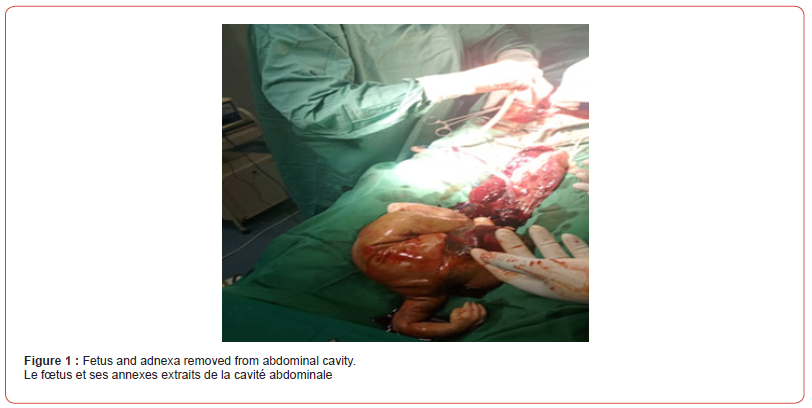
- A fetus with all its appendages in the abdominal cavity
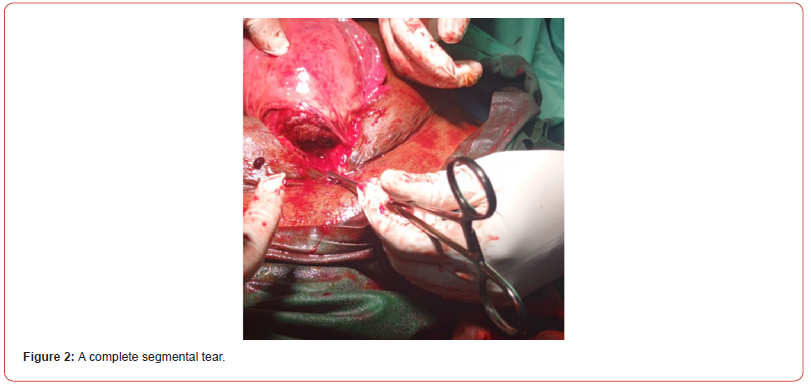
- A segmental uterine rupture measuring approximately 12
cm with clean, non-bleeding edges
- The procedure consisted of
- Extraction en bloc of a macerated first-degree stillborn
male weighing 2800 g
- 5/2 Vicryl hysterography
- Pelvic cleansing
- Closure of the various planes.
Post-operative care included triple antibiotic therapy. No complications were diagnosed in the post-operative surveillance room (SSPI). The patient was discharged at the 5th post-operative [11,12] à supprimer ?.
Discussion
Uterine rupture is a serious obstetric complication. Its frequency varies from continent to continent. In Europe, it varies from 0.05% to 0.078%. It ranges from 0.31% to 1.4% for scar uterus due to the increasing incidence of caesarean sections [2]. In sub-Saharan Africa, it varies from 0.61% to 11.5% [7,8]. In Chad, the incidence is 0.8% [13].
The prognosis for uterine rupture is poor in developing countries, with a maternal mortality rate of between 11.26 and 35% and a fetal death rate of between 80% and 100% [7,9,10]. In our clinical case, we noted a fetal death correlating with the data in the literature. However, we noted no maternal morbidity or mortality.
Several etiologies have been suggested. Most often it is a uterine scar [14], as in this case.
The diagnosis of uterine rupture may be made during labour on the basis of various clinical signs, but it may also be revealed after delivery by caesarean section without any clinical signs having occurred. In sub peritoneal forms, the clinical signs are discreet and may go unnoticed. Also, signs are often less marked in cases of uterine rupture in a scarred uterus than in a healthy uterus [15,16], as illustrated by this clinical case.
Management consists of emergency laparotomy for conservative or radical treatment. The severity of the maternal and fetal consequences depends in part on the time taken to perform the operation. The French National College of Gynecologists and Obstetricians (CNGOF) does not recommend a time limit for extraction. However, the American College of Obstetrics and Gynecology recommends a delay of 30 minutes or less [11]. In this case, surgery was performed four days after the uterine rupture, which was initially diagnosed as an abdominal pregnancy.
Maternal prognosis depends on whether or not the uterus is scarred. The rupture of a healthy uterus is sudden, and the hemorrhage may be significant, leading to DIC. In the past, women died of hemorrhagic shock or puerperal peritonitis. Today, advances in resuscitation and hygiene have improved maternal prognosis. The risk of maternal mortality varies from 1.6% to 14% in developed countries (1% in France) and from 2.5% to 20% in developing countries. Maternal morbidity is around 15% [17].
Fetal mortality is 5.5% in developed countries, compared with 50% in developing countries [10,16].
Conclusion
Uterine rupture is a rare obstetric complication but is associated with sometimes serious maternal and neonatal morbidity and mortality. A scarred uterus is a major risk factor. Treatment is surgical, conservative or radical, and should be carried out without delay. Complete unrecognized rupture, without hemoperitoneum and with a stable hemodynamics state for more than 24 hours, is rare. It should always be considered when the patient presents with diffuse abdominal pain in the context of a scarred uterus.
Acknowledgement
None.
Conflict of Interest
Authors declare no conflict of interest.
References
- Merger R, Levy J et, Melchior J (2001) Précis d'Obstétrique, 6ème édition, Masson, Paris.
- Marpeau L, Lansac J, Teurnier F (2001) Traité d'Obstétr Masson.
- Shipp TD, Zelop C, Cohen A, Repke JT, Lieberman E (2003) Post-cesarean delivery fever and uterine rupture in a subsequent trial of labor. Obstet Gynecol 101(1): 136 -139.
- AB Caughey , TD Shipp, JT Repke, CM Zelop, A Cohen, et al. (1999) Rate of uterine rupture during a trial of labor in women with one or two prior cesarean deliveries. Am J Obstet Gynecol 181(4): 872-876.
- CM Zelop, TD Shipp, JT Repke, A Cohen, E Lieberman (2001) Outcomes of trial of labor following previous cesarean delivery among women with fetuses weighing >4000 g. Am J Obstet Gynecol 185(4): 903-905.
- Harper LM, Cahill AG, Roehl KA, Odibo AO, Stamilio DM, et al. (2012) The pattern of labor preceding uterine rupture. Am J Obstet Gynecol 207(3): 210.
- Sepou A, Yanza MC, Nguembi E, Ngbale R, Kouriah G, et al. (2002) Les ruptures utérines à la maternité de l'hôpital Communautaire de Bangui (Centrafrique). Med Trop (Mars) 62(5): 517-520.
- Vangeenderhuysen C, Souidi A (2002) Rupture utérine sur utérus gravide : étude d'une série continue de 63 cas à la maternité de référence de Niamey (Niger). Med Trop 62(6): 615-618.
- Abauleth YR, Koffi AK, Cisse ML, Boni S, Djanhan Y, et al. (2006) Prognosis of uterine rupture during labour: A propos de 293 cas colligés au chu de Bouaké (Côte D'ivoire). Méd Trop 66(5): 472- 476.
- Lankoandé J, Ouédraogo CMR, Touré B, Ouédraogo A, Akotionga M, et al. (1997) A propos de 80 cas de ruptures utérines à la Maternité du Centre Hospitalier National de Ouagadougou, Burkina Faso. J Gynecol Obstet Biol Reprod 26: 715-719.
- Lecerf M, Vardon D, Morello R, Lamendour N, Dreyfus M (2013) Can a caesarean section be performed in less than 30 minutes in unsuitable premises in order to follow the ACOG recommendations? J Gynecol Obstet Biol Reprod (Paris) 42(4): 393 400.
- Guiliano M, Closset E, Therby D, LeGoueff F, Deruelle P, et al. (2014) Signs, symptoms and complications of complete and partial uterine ruptures during pregnancy and delivery. Eur J Obstet Gynecol Reprod Biol 179: 130-134.
- Foumsou L, Gabkika MB, Ache H, Lagabka BN, Foba K, et al. (2021) Analysis of risk factors for uterine rupture at the University Hospital of Mother and Child in N'djamena (Chad). Annales de la SOGGO.
- Menihan CA (1998) Uterine rupture in women attempting a vaginal birth following prior cesarean birth. J Perinatol 18(6 Pt 1): 440-443.
- Pérez-Adán M, Alvarez-Silvares E, García-Lavandeira S, ViloutaRomero M, Doval-Conde JL (2013) Complete uterine ruptures. Ginecol Obstet Mex 81(12): 716-722.
- Direction Nationale de la Santé (DNS) (2016) Protocole des Soins Obstétricaux et Néonataux d'U
- Traoré M (2019) La ligature des trompes : indication au cours de la césarienne : à propos de 91 cas colligés en 3 ans dans le service de Gynécologie - Obstétrique de l'hôpital national du Point ‘ G ’ à Bamako et Mopti. [Thesis :Medicine]. Bamako : University of bamako, Bamako.
-

This work is licensed under a Creative Commons Attribution-NonCommercial 4.0 International License.