

 Research Article
Youth Participation in Cassava Value Chains in Ghana: A Nexus for Poverty Reduction and Rural Employment
Received Date:October 01, 2025; Published Date:November 13, 2025
Abstract
A significant youth participation in agriculture value chains can be a solution to rural unemployment and underemployment. The cassava value
chain represents a strategic and growing sector for economic development in several countries including Ghana, where the youth and women can
enhance their job creation and contribution to enhance food security. The study focused on youth (men and women between ages 18 to 35 years)
participation and factors that influence their extent of participation in the cassava value chain (production, processing and marketing). The study
was conducted in the Eastern Region, Ghana, a major cassava producing region. With low youth-specific participation in agriculture, in-depth data
was collected from about 170 youth who benefited from Ghana government root and tuber improvement programme in 2014. Multistage sampling
technique was applied in the selection of respondents with in-depth the interviews of 38% producers, 45% processors, and 17% marketer actors.
A seven-point Likert scale type questions was used to determine the extent of participation. The mean extent of youth participation in marketing
(0.656) is statistically significant than in production (0.645) and processing (0.642). There was no statistically significant difference between the
extent of male and female youth participation in any of the value chain nodes. Males as much as females participate in the cassava value chains. Using
the Tobit estimation approach, the key economic factors that influence youth participation are access to credits, extension visits, products marketed,
access to radio, education, point of sale and farm productivity. The youth’s inability to access improved planting materials and credit to expand their
production constraints their participation in production. For processors, the most enhancing factors for the youth’s involvement is their ability to
process all year, the relative ability to access raw materials and ability to expand their processing business.
There also seems to be a market for the processors as they can sell all or most of their produce. For cassava marketers, the most enhancing factor
is their ability to sell most of their products. These findings present a remarkable opportunity for policy to enhance cassava value chain businesses
and significantly contribute to increasing youth involvement in agricultural development. The presence of the youth in agriculture presents
long-term involvement and ownership in production, processing and marketing; and having available markets for their product increases rural
employment and household’s income. Development efforts through supporting institutional incentives such as improved farm technology access,
access to credits, extension visits and trainings can help increase the extent of youth participation in the cassava value chain in African countries.
Keywords:Cassava; value chain; youth; participation; involvement; unemployment; actors; ghana
Introduction
Ghana is the third major cassava producer in Africa [1,2], with 90% of farmers engaged in production contributing to about 22% of Ghana’s Agricultural GDP [3] producing 25.5 million metric tons, which is an increase in volume compared to 24.5 million metric tons in the previous year [4-6] As a staple crop, cassava contributes to food security for over 500 million people in Sub-Saharan Africa [7,8]. Cassava is a very important root crop in Ghana, which contributes largely to the country’s agricultural Gross Domestic Product (GDP). Cassava plays a crucial role in ensuring food security, especially in regions where other staple crops may not be as resilient or available [9].
The cassava value chain represents a strategic and growing sector for economic development in several countries including Ghana [10-12]. Where the youth and women can enhance their job creation and contribution through value addition to enhance food security [13]. Mainly a woman’s crop, cassava has many uses in the food chain and the opportunity to add value to cassava trade can be greatly enhanced by removing the drudgery in cassava production and processing in the value chain. Africa has the youngest population in the world, and estimated at 200 million, the number of the youth will double by 2045 [14-17]. It is important to engage and empower youth in agriculture to ensure the sustainability and resilience of the global food supply chain. Creating decent employment opportunities for this rapidly increasing youthful labour force is critical.
While national youth development policies and plans may articulate the role of the youth in national development, focus on youth in agricultural businesses is inadequate [18,19]. This is despite the fact that many countries in Africa, including Ghana depend heavily on agriculture, with the risk that these countries may not readily create sufficient jobs for the youth in non-agricultural sectors in the medium term [20,21]. Rural youth in Africa are scrambling at unprecedented rates to cities with little success of finding decent employment [22,23]. These youth in transition add on to the burgeoning number that are already hard pressed to find meaningful employment in urban areas. Moreover, the rapidly transforming cultural landscape is also weakening the social safety nets that many youths in the past relied to support their meaningful transition. That is not to say that nothing is happening with regards to youth. Most agendas like the Uganda Reform Agenda are focused on creating more and better jobs through agriculture [24].
In the same 2018 year, the Ugandan Economic Policy Research Centre provided a change in focus of national planning towards agroindustrialization [25], to promote inclusive growth, employment and wealth creation on its long-term aspiration to transition to a modern economy. The government of Ghana on the other hand has rolled out several interventions to address youth unemployment and underemployment. The Ghana guiding policy, the Coordinated Programme of Economic and Social Development Policies (2017–24): An Agenda for Jobs-Creating Prosperity and Equal Opportunity for All, places the issues of youth unemployment and underemployment at the centre of national development. Specific to programming in Ghana, the revamping of the Youth Employment Agency (YEA), the work of the Microfinance and Small Loans Centre (MASLOC), and the operationalization of the Nation Builders Corps (NABCO) are avenues for promoting youth employment.
In addition, implementation of the One-District-One-Factory, One-Village-One-Dam program and other sectoral initiatives are intended to revive formerly well-to-do but now-distressed businesses, as well as promote the establishment of strategic new business intervention skills in agriculture, agribusiness incubation, apprenticeships, enterprise development, entrepreneurship trainings and vocational trainings in rural areas [26]. The drudgery in manual processing of roots and tubers (cassava), for example, is a disincentive to the youth who want to go into small-scale cassava processing for markets [27]. Simple processing equipment for cassava such as graters for processing cassava into gari (flour of the fresh starch cassava root) and chippers used to process cassava into chips and flour are available but largely unaffordable to the youth. These equipment’s can be locally fabricated and manufactured with training for women and youth to enhance affordability and access.
These equipment’s can significantly enhance the processing of cassava into gari, other products and significantly enhance the value addition and youth participation along the various production, processing and marketing nodes. Once this is achieved it becomes imperative that active youth participation observed through their active engagement and taking ownership of the processes [28], can become a reality. These actions can significantly contribute to livelihood and respective household well-being. Most empirical analysis of youth engaged in agriculture in Africa has been at an aggregate level [29]. With such analysis, it is difficult to understand where along the value chain and to what extent the youth participate in agricultural related activities. Some studies have reported that youth will be more interested in the downstream segments of agrifood value chains such as agro-processing and marketing because they offer them quick money and assured markets, and there is less drudgery associated with these activities. A key gap in evidence therefore is a lack of empirical and a comprehensive analysis of the youth’s level of involvement in value chains and the factors that enhances these.
It is against this background that this study analyses the extent of participation of the youth (defined for ages 18 to 35 years) in cassava value chains in Ghana and the determinants of involvement in the chain. This study uses the cassava value chain as a case study to fill this evidence gap. Thus, the objective of this study is to determine factors that influence the extent of youth’s involvement along the cassava value chain as a solution to rural unemployment and underemployment to enhance youth job creation and contribution to enhance food security. 2.0.
Methods
Study Area
The study was conducted in two districts (West Akim and Birim Central) in the Eastern Region, Ghana. The Eastern region is one of the major roots and tuber producing regions in Ghana. Some efforts have over the years been made in the region to add value to the agricultural produce through processing under the Root and Tuber Improvement and Marketing Program (RTIMP). A multi-stage sampling, in-depth interview technique was adopted for the study in selecting the location and the sampling units in the study area. Youth involvement in agriculture is low [30-32]. Given the focus of the study, firstly the Eastern region known for largely producing cassava was purposively selected, Secondly, a random sample of two districts were selected in the region. Thirdly, a random sample of 170 youths involved separately in production, processing and marketing of cassava in the study areas were selected as the respondents. The sample consisted of young men and women between ages 18 to 35 years who live in those communities and have benefited from the Root and Tuber Improvement program (RTIMP) and other cassava value chain interventions, with various demographic backgrounds (Figure 1).

Methods of Data Analysis
Several factors could determine the extent of involvement of the youth in the cassava value chain including socio-economic, characteristics of the value-chain activity and institutional factors. In the cassava value chain, and following from Brennan et al. (2007), Likert-type statements (see statements in Figure 1-3) on enabling factors that may enhance the extent of involvement in the cassava value chain were made, and on a scale of 1 (strongly disagree) to 5 (strongly agree)1, evaluated to measure the youth’s extent of involvement in each node. To measure the extent of youth involvement in production, processing and marketing nodes separately, the scoring in the Likert-style questions for each respondent was converted into a scale as “total points scored in response to the Likert statements ÷ Total Max point” and converted into a scale magnitude between 0.0 and 1.0. The Tobit estimation approach following from Maddala (1983) were followed using the respondents’ socio-economic characteristics, characteristics of the value-chain activity and institutional factors, among others, as explanatory variables in explaining the extent of youth involvement along the nodes in the cassava value chain.
The Tobit model is expressed as:
Yi = Xi β +ε i, I =1,2...N
where N is the number of observations in each value chain
node, Yi is the dependent variable (extent index (or scale)
measured as total points scored ÷ Total Max point) in production,
processing and marketing of cassava; Xi is a vector of independent
explanatory variables (socio-economic, characteristics of the valuechain
activity, institutional factors, among others), β is a vector of
estimated parameters, and  i is a standard normal independently
distributed error term.
i is a standard normal independently
distributed error term.
Results and Discussions
Factors Influencing the Youth’s Extent of Involvement in the Cassava Value Chain
Table 1 presents the estimated factors that influence the extent of youth involvement in the cassava value chain. The statistically significant factors that cut across the value chain activities are those institutional factors of access to extension services (production and processing) and access to credit (processing and marketing (Table 1).
Table 1:Tobit estimation of determinants of extent of Youth involvement along the cassava value chain.
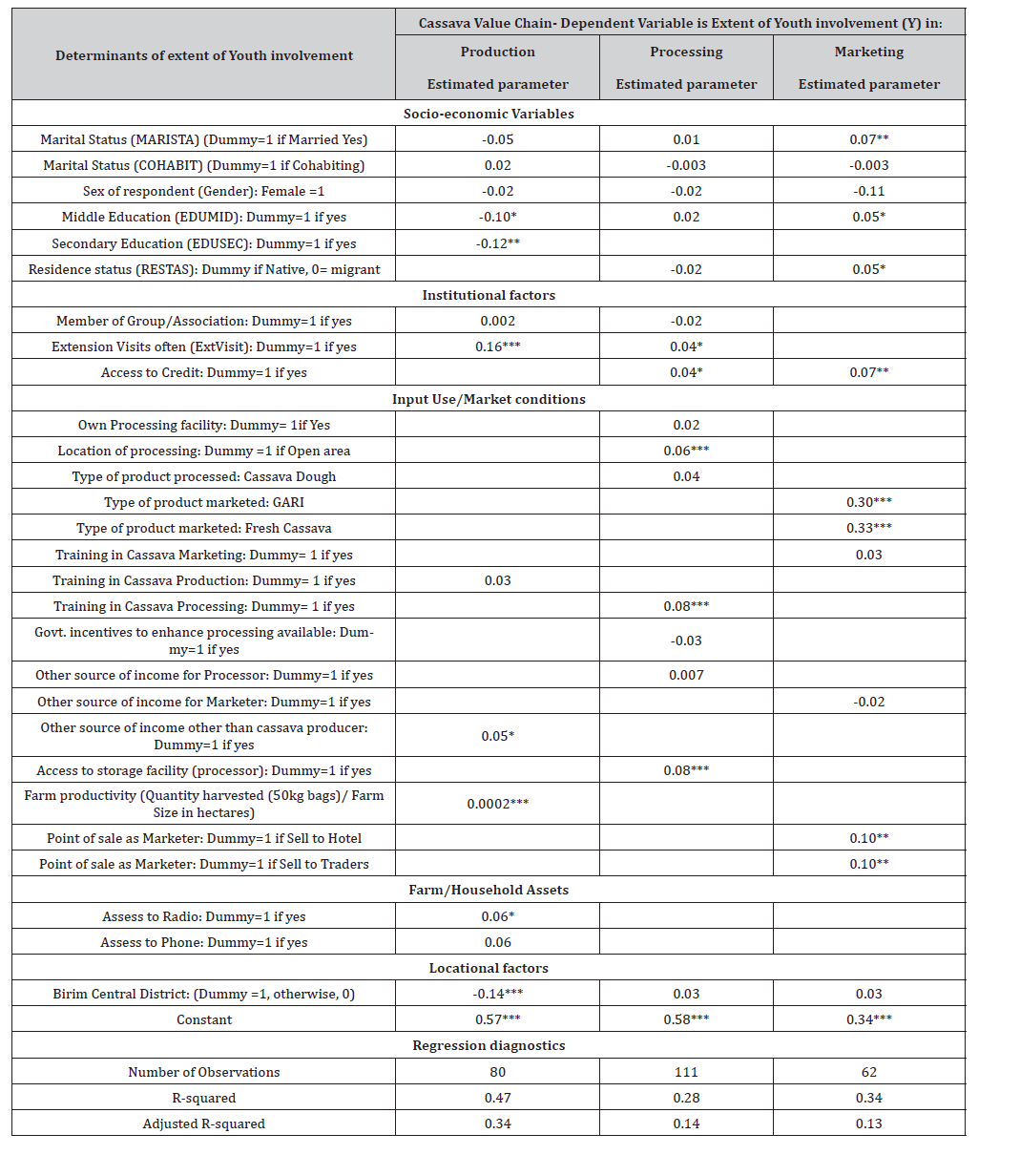
Statistical significance: *Significant at 10%; **Significant at 5%; ***Significant at 1%.
In Table 1, access to extension and to formal credit are viewed by the youth as the most significant and positive determinants in deepening their extent of participation in production, processing and marketing. This is consistent with studies by [33,34], who found access to extension to be significant in strengthening farmer capacity by providing information and technologies and enhancing skills. Also, the positive and significant relationship of credit access is consistent with studies by [35,36], who found that credit access enables credit recipients hire labour for processing activities, improving household welfare and better nutrition. Education is another significant determinant. However, as the youth education increases (beyond middle school, which is 10 years of formal education), their preference along the chain is into marketing. This result conforms with Southern African Confederation Agricultural Union (2013) and FAO (2014) who reported that youth will be more interested in the downstream segments of agri- food value chains such as agro-processing and marketing because they offer them quick money and assured markets [37].
In production, increases in farm productivity and indulgence in other sources of income are key determinants in the extent of youth involvement in the chain, whilst in processing, having access to an open space to operate on, and receiving training in cassava processing and access to storage facility are significant key determinants [38]. Owning a processing facility is a positive but not a significant determinant of the extent of involvement. In marketing, the type of product marketed (fresh cassava and Gari) are significant determinants, whereas the client type (selling to hotel and to other traders) determine their extent of involvement.
Table 2 summarizes the total (expected) score (35 marks) which is scaled to 1.0; the maximum score, minimum and mean score for the extent of youth (with the corresponding scaled values) participation along the various cassava value chains. In general, on a scale of 1 (strongly disagree) to 5 (strongly agree), the determinants of the youth’s extent of participation along the cassava value chain, can be categorized as indifferent: production (3.28), processing (3.21) and marketing (3.28) [39]. Again, in general, the youth’s extent of involvement is constrained by lack of access to credit and extension services. However, the cassava value chain’s market opportunities are high as all actors in the chain can market their produce [40].
Table 2:Magnitudes in the scales for each node’ extent of youth involvement.
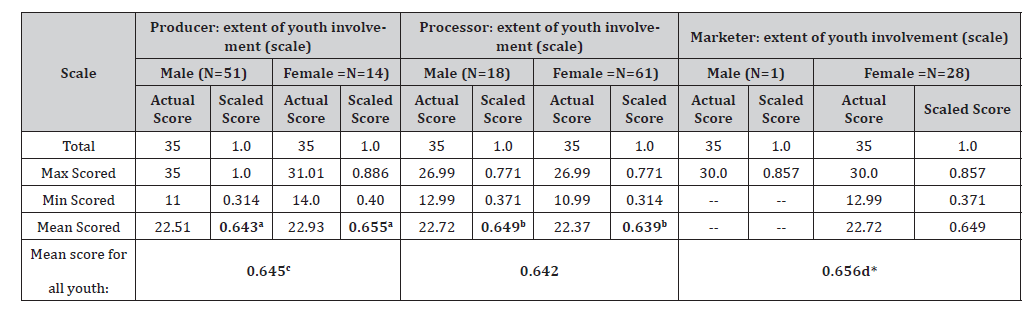
Source: Computed from field data, 2016 a, b no statistically significant difference between male youth and female youth within the node c, d statistically significant difference between extents of youth involvement.
From table 2, the mean scaled scores for all youth in marketing (0.656) are relatively larger than for production (0.645) and processing (0.642). The difference in the score between marketing and production only is statistically significant at the 10% level. This implies that the extent of the youth involvement in marketing is relatively stronger than in production [41]. This result particularly buttresses the report that youth will be more interested in the downstream segments of agri-food value chains such as agroprocessing and marketing because they offer them quick money and assured markets than farm-level production of the cassava root crop. Between male youth and female youth, the difference in the extent of involvement is statistically not significant within any node, implying that female as much as male are likely to experience similar levels of participation in the value chain (Table 2) [42]. Figures 1-3 present factors that the youth perceive as currently enhancing (or not enhancing) the extent of their participation in the cassava value chain (higher values indicate most factor enhancing extent of involvement and low values least enhancing factors (low values are most constraining factors) (Figure 1).
In cassava root crop production, the factors not influencing much the extent of participation of the youth are access to credit (2.38), inability to access improved planting materials (2.93) and extension services (2.94) (see Fig. 1). However, there seems to be market for the producers as they are relatively able to sell all or most of their produce (4.27), a factor that is very enhancing for the youth’s involvement [43]. The youth’s inability to access improved planting materials and credit to expand their production, though they have enough land to expand their production (3.67), constraints the extent of their participation in production in the cassava value chain. This could be attributed to high cost of improved planting materials used in production. Inadequate funds could inhibit the young farmers from accessing resources such as hired farm labor and new technologies (improved seeds, agro-chemicals) which can influence efficient production. This finding is consistent with the study by Esiobu (2019) (Figure 2) [44].
Similarly, in cassava processing, access to credit (2.44) and extension services (2.30) currently do not enhance the youth’s extent of participation (fig 2). The most enhancing factors for the youth’s involvement is the mostly ready market available to sell their processed produce (4.42), the youth being relatively able to access raw materials (3.93) and able to expand their processing business (3.42) as well as having the capacity to hire labour to help in the processing (3.00) [45]. There also seems to be some ability for processing to be undertaken all year (Figure 3).


For cassava marketers, keeping records of their marketing activities (2.07), having access to credit (2.66) do not influence youth participation in marketing (Figure 3). However, the most enhancing factor that influence youth involvement in marketing is their ability to sell all or most of their products (4.21), ability to market cassava products throughout the year (3.69), the ability to access cassava and its products to the market on a regular basis (3.76) as well as expanding the cassava market business yearly (3.34). The youth in the study area are market- oriented and have interest in the market of processed cassava business. They might have the agripreneur spirit but lack financial ability to sell on commercial basis as well as training or extension programs [46].
Conclusion
The youth’s extent of involvement in agricultural value chains is enhanced by factors including access to markets and access to raw materials but constrained by institutional factors such as lack of credit and extension access. There seem to be no difference in gender perceptions in the factors that affect the extent of youth involvement. Female youth see the same factors as male youth as either enhancing or constraining their involvement. The youth’s inability to access improved planting materials and credit to expand their production, though there are no constraints to land availability, constraints the extent of their participation in production in the cassava value chain. For processors, the most enhancing factor for the youth’s involvement is their ability to process all year, the relative ability to access raw materials and the ability to expand their processing business. There also seems to be a market for the processors as they can sell all or most of their produce. For cassava marketers, the most enhancing factor is their ability to sell most of their products.
These findings present a remarkable opportunity for policy to enhance cassava value chain businesses and significantly contribute to increasing youth involvement in agricultural development. The youth present opportunity for long-term involvement and ownership of processing facilities, products marketed and having markets for their produce. Building on this opportunity, the youth involvement can improve the challenges of rural unemployment and underemployment, increase food security and improve livelihoods towards poverty eradication. Development efforts through supporting institutional incentives such as access to credits, extension visits and trainings that enhance youth productivity, profitability and commercialization of markets can help increase the extent of youth involvement in the cassava value chain. To optimise market opportunities, there must be policies to support suitable modernized cassava value chain activities such as mechanical peelers and chippers to aid in increasing productivity and reducing overhead costs to increase income the youth obtain in their processing operations.
Increased processing and marketing enhance farm level cassava production. Ministries of Food and Agriculture and African rural enterprise projects should provide the youth access to improved planting materials. Financial institutions should provide farm credit in the form of inputs rather than loans, as well as enhancing youth integration into farmer cooperatives for monitoring youth farmers to ensure the credit inputs are used for cassava value addition and not on other purposes to increase their production and sustain income among young farmers.
Limitations of the Study
To our knowledge, this is not the first study to review the role of youth participation in poverty reduction and rural job creation for long-term economic growth in Ghana and Africa. Despite its importance, the study was not without flaws. The data presented was collected in 2016 and is still relevant to the study’s objectives. Besides, this research paper, the data has not been published in any publication by any other researcher. Consequently, the results presented in this study are biased towards youth in rural areas versus youth in peri-urban and urban areas. For future studies, there is a need to broaden the scope of the research to ensure the inclusion of the youth in both rural, peri-urban, and urban areas and as well consider the tradeoffs in the locations.
Funding
The authors would like to acknowledge the financial support received from the International Development Research Council (IDRC), Ottawa, Canada. The views here do not necessarily represent that of IDRC or its Board of Governance.
Acknowledgement
I would like to acknowledge the supervision and guidance from my mentor, Dr. Jemima Njuki, who was my mentor during the award. The authors also wish to express their gratitude to the Regional Universities Forum for Capacity Building in Agriculture (RUFORUM) for giving them the opportunity to share their findings and present the paper as an open access in the RUFORUM working documents. Appreciation goes to the cassava farmers for taking time to provide useful information that guided this study. Thanks to all who were involved in the data collection.
Disclosure Statement
No potential conflict of interest was reported by the author(s).
Authors’ Contributions
The first author designed data collection tools, gathered primary data and analysed the data. All authors were involved in data analysis, interpretation and write-up. All authors conceptualized the study, read and approved the final manuscript.
Availability of Data and Materials
The data that support the findings of this research can be obtained from the authors upon request.
Citation Information
Cite this article as: Youth Participation in Cassava Value Chains in Ghana: a nexus for poverty reduction and rural employment.
References
- Bayitse R, Tornyie F, Bjerre AB (2017) Cassava cultivation, processing and potential uses in Ghana. Handbook on Cassava, PP. 313-333.
- Torkpo SK, Amponsah E, Arhin CD, Offei SK (2021) Occurrence of cassava mosaic begomovirus-associated satellites on cassava in Ghana. Cogent Food & Agriculture 7(1): 1963929.
- Acheampong PP, Owusu Danquah E, Agyeman K, Obeng Dankwa K, Addiso NM (2021) Research and Development for Improved Cassava Varieties in Ghana: Farmers’ Adoption and Effects on Livelihoods. Intech Open.
- Ministry of Food and Agriculture (MoFA) (2021) Agriculture in Ghana: Facts and figures (2020). Statistics Research and Information Directorate, MoFA. Accra, Ghana.
- (2020) Food and Agriculture Organization. Youth in agriculture: The future of farming and rural development in Africa.
- Antwi-Boateng A (2020) The impact of access to credit by smallholder cassava farmers on cassava production in Ghana.
- Immanuel S, Jaganathan D, Prakash P, Sivakumar PS (2024) Cassava for Food Security, Poverty Reduction and Climate Resilience: A Review. Indian Journal of Ecology 51(1): 21-31.
- Byju G, Suja G (2020) Mineral nutrition of cassava. Advances in Agronomy 159: 169-235.
- Ominikari AG, Samuel Preye J, Titus LB (2024) Factors Affecting Youth Involvement in Cassava Farming in Khana Local Government Area of River State, Nigeria.
- Darko-Koomson S, Aidoo R, Abdoulaye T (2020) Analysis of cassava value chain in Ghana: implications for upgrading smallholder supply systems. Journal of Agribusiness in Developing and Emerging Economies 10(2): 217-235.
- Dankwa KO, Peprah BB (2020) Industrialization of Cassava Sector in Ghana: Progress and the Role of Developing High Starch Cassava Varieties. Agricultural Journal 15(2): 26-29.
- Dankwa KO, Peprah BB (2019) Industrialization of cassava sector in Ghana: progress and the role of developing high starch cassava varieties. Ghana journal of agricultural science 54: 2.
- Anning-Dorson T (2023) Cassava-Gari Value Chain Participation and Rural Wo men’s Wellbeing: An Exploratory Study. African Journal of Food, Agriculture, Nutrition and Development 23 (116): 22117-22131.
- (2012) Africa Economic Outlook. Part Two, Chapter 6. Special theme: Promoting Youth Employment, AfDB, OECD, UNDP, UNECA.
- (2014) FAO, Global Forum on Food Security and Nutrition. The Future of Family Farming: Empowerment and equal rights for Women and Youth.
- Adegbola YP, Crinot GF, Dassou SS, Atacolodjou AL, Kouton-Bognon B, et al. (2020) Enhancing youth employment opportunities in rural economies in Benin. In Forum for Agricultural Research in Africa 5(1): 1-48.
- Ali MD, Hassan MDI, Yusuf IM, Nur AM, Adan OH, et al. (2022) Youth Unemployment in Somalia: A Case Study of Baidoa, Southwest State of Somalia. International Journal of Research and Innovation in Social Science 6(5): 500-507.
- Geza W, Ngidi M, Ojo T, Adetoro AA, Slotow R, et al. (2021) Youth Participation in Agriculture: A Scoping Review. Sustainability 13(16): 9120.
- Boadu ES (2024) Evaluating Ghana’s Youth-centred Food-Security Policies: A Collaborative Governance Approach. Sustainability 16(9): 3830.
- Brooks K, Zorya S, Gautam A (2012) Employment in agriculture; Jobs for Africa’s youth, 2012 Global Food Policy Report, International Food Policy Research Institute (IFPRI).
- Dzanku FM, Tsikata D (2022) Implications of socioeconomic change for agrarian land and labour relations in rural Ghana. Journal of Rural Studies 94: 385-398.
- Balt M (2015) Looking for green Pastures: African Youth and their Future Jobs.
- Sumberg J, Fox L, Flynn J, Mader P, Oosterom M (2021) Africa’s “youth employment” crisis is actually a “missing jobs” crisis. Development Policy Re view 39(4): 621-643.
- Delgado (2018) Economic Policy Research Centre. Fostering a sustainable agro-industrialisation agenda in Uganda. Kampala.
- Fowler M, Rauschendorfer J (2019) Agro-industrialisation in Uganda: Current status, future prospects and possible solutions to pressing challenges. Working paper, International Growth Centre.
- Dadzie CE, Fumey M, Namara S (2020) Youth Employment Programs in Ghana; Options for Effective Policy making and Implementation.
- Ahaibwe G, Mbowa S, Mayanja ML (2016) Youth engagement in agriculture Uganda: Challenges and Prospects. Economic Policy Research Centre (EPRC) Research Series No.106.
- Brennan MA, Barnett RV, Baugh V (2007) Youth Involvement in Community Development: Implications and Possibilities for Extension. Journal of Extension 45(4).
- Terri Raney, Henning Steinfeld, Jakob Skoet (2009) The state of food and agriculture 2009: Livestock in the balance. Food and Agricultural Organization.
- Bolang PD, Baddianaah I, Osumanu IK (2024) Towards meeting the food needs of urban households in sub-Saharan Africa: an analysis of formal sector employees’ participation in agricultural production in urban Wa, Ghana. Cogent Social Sciences 10(1): 2309711.
- Ninson J, Brobbey MK (2023) Review on engaging the youth in agribusiness. Cogent Social Sciences 9(1): 2193480.
- Jumpah ET, Ampadu-Ameyaw R, Owusu-Arthur J (2020) Youth employment in Ghana: Economic and social development policies perspective. World Journal of Entrepreneurship, Management and Sustainable Development 16(4): 413-427.
- Muhammed Y, Ajayi OJ, Muhammad HU, Oloruntoba VT, Abdullahi A, et al. (2020) Participation of Rural Youths in Cassava Production in Ife lodun Local Government Area of Kwara State, Nigeria. Journal of Agricultural Economics, Extension & Social Sciences 3(1): 162-169.
- Masamha B, Uzokwe VN, Ntagwabira FE, Gabagambi D, Mamiro P, et al. (2017) Gender influence on participation in cassava value chains in smallholder farming sectors: evidence from Kigoma region, Tanzania. Experimental Agriculture 55(1): 1-16.
- Daudu AK, Abdoulaye T, Bamba Z, Shuaib SB, Awotide BA (2023) Does youth participation in the farming program impact farm productivity and household welfare? Evidence from Nigeria. Heliyon 9: 4.
- Obisesan AA (2019) What drives youth participation and labour demand in agriculture? Evidence from rural Nigeria.
- Birner R, Davis K, Pender J, Nkonya E, Ponniah A, et al. (2009) From best practice to best fit: A framework for designing and analysing pluralistic agricultural advisory services worldwide. Journal of Agricultural Education and Extension 15(4): 341-355.
- Burns A, Gleadow R, Cliff J, Zacarias A, Cavagnaro T, et al. (2010) Cassava: the drought, war and famine crop in a changing world. Sustainability 2(11): 3572-3607.
- Byju G, Suja G (2020) Mineral nutrition of cassava. Advances in Agronomy 159: 169-235.
- Conning J, Udry C (2005) Rural Financial Markets in Developing Countries, Economic Growth Centre. Yale University, and Centre Discussion. PP. 914.
- Christoplos I (2010) Mobilizing the potential of rural and agricultural extension. Rome. Italy: FAO of the UN and the Global Forum for Rural Advisory Services.
- Esiobu NS (2019) Relative Efficiencies of Resource Use Among Cassava Farmers in Imo State, Nigeria; An M.Sc Thesis Submitted to the Department of Agricultural Economics, Extension and Rural Development, Faculty of Agriculture and Veterinary Medicine; Imo State University, Owerri, Nigeria. Partial Fulfilment of the Requirement for the Award of Master’s Degree in Agricultural Economics.
- Maddala GS (1983) Limited-Dependent and Qualitative Variables in Economics. Society Monographs (3). Cambridge University Press.
- Oladoyin OP, Akinbola AE, Aturamu OA, Ilesanmi JO (2022) Economic analysis of cassava production in Akoko District of Ondo State, Nigeria. World Journal of Advanced Research and Reviews 14(1): 391-399.
- Robinson M, World Bank (2001) The Micro-finance Revolution: Sustainable Finance for the Poor. Washington DC.
- UNCTAD (2012) Nfocomm Commodity Profile. Cassava. United Nations Conference on Trade and Development.
-

This work is licensed under a Creative Commons Attribution-NonCommercial 4.0 International License.