


 Mini Review
The Impact Mechanism and Response Strategies of Precipitation Changes on Groundwater Level
Received Date:December 22, 2025; Published Date:December 29, 2025
Abstract
Climate change has led to a significant reconstruction of the global spatial and temporal distribution pattern of precipitation. Changes in precipitation intensity, frequency, seasonal distribution, and the probability of extreme events have become the core natural factors driving groundwater level fluctuations by affecting groundwater recharge, runoff, and discharge processes. This article systematically summarizes the global characteristics and regional differences of precipitation changes and deeply analyses the key mechanisms by which precipitation changes affect groundwater levels (infiltration recharge, seasonal regulation and storage, extreme event impact). In the future, adaptive measures such as strengthening cross scale monitoring, optimizing water resource scheduling, and promoting coastal cities need to be taken to cope with groundwater level fluctuations caused by precipitation changes, ensure sustainable use of water resources, and maintain ecosystem stability.
Keywords:Precipitation changes, Groundwater, Impact mechanisms
Introduction
Global climate change is also reshaping the Earth’s hydrological cycle system, with precipitation as the core link of the hydrological cycle. The changes in its spatial and temporal distribution directly affect surface runoff, soil moisture content, and groundwater dynamics. Groundwater, as an important global reserve of freshwater resources, accounts for over 30% of the total available freshwater resources worldwide, supporting 40% of irrigation agriculture and 20% of urban water supply demand [1]. The stability of groundwater level is not only related to the safety of water resource supply, but also directly affects the maintenance of wetland ecosystems, the prevention and control of soil salinization, and the prevention and control of geological disasters such as land subsidence. Therefore, in-depth analysis of the impact path of precipitation changes on groundwater levels has important theoretical and practical significance for accurately predicting future water resource dynamics and formulating adaptive management strategies. This article systematically analyses the impact mechanism and response strategies of precipitation changes on groundwater, providing scientific support for groundwater resource management under the background of climate change.
Impact Mechanism of Precipitation Changes on Groundwater Level
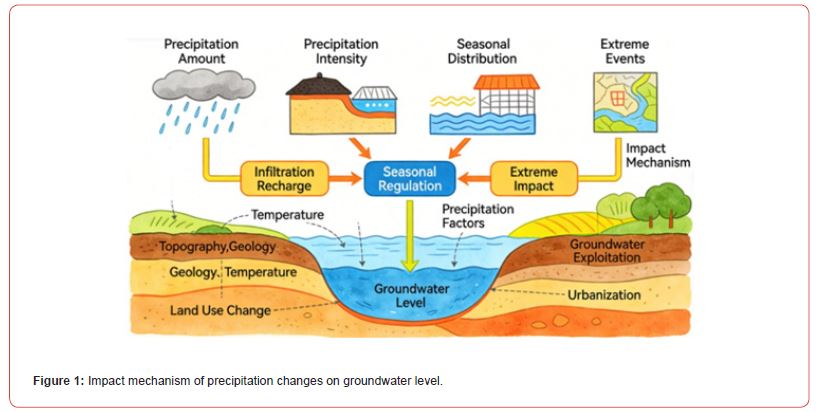
Infiltration Replenishment Mechanism: Dual Regulation of Total Precipitation and Intensity
Groundwater recharge mainly comes from precipitation infiltration, and its recharge amount depends on the matching degree of total precipitation, precipitation intensity, and infiltrationconditions. When the intensity of precipitation is less than soil infiltration, precipitation can fully infiltrate into the underground aquifer, forming effective recharge; When the precipitation intensity exceeds infiltration, excess precipitation is converted into surface runoff, and the replenishment efficiency significantly decreases. The impact of precipitation intensity is more complex: most of the water in light rain (daily precipitation<10 mm) is intercepted by vegetation or evaporated from the surface, with very little infiltration recharge; The intensity of moderate rain (10-25mm) matches the infiltration capacity the highest, and the replenishment efficiency is optimal; Due to the excessive intensity of rainstorm (>50 mm), the surface runoff accounts for 60-80%, and the recharge efficiency decreases instead.
Seasonal Regulation and Storage Mechanism: Seasonal Distribution of Precipitation and Aquifer Storage Capacity
The seasonal distribution of precipitation affects the seasonal regulation and storage of aquifers, resulting in seasonal fluctuations in groundwater levels. In the monsoon climate zone, precipitation is concentrated during the rainy season (June September), with infiltration accounting for 70-90% of the annual supply, and the groundwater level rises accordingly; During the dry season (October May), precipitation is scarce, and groundwater levels continue to decline due to evaporation, transpiration, and mining consumption. The change in seasonal distribution of precipitation directly changes the amplitude and rhythm of water level fluctuations: if the concentration of precipitation during the rainy season increases (such as concentrated in 1-2 months), the groundwater level will rise rapidly in a short period of time, which may cause shallow groundwater overflow or soil salinization; If the dry season lasts longer, the decline of groundwater level will increase, especially in areas with large groundwater mining output, which may lead to the storage capacity (water yield, elastic release coefficient) of aquifer drainage aquifers and also affect the seasonal regulation and storage effect: loose rock aquifers (such as alluvial fans, preludial plains) have high water yield, strong storage capacity and relatively gentle seasonal fluctuation of water level; The aquifer in bedrock fissures has a low water yield and weak storage capacity, and the water level is more sensitive to seasonal precipitation changes, with larger fluctuations.
Impact Mechanism of Extreme Events
Extreme precipitation events (continuous drought, extremely heavy rainstorm) affect the groundwater level in a non-linear way, and their impact is far greater than that of conventional precipitation changes. In sustained drought events, the total amount of precipitation significantly decreases, soil moisture content continues to decline, and groundwater recharge is insufficient for a long time, resulting in a continuous decline in groundwater level. If drought persists for many years, even in humid areas, the groundwater level may drop to historical lows and the recovery period may be longer. The impact of extremely heavy rainstorm event is twofold: in the short term, high-intensity precipitation may lead to rapid soil saturation, sharp increase of surface runoff, and decrease of recharge efficiency, but rainstorm with a long duration (such as moderate to heavy rain for 3-5 consecutive days) can fully infiltrate, resulting in rapid rise of groundwater level, and even lead to connection between groundwater and surface water, resulting in flood risk [2,3]. In the long run, frequent extremely heavy rainstorm may change the regional hydrological cycle, increase the total amount of groundwater recharge, and promote the long-term rise of groundwater level (Figure 1).
Adaptive Coping Strategies
To cope with groundwater level fluctuations caused by precipitation changes, it is necessary to adopt an adaptive strategy of “monitoring regulation repair” in combination with regional characteristics.
Strengthen Cross Scale Monitoring and Early Warning System
Establish a global regional watershed three-level groundwater level and precipitation monitoring network, integrate satellite remote sensing, ground observation wells, precipitation radar and other data, and build a real-time monitoring platform. Develop a groundwater level warning model for extreme precipitation and drought events, predict abnormal fluctuations in water levels in advance, and provide support for water resource scheduling and disaster prevention and control.
Optimizing Water Resource Scheduling and Mining Control
In arid and semi-arid areas, strictly control the mining output of groundwater, implement the “balance between exploitation and replenishment” system, supplement surface water resources through inter basin water transfer (such as China’s South to North Water Transfer Project), and reduce groundwater dependence; In humid areas, shallow groundwater is diverted through hydraulic engineering (drainage channels, pumping stations) to reduce the risk of soil salinization. At the same time, promote water-saving technologies (drip irrigation, sprinkler irrigation), improve water resource utilization efficiency, and reduce groundwater extraction pressure.
Improving the Infiltration Conditions of the Underlying Surface
Promote the construction of sponge cities in urban areas, improve surface infiltration rates and increase groundwater recharge through facilities such as permeable paving, rain gardens, and artificial wetlands; In rural areas, implement soil and water conservation measures (terraced fields, vegetation coverage) to reduce surface runoff and improve infiltration efficiency. For example, in the pilot area of sponge cities in Shenzhen, China, through permeable paving and rainwater garden construction, the annual groundwater recharge has increased, and the rate of groundwater level decline has slowed down.
Strengthen Ecological Restoration and Aquifer Protection
In areas with severe groundwater level decline, implement ecological water replenishment (such as diverting Yellow River water to recharge groundwater) to promote the restoration of aquifers; In ecologically sensitive areas such as wetlands and rivers, establish a red line for ecological protection of groundwater, maintain the lowest groundwater level, and ensure the stability of the ecosystem. For example, California in the United States has introduced Colorado River water resources into underground aquifers through ecological water replenishment projects, restoring a portion of wetland areas.
Conclusion
The reconstruction of precipitation spatiotemporal distribution caused by climate change has become the core natural factor driving global groundwater level fluctuations through three mechanisms: infiltration recharge, seasonal regulation and storage, and extreme event impact. An increase in total precipitation usually promotes groundwater recharge, leading to a rise in groundwater levels [4,5]; A decrease in precipitation leads to insufficient replenishment, which in turn drives down the groundwater level; The changes in precipitation intensity and seasonal distribution further exacerbate the fluctuation amplitude of groundwater level by altering infiltration efficiency and storage processes.
In the future, with the continuous intensification of global warming, regional differences and extreme trends in precipitation changes will be further strengthened, and the risk of abnormal fluctuations in groundwater levels will significantly increase. To ensure water resource security and ecosystem stability, it is necessary to establish a “natural artificial” collaborative groundwater resource management system through adaptive measures such as strengthening monitoring and early warning, optimizing water resource scheduling, improving infiltration conditions, and enhancing ecological restoration. At the same time, it is necessary to strengthen cross regional and interdisciplinary collaborative research, deeply analyse the coupling relationship between precipitation changes and groundwater levels, and provide more accurate scientific support for addressing climate change.
The stability of groundwater level is the foundation of sustainable utilization of water resources and an important indicator of ecosystem health. In the face of the challenges brought by climate change, only by fully understanding the impact mechanism of precipitation changes and adopting scientific and effective response strategies can we achieve long-term protection and rational utilization of groundwater resources and provide guarantees for the sustainable development of human society.
Acknowledgment
The authors would like to express sincere gratitude to the chief editors and the reviewers for their professional assistance.
Conflict of Interest
The authors declare no conflict of interest.
References
- Loaiciga HA, Doh R (2024) Groundwater for People and the Environment: A Globally Threatened Resource. Ground Water 62(3): 332-340.
- Xu HS, Zhang X, Guan XJ, Tianye Wang, Chao Ma, et al. (2022) Amplification of Flood Risks by the Compound Effects of Precipitation and Storm Tides Under the Nonstationary Scenario in the Coastal City of Haikou, China. Natural Hazards 13: 602-620.
- Khanam M, Sofia G, Anagnostou EN (2024) To what extent do flood-inducing storm events change future flood hazards?. Hydrology and Earth System Sciences 28(14): 3161-3190.
- Zhang JE, Felzer BS, Troy TJ (2016) Extreme precipitation drives groundwater recharge: the Northern High Plains Aquifer, central United States, 1950–2010. Hydrological Processes 30(14): 2533-2545.
- Shi BW, Wan C, Hu WW, Congchao Xu (2023) Analysis and prediction of the changes in groundwater resources under heavy precipitation and ecological water replenishment. J Water & Climate Change 14(6): 1762-1778.
-

This work is licensed under a Creative Commons Attribution-NonCommercial 4.0 International License.