


 Research Article
Research on the Technology of Food-Tobacco Integration for Improving Quality and Efficiency
Received Date:August 21, 2026; Published Date:September 01, 2026
Abstract
In order to explore effective technical paths for improving the quality and efficiency of tobacco field, and promoting the green and sustainable development of the tobacco industry, based on the ecological regulation of “agriculture and tobacco integration”, the integrated and application demonstration of the tobacco quality improvement and efficiency enhancement technology through the integration of tobacco and grain was carried out at the Lishan Tobacco Station in Fukuquan City, Qiannan Prefecture, Guizhou Province. Through the research on key technical links such as the suitable varieties and the optimal sowing period of sweet potatoes under the tobacco-sweet potato intercropping, the yield-quality of the tobacco and economic effectiveness of tobacco field were analyzed. The results show that in terms of economic characteristics, the three treatments A1V1, A1V2 and A2V1 were superior to the other treatments; in terms of the chemical composition of tobacco leaves and their coordination, the three treatments A1V1, A1V2 and A2V1 were closer to the standards of high-quality tobacco leaves. Considering the yield and the economic effectiveness of the tobacco fields, finally, A1V2 was the best, followed by A1V1. Therefore, it is recommended to choose varieties V1 and V2 and carry out intercropping of sweet potato seedlings from May 15th to 30th.
Keywords:Flue-cured tobacco; food and tobacco integration; improving quality and efficiency
Introduction
The tobacco industry is an important economic sector in Fukuquan City, Qiannan Prefecture, Guizhou Province. It serves as a crucial foundation for the high-quality development of modern tobacco agriculture. The cultivation of a single crop cannot meet the needs of modern agricultural development. To achieve increased income, it is necessary to integrate grain and tobacco, enhance the overall agricultural efficiency, and provide effective guarantees for the quality improvement and upgrading of the agricultural industry [1]. Previous research results indicate that, the integrated cultivation model of “tobacco-sweet potato” can effectively promote the growth of tobacco plants and significantly reducing the occurrence diseases [2,3]. Qiannan Prefecture in Guizhou Province is an important high-quality tobacco production area. Luping Town, as a typical tobacco-growing village in the county, has representative terrain, climate, soil conditions and farming habits within the region.
Moreover, the local area is actively exploring the development model of grain-tobacco integration (such as tobacco-bean, tobaccosweet potato intercropping), providing an ideal practical site for this research. This study systematically evaluates the technical system for improving the quality and efficiency of tobacco based on grain-tobacco integration, aiming to establish production technical norms for intercropping tobacco - sweet potatoes and promote their application, providing theoretical support and practical demonstrations for the improvement of tobacco leaf quality and comprehensive benefits under the grain-tobacco integration model.
Materials and Methods
Materials
Using the tobacco variety “Yunyan 87”, and the sweet potato varieties “Shangtu 19”, “Qianyu 26” and “Qianyu 11” as materials. The experiment was conducted from April to October 2025 at Liushan Tobacco Station in LuPing Town, Qianan Buyi and Miao Autonomous Prefecture, Guizhou Province.
Experiment Design
The experiment adopted a randomized block design. Different varieties of sweet potatoes (A1 was the commercial sweet potato variety 19, A2 was the Guizhou sweet potato variety 26, A3 was the Guizhou sweet potato variety 11) and the time of transplanting the sweet potato seedlings (V1 was May 15th, V2 was May 30th, V3 was June 15th) were used in the intercropping of tobacco-sweet potatoes. Tobacco alone was used as the control (CK). A total of 5 treatments were set up; each treatment plot was 18 square meters, with 3 replications. The row and plant spacing of tobacco was 120 cm × 50 cm. Transplanting was carried out in mid-April, and tobacco leaf harvesting ended on August 10th. Sweet potatoes or soybeans were intercropped on the tobacco ridges on both sides of the tobacco plants (with a distance of 30 cm from the tobacco plants), and the sweet potatoes were harvested at the end of September. The management measures of the tobacco fields were in accordance with the local tobacco production technical plan, and no additional fertilization was provided for the intercropping.
Measurement Indicators and Methods
Tobacco Yield-Quality
The determination of the indicators (economic characteristics and chemical composition) was carried out according to the methods described in the literature [4].
Economic Effectiveness
The calculation formula is as follows: Total cost = Cost of tobacco planting + Cost of sweet potatoes planting, Total income = Tobacco output × Tobacco price + sweet potatoes output × Price of sweet potatoes, Net income = Total income - Total cost.
Results and Discussion
The Effect of Intercropping on the Quality of Tobacco Leaves
The Effect of Intercropping on the Economic Characteristics of Tobacco Leaves
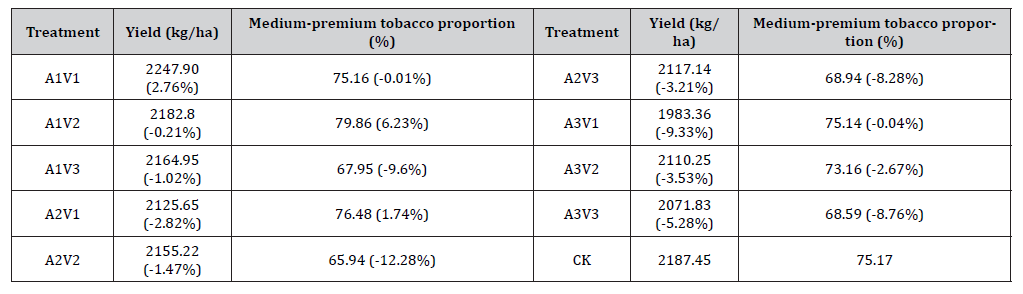
There are significant differences among the various treatments. In terms of the proportion of medium and above grade tobacco in the total output, treatments A1V1, A1V2 and A2V1 outperformed the other treatments (Table 1).
Table 1:The Economic characteristics of intercropping tobacco-sweet potatoes system.
The Effect of the Chemical Composition and Its Coordination of Tobacco Leaves
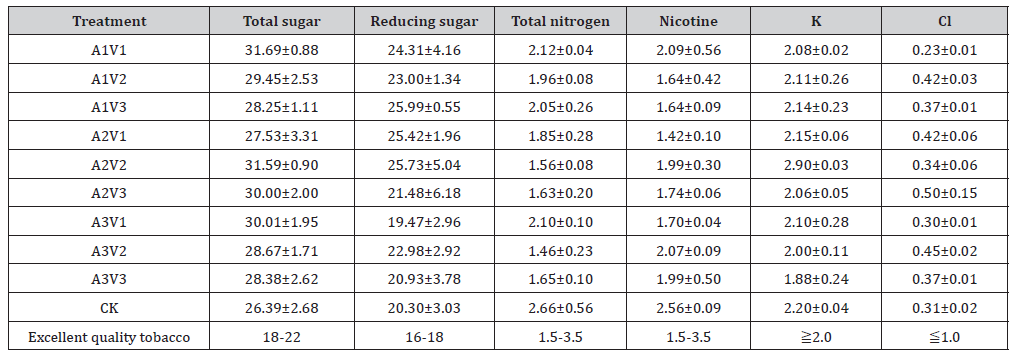
All the total nitrogen, nicotine (except A2V1), potassium (except A3V3), and chlorine in the samples met the standards for high-quality tobacco leaves. However, the total sugar content in all the treatments was relatively high, and the reducing sugar content was only slightly closer to that of high-quality tobacco leaves in the A3V1 treatment (the other treatments were all higher) (Table2).
Table 2:The Economic characteristics of intercropping tobacco-sweet potatoes system.
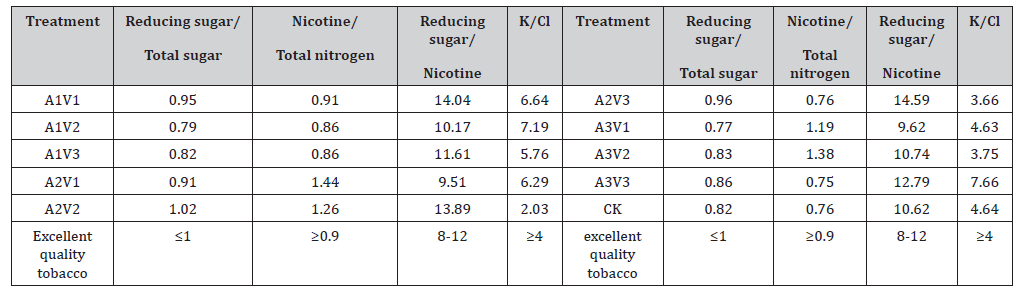
The contents of reducing sugar/total sugar, reducing sugar/ nicotine (except for the CK treatment) and potassium/chlorine met the standards for high-quality tobacco leaves. However, nicotine/ total nitrogen only met the standards for A1V2, A1V3, A2V1, and A3V1(Table 3).
Table 3:The Chemical composition coordination of C3F on intercropping tobacco-sweet potatoes system.
The Effect of Intercropping on the Economic Effectiveness of Tobacco Field
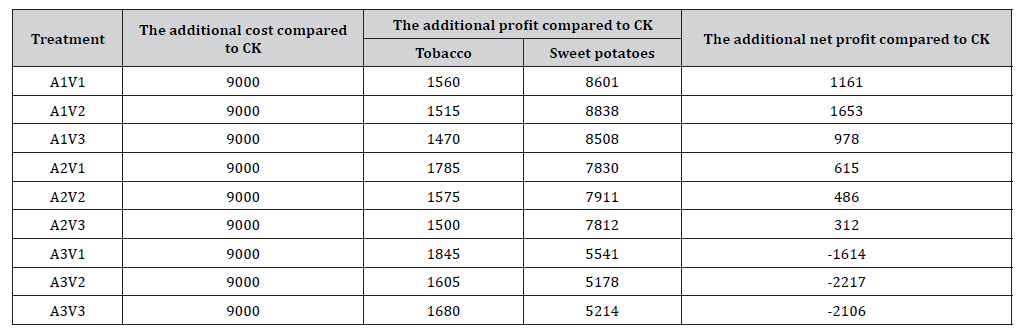
The combination is best for A1V2, followed by A1V1(Table 4).
Table 4:The Economic effectiveness of tobacco field on intercropping tobacco-sweet potatoes system (Unit: RMB/ha).
Conclusion
In terms of economic traits, the three treatments A1V1, A1V2 and A2V1 outperformed the others. In terms of chemical composition and coordination, the three treatments A1V1, A1V2 and A2V1 were relatively close to the standards of high-quality tobacco leaves. Considering the yield of sweet potatoes and the economic benefits of the tobacco fields, ultimately, A1V2 was the best, followed by A1V1.
Author Contribution
Jun Zhong wrote the manuscript and the first author. Xizhong Zhang and Qiang Li are the co-corresponding author. All authors contributed to manuscript revision, read, and approved the submitted version.
Funding
This study was supported by the China Tobacco Guizhou Industrial Co Ltd Qiannan state Company project (2025-522700-2- 7-0071) and Hunan Agricultural University project (25KJ010).
Conflict of Interest
The authors declare that the research was conducted in the absence of any commercial or financial relationships that could be construed as a potential conflict of interest
References
- Yang LQ, Chen P, Long T (2024) The current situation and prospects of tobacco and grain complementary cultivation research in china. South China Agriculture 18(19): 53-57.
- Zhang J, Li XY, Luo YT (2015) Effect of relay-intercropping of tobacco with tuber pattern on the utilization of climatic resource and economic benefit. Journal of Anhui Agri Sci 43(25): 42-43.
- Luo YT, Tang Y, Ao JJ (2016) Study on the optimal sweet potato cutting periods with flue-cured tobacco intercropping in qiandongnan prefecture. Journal of Anhui Agri Sci 44(23): 24-26.
- Zhong J, Li JY, Lei T, Yuming W, Xingqi W, et al. (2025) Effects of intercropping sweet potato on economic characteristics, physical properties and chemical composition of flue-cured tobacco. Journal of Agriculture and Forestry 4(3); 45-57.
-

This work is licensed under a Creative Commons Attribution-NonCommercial 4.0 International License.