

 Mini Review
Plant Growth Promoting Rhizobacteria (PGPR) for Sustainability: Bioremediation and Biofertilization: A Mini-Review
Received Date:April 08, 2026; Published Date:April 15, 2026
Abstract
Healthy soil supports not only plant life but also human well-being, a widely recognized fact. Green plants serve as the primary producers in all ecosystems, forming the foundation of the entire food web. All life forms are directly or indirectly interdependent and ultimately reliant on soil. However, soil degradation poses significant risks to biodiversity, food security, and human health. Plant growth-promoting rhizobacteria (PGPR) play a crucial role in enhancing the resilience of soil ecosystems. Bioremediation using PGPR represents an Insitu, sustainable approach that offers dual benefits: restoration of soil quality and enhancement of crop productivity.
Keywords:Soil restoration; PGPR; pollution; microorganisms; sustainability
Introduction
Soil, the uppermost layer of the Earth, serves as a habitat for a vast diversity of living organisms and supports complex ecological processes. It provides a dynamic ecosystem essential for sustaining biodiversity. However, since the Industrial Revolution, intensified mining activities and the prolonged use of industrial and agricultural chemicals, including pesticides and herbicides, have significantly contributed to soil pollution, fertility loss, and structural degradation [1]. Degraded soils exhibit reduced porosity, increased hydrophobicity, and diminished water retention capacity [2]. These changes adversely affect primary producers, thereby disrupting entire ecosystems. Additionally, organic matter depletion accelerates in degraded soils, further compromising soil quality. Environmental pollutants such as industrial effluents, heavy metals, and plastic waste represent major global threats, negatively impacting biodiversity, food security, and human health [3]. Under natural conditions, soil maintains a balance of water and nutrients through microbial activity, which also preserves soil structure and porosity. Bioremediation strategies mimic these natural processes by employing microorganisms capable of restoring soil health. Among these, plant growth-promoting rhizobacteria (PGPR) have emerged as highly effective agents due to their multifunctional roles in soil restoration and plant growth enhancement.
Mechanisms of PGPR in Soil Detoxification
PGPR play a vital role in the bioremediation of heavy metalcontaminated soils through several mechanisms. One important process involves the production of metal-chelating compounds that bind toxic metal ions in the rhizosphere, thereby reducing their mobility and bioavailability [4]. Additionally, PGPR form biofilms that act as protective barriers, limiting heavy metal exposure to plant roots [5]. Certain microorganisms can also transform highly toxic metals into less toxic forms via enzymatic activity and biosorption [6]. In hydrophobic soils, bioaugmentation improves soil hydraulic properties by enhancing porosity and water-holding capacity. Beyond heavy metal contamination, nutrient depletion and recurrent drought further exacerbate soil degradation, resulting in reduced crop productivity and disruption of biogeochemical cycles. PGPR promote plant growth by improving root architecture and increasing water absorption efficiency. They also produce phytohormones such as abscisic acid (ABA), which regulates stomatal closure and enhances plant water-use efficiency under stress conditions for essential vital activities [7].
PGPR as Promising Biofertilizers
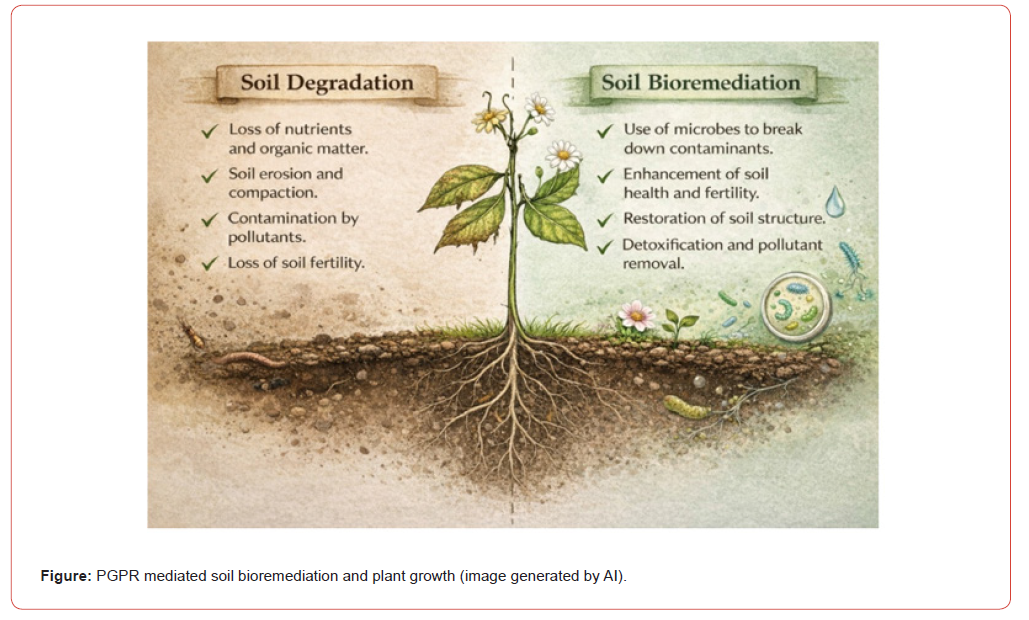
PGPR effectively colonize the rhizosphere and enhance nutrient availability and plant growth. Nitrogen-fixing genera such as Azotobacter, Azospirillum, and Rhizobium convert atmospheric nitrogen into bioavailable forms, thereby improving soil fertility in nutrient-deficient conditions [8]. Additionally, several species of Bacillus, Pseudomonas, and Enterobacter are capable of solubilizing phosphorus and other essential nutrients [9], and increase its uptake by plants. PGPR also synthesize plant growth regulators, including indole-3-acetic acid, gibberellins, and cytokinins, which further enhance plant development [10,11]. Plants growing in degraded soils are often more susceptible to diseases and environmental stresses. PGPR-mediated bioaugmentation enhances plant resilience by improving overall plant vigor and enabling the production of osmoprotectants, stress-related enzymes, and phytohormones [12] (Figure 1).
Discussion
Despite the well-documented benefits of plant growthpromoting rhizobacteria (PGPR) in soil restoration and plant growth enhancement, several limitations and challenges remain. The effectiveness of PGPR under field conditions often shows significant variability compared to controlled laboratory studies, largely due to differences in soil type, climate, and native microbial communities [13]. Additionally, the survival and colonization efficiency of introduced PGPR strains can be inconsistent, limiting their long-term impact [14]. While many studies report positive outcomes, discrepancies exist regarding the extent of their effectiveness under stress conditions, indicating the need for more standardized and large-scale field trials. Furthermore, the interaction between PGPR and plants is highly complex and influenced by multiple biotic and abiotic factors, which are not yet fully understood. Economic feasibility and scalability of PGPR-based bioformulations also require further evaluation for widespread agricultural application [15]. Therefore, future research should focus on improving strain stability, understanding plant–microbe interactions at the molecular level, and developing efficient delivery systems to maximize their practical utility in sustainable agriculture [16].
Conclusion
This review highlights the significant potential of PGPR as a sustainable solution for improving soil health, enhancing plant growth, and increasing agricultural productivity. PGPR also contribute to soil detoxification by removing or immobilizing toxic substances. Degraded soils, characterized by disruptions in essential biogeochemical cycles, are generally unsuitable for optimal plant growth; however, PGPR effectively mitigate these adverse effects and promote plant development [17]. Furthermore, PGPR-inoculated plants exhibit distinct gene expression patterns under environmental stress compared to non-inoculated plants, indicating enhanced stress tolerance mechanisms [18]. The multifunctional nature of PGPR makes them a powerful tool for soil remediation and sustainable agriculture. Their application reduces dependence on chemical inputs, thereby supporting environmentally friendly practices and contributing to long-term food security.
Acknowledgment
None.
Conflict of Interest
No conflict of Interest.
References
- Hu Y, Wang J, Yang Y, Li S, Wu Q, et al. (2024) Revolutionizing soil heavy metal remediation: cutting edge innovations in plant disposal technology. Sci Total Environ 918: 170577.
- Coban O, DE Deyn GB, Van Der Ploeg M (2022) Soil microbiota as game-changers in restoration of degraded lands. SCIENCE 375(6584): abe0725.
- Oubohssaine M, Sbabou L, Aurag J (2025) Enhancing ecosystem restoration and soil productivity through PGPR: a sustainable approach to bioremediation and biofertilization. Discover Applied Sciences 7:1379.
- Sharma I, Sharma S, Sharma V, Singh AK, Sharma A, et al. (2024) PGPR-enabled bioremediation of pesticide and heavy metal-contaminated soil: a review of recent advances and emerging challenges. Chemosphere 362: 142678.
- Karnwal A, Kumar G, Din Mahmoud AE, Dutta J, Singh R, et al. (2025) Eco-engineered remediation: microbial and rhizosphere-based strategies for heavy metal detoxification. Curr Res Biotechnol 9: 100297.
- Pratush A, Kumar A, Hu Z (2018) Adverse effect of heavy metals (As, Pb, Hg, and Cr) on health and their bioremediation strate gies: a review. Int Microbiol 21(3): 97-106.
- Nadeem SM, Ahmad M, Zahir ZA, Javaid A, Ashraf M (2014) The role of mycorrhizae and plant growth promoting rhizobacteria (PGPR) in improving crop productivity under stressful environments. Biotechnology Advances 32(2): 429-448.
- Hardoim PR, Overbeek LS, Gabriele B, Pirttilä AM, Compant S, et al. (2015) The hidden world within plants: ecological and evolutionary considerations for defining functioning of microbial endophytes. Microbiol Mol Biol Rev 79(3): 293-320.
- Singh NB, Singh D, Singh A (2015) Biological seed priming mitigates the effects of water stress in sunflower seedlings. Physiology and Molecular Biology of Plants 21(2): 207-214.
- Jose Antonio L, Agustin P, Beatriz R, María Ruiz P, Francisco Javier GM (2004) “Effect of inoculation of Bacillus licheniformis on tomato and pepper”, Agronomie 24(4): 169-176.
- Rizvi A, Ahmed B, Umar S, Mohd SK (2024) Comprehensive insights into sorghum (Sorghum bicolor) defense mechanisms unveiled: Plant growth-promoting rhizobacteria in combating Burkholderia-induced bacterial leaf stripe disease. Plant Stress 11: 100397.
- Lee S, Kim JA, Song J, Choe S, Jang G, et al. (2024) Plant growth-promoting rhizobacterium Bacillus megaterium modulates the expression of antioxidant-related and drought-responsive genes to protect rice (Oryza sativa L.) from drought. Front Microbiol 15: 1430546.
- Thakur R, Dhar H, Mathew S, Gulati A (2024) PGPR inoculants journey from lab to land: Challenges and limitations. Microbiological Research 289: 127910.
- Santoyo G, Urtis-Flores CA, Loeza-Lara PD, Orozco-Mosqueda MdC, Glick BR (2021) Rhizosphere Colonization Determinants by Plant Growth-Promoting Rhizobacteria (PGPR). Biology 10(6): 475.
- Espinosa Palomeque B, Jiménez-Pérez O, Ramírez-Gottfried RI, Preciado-Rangel P, Buendía-García A, et al. (2025) Biocontrol of Phytopathogens Using Plant Growth Promoting Rhizobacteria: Bibliometric Analysis and Systematic Review. Horticulturae 11(3): 271.
- Samonty I, Hasan MZ, Hossain MR, Mahamud AGMSU (2025) The PGPB paradox: A critical review of field performance and practical constraints in agriculture. World J Microbiol Biotechnol 41(9): 321.
- Upadhyay SK, Rajput VD, Kumari A, Espinosa-Saiz D, Menendez E, et al. (2023) Plant growth-promoting rhizobacteria: a potential bio-asset for restoration of degraded soil and crop productivity with sustainable emerging techniques. Environ Geochem Health 45(12): 9321-9344.
- Saakre M, BaburaoTM, SalimAP, Ffancies RM, AchuthanVP, et al. (2017) Identification and characterization of genes responsible for drought tolerance in Rice mediated by Pseudomonas fluorescens. Rice Sci 24(5): 291-298.
-

This work is licensed under a Creative Commons Attribution-NonCommercial 4.0 International License.