

 Mini Review
Natural Cork Stoppers: Surviving Climate Change, Declining Cork Quality, and the Transition towards Agglomerated Products?
Received Date:August 18, 2026; Published Date:September 03, 2026
Abstract
In southwestern Europe, Portugal is the leading producer of cork in the world, supplying over 50% of global demand, which amounts to approximately 200,000 tonnes each year. The country manages around 730,000 hectares of cork oak forests, making up about 30% of the world’s cork oak area. The Portuguese cork industry is also the largest globally, generating annually over €1.2 billion out of an estimated €2.8 billion (approximately USD 3.1 billion) in worldwide cork trade. Portugal holds nearly 70% of the premium wine closure market share with its natural cork stoppers, dominating the natural cork trade worldwide. In the early 20th century, Portugal was concerned about emerging cork-producing countries such as Russia, Japan, Argentina, Italy, and the United States, which were beginning to supply their own crushed and granulated cork. There was a fear that these countries could start manufacturing competing stoppers made from mid- or low-grade raw cork, potentially undermining Portugal’s natural cork trade. Nearly ninety years later, however, the threat seems to arise from within the system itself, as the country’s soils and climate are progressively redirecting cork production from high-value natural cork towards lower-grade raw material intended for agglomerated products.
Keywords:Quercus suber L; mediterranean basin; natural cork; cork quality; agglomerated cork products
Introduction
In the western Mediterranean Basin, evergreen cork oak (Quercus suber L) woodlands are crucial for rural livelihoods. They provide a variety of essential ecosystem services and support a nonwood bioeconomy that relies on the sustainable harvesting of cork oak bark, the cork, which is the sixth most valuable non-timber forest product globally [1]. Cork is a biological material with a unique honeycomb cellular structure, containing approximately 40 million airtight cells per cm³. Each cork cell is a dead cell with an empty lumen and thick, suberized cell walls. This cellular tissue serves as a barrier to dehydration and offers fire protection for the oak tree. To facilitate gaseous exchange between the tree and its environment, the phellem is interspersed with lenticular phellogen, which forms radial lenticels that cross the cork tissue [2]. Cork oak trees are well-suited to the Mediterranean’s summer conditions in poor soils, thanks to their water-conserving traits.
These traits include small, sclerophyllous leaves that regulate transpiration through strong stomatal control, and a dimorphic root system that can access deep groundwater while maintaining shallower roots during periods of water deficit. Additionally, their cork provides thermal insulation and reduces water loss. However, with the increasing frequency and intensity of droughts, these woodlands are becoming more vulnerable. As a result, cork oak trees have significantly altered their growth patterns and/or have constrained their growth rates [3,4].
Cork Oak Growth Under Climate Change Effects: Two Responses, One Vulnerability
Cork oak trees exhibit a local response to climate change in their stem radial growth, which is influenced by factors such as soil depth, slope position, aspect, and groundwater access by their roots [5]. This response significantly impacts cork yield production, both in terms of quantity and quality, on a global scale. Under sustained, extreme drought conditions, the annual stem increment of mature cork oaks can decline by half, leading to a slower growth pattern. Younger trees, which have shallower roots, suffer the most, with their recovery times exceeding two years compared to the typical season required for mature trees. Cork growth contributes to over 70% of the radial increment of a stripped tree, and it is even more sensitive to climate conditions than stem (wood and cork) growth. Cork production is particularly influenced by the rainfall during the previous winter and the temperature in spring. Notably, cork growth takes priority over wood growth; trees mobilize stored reserves to prioritize cork formation, especially in the years immediately following cork harvesting when replenishment is crucial.
During this period, drought can reduce cork growth by up to 40%, impacting early cork growth for up to three years after harvesting. The growth pattern can provide insights into cork density: autumn cells, which have thick walls and small lumens, determine the maximum density of the growth ring, while spring cells influence its width. In prolonged drought conditions, trees seem to compensate by thickening the walls of autumn cells rather than reducing cell numbers, resulting in increased density even as width decreases [6]. The severity and frequency of drought not only slow growth but also increase cork density. Could the soils and climate in Portugal be pushing the national cork yield toward mid- and low-grade raw materials for the cork industry? Significant efforts have been made in adaptive forest management, including the selection and cloning of locally adapted genotypes in intensive agroforestry, implementing fertigation practices, promoting mixed and irregular stand structures, protecting groundwater, and employing climate-informed growth modeling. However, these measures can only mitigate the effects of climate change and cannot independently reverse the alterations in cork properties driven by climate factors.
Cork Growth Rates and Patterns Define Thickness and Quality of the Cork
Cork is primarily used for wine bottling, and the quality of cork is crucial for the cork industry, as it largely determines the suitability for producing natural cork stoppers, which have the highest added value [7]. Two key parameters that influence cork quality are the thickness of the cork and its porosity. The thickness is determined by the tree’s growth rate and pattern, while porosity is related to the abundance and size of lenticels, which are largely influenced by tree genetics. Natural cork stoppers are punched out from the tree bark at a perpendicular angle. If the cork grows poorly, it may result in inadequate thickness, leading to the use of the cork for discs or for processing into agglomerated products instead. Additionally, cork with dense, narrow rings is of lower quality, as it has reduced thickness and compressibility, which detracts from its suitability for natural stoppers [1,8]. From an industrial processing perspective, the economic value of producing stoppers seems to depend more on the proportions of different thicknesses than on porosity, even though the quality and price of natural cork stoppers are typically based on their surface porosity, which is determined by the lenticels.
In recent years, denser cork with narrow annual rings has become less suitable for making natural stoppers and discs, which are the products of highest value. However, this same material can still be used for granulation and subsequent manufacturing into technical stoppers, composite discs, insulation products, and flooring. If the drought continues to reduce ring width while increasing density, a larger portion of the cork yield may be allocated to agglomerated products rather than to natural cork. Additionally, the global crisis in the wine industry, driven by changing consumer habits, has directly reduced the demand for cork stoppers. This has caused an immediate contraction in cork exports and has put downward pressure on raw cork prices. Consequently, a pressing question arises: Is the Portuguese cork industry proactively adapting its business model to prioritize cork agglomerates over natural cork products? Undoubtedly, the changes in the positioning of the cork industry have already impacted cork trade in the field and affected market prices see (Table 1).
Table 1:Indexed prices for cork raw material are related to cork thickness and porosity (quality). Prices have been reduced to less than half, for all cork quality grades.

If there is a new positioning within the cork industry, it should not simply be seen as a decline or adaptation, nor should it be regarded as a neutral shift. Agglomerated stoppers differ significantly from natural cork stoppers in terms of value distribution, profit margins, processing intensity, labor requirements, and market positioning. The production of natural cork stoppers has become economically viable only for thicknesses ranging from 27 mm to 40 mm and using high-quality cork (grades 1st to 3rd) due to the substantial amount of residual cork material generated-up to 70%. Consequently, most cork planks are categorized as refuse cork, which is then sent for granulation and further processed into agglomerated products.
Table 2:Natural cork products are indexed based on the thickness and quality of the raw cork material, with quality ratings ranging from 1st to 3rd. Materials rated 4th to 6th quality are considered refuse (to granulate).

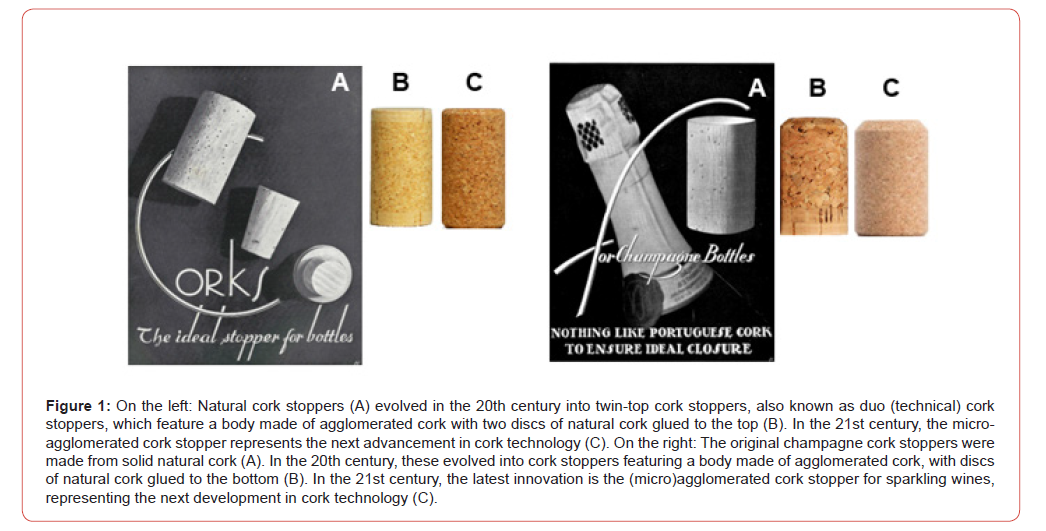
These changes are not new; cork products have evolved significantly in industrial processing (Figure 1). Despite these developments, the cork economy-ranging from forest management to industrial transformation-remains heavily reliant on the production of natural cork wine stoppers. These stoppers continue to be the most valuable products in the cork supply chain, justifying the high costs of raw materials. Even though all by-products and residues are processed into agglomerates for use in bottling, surfacing, and other materials, the primary value still lies in wine stoppers.
Conclusion
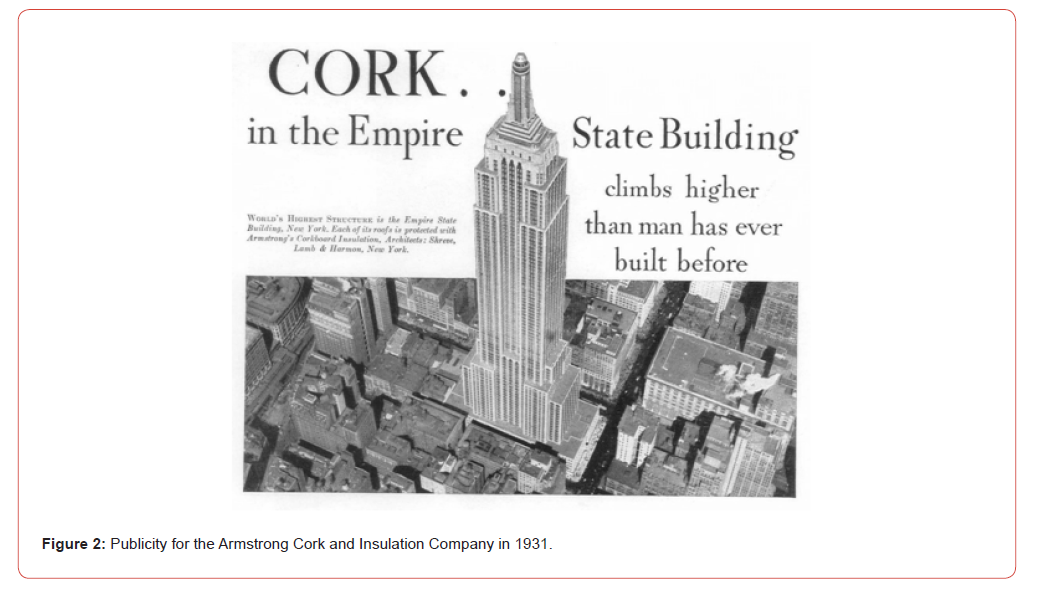
The main challenge facing the Portuguese cork sector is not only the ability to maintain its position as a producer of high-quality natural cork but also whether the transition to a product portfolio that includes both natural and agglomerated cork will be strategically managed. It should not be a result of the gradual decline in the quality of raw materials. The cork oak woodlands need to intensify their efforts to supply the cork industry with sufficient high-quality raw material. This can be achieved through adaptive management practices, such as flexible cork harvesting schedules and the mechanization of cork harvesting. These approaches would help reduce costs and increase the efficiency of one of the most critical operations in the cork value chain. In doing so, the industry can keep up with shifts in demand while maximizing the production of high-quality cork planks with adequate thickness and minimizing waste. Producing cork stoppers will continue to be the foundation of both the economic and ecological sustainability of cork oak woodlands. However, a key strategy for the cork industry should be to diversify its product (Figure 2) offerings beyond wine corks, in order to mitigate risks associated with fluctuations in the wine market.
Acknowledgment
None.
Conflict of Interest
No conflict of interest.
References
- Pereira H (2007) Cork: Biology, production and uses. Elsevier, Amsterdam. The Netherlands pp: 329.
- Crouvisier-Urion K, Chanut J, Lagorce A, Winckler P, Wang Z, et al. (2019) Four hundred years of cork imaging: New advances in the characterization of the cork structure. Sci Rep 9(1): 19682.
- Costa A, Barbosa I, Roussado C, Graça J, Spiecker H (2016) Climate response of cork growth in Mediterranean oak (Quercus suber L.) woodlands of southwestern Portugal. Dendrochronologia 38: 72-81.
- Costa A, Graça J, Barbosa I, Spiecker H (2022) Effect of climate on cork ring width and density of Quercus suber L. in southern Portugal. Trees 36: 1711-1720.
- Mendes MP, Ribiro L Soares David T, Costa A (2016) How dependent are cork oak (Quercus suber L.) woodlands on groundwater? A case study in southwestern Portugal. For Ecol Manage 378: 122-130.
- Costa A, Cherubini P, Graça J, Spiecker H, Barbosa I, et al. (2022) Beyond width and density: stable carbon and oxygen isotopes in corkrings provide insights of physiological responses to water stress in Quercus suber L. Peer J 10: e14270.
- Gil L (2014) Cork: a strategic material. Frnt Chem 2: 16.
- Silva SP, Sabino MA, Fernandes EM, Correlo VM, Boesel LF, et al. (2008) Cork: properties, capabilities and applications. International Materials Reviews 53(4): 256.
-

This work is licensed under a Creative Commons Attribution-NonCommercial 4.0 International License.