


 Research Article
Comparative Thermal Losses of One, Two and Three -Layer Windows in Winter
Received Date:July 21, 2026; Published Date:July 31, 2026
Abstract
A one -dimensional non- stationary model and a program for calculating thermal losses have been developed one, two and three glass windows at variable outdoor temperatures and solar radiation. Comparative studies of thermal losses of these windows were carried out. It is shown that relative to a two-layer window, the thermal losses of a single-layer is 60-90% more, and in a three-layer loss 23-30% less. The program allows you to determine the change in the temperature of the glass and investigate the effect on thermal losses of thickness, and the coefficients of the absorption of glass, the temperature of the air and walls of the room, and in the first approximation the effect of the ratio of the area of the window and the room.
Keywords:Non-stationary heat transfer; thermal resistance of the window; heat flows convection; radiation and passage
Introduction
Reducing thermal losses (heat gains/losses) through transparent building enclosures (windows, glazed facades) is one of the important tasks in building energy saving [1,2]. To reduce these losses, a number of solutions have been proposed - insulating glass units (including gas fills), low-emissivity coatings on inner glass surfaces (reducing heat loss from the room by increasing long-wave reflectance), semi-transparent screens outside or inside insulating glass units, ventilated facades, external blinds, etc. [3-5]. Calculations and experimental studies are ongoing to evaluate these solutions [6-10]. Because the problem is multifactorial, many studies use the steady-state approach and mainly refer to a generalized parameter- the equivalent thermal resistance R₀. This parameter is standardized for different climatic zones and seasons [11,12]. The convective heat transfer coefficients entering R₀ are also standardized; they indirectly account for radiative exchange coefficients.
Such a generalized approach complicates the determination of the influence of individual window parameters (number of glass layers, thickness, radiative characteristics) and of external conditions (outdoor temperature, solar radiation, sky and surroundings radiation) on heat losses. References [13-15] note that the equivalent thermal resistance is generally variable and that analysis of heat fluxes through windows and facades should be carried out using un-steady approaches that account for both variabilities of external parameters and thermal inertia of transparent enclosures, and that separate convective and radiative heat fluxes should be considered. The aim of this work is to develop a one-dimensional unsteady model of heat exchange in windows and facades and to conduct a comparative study of the influence of the number of glass layers on thermal losses in winter, assuming constant indoor air and wall temperatures.
Methodology
The calculation scheme for a triple-glazed window, problem parameters and convective and radiative heat fluxes are shown in Figures 1a,b: 1-3 are the transparent elements (glasses), 4 is a fictitious plane with wall temperature and effective absorption and emission properties α∋ (ε∋ ), characterizing multiple reflections between window and room, 5-room, ES- total radiative flux incident on the window (hereafter specific fluxes or flux densities in W/m²), including solar radiation (EС), and combined radiation of the sky and surrounding structures (their effective density qr and temperature tr).
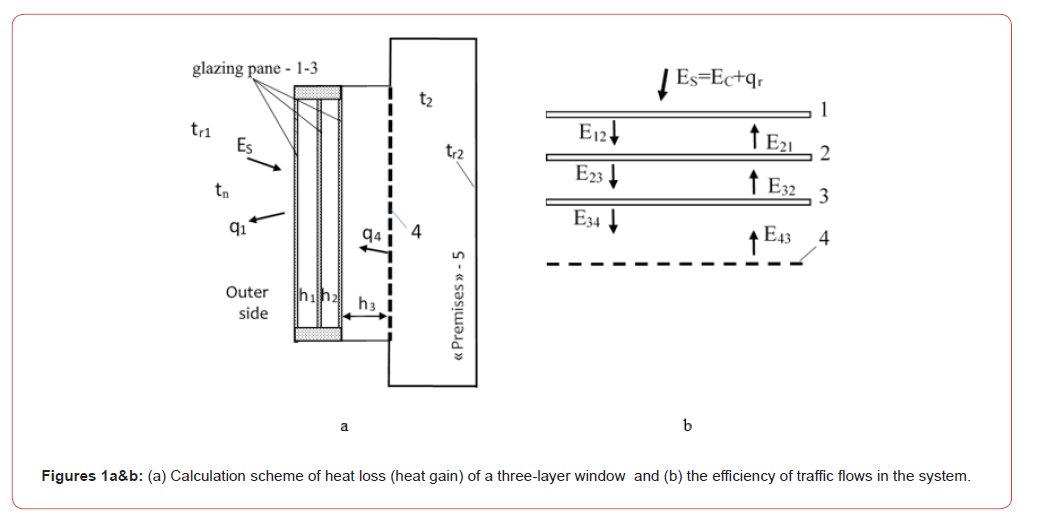
Let tn denote the outdoor air temperature, t2. tr2 the temperatures of the room air and walls (temperatures with small letter t are in o С, with capital T in K),αp (εp ) are the wall absorption and emission coefficients. Figure. 1b shows the scheme for determining the effective radiation fluxes in the system. The mathematical model is based on the assumption that temperature gradients within the glazing panes are small, i.e., their mean (mass-averaged) temperatures are used, so the problem re-duces to equations for changes of the panes’ enthalpies over an elementary time step Δτ . As in the finite difference method [16], it is assumed that heat exchange during a small-time interval Δτ occurs at constant element temperature and changes abruptly at the end of the interval Δτ . The model also includes equations that describe notable (order-of-magnitude) changes in the glass absorption coefficient β in the wavelength region up to 2.7 μm and beyond. For ordinary window glass, in the shorter-wavelength range (index “v”), βv≈0.6 , (1/сm), while in the longer-wavelength thermal range (index “n”), βn ≈6 , (1/cm) [17].
For example, for glazing pane 1 the enthalpy at time step j+1,
 , equals
where  is the enthalpy of glass 1 at time j, and dQ1 is the
enthalpy change over Δt , equal to
is the enthalpy of glass 1 at time j, and dQ1 is the
enthalpy change over Δt , equal to

Where αv,αn are the glass absorption capabilities in the first and second spectral ranges (and correspondingly their emission capabilities εv =αv,εv=αp; qk1, qk12 – are convective losses of the pane;

“black” emission at the temperature of pane 1; q1n ( q1n = bn∗q1 ) − portions of radiation fluxes incident on pane 1: incident, effective and self-emitted in the first (coefficients cv,bv) and second (cn,bn) ranges. Coefficients c and b characterize the fractions of the radiation flux in those ranges and equal, for solar radiation, cv=0.97, cn=0.03, while for thermal radiation bv=0, bn=1. Convective losses of pane 1 to the outside and inward toward the interspace are


Convective heat transfer coefficients, except for interspaces, are determined for natural convection using formulas for a vertical plate, and for forced convection using formulas for flow past a flat surface with air speed w [18-20]. Convective heat transfer within the interlayer between panes is determined by a conduction-type mechanism [18,21]. To determine effective radiative fluxes in a three-layer window including the fictitious plane, we generally have the system of equations [22]






where  are self-emission fluxes of the elements;
K1 ÷ K3 , r1 ÷ r3 are the total normal (angle of incidence not accounted
for) transmission and reflection coefficients of panes 1-3-equal to
the ratios of transmitted or reflected radiation by the pane to the incident
radiation (for glass they are set by refractive index or normal
reflection coefficient of a surface ρ0
, absorption coefficients β and
thickness h). Coefficients K, r and α (ε ) for comparative evaluation
of heat losses (gains) are determined approximately-taking into account
three internal reflections at the pane surfaces for the case of
normal incidence. For glass panes, expressions (5)–(10) are written
separately for the first and second wavelength ranges. The system
(5)–(10) is coupled (at time j the temperatures of all system elements
and incident fluxes are known) and was solved by the Gauss
method. It should be noted that for low-emissivity glasses analogous
equations should be written for at least three ranges: visible
(up to 0.78 μm), thermal (0.78-2.7 μm) and thermal (2.7–25 μm).
Effective radiative characteristics of the fictitious plane (indices α∋
and ε∋
) are approximated as [23]
are self-emission fluxes of the elements;
K1 ÷ K3 , r1 ÷ r3 are the total normal (angle of incidence not accounted
for) transmission and reflection coefficients of panes 1-3-equal to
the ratios of transmitted or reflected radiation by the pane to the incident
radiation (for glass they are set by refractive index or normal
reflection coefficient of a surface ρ0
, absorption coefficients β and
thickness h). Coefficients K, r and α (ε ) for comparative evaluation
of heat losses (gains) are determined approximately-taking into account
three internal reflections at the pane surfaces for the case of
normal incidence. For glass panes, expressions (5)–(10) are written
separately for the first and second wavelength ranges. The system
(5)–(10) is coupled (at time j the temperatures of all system elements
and incident fluxes are known) and was solved by the Gauss
method. It should be noted that for low-emissivity glasses analogous
equations should be written for at least three ranges: visible
(up to 0.78 μm), thermal (0.78-2.7 μm) and thermal (2.7–25 μm).
Effective radiative characteristics of the fictitious plane (indices α∋
and ε∋
) are approximated as [23]

Where Θ = F/Fc is the ratio of window area F to the area of room walls Fc. The temporal variability of the solar flux Ес incident on the window was modeled as

where E0 is the normal solar irradiance at noon (it remains fairly constant through most of the day [24]), and i is the angle of incidence of solar rays on the window, which depends on latitude, season and the window orientation. Daily variation of outdoor air temperature tn for comparative assessment of heat losses (gains), accounting for its asymmetry, was approximately modeled by two periodic functions with temperature minimum tmin at 4.00 and maximum tmax at 16.00 [25]. The model separately accounts for convective and radiative flows. Based on this model a program written in Delphi was developed to compute temperatures and resultant heat fluxes through single-, double- and triple-glazed windows. The total resultant heat fluxes were determined in two sections-at the window outer face (qres1) and at the room side (qres2), i.e.,
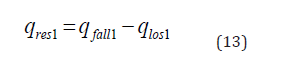
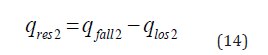
where qfall1, qfall2 are the fluxes incident on the window and from the window onto the fictitious plane, qlos1, qlos2 are heat losses of the window to the outside and from room to window, including respective differential fluxes by convection qk, radiation qiz and transmission qtr. Fluxes at the second section allow accounting not only for the thermal inertia of the system but serve as a consistency check of the program-in steady state these resultant fluxes should be equal. Checks for the steady case showed discrepancies not exceeding 0.1%.
Results and Discussion
Studies of thermal losses (gains) for south-facing single-, double- and triple-glazed windows were carried out for winter conditions (solar declination δ =-23.5, tmax=-10, tmin=-20, sky temperature tr1=0, ground tz=-10, resulting effective temperature -4.9) for clear and overcast days (E0=700,0 W/m²) with and without wind (w = 0, 5 m/s). Glass parameters: thickness 4 mm, β1 = 0.6 and β2 = 6, single-face reflectance across the spectrum ρ0= 0.04 so that the full fractions of incident radiation-reflection, absorption and transmission- were: rv=0.068 and rn=0.043, av=0.2115 and an=0.8761, transmissions Kv=0.7257 and Kn=0.0836. Indoor air and wall temperatures t2 and tr2 were taken constant at 200С,α =ε = 0.5 , Θ =F / Fπ = 1 (i.e., window area equals a reference fraction of wall area). Inter-pane spacing was 1.5 cm. Figure 2 shows the change of resultant fluxes qres (qres>0 means heat gains into the window, qres<0 means heat losses through the window) for single-, double- and triple-glazed windows during two days for E0=700 in calm conditions (w=0). As seen in Figure 2, resultant fluxes and their differential components-convection, radiation and transmission-depend not only on the number of panes but also strongly on external parameters. Moreover, even in winter on sunny day resultant fluxes are positive for a single-glazed window. In general, steady state in windows establishes fairly quickly even for a triple-glazed window (qres2, Figure. 2c). With increasing number of panes, the resultant daytime flux slightly increases.
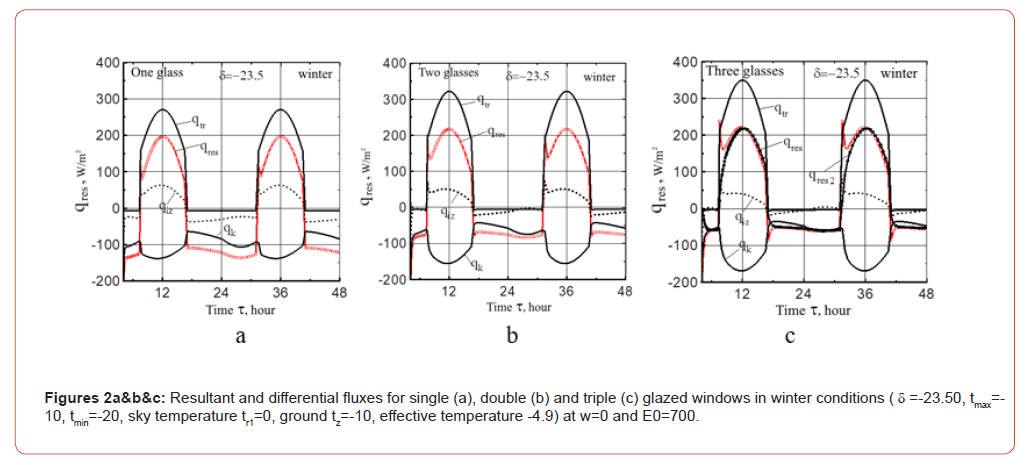
At night the largest heat losses, as expected, occur for the single- glazed window. Figure. 3a shows resultant fluxes of single- and triple-glazed windows relative to the double-glazed window, and Figure. 3b shows temperatures of the outer panes of these windows.
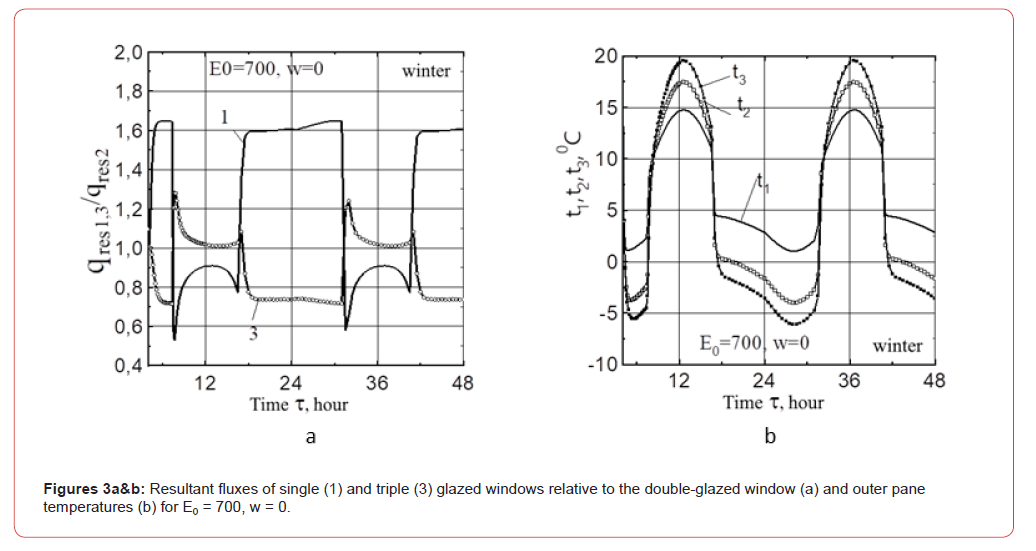
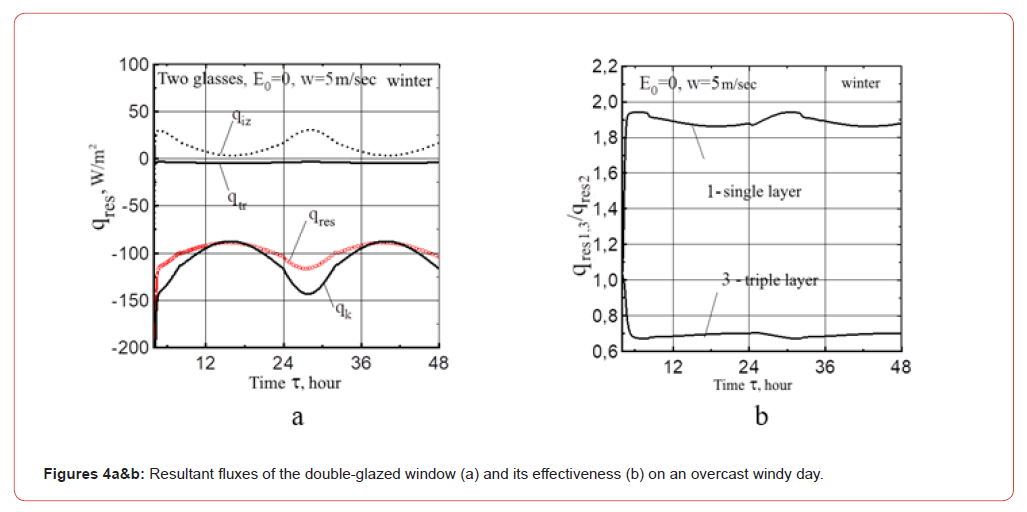
It can be seen that in this case (w=0) the presence of a second pane reduces losses by about 60%, and adding a third pane further reduces losses by about 24%. From Figure 3b the outer pane temperature of the single-glazed window at night is always higher than that of the double- and triple-glazed windows. Moreover, for the triple-glazed window the outer pane temperature may become even lower than the effective radiation temperature of the sky and ground, so qiz (see Figure 2c) may become positive. Figures 4a and 4b show thermal losses of the double-glazed window on an overcast day with w=5 m/s. Here resultant fluxes (losses) are larger (more negative) than in Fig. 2b, but because the outer pane temperature drops significantly, the differential radiative flux qiz becomes noticeably positive. That is, simple summation of convective and radiative coefficients is not always possible and one must account for the signs of the individual fluxes. Also note that here the influence of the number of panes is greater than in the windless day. Thus, the second pane reduces losses of a single pane by almost 90%, and the addition of a third pane reduces losses by a further ≈30%. Investigation of other cases (sun and wind; no sun and no wind) showed that generally the effectiveness of the second and third panes is similar, allowing use of these results under other external parameter sets.
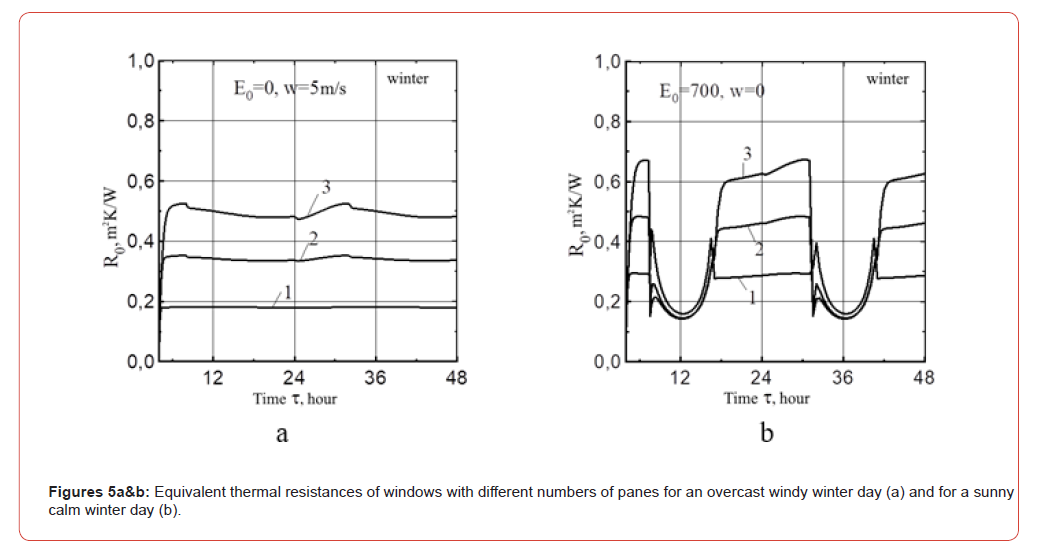
Knowledge of the resultant fluxes also permits evaluation of actual values of equivalent thermal resistance R₀ for single-, doubleand triple-glazed windows. From the general definition of R₀ [18] it follows that

Values of R₀ for two characteristic cases are shown in Figure 5.
The obtained R₀ values (Figure 5a) for a winter overcast day with wind, when resultant fluxes are negative (window loses heat), generally agree with their normative values [11]. It should also be noted (Figure 5b) that on a sunny, windless winter day resultant fluxes can be positive (see Figure 3b) and R₀ becomes very small and practically independent of the number of panes. That is, standardized R₀ values reflect specific climatic conditions and requirements for indoor air temperatures. Their variation with external parameters is secondary; in practice the more informative quantities are the resultant heat fluxes, which in the first approximation determine the heating power required to compensate heat losses through transparent enclosures. It is also worth noting that R₀ weakly depends on outdoor air temperature changes in winter.
Conclusion
• One-dimensional transient thermal models and computational
programs have been developed to calculate thermal losses of
single-, double- and triple-glazed windows, taking into account
variations of outdoor air temperature and solar radiation. The
model and programs allow determination of glass temperatures
and the influence on thermal losses of glass thickness
and absorption coefficients, indoor air and wall temperatures,
and-in a first approximation-the effect of the window-to-room
area ratio.
• A comparative investigation of winter thermal losses for single-,
double-and triple-glazed windows was carried out. It
was found that a double-glazed window reduces losses of a
single-glazed window by almost 80-90%, and adding a third
pane to a double-glazed window reduces losses by 25-30%.
Evaluation of the windows’ equivalent resistances R₀ showed
that they are comparable to normative values. The model and
program permit analysis of the structure of heat losses-convection,
radiation and transmission.
Acknowledgment
The work was carried out within the framework of state fundamental research of the Scientific and Technical Center with a design bureau and pilot production of the Academy of Sciences of the Republic of Uzbekistan.
References
- (2012) Global Energy Assessment. Towards a Sustainable Future. IIASA Austria.
- IN Doroshin, M Dragic LV (2022) Features of energy efficiency and foreign experience in the application of energy-efficient facade systems in housing construction. Engineering Bulletin of the Don PP. 6.
- AA Verkhovsky, II Nanasov, EV Elizarova (2012) Energy efficiency of translucent enclosing structures. Housing construction 6: 60-63.
- Pchelintseva SI (2010) Tikhomirnov. Energy saving problems in Russia. Modern requirements for window and facade glazing systems of buildings. Construction sciences 3: 445-449.
- TA Akhmyarov, AV Spiridonov, IL Shubin (2015) New generation of energy-efficient ventilated translucent and façade structures with active heat flow recovery. Housing construction 1: 18-23.
- OI Matveeva, LS Savvinov (2013) Experience of operation of energy-efficient windows of residential and public buildings in the climatic conditions of Yakutia. Housing construction 6: 44-49.
- VM Zakharov, EG Avdyunin, NN Smirnov, AA Yablokov, DA Lapateev (2016) Development, software implementation and verification of the adequacy of a mathematical model of the heat transfer process through a window with heat-reflecting screens. Vestnik IGEU 3: 3-26.
- VV Ivanov, LV Karaseva, AN Butenko, SA Tikhomirov (2009) Heat Transfer in Translu-cent Structures. News of Universities. North Caucasus Region. Technical Sciences 1: 93-94.
- AA Smykov (2017) Features of Radiation Heat Losses through Translucent Enclosing Structures. NGASU Publishing House PP. 11.
- IA Klykov, PV Stratiy (2018) Laboratory Tests to Determine the Heat Transfer Resistance of a Vacuum Glazing Unit Sample. System Technologies 26: 162-168.
- (2004) Design of thermal protection of buildings. PP. 139.
- Bülow-Hübe H, Fönsterluckor, Skodder M (2010) Window Shutters. 3rd Nordic Passive House Con-ference on Sustainable Building. Aalborg University PP. 121-124.
- Ismanzhanov AI, Klichev SI, Rasakhodzhaev BS, Ermekova ZK (2018) Transmission of solar radiation by semicylindrical and segmented transparent protections. Appl Sol Energy 54(6): 437- 443.
- OD Samarin, PV Vinsky (2013) Heat Transfer Features in Modern Energy-Efficient Glazing. Housing Construction 10: 11-13.
- NN Smirnov, VK Pyzhov, VM Zakharov, EG Avdyunin, DA Lapateev (2016) Using Windows with Adjustable Heat-Transfer Resistance to Improve the Energy Efficiency of Indoor Dynamic Microclimate Systems. Bulletin of ISU 6: 26-42.
- AI Leontiev (1979) Heat and Mass Transfer Theory. Moscow, Higher School PP. 495.
- LN Latyev, VA Petrov, VA Chekhovsky (1974) Radiative Properties of Solid Materials. Energia 9(7): 470.
- MA Mikheyev, IM Mikheeva (1973) Fundamentals of Heat Transfer. Moscow: Energia PP. 319.
- Heat Power Engineering and Thermal Engineering, General Issues, Book 1, Handbook edited by VA Grigoriev, VM Zorin, Moscow: Energoizdat PP. 455.
- BS Rasakhodzhaev, LN Danilevskii, NK Kubatov, Zh Zh Shoimov, Ch A Adylov, et al. (2025) Study of Technical and Economic Indica-tors of Autonomous Energy Complexes using Renewable Energy Sources for Heat and Elec-tricity Supply to Greenhouses. Applied Solar Energy 60: 860-867.
- Savin VK (2007) Construction Physics: Energy Transfer, Energy Efficiency, Energy Saving. Mos-cow: Lazur PP. 432.
- Sparrow EM, Sess RD (1977) Radiative Heat Transfer. Energy PP. 294.
- Siegel R, Howell J (1975) Radiative Heat Transfer, Moscow: Mir PP. 934.
- Duffy J, Beckman WA (2024) Thermal Processes Using Solar Energy. Moscow PP. 420.
- Sh I Klychev, SA Bakhramov, MM Zahidov, IG Kenzhaev, Zh Zh Tursunbaev, et al. (2024) Heating Capacity of Single-Story Passive Solar Houses. Applied Solar Energy 60(5): 736-742.
-

This work is licensed under a Creative Commons Attribution-NonCommercial 4.0 International License.