

 Opinion
Agronomic Characteristics of the Indigenous Aromatic Sponge Gourd (Luffa cylindrica (L.) M. Roem.) Maintained by the E De Community in Đak Lak Province, Vietnam
Received Date:November 01, 20; Published Date:November 21, 2025
Abstract
The study aimed to evaluate the growth performance, yield, and fruit quality of the round-fruited aromatic sponge gourd landrace (commonly called “round luffa”) cultivated by the E De ethnic community in Đak Lak Province. The experiment assessing the agro-biological characteristics of the aromatic luffa genetic resource was arranged in a completely randomized design (CRD) with three replications during the Summer-Autumn crop of 2025. The results showed that the round-fruited aromatic luffa had a growth duration of 160 ± 5 days, a vine length of 6.8 m, and elliptical fruits measuring 26.8 cm in length and 12.0-14.0 cm in diameter, with a fruit weight of 220-250 g and a marketable yield rate of 98.5%.
Keywords:Round-fruited aromatic sponge gourd (round luffa); evaluation; agro-biological characteristics
Introduction
Aromatic sponge gourd (Luffa cylindrica (L.) M. Roem), belonging to the Cucurbitaceae family, is a widely cultivated and highly valued vegetable in Vietnam due to its nutritional properties. Beyond its use as a fresh vegetable, luffa fibres have attracted attention for their potential applications in developing filtration membranes for heavy metal removal, highlighting the species’ relevance as a raw material for food processing, pharmaceuticals, and novel biomaterials [1]. In recent years, systematic efforts to collect and conserve plant genetic resources have intensified in Vietnam. The Plant Re sources Centre (PRC) under the Vietnam Academy of Agricultural Sciences has played a leading role in collecting and maintaining crop germplasm, including luffa. By December 2024, a total of 1,024 luffa [2], accessions had been collected nationwide.
In the Central Highlands, 99 accessions of traditional crops have been documented from ethnic groups such as Ba Na, Co Ho, Dao, E De, Gia Rai, Gie Trieng, H’Mong, Kinh, Mạ, M’Nong, Ra Glai, Tay, and Xo Dang. Within the framework of a provincial-level project entitled “Conservation of Selected Indigenous Short-Duration Crop Genetic Resources (rice, waxy maize, bitter eggplant, and aromatic luffa) in Đak Lak Province,” implemented from December 2024, an additional 55 accessions were collected, including seven luffa accessions maintained by the E De and M’Nong communities. Traditionally, aromatic sponge gourd is recognized for its elongated, cylindrical fruits (25-30 cm long) with soft texture, pleasant aroma, and mild sweetness. However, field surveys conducted in 2024 across several districts of Đak Lak revealed that the E De people predominantly cultivate a round-fruited variety, locally referred to as “round luffa,” with fruits approximately 26.8 cm in length and 12-14 cm in diameter.
This landrace is generally grown on a small-scale in-home garden, along fences and pond edges, intercropped with maize, upland rice, coffee, or pepper, providing fresh vegetables for daily consumption. These practices indicate the significance of this landrace as a locally important vegetable with potential for sustainable, clean food production. Given the growing demand for diverse and high-quality vegetables, this study aims to evaluate the growth, development, yield, and fruit quality of the round-fruited aromatic luffa preserved and traditionally maintained by the E De community over generations. The findings are expected to contribute to the conservation and utilization of indigenous crop genetic resources in the Central Highlands of Vietnam.
Materials and Methods
Plant Material
The study used the round-fruited aromatic sponge gourd (Luffa cylindrica (L.) M. Roem) landrace maintained by the E DE ethnic community in Đak Lak Province.
Experimental Design and Methods
Experimental Design
The experiment was conducted during the Summer-Autumn cropping season of 2025 to evaluate the growth and development of the round-fruited aromatic sponge gourd. The trial was arranged in a completely randomized design (CRD) with three replications, each consisting of 10 plants. Plants were spaced 2.0 × 0.4 m (row × plant), with straw mulch applied on raised beds. The total experimental area was 450 m². Fertilization rates per hectare were as follows: 20 t of farmyard manure, 200 kg of lime, 120 kg of superphosphate, 60 kg of urea, 60 kg of KCl, and 300 kg of NPK 18:16:8. Basal application included the entire amount of lime, farmyard manure, superphosphate, 30 kg of urea, and 100 kg of NPK. Topdressing was applied in three splits using the remaining nitrogen, potassium, and NPK.
Observed Parameters and Measurements
The study focused on assessing the agro-biological characteristics, growth, yield, fruit quality, and resistance to pests and diseases of the round-fruited aromatic sponge gourd. Observed parameters included:
Growth traits: days to male flowering, days to female flowering,
days to harvest, growth duration, vine length.
Morphological traits: stem type and climbing habit; leaf
blade shape, leaf length, leaf width, and leaf colour; floral characteristics.
Fruit traits: number of fruits per plant, fruit length (cm),
fruit diameter (cm), fruit weight (g), number of marketable fruits
per plant.
Seed traits: seed length, width, thickness, and 100-seed
weight.
Fruit quality attributes: fruit shape, skin colour, fruit apex
shape, fruit basal shape, aroma, firmness, and sweetness.
Pest and disease incidence was monitored at 30, 60, 90, and 120 days after planting. Disease severity was assessed using standard scoring scales and infection rates for powdery mildew and downy mildew.
Data Analysis
All collected data were analysed statistically using Microsoft Excel 2010.
Results and Discussion
Growth Duration and Development of the Round-Fruited Aromatic sponge Gourd Landrace
The growth stages of the round-fruited aromatic sponge gourd were evaluated based on key phenological traits, including the timing of first female flowering, first fruit harvest, and overall harvest period [3]. The results indicated that the average duration from planting to the appearance of the first male flower was 70 days, while the time to the first female flower was 62 ± 3 days. The interval from planting to the first fruit harvest was 102 ± 3 days, and the total growth duration of this landrace was 160 ± 5 days. This growth period is longer than that of hybrid commercial varieties, such as Takal 07 (107 days) and F1-P500 from Phu Nong Seed Company (120 days) [4]. The extended growth duration may reflect an adaptive trait of this indigenous landrace to local ecological conditions and also indicates its potential for greater biomass accumulation and prolonged nutrient accumulation. Thus, the round-fruited aromatic sponge gourd exhibits a growth cycle that is 40-60 days longer than commercial varieties, consistent with its wild or less selectively bred nature. This characteristic suggests potential for use in breeding programs aimed at developing drought-tolerant or pest-resistant varieties (Table 1).
Stem and Leaf Characteristics
The stem of the round-fruited aromatic sponge gourd has an angular shape and develops tendrils for climbing. The average number of nodes per plant is 13.3 nodes, with an average internode length of 16.5 cm. The plant bears large, simple leaves that are dark green and arranged alternately [5]. The leaf blade is kidney-shaped. Average leaf dimensions are 21.5 cm in length and 24.2 cm in width. Each leaf has 5-7 lobes with shallow lobe separation, displaying a palmate pattern. The leaf margin is finely serrated, and the surface is covered with rough trichomes. The upper leaf surface is dark green with dense trichomes, while the lower surface is light green with sparse, rough trichomes. The petiole is green, averages 12.5 cm in length, and is covered with short white hairs. Each plant typically produces 30-35 leaves (Figure 1) (Table 2).

Table 1:Growth duration of the round-fruited aromatic sponge gourd landrace (Đak Lak, 2025).

Table 2:Selected leaf characteristics of the round-fruited aromatic sponge gourd landrace (Đak Lak, 2025).

Flower Characteristics
The flowers of the aromatic sponge gourd are bright yellow and unisexual, occurring on the same plant, with a large diameter, and are borne in the leaf axils. Male flowers are clustered, pubescent, lobed, with five pointed segments; the corolla consists of five separate petals with rounded tips. There are five stamens, and the flower stalk (peduncle) measures 19-25 cm in length [6]. Female flowers occur singly, with broad petals averaging 5 cm in length. Pollination is primarily carried out by insects, with the effective pollination period lasting approximately 9-10 hours (Figure 2).

Fruit and Seed Morphology
Fruit morphology: The round-fruited aromatic sponge gourd has a peduncle with a circular cross-section, without widening at the base. Peduncle length ranges from 10-15 cm, and detachment of the peduncle from the fruit is difficult. The fruit apex is rounded.
Morphological Characteristics of Fruit and Seeds
Fruit morphology: The round-fruited aromatic sponge gourd has a cylindrical peduncle with a circular cross-section, not expanded at the base, with a peduncle length of 10-15 cm. The peduncle is difficult to detach from the fruit, and the fruit apex is rounded (Table 3). The round-fruited aromatic sponge gourd has elliptical fruits with a dark green skin and prominent, well-defined sponge on the surface. The fruit apex is round, and the cross-section of the fruit is circular. The fruits measure 26.8 cm in length and 12-14 cm in diameter (width) [7].
Table 3:Selected fruit characteristics of the round-fruited aromatic sponge gourd landrace (Đak Lak, 2025).

Fruit morphology
The round-fruited aromatic sponge gourd has an elliptical shape, with a dark green fruit skin. The sponge on the fruit surface are prominent and well-defined. The fruit apex is rounded, and the cross-section is circular. Average fruit dimensions are 26.8 cm in length and 12-14 cm in diameter (Table 4) (Figure 3).

Seed Characteristics
Evaluation of seed morphology at the mature (dry) fruit stage of the round-fruited aromatic sponge gourd showed that the seeds are black, with a smooth surface and a distinct seed margin. Seed margin colour in this species is typically black, whereas in other genotypes it may appear yellowish-brown, grey, or black. The Detachment of seeds from the ovary is moderate. Seed dimensions are as follows: length 12-13 mm, width 8-9 mm, and average thickness 2.00 mm. Regarding the number of seeds per fruit, genotypes can be categorized into three groups: less than 200 seeds, 200- 300 seeds, and more than 300 seeds per fruit. The round-fruited aromatic sponge gourd produces 300-315 seeds per fruit [8]. The 100-seed weight of the evaluated genotypes ranges from 7.8-8.2 g, corresponding to the small-to-medium seed size category (Table 5).
Table 4:Selected leaf characteristics of the round-fruited aromatic sponge gourd landrace (Đak Lak, 2025).

Table 5:Seed characteristics of the round-fruited aromatic sponge gourd landrace (Đak Lak, 2025).

Fruit Quality of the Round-Fruited Aromatic Sponge Gourd Landrace
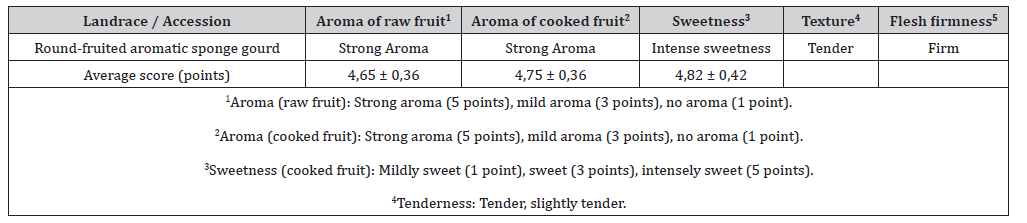
Consumers currently prefer young aromatic sponge gourd fruits that are uniformly slender, with bright green skin and smooth surfaces. Fruits with white, tender flesh, low fibre content, mild sweetness, and characteristic aroma are highly appreciated, especially for soups or stir-frying. With increasing attention to food safety, products with traceable origins, produced under VietGAP or organic standards, and free from pesticide residues are prioritized. Additionally, consumers consider freshness, short shelf life, and often select fruits of moderate size (200-250 g) for ease of preparation. In current consumption trends, small packaged fruits with traceability labels and cold storage are particularly favoured, especially in large urban areas. Sensory quality of the round-fruited aromatic sponge gourd was evaluated according to Vietnamese standard TCVN 3215-79. The assessment, conducted by a panel of evaluators, indicated that the fruits have attractive appearance and dark green colour, with a distinct aroma that spreads quickly and widely. The average aroma score after cooking was 4.65, while the overall aroma intensity after cooking scored 4.75. The fruit flesh was tender and sweet, with an average sensory score of 4.84 (Table 6).
Table 6:Selected fruit quality traits of the round-fruited aromatic sponge gourd (Đak Lak, 2025).
Aroma, Sweetness, Tenderness, and Flesh Firmness
Aroma: Aroma is a valuable trait of the round-fruited aromatic sponge gourd and is difficult to select for in breeding. Aroma is evaluated in two stages: before cooking and after cooking. Both stages are assessed on a three-level scale: strong aroma (5 points), mild aroma (3 points), and no aroma (1 point). The landrace was rated as having a strong aroma both before and after cooking, with an average score of 4.75 ± 0.36/ 5. Sweetness: The sweetness of cooked fruit is evaluated on three levels: mildly sweet (1 point), sweet (3 points), and intensely sweet (5 points). The round-fruited aromatic sponge gourd was rated as intensely sweet after cooking, with an average sensory score of 4.82 ± 0.42 / 5. Tenderness: Fruit tenderness is assessed on two levels: tender and slightly tender. The landrace was rated as tender. Flesh firmness: The fruit flesh of the round-fruited aromatic sponge gourd was rated as firm, indicating a dense and desirable texture for consumption [9].
Yield Components and Productivity
The round-fruited aromatic sponge gourd exhibits vigorous growth and strong branching, with slender vines measuring 5.5-6.8 m in length, slightly ribbed and sparsely hairy. Leaves are shallowly lobed with serrated margins; the abaxial surface is sparsely hairy, while the adaxial surface has denser hairs. Tendrils are simple, unbranched, and measure 17-19.5 cm in length. Flowers appear 65- 70 days after planting, are yellow, and occur singly in the leaf axils. Both male and female flowers have peduncles 13-15 cm long and flower diameters of 10.5-12 cm. Immature fruits are dark green and elliptical, turning light brown upon ripening. Fruits are harvested approximately 102 days after planting, with an average length of 26.8 cm, diameter of 12-14 cm, and fruit weight of 220-250g. The primary factors determining yield in aromatic sponge gourd are the number of fruits per plant and average fruit weight. Studying these yield components is essential for identifying appropriate agronomic practices that optimize growth and maximize productivity [10].
The number of fruits per plant depends on nutrient accumulation, environmental conditions, cultural practices, and fertilization regime, and it is closely correlated with total yield. The average fruit weight of the round-fruited aromatic sponge gourd landrace ranges from 220-250 g, and, together with the number of fruits per plant, directly determines total fruit yield (Table 7). Theoretical yield (tons/ha): The theoretical yield of the round-fruited aromatic gourd variety reaches 19.9 tons/ha, which is lower than that of several hybrid aromatic gourd varieties such as Takal 07 (28.7 tons/ ha) and F1-P500 of Phu Nong Seed Company (19.9 tons/ha). Actual yield (tons/ha): The actual yield of the round-fruited aromatic sponge gourd variety reaches 16.8 tons/ha, with a marketable fruit rate ranging from 85% to 90%.
Pest and Stress Tolerance
Aromatic sponge gourd belongs to the Cucurbitaceae family and is susceptible to common cucurbit diseases, including powdery mildew, anthracnose, vine wilt, downy mildew, and fruit rot. Common insect pests include caterpillars, leafhoppers, and aphids. Monitoring results indicated that the round fruited aromatic sponge gourd exhibits low susceptibility to severe pest and disease damage. Frequently observed pests, such as caterpillars, soft-bodied leafhoppers, and mealybugs, appeared sporadically and were effectively managed through manual control or routine monitoring. However, fruit fly infestation posed a significant threat during the young fruit stage, especially under drought conditions. Regarding disease incidence, the round-fruited aromatic spongegourd showed only mild infections of powdery and downy mildew [11]. These results suggest that this landrace possesses strong biological resistance and can be cultivated effectively without chemical pesticides, making it suitable for organic farming systems. Furthermore, the round-fruited aromatic sponge gourd demonstrates good adaptation to the hot, humid, and sunny climate of the Central Highlands. It is particularly well suited for rain-fed cultivation, with sowing recommended at the onset of the rainy season.
Table 7:Yield and Yield Components of the Round-Fruited Aromatic sponge Gourd (Đak Lak, 2025).

Conclusion
The results of this study indicate that the round-fruited aromatic sponge gourd is a valuable indigenous genetic resource with both biological and economic significance. This landrace exhibits a long growth cycle and strong adaptability to adverse conditions, including nutrient-poor soils, drought, and pest pressure. Its high natural resistance reduces dependence on chemical pesticides, thereby contributing to sustainable agricultural production and ensuring food safety standards. The fruits are characterized by an elliptical shape and are rich in essential vitamins and minerals, with nutrient levels exceeding those of many hybrids aromatic sponge gourd varieties. This highlights its considerable potential for sustainable agricultural and nutritional applications. The distinctive morphological, biological, and micronutrient traits of this landrace not only provide opportunities for the development of locally produced clean vegetables but also contribute to the diversification of genetic resources, enhancement of economic value for farmers, and support the conservation and sustainable utilization of local biodiversity.
Acknowledgment
The authors sincerely thank the Department of Science and Technology of Đak Lak Province for providing funding to conduct this research under the project titled: “Conservation of selected short-duration local crop genetic resources (rice, glutinous maize, bitter solanum, and aromatic sponge gourd) The task is led by the Plant Resources Center and was implemented from December 2024 to December 2025.”
Conflict of Interest
The authors declare no conflict of interest.
References
- Wierucka K, Hatten CER, Murphy D, Allcock JA, Anderson AA, et al. (2023) Human-wildlife interactions in urban Asia. Glob Eco & Conser 46: e02596
- Cao Z, Li Y, Zafar SU, Wang Y, Nie C, et al. (2024) An integrated historical study on human–tiger interactions in China. Integr Conser 3(3): 183-195.
- Hill CM (2021) Conflict Is Integral to Human-Wildlife Coexistence. Front in Conser Sci 2: 734314.
- Usman M, Farooq M, Wakeel A, Nawaz A, Cheema S, et al. (2020) Nanotechnology in agriculture: Current status, challenges and future opportunities. Sci of Tot Environ 721: 137778.
- Neme K, Nafady A, Uddin S, Tola YB (2021) Application of nanotechnology in agriculture, postharvest loss reduction and food processing: food security implication and challenges. Heli 7(12): e08539.
- Sharma V, Kaur G, Sreethu S, Chhabra V, Kashyap R (2025) Smart irrigation systems in agriculture: An overview. Comp & Electro in Agr 239: 111008.
- Koopler I, Malkison D (2018) Differential response of mammals to agricultural fences - The effects of species vagility and body size. Bas & App Eco 33: 79-88.
- Rejeb A, Abdollahi A, Rejeb K, Treiblmaier H (2022) Drones in agriculture: A review and bibliometric analysis. Comp & Electro in Agr 198: 107017.
- Kansky R, Riechers M, Fischer J (2025) Using causal loop diagrams to see the “big picture” and embrace complexity in human-wildlife coexistence governance. Bio Conser 308: 11119.
-

This work is licensed under a Creative Commons Attribution-NonCommercial 4.0 International License.