


 Research Article
Typical Agronomic Morphological Characteristics of the Tram Tau upland Taro Landrace in Yen Bai Province, Vietnam
Received Date:May 28, 2025; Published Date:June 23, 2025
Abstract
Tram Tau upland taro is the general name for indigenous taro from Tram Tau district, Yen Bai province. This variety has been granted a certification mark by the Intellectual Property Office and is recognized as a 3-star OCOP product of the district. To establish a basis for restoration, it is essential to describe the distinct morphological and agronomic characteristics of the variety. We cultivated and evaluated the variety assessment in Khau Ly village, Ban Mu commune, Tram Tau district, Yen Bai province. The plant exhibits a semi-erect growth habit, with no stolon’s and unbranched corms. The average plant height is 115cm, the maturity period ranges from 8 to 10 months. The leaves are green, thick, with spotless, and cup-shaped, and the predominantly semi-vertical orientation (tip pointing upwards).
The leaf lamina margin is undulated (broad waves), and the leaf margin color is lighter than the main leaf blade. The petiole attachment point is yellow. The outline of the sinus is broad and sharp-pointed (>450). The average leaf length is 45.5 cm, and the width is 37 cm. The predominant color of the longitudinal leaves is dark green. The margin of the petiole sheath is purple, no petiole sheath surface glaucous. The upper one-third of the petiole is dark purple; along the leaf light green stripes are present along the sheath, with observable color variation. The Tram Tau upland variety has an unbranched central corm and a round shape. The flesh color of the centre corm is white, the tuber tip is white, and the vascular fibres are yellow. The cormels weight range from 50 to 100 g, egg-shaped to round. The central corm weighs approximately 150-200g, and the yield ranges from 10 to 14 tons per hectare. These distinct morphological and agronomic traits are crucial for the conservation and restoration of variety.
Keywords:Agronomic; characteristic; morphological; Tram Tau upland taro landrace
Introduction
Taro belongs to the genus Colocasia, within the sub-family Colocasioideae of the monocotyledonous family Araneae. Because of a long history of vegetative propagation, the genus Colocasia’s taxonomy requires precise taxonomic classification. Cultivated taro is classified as Colocasia esculenta, but the species was considered polymorphic. There are at least two main botanical varieties recognized: i) Colocasia esculenta (L.) Schott var. esculenta; ii) Colocasia esculenta (L.) Schott var. ant quorum (Schott) Hubbard & Rehder, synonymous with C. esculenta var. globularia Engl. & Krause [1]. The dasheen type Colocasia esculenta (L) Schott var. esculen characterized by a prominent central corm (Cormels are often small and of poor quality); the eddoes type Colocasia esculenta (L.) Schott var. ant quorum primarily yields small high-quality Cormels (many small tubers, good quality, etc.), and the main tubers are often harvested but unsuitable for human consumption (because the main tubers are frequently stiff and itchy when eaten, etc.) but are mainly harvested to serve livestock feeding [2].
Tram Tau upland taro is the general name of varieties belonging to the indigenous taro group of Tram Tau district, Yen Bai province, which have been grown for a long time in Tram Tau district and are now being brought to some other districts such as Mu Cang Chaiwhere the weather conditions are similar to Tram Tau district. In Tram Tau district, products from these taro varieties are considered geographically distinctive local products, have been granted a certificate of goods by the Intellectual Property Office, and are certified as 3-star OCOP products of the district. Tram Tau upland taro varieties usually have medium to tall plants, egg-shaped or round tubers, thin tuber skin, white tuber flesh, soft, fragrant, rich in taste, and delicious. The planting season is usually around March every year, and the tuber harvest time is generally from the end of September to the end of November [3].
Previously, the cultivation of upland taro varieties was mainly to serve the needs of households and had limited commercial value, so the area was still fragmented and not concentrated; people planted in an uncoordinated and spontaneous manner, and there was no research on cultivation techniques, propagation methods, etc. The tubers used as seeds were often of poor quality and not guaranteed by local people because people usually relied on inferior Cormels that could not be traded, were of poor quality, and were inedible. This problem led to the appearance of individuals with poor growth and development in Tram Tau upland taro populations, with unfavourable genetic variations; some plants were morphologically deformed in the direction of changing the shape of the tubers from egg-shaped and round, long, the quality of the tubers was reduced, the Cormel-to-clump weight ratio was low, leading to a decrease in commercial tuber yield adversely impacting the economic efficiency of potato growers [4,5].
To establish a scientific basis for selecting and restoring varieties, in addition to investigating the indigenous knowledge of the Mong people in Tram Tau Yen Bai in cultivating and preserving this taro variety, it is essential to evaluate the additional agronomic and morphological traits of the variety, thereby introducing a description of the agronomic traits of the Tram Tau taro variety to serve the selection and restoration of this taro variety to maintain the good agronomic characteristics of the variety, improve the yield quality as well as the quality of the tubers of this native taro variety. Based on the above practical needs, we evaluated the agronomic morphological characteristics of the variety to serve the restoration of the Tram Tau upland taro variety.
Materials and Methods
Description of the Study Area
The study was conducted at Khau Ly village, Ban Mu commune, Tram Tau districts, Yen Bai province in Vietnam, latitude 21o26’52’’ N and longitude 104o26’0’’ E, with altitude 1300 m. Tram Tau has the unique characteristics of the Northwest climate: cool all year round, with average annual temperature from 22-230C [6].
Materials
All rhizomes of Tram Tau upland taro were checked for quantity and quality parameters. The average cormel weight was 20 g. Rotten and diseased rhizomes were removed; chosen cormel were healthy and disease-free rhizomes. We applied 1 ton of microbial fertilizer, 420 kg superphosphate and 420 kg lime powder/ha at planting time. Two months after planting, 150 kg urea and 100 kg potassium/ha were added, while 150 kg urea and 200 kg potassium/ ha added 4 months after planting [3].
Experimental Design and Management
Experimental layout: Taro roots planted spaced 0.7 m between rows, and 0.4 m of plants within a row were arranged, with a population of approximately 35,000 plants per hectare. cormel of the same size were used as material and planted on March 3, 2022. The taro was planted at Khau Ly village, Ban Mu commune, Tram Tau district, Yen Bai province, and farming relies on natural water sources.
Morphological data Collection
The descriptor guideline of taro (C. esculenta) was developed by PRC (2012) [7] and was followed for data collection. Two data sets (qualitative and quantitative) were collected to assess the diversity and find key morphological traits in taro accessions. Among the descriptors developed by La Tuan Nghia et al. (2014) [8] to characterize taro accessions, qualitative and quantitative characteristics were used. The selected traits were considered highly heritable and used for analysis. Both foliar and subterranean data were considered. Foliar traits were scored five months after planting, while subterranean characteristics were evaluated at harvest time. Most of the data were recorded on an individual plant basis using sample averages of five plants selected at random from two rows.
Qualitative Traits
Based on the characterization protocol for taro, build by Plant Resources Center (Vietnam). Each trait will have different levels of expression, observe with the eyes and determine the corresponding expression level of the trait.
Measured Quantitative Traits
Plant height was measured from the soil surface up to the base of the second youngest, fully formed, fully unfolded leaf on fully mature plants (cm). Leaf blade length and leaf blade width were measured from the base of the sinus to the top of the leaves and across widest parts of the leaves, respectively (cm). The petiole sheath length was measured from the soil surface up to the end of the opened sheath point (cm). “V” angle was used a protractor placed perpendicular to the petiole junction of the leaf so that the edge of the protractor was along the main vein at the sinus, align the right angle up to the main vein of the opposite sinus and determine the angle value (0). Depth of the sinus was measured from the base of the sinus to the point perpendicular to the line passing the top of the lobe leaves (cm). Distance between the main vein junction and base of the sinus was measured from base of the sinus to petiole junction on the upper side of the leaves (cm). Length of corms measured from tail to head and width of corms measured at thickness in the middle of the corm (cm). Number of Cormels were individual counted (count). Corm weight and cormels weight of clump were weighted corm and cormels of individual clump, respectively (g). Corm yield was measured by weighing the corms and cormels together (g). It was then converted into yield per hectare using the following formula: Yield per hectare in tonnes.

Results and Discussion
Natural Conditions of Tram Tau District and Tram Tau upland taro Production
Tram Tau district one central township (Tram Tau Town) and 11 communes including Ban Mu, Ban Cong, Hat Luu, Xa Ho, Tram Tau, Pa Hu, Pa Lau, Tuc Dan, Phinh Ho, Lang Nhi and Ta Si Lang communes. The district is home to 11 ethnic groups, with Mong people accounting for 79%, the Thai 13.11%, and the remaining population belonging to are other ethnic groups such as Kho Mu, Tay, Muong, Kinh... The people of these ethnic groups still preserve most of the unique traditional cultural features such as the New Rice Celebration, Going to the Field Festival, forging, rattan and bamboo weaving, linen spinning, weaving, brocade weaving, etc. Tram Tau district has a total natural land area of 74,670.59 hectares. The climate is characteristic of the Northwest highlands, cool all year round, with an average annual temperature ranging from 22 - 230C [6].
The total cultivated area of Tram Tau upland taro landrace in 05 years (2021-2025) in Tram Tau district was 3,001 hectares, with an output of 27,566 tons (not including 2025) and an average yield of 13.62 - 14.05 tons/ha. For a long time, the Tram Tau upland taro landrace has been the main taro variety in the taro variety structure of Tram Tau district and Yen Bai province, with the following annual area, yield, and output in Tram Tau district: In 2021: The area planted with Tram Tau upland taro was 200 hectares, the yield 14.0 tons/ha, the output 2,800 tons. In 2022, The area planted with Tram Tau upland taro was 401 hectares, the yield 14.05 tons/ha, and the output 5,633 tons. In 2023, The area planted with Tram Tau upland taro was 600 hectares, the yield 13.62 tons/ha, and the output 8,173 tons. In 2024, The area of Tram Tau Taro cultivation was 800 hectares, the yield 13.68 tons/ha, and the output 10,960 tons. 2025 Tram Tau Taro cultivation is 1,000 hectares [9-13].
Morphological characteristics of Tram Tau upland taro
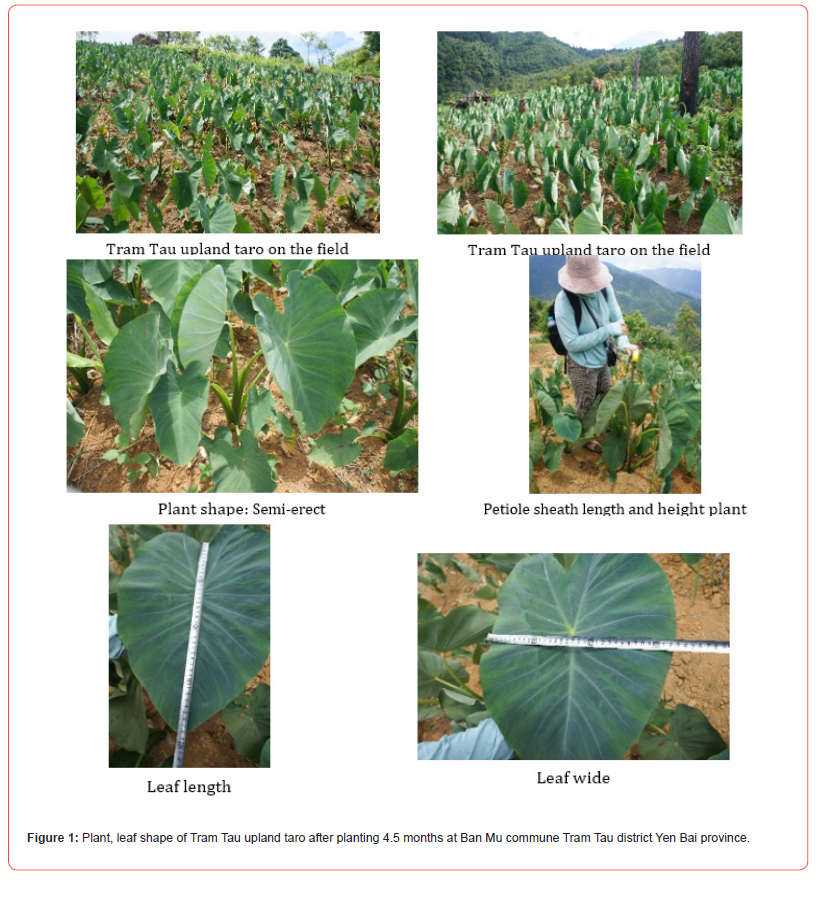
The agronomic traits of Tram Tau upland taro were evaluated according to the descriptor format for taro genetic resources and descriptor format for taro genetic resources in Tables 1-4. It includes i) growth habit; ii) leaf morphology, iii) petiole characteristics, and iv) tuber traits. For each group, the most distinctive traits are presented to facilitate differentiation through visual observation and standardized assessment. These typical traits of the Tram Tau upland taro variety will be advantageous in evaluating and selecting lines to restore the right original variety to improve the genetic resources for production. Growth behaviour: The Tram Tau upland taro belongs to the eddoes botanical type, with the tuber clump structure including a corm and many cormels growing from the corm (mother tuber). The growth behaviour of the plant is semi-straight (Figure 1) and does not form stolon, formation of branched tubers. The plant height is tall, fluctuating from 100cm to 130 cm; the average is 115 cm. The maturity period of the variety from planting to harvest is usually 8 to 10 months (Table 1).
Table 1:Growth habit of the Tram Tau upland taro (Ban Mu Commune, Tram Tau district, Yen Bai province 2022).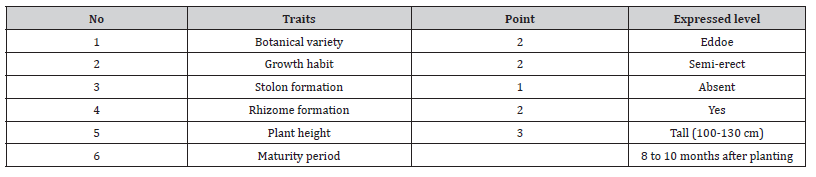
Leaf Morphology
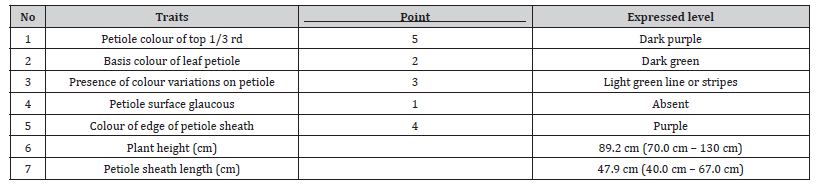
The leaf of the Tram Tau upland taro landrace has a green, thick, no spots on the leaves, the predominant shape of the lamina is cup-shaped, and the predominant orientation of the lamina is semi-vertical (tip pointing upwards). The leaf lamina margin is undulated (broad waves), and the leaf margin color is lighter than the leaf color. The petiole junction color is yellow. The color of veins on the upper and lower leaf surfaces is the same color as the lamina. The outline of the sinus is wide and sharp-pointed (>450). The average leaf length reaches 45.5 cm, varies from 39-58 cm, and the average leaf width is 37 cm, ranging from 30 to 50 cm (Table 2) (Figure 1). Petiole characteristics: The primary color of the petiole sheath is dark green. The color of the edge of petiole sheath is purple; there is no chalk on the leaf sill. The color along the upper 1/3 of the leaf is dark purple; along the leaf, there is a color change of light green stripes on the leaf sheath. Thus, the characteristics of the leaf sheath of the Taro variety are distinctive and taxonomically significant (Table 3).
Table 2:Leaf (lamina) characteristic of the Tram Tau upland taro (Ban Mu Commune, Tram Tau district, Yen Bai province 2022).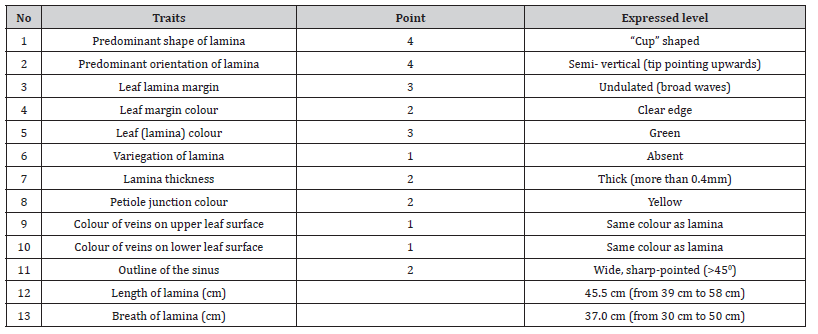
Table 3:Leaf petiole characteristic of the Tram Tau upland taro (Ban Mu Commune, Tram Tau district, Yen Bai province 2022).
Tuber Traits
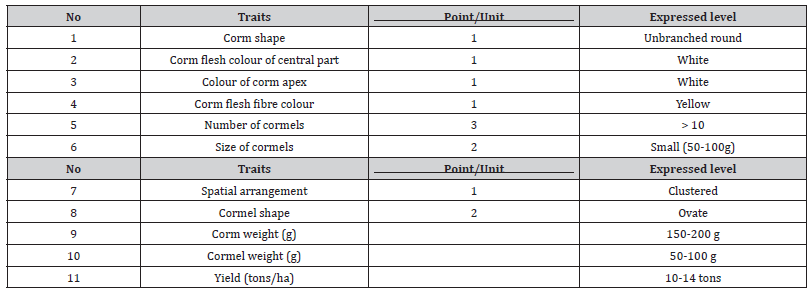
Taro generally has two types of tubers: the central corm (mother tuber) and cormels that grow from the mother tuber. The Tram Tau upland landrace has an unbranched, round-shape central corm. The flesh color of the tuber in the centre is white, the tuber tip is white, and the bulb fibres are yellow. The number of cormels is over 10, small size, from 50-100g. The cormel are arranged in clusters, egg-shaped to round. The weight of the corm reaches 150-200g; The weight of cormels is 50-100g, the yield ranges from 10-14 tons/ha (Table 4) (Figure 2). The agronomic traits of Tram Tau upland taro were evaluated based on the descriptor format for taro genetic resources and divided into four groups includes i) growth behaviour, ii) leaf characteristics, iii) leaf petiole characteristics, and iv) tuber characteristics. The Tram Tau upland taro variety has a botanical variety classified as eddoes type, with the tuber clump structure including a corm and many cormels growing from the corm (mother tuber). The growth behaviour of the plant is semi-straight, without stolon, and branched tubers.
The plant height is tall, averaging 115 cm. The maturity arranges from 8 to 10 months. The leaf was a green, thick, spotless, cupshaped, and the predominant orientation of the lamina is semi-vertical (tip pointing upwards). The leaf lamina margin is undulated (broad waves), and the leaf margin color is lighter than the leaf color. The petiole junction color is yellow. The outline of the sinus is wide and sharp-pointed (>450). The average leaf length reaches 45.5 cm, varies from 39-58 cm, and the average leaf width is 37 cm, ranging from 30 to 50 cm. The primary color of the longitudinal leaves is dark green. The color of the edge of the petiole sheath is purple; there is no chalk on the leaf sill. The color along the upper 1/3 of the leaf is dark purple; along the leaf, there is a color change of light green stripes on the leaf sheath. The Tram Tau upland variety has an unbranched corm, round-shape. The flesh color of the tuber in the centre is white, the tuber tip is white, and the bulb fibres are yellow. The caramel sizes were from 50-100g, egg-shaped to round. The weight of the corm reaches 150-200g and the yield ranges from 10-14 tons/ha.
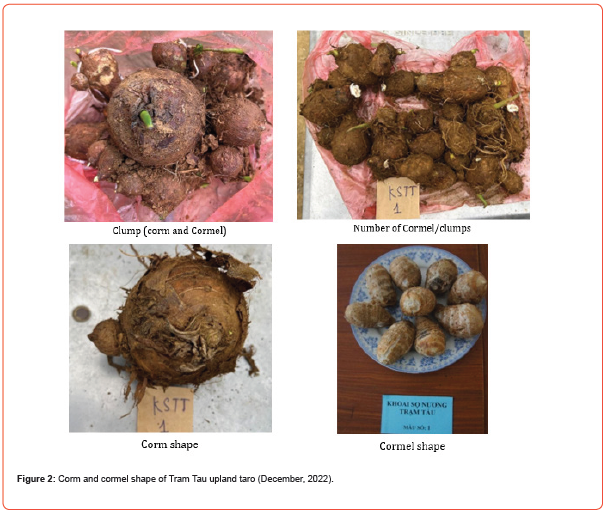
Table 4:Corm characteristic of the Tram Tau upland taro (Ban Mu Commune, Tram Tau district, Yen Bai province 2022).
Conclusion
The typical agronomic traits of Tram Tau upland taro were evaluated and divided into four groups, including i) growth behaviour, ii) leaf characteristics, iii) leaf petiole characteristics, and iv) tuber characteristics. The Tram Tau upland taro variety has a botanical variety, eddoes type, with the tuber clump structure including a corm and many cormels growing from the corm (mother tuber). The growth behaviour of the plant is semi-straight, with no stolon and branched tubers. The plant’s height is an average of 115 cm-the maturity period is 8 to 10 after planting. The leaf was green, thick, with no spots, and cup-shaped, and the predominant orientation of the lamina was semi-vertical (tip pointing upwards). The leaf lamina margin is undulated (broad waves), and the leaf margin color is lighter than the leaf color. The petiole junction color is yellow. The outline of the sinus is broad and sharp-pointed (>450). The average leaf length reaches 45.5 cm, and the leaf width is 37 cm.
The primary color of the longitudinal leaves is dark green. The color of the edge of the petiole sheath is purple; there is no chalk on the leaf sill. The color along the upper 1/3 of the leaf is dark purple; along the leaf, there is a color change of light green stripes on the leaf sheath. The Tram Tau upland landrace has an unbranched corm and a round shape. The flesh color of the tuber in the centre is white, the tuber tip is white, and the bulb fibres are yellow. The cormel size was from 50-100g, egg-shaped to round. The weight of the corm reaches 150-200g, and the yield ranges from 10-14 tons/ ha. These typical agronomic morphological characteristics of the Tram Tau upland taro landrace are necessary to serve the restoration variety.
Acknowledgement
This research was funded/supported by the project “Ecological Agriculture for Sustainable Landscapes to Reduce Poverty for Ethnic Minorities in the Northern Mountainous Region” of the International Organization for Agricultural and Forestry Research in Vietnam (CIFOR-ICRAF), project leader Dr. Nguyen Quang Tan, the implementation period is from 9/2021 to 8/2025 with funding from the Bread for the World Organization (BfdW), co-funding from the International Fund for Agricultural Development (IFAD), Danish Forest Extension Center (DFE).
Conflict of Interest
The authors affirm that they have no conflict of interest.
References
- Purseglove JW (1972) Tropical Crops. Monocotyledons. Longman, London, UK. PP. 52-54.
- FAO (1999) Taro cultivation in Asia and the Pacific. Food and Agriculture Organisation of the United Nations, Rome, Italy.
- The People's Committee of Tram Tau district (2022) Decision on the issuance of Technical Guidelines for growing Tram Tau upland taro variety with certification marks.
- Hoang Thi Nga, Le Van Tu, Nguyen Thi Ngoc Hue, Nguyen Quang Tin, Nguyen Quang Tan, et al. (2023) Traditional knowledge of H’Mong ethenic group for the use and conservation of taro genetic resources in Tram Tau district, Yen Bai province. Science and Technology Journal of Agriculture and Rural Development 4: 79-88.
- Thi Nga Hoang, Thi Hanh Duong, Van Tung Vu, Kim Chi Nguyen, Thi Hoa Nguyen, et al. (2023) Evaluating Taro Genetic Resources Collected from the Northern Provinces of Vietnam. International Journal of Agriculture and Biology (IJAB) 30(2): 100-106.
- Uỷ ban Nhân dân huyện Trạm Tấu (2022) Giới thiệu chung Trang thông tin điện tử của huyện Trạm Tấ
- PRC (2012) Characterization and evaluation for Taro. Plant Resources Center, Hanoi, Vietnam.
- Nghia LT, NTT Hue, PH Cuong, VD Toan, NT Hung, et al. (2014) Handbook for the Conservation of Agricultural Plant Genetic Resources. Agriculture Publishing House, Hanoi, Vietnam.
- Department of Agriculture and Rural Development of Tram Tau district (2021) Agricultural production results in 2021, orientation and tasks in 2022 of Tram Tau district.
- Department of Agriculture and Rural Development of Tram Tau district (2022) Agricultural production results in 2022, orientation and tasks in 2023 of Tram Tau district.
- Department of Agriculture and Rural Development of Tram Tau district (2023) Agricultural production results in 2023, orientation and tasks in 2024 of Tram Tau district.
- Department of Agriculture and Rural Development of Tram Tau district (2024) Agricultural production results in 2024, orientation and tasks in 2025 of Tram Tau district.
- People's Committee of Tram Tau district (2025) Report on the 5-year summary of the results of the implementation of Resolution No. 20-NQ/TU dated January 20, 2021 of the Yen Bai Provincial Party Committee on the development of the agricultural sector in the direction of improving quality, efficiency and added value associated with the construction of a sustainable new countryside in Yen Bai province, period 2021-2025.
-

This work is licensed under a Creative Commons Attribution-NonCommercial 4.0 International License.