

 Short Communication
Perceptions and Practices of Irish Potato Farmers on Mitigating the Impacts of Climate Change and Land Degradation in Kabale District, Southwestern Uganda
Received Date:August 14, 2025; Published Date:September 02, 2025
Abstract
Climate change and land degradation adversely impact crop productivity and impose a major constraint on farming planning. This is happening mostly under rain-fed conditions across developing countries. This study is on the assessment of farmers’ perception and practices on Irish potato growing towards mitigating the impacts of climate change and land degradation in Kabale district in southwestern Uganda. Primary data was obtained through field observations in farmers’ fields and the administration of checklists in Kabale district. It was observed that farmers’ practices, especially monoculture, steep slope cultivation, shifting cultivation, and destruction of terraces, as well as climate change factors like prolonged drought, have the potential for land degradation and climate stress effects such as increased crop disease and agricultural production decline. Farmers are seasonally faced with the problem of climate change through unpredictable weather events.
Keywords:Irish potato; cultivation; soil erosion; climate change; Uganda
Introduction
Environmental degradation is one of the most serious threats to sustainable development in Uganda, with adverse impacts on environment, crop health, food security, economic activities, natural resources, and physical infrastructure [1]. Tropical countries like Uganda are vulnerable to climate change impacts, particularly to changes in rainfall amounts and due to natural resource dependence. Uganda’s annual population growth is about 3.5% while the annual growth rate of food production is about 1.5%. This affects the accessibility to food, its availability and utilization systems [2]. Crop production tends to decline with rising temperatures, erratic and uncertain rainfall regimes. This situation is exacerbated by other factors such as soil erosion. This affects crop productivity in many highland areas of East Africa including the fragile highlands of Kigezi in Southwestern Uganda [3]. The study was conducted in Kabale district, in the Kigezi region which is one of the hilly areas that is found in Southwestern Uganda.
In terms of climate, the Kigezi region at large has temperatures which range between 19-23 degrees Celsius with humidity of about 80%, an altitude of approximately 410 kilometres above sea level and a total rainfall of 193.16mm with 255.7 rainy days per year [4]. The Kigezi region has a population density of about 300 per km2 [5]. It is one of the most densely populated areas in Uganda with 70% of the population engaged in subsistence farming. Apart from the Irish potato, the eight major crops grown in the Kigezi highlands over time include maize, beans, cabbage, sweet potatoes, sorghum peas, wheat and bananas [6]. Being a highland area, the Kigezi region is affected by soil erosion, majorly in the districts of Kabale, Kanungu, Kisoro, Rukungiri and Rukiga; and elsewhere in Uganda, the Mount Elgon region in Mbale and the Mount Rwenzori region [6]. In most of these areas, erosion is caused by water, but there are other districts, not highland areas, like Karamoja and Kaabong, where erosion is caused by wind. Cultivation by farmers is done on steep slopes which has resulted in soil erosion and land degradation.
When it rains the most fertile soil is washed away by moving water which reduces fertility. Recently, climate change has worsened the problem of heavy rains on bare soils during the planting season and prolonged droughts in the growing season [7]. Due to reduced crop yields because of the problem of land degradation compounded by climate change, farmers must consider solutions on how to reduce their problems. Therefore, there is a need to find out their perception of the problems they are facing, and the possible solutions on how these problems can be solved or mitigated. The Irish potato is one of the crops that can easily be grown by people in Kabale district in the sub counties of Kamuganguzi; Katuna Town Council; Southern and Northern Central Divisions, Buhara, Kitumba, Kyanamira, Kahungye, Maziba, Ryakarimira, Kaharo and Butanda. However, of these subcounties, 6 are the major producers of Irish potatoes, namely, Buhara, Ryakarimira, Katuna Town Council, Kitumba, Southern Division and Kaharo [8]. The goal of our study was to identify farmers’ perceptions and practices towards Irish potato growing in relation to the impact of climate changes and land degradation in Kabale district.
Material and Methods
Field Visits and Physical Observation
We visited the farmers’ fields to directly observe the different situations on the farmers’ fields, particularly the signs of land degradation and the strategies to manage it; as well as any observable effects of climate change and how the farmers were mitigating these effects. This helped us obtain clear information, especially after rainfall when we would observe the damage caused by the rains. We were able to make observations and recordings to get the generation of the problems that are currently being faced by the farmers and identifying the strategies that farmers were using to limit them.
Selection of Interviewee Farmers and Focus Groups Individual farmers
Sixteen Irish potato farmers were purposively selected from Kabale district for the administration of a checklist that we had drafted to collect the data. The selection began with contacting personally known farmers who then directed us to the other farmers we could visit.
Focus Group Discussions
We selected six farmer groups from Kabale district, one from each of the six sub counties, the major producers of Irish potatoes in the district. Each group had ten people to give us the answers for the questions we administered from the checklist. The selection criterion was purposive, targeting genuine Irish potato farmers in the area.
Interviewing Using a Checklist
We interviewed the selected farmers with a checklist consisting
of the following questions:
a) Question 1: According to your opinion, why do you like
growing Irish potatoes?
b) Question 2: Are you a large-scale farmer or small-scale
farmer?
c) Question 3: Which practices do you use in planting your
Irish potatoes?
d) Question 4: What do you think are the contributions of
Irish potato growing on environmental degradation and climate
change?
e) Question 5: As a farmer, which advice do you give us to
regulate the rate of environmental degradation and mitigate
climate changes?
Results and Discussion
Field Observations
Tyrosol, 3-hydroxytirosol, luteolin 7 glucoside, luteolin, oloeuropein, verbascoside, p-cumaric acid, vanillic acid, and squalene were purchased from Sigma-Aldrich Inc. (St. Louis, MO, USA).
We observed different things in the farmers’ fields including
several problems and the different coping strategies to manage
these problems:
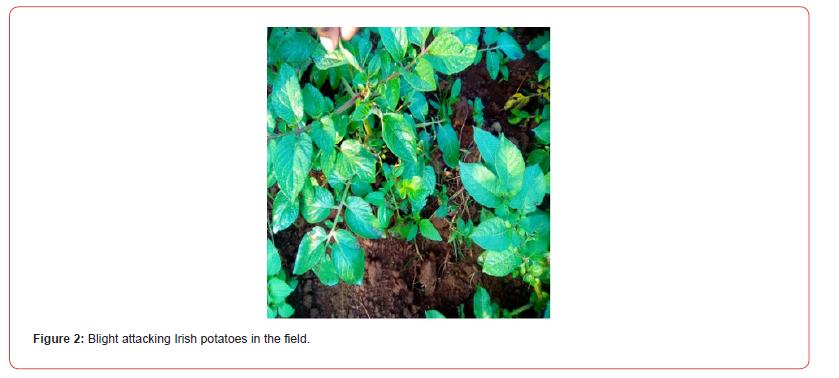
a) Different diseases like Irish potato blight and wilting
(Figure 2).
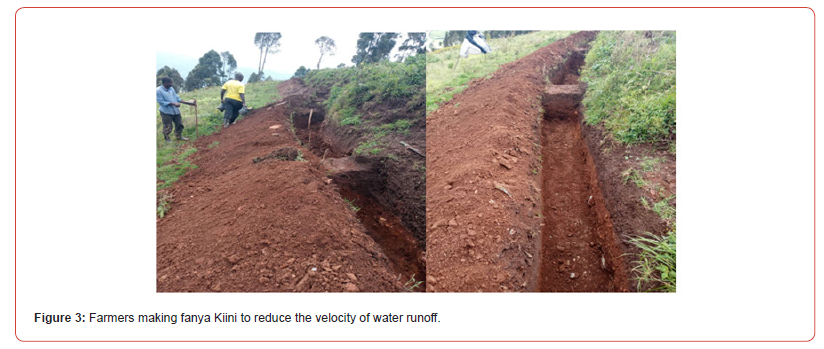
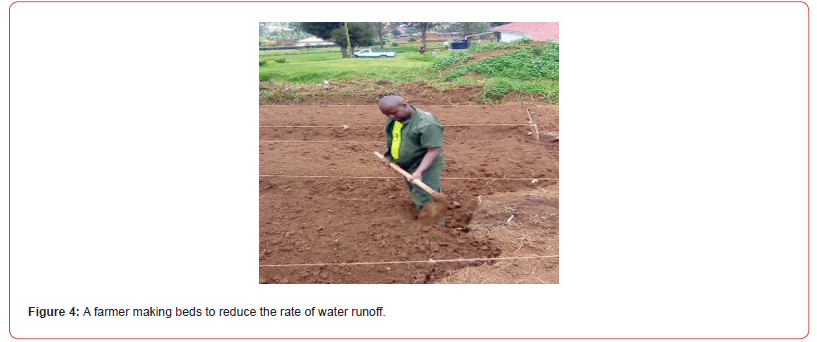
b) Running water created some gullies causing damage and
the farmers had implemented strategies such as constructing
fanya kyiini (Figure 3) and making raised beds for crop growing
with in the gardens to stop the velocity of running water within
the fields (Figure 4). Fanya kyiini is the making of trenches in
the soil to reduce the velocity of water runoff.
Results from Farmers Individual Farmers
Responses of the 16 farmers from the checklist interview are presented and discussed as follows, according to each question. Farmers were responding positively to the questions that we had drafted. Food security was the most common response from the farmers, who liked planting Irish potatoes for food security. Four responded that they grow them for income generation (Table 1). In addition, it is a particularly suitable crop considering that it has quick maturity which helps to efficiently maintain food security in the region. Kigezi being hilly, most of the area is occupied by volcanic soils which are fertile making most of the farmers adopt agriculture for food security [9].
Table 1:Responses of farmers to question 1: According to your opinion, why do you like growing Irish potatoes?
Question 2: Are you a large-scale farmer or small-scale farmer?
All the farmers interviewed were small scale farmers. This is
probably due to limited land since Kabale district has a relatively
high population. Kabale district is one of the most populated
districts in the Kigezi region with a high population growth rate
making land for agriculture very scarce hence farmers grow Irish
potatoes majorly for subsistence and a few surpluses for sale (Table
2). The highest response (9) on the practices the farmers use in Irish
potato cultivation was disease and pest control (mainly application
of fungicides) while the rest were focusing mainly on activities to
do with planting such as seed selection and tillage. Farmers focus
mostly on disease and pest control because most of the diseases
like wilt are very dangerous to the shoots as they can lead to the
total death of the plant before the establishment of tubers, and
this can lead to losses which discourages farmers from investment.
Potato is vulnerable to a wide range of pathogenic organisms, all of
which can cause severe quality and yield losses.
The susceptibility of crops to diseases is influenced by changes in temperature and moisture [10]. When under water stress the plants are most susceptible to disease attack. Consequently, potato production is highly reliant on pesticide use, and this has a negative effect on the sustainability of the crop production. To mitigate these problems, effective and evidence-based crop protection recommendations need to be provided to growers. By putting the control measures, farmers will maximize production and productivity hence encouraging investment among other people (Table 3). The major response (10) from the farmers was pollution from chemicals contaminating the air, water and soil, leading to various adverse effects on different organisms like humans and plants. This reduces the performance of these organisms and affects both soil chemical and physical properties. Pollution can make the air quality to be used by the living organisms very low due to accumulation of acids and toxins within the air. Even during application of the chemicals, the surrounding area gets polluted, also affecting the people themselves.
Table 2:Responses of farmers to question 3: Which practices do you use in planting your Irish potatoes?
Table 3:Responses of farmers to question 4: What do you think are the contributions of Irish potato growing on environmental degradation and climate change?

The soil is also polluted by the chemicals thus affecting the growth rate of crops [11]. Other farmers were focusing on the destruction of biodiversity through swamp reclamation. According to the National Environmental Management Authority, most of the swamps in Kabale are being cleared for agriculture and particularly Irish potato growing because the population has increased and there is more need for food to sustain the growing population. A few others mentioned soil erosion and exhaustion among other responses (Table 4). The highest responses of 5 were those concerning mulching, tree planting, minimum tillage, and application of organic manures to bind the soil particles together. Organic fertilization is mostly liked by farmers because of its potential to hold more water within the soil, binding the soil particles together, changing the soil colour to black helping it to attract more sunlight responsible for raising the soil temperature and so many others including the following; which are also enhanced by mulching and minimum tillage:
Table 4:Responses of farmers to question 5: As a farmer, which advice do you give us to regulate the rate of environmental degradation and mitigate climate change?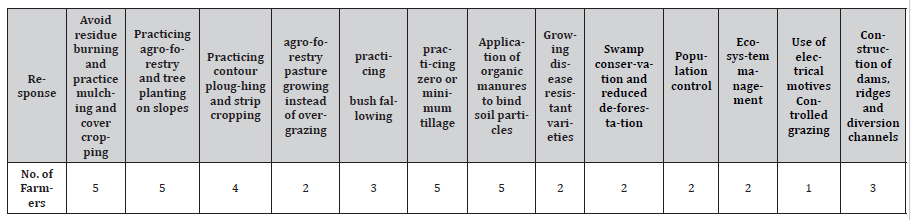
a) Soil Fertility and Productivity: Organic matter enhances
soil fertility by providing essential nutrients for plant growth.
It acts as a reservoir of nutrients, releasing them gradually as
needed by plants. Soils rich in organic matter support higher
crop yields and healthier vegetation.
b) Physical Properties of Soil: Organic matter improves
soil structure by binding soil particles into aggregates. These
aggregates create pore spaces, allowing water, air, and roots
to move freely. Good soil structure enhances water retention,
drainage, and aeration. Agroforestry and tree planting on the
slopes helps to hold the soil together thus reducing the rate of
soil erosion. The agroforestry trees provide other benefits such
as cattle feed, while other trees provide fuelwood and timber.
Focus Group Discussions
(Table 5) Most of the farmer groups grow Irish potatoes for food as evidenced by their majority response. Others mentioned disease control, that they have a curative effect on blood sugar and pressure control, and that they may improve digestive health as well as providing carbohydrates. They are also liked because they are quick maturing and are a source of income. According to Elong (2021), the demand for Irish potatoes is estimated to be over 850,000 Mt per annum with urban demand outpacing rural demand. With the increasing urbanization, changing eating habits by the majority youth and high population growth, chips consumption is set to rise by over 50% in the coming period offering the potato industry huge opportunities for enterprise development and economic growth. NAADS supports the Irish potato development interventions by distributing potato seed of improved varieties with preferred end user characteristics. It also supports farmers, small and medium enterprises to engage in organized production, marketing, and processing of Irish potatoes.
Table 5:Responses of farmers to question 1: According to your opinion, why do you like growing Irish potatoes?
This makes the best use of Irish potatoes being the source of food as all the farmer groups stated. It can also be used as a staple for some families due to quick maturity of three months hence making farmers easily supply their markets as well as getting food for their children. The high population in Kigezi region, Kabale district inclusive, has also led to the trader’s source Irish potatoes from eastern Uganda in order to supply to the increasing population and cater for the lives of the available population.
Question 2: Are you a large-scale farmer or small-scale farmer?
As applied to combined efforts in agriculture, farmers try
to merge the scattered plots of different farmers in form of
consolidation for a common goal of planting Irish potatoes. This
helps them to have enough land for cultivation of Irish potatoes.
This further facilitates in marketing of Irish potatoes to different
communities because they gain a high market search ability to
different communities in need of Irish potatoes since they can be
used to serve different purposes like food, value addition, feeding
animals, and more to that for export. In addition, when farmers
form groups, it is easy for the government to support them with
some funds and incentives in order to boost agriculture production.
This is also to increase agricultural exports as well as increasing the
growth and development of agro-based industries, especially those
involved in value addition like making chips (Table 6).

Farmer groups put much emphasis on disease control. Most of Irish potato diseases can spread from one crop to another, e. g. Irish potato blight and wilt. These diseases may cause serious losses to farmers if not controlled. This makes farmer groups invest in disease control measures like application of fungicides in the gardens in order to optimize production and support the growing population since Kabale district is highly populated with a total population of 593,160 people there is more need for food to support the population (Table 7)..
Table 7:Responses of farmers to question 4: What do you think are the contributions of Irish potato growing on environmental degradation and climate change?
Table 8:Responses of farmers to question 5: As a farmer, which advice do you give us to regulate the rate of environmental degradation and mitigate climate changes?

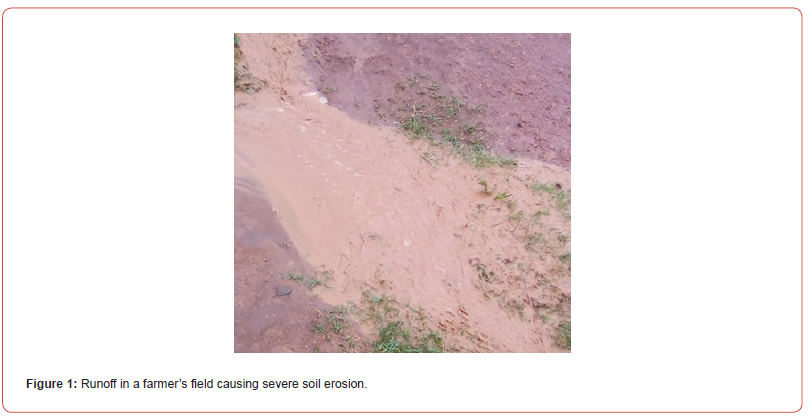
Farmer groups stated that environmentally, Irish potatoes are causing air pollution and soil erosion. This is because farmers do apply inorganic fertilizers and synthetic fungicides to protect crops against diseases which cause heavy losses due to premature death of the plants. Among the cultivation practices on how diseases in Irish potatoes can be controlled are seed selection, crop rotation and removing the debris of Irish potatoes from the gardens before planting. In addition, farmers in the groups say that growing Irish potatoes can lead to soil erosion due to continuous cultivation, land fragmentation and the steep slopes in the district [12]. The hilly nature makes the water attain a high velocity leading to landslides and soil erosion as it was shown in (Figure 1), where water was running rapidly downslope in the farmers’ fields (Table 8).
Most of the farmers’ responses from these groups were on the good farming practices to restore the soil for sustainable utilization. Due to the increased fertility rates in women, population is becoming very high creating pressure on land making the areas densely populated [13], in Kabale district. If Irish potato growing is to be more beneficial to farmers, they must adhere to good farming practices to reduce the incidence of disease outbreaks and protect the soil from getting exhausted in terms of nutrients, soil health and ecosystem resilience at large. By following these practices, farmers can achieve high economic returns out of their investments through using organic fertilization that has a high impact on the soil in terms of pH, water holding capacity, soil colour and other soil living organisms [14-16].
Discussion
a) Farmers are majorly producing Irish potatoes for food to
boost food security in their homes.
b) Seed selection is important in the practice of raising Irish
potatoes.
c) Practicing agroforestry will help to reduce the rate of soil
erosion and to boost nutrient recycling.
d) Farmers encourage the use of good agronomic practices to
reduce the rate of environmental degradation. These practices
include organic farming, seed selection, contour ploughing,
bush fallowing and several others as stated in the Table for the
Q5 responses.
e) Farmers’ collaboration through making of groups can
lead to large scale farming as was stated under responses from
groups on Q2; that all farmer groups can be on a large-scale
farming.
Recommendations
Based on our findings, we formulated recommendations on
what can be done to control the increased rate of environmental
degradation and to mitigate the effects of climate change:
a) Practicing mulching to conserve water in the soil and
increase the work of microorganisms.
b) Practicing crop rotation to conserve the soil structure
which helps to improve the water holding capacity of the soil.
c) Use of organic manures instead of inorganic fertilizers.
d) Practicing bush fallowing to facilitate the regaining of soil
fertility and water infiltration.
e) Addition of organic matter into the soil to facilitate the
work of living organisms within the soil
f) Punishing law breakers against the poor use of natural
resources like swamp reclamation.
g) Controlled bush burning to avoid too much accumulation
of smoke in the atmosphere which causes ozone depression.
h) Controlled grazing to avoid the cases of landslides and soil
erosion.
i) Construction of dams on rivers to limit the speed of water,
hence reducing flooding in the low-lying areas.
j) Construction of ridges and contours around the mountain
slopes which disrupt water movement and velocity making
water to attain a low speed that reduces the erosive action and
construction of diversion channels to limit the amount of water
moving in one direction.
Areas Recommended for Further Study [Knowledge Gaps]
a) The hindrances that stop farmers from participating in
market and research analysis.
b) The relationships between agronomic practices and
environmental changes.
c) What can be done to motivate small scale farmers to be
involved in large scale farming?
Acknowledgement
This work was made in the context of the Erasmus+ project 2023-1-SK01-KA171-HED-000147039, KEGA 002TU Z-4/2022 and Project VEGA 1/0575/25.
References
- Cooper R (2018) Current and projected impacts of renewable natural resources degradation on economic development in Uganda. K4D emerging issues report.
- Connolly-Boutin L, Smit B (2016) Climate change, food security, and livelihoods in sub-Saharan Africa. Regional Environmental Change 16: 385-399.
- Nammanda I (2019) Impact of Climate Variability and Change on Irish Potato Production in Kigezi Highlands of Uganda (Doctoral dissertation, Makerere University).
- Twagiramaria F, Tolo CU (2016) Kabale District Meteorological Department (2011) Temperatures and Rainfall for Stations in Kabale. Natural Resources 7: 1.
- (2021) Uganda Bureau of Statistics (UBOS) (2017) The National Population and Housing Census -Area Specific Profile Series.
- Zinyengere N, Theodory FT, Gebreyes M, Speranza CI (2017) Beyond agricultural impacts: Multiple Perspectives on Climate Change and Agriculture in Africa. Elsevier Academic Press.
- Muhereza R (2023) Kigezi turns to eastern Uganda for Irish potatoes amid scarcity. Daily Monitor.
- Elong CM (2021) National Agricultural Research Organization: Annual Report 2019-2020. Entebbe, Uganda.
- Wijesinha-Bettoni R, Mouillé B (2019) The contribution of potatoes to global food security, nutrition and healthy diets. American Journal of Potato Research 96: 139-149.
- Sharma R, Verma S (2019) Environment-pathogen interaction in plant diseases. Agricultural Reviews 40(3): 192-199.
- Ndungu J, Danga B, Henga S, Makumbi D (2023) Estimation of Combining Ability of Maize Inbred Lines for High Plant Density Tolerance in Medium Altitudes of Kenya. International Journal of Agriculture 8(2): 54-79.
- Kebirungi I (2014) An Evaluation of the Causes and Effects of Soil Erosion in Kabale District. A Case Study of Ikumba Sub-County (Doctoral dissertation, Kabale University).
- Bamwerinde W, Bashaasha B, Ssembajjwe W, Place F (2006) Determinants of land use in the densely populated Kigezi highlands of southwestern Uganda. International Association of Agricultural Economists Conference.
- Hussain A, Bashir H, Zafar SA, Rehman RS, Khalid MN, et al. (2023) The importance of soil organic matter (som) on soil productivity and plant growth. Biological and Agricultural Sciences Research Journal 2023(1): 11.
- Twagiramaria F, Tolo CU, Zinyengere N (2018) Adaptation to and coping strategies for climate change and variability by rural farmers in Kigezi Highlands, Uganda. In Beyond Agricultural Impacts. PP. 55-75.
- URN (2022) Kigezi: Drop in Irish potato production worries agriculture experts, farmers. The Independent Uganda.
-

This work is licensed under a Creative Commons Attribution-NonCommercial 4.0 International License.