

 Review Article
Cultivating Green Talents of Agricultural Extension Programs in Taiwan
Received Date:September 29, 2025; Published Date:October 06, 2025
Abstract
Agricultural extension faces great challenges. Recently, most of the food in the world is produced by aging smallholder farmers; this is also true and a serious issue faced by Taiwan government’s agricultural sector for the number of farmers whose age are over 65 has doubled in 20 years. Compared to the figures of the past decade, there was a decrease in the number of farmers under the age of 35 from 22.5% to 10.4%. To help cope with this issue and subsequently meet the challenges to re-engage the youth in agriculture, the role of agriculture extension is clear. Promoting youth to become continuously devoted to agriculture by facilitating young people’s vision of a bright future in agriculture and rural development requires a more integrated effort from Taiwan’s current agricultural extension system. Several initiatives are analysed in this paper, such as New Farmers Training Program which started in 2017, the Rural Young Program which was introduced in 2017, the New Generation of Agricultural Workers Training Program and Project Guidance for Young Farmers which originated in 2013, Rural Up Programs which were launched in 2011 and so on are coordinated by the Council of Agriculture (CAO), which was upgraded to the Ministry of Agriculture (MOA) in 2023.
The program’s goals aim to provide youngsters interested in farming and agriculture with various educational offerings for capacity building in farming and managing agribusiness successfully. Moreover, additional incubation systems are developed to cultivate agro-entrepreneurs to be capable of making a sustainable living in rural areas with the knowledge and insights linked to agriculture production. None of the achievements related to these initiatives has come easily. As far as the extension outcomes are concerned, there are workable solutions and better supportive environment, co-created by the youth themselves and are available to newcomers of young people or the followers who are also trying to earn a livelihood in agriculture in the rural areas. Some of the outputs and outcomes achieved further offer a sense of the changes in extension approaches in Taiwan. In addition to the publicly funded agricultural extension programs primarily delivered by civil servants, some advisory systems and nonformal education alternatives to public provision are explored.
The core of this paper also aims to identify key innovations concerning extension services. Along with governments’ efforts to cultivate green talents in agriculture, the new services help address challenges facing Taiwan’s current agricultural extension. These changes include the management of extension, decentralization and institutional pluralism, empowerment and participatory approaches, privatization and commercialization, and interconnecting farmers and rural people with various stakeholders locally and globally, and the use of appropriate information and communication media. It is worthy of attention that the change effects in extension services appear most promising to enhance the effectiveness of agricultural extension in Taiwan.
Keywords:Youth in agriculture; public agricultural extension system; agriculture and rural development; extension service; agricultural extension approach
The Problem of Aging in Agriculture in Taiwan
Farmers are aging across the world in both developed and developing countries [1], which is a universal problem critical to the sustainability of our future food systems. It is also one of the major challenges to the development of agro-food industry faced by Taiwan government while a rapid increase in proportion of aged 65 older farmers about 20% in 20 years, and more than 27% decrease in youth engaging in agriculture and farming in rural areas within the same period of time since 1990. According to the average age of farmers in Taiwan has been on the rise and reached 64.4 years old in 2020. In fact, the number of young farmers whose age are under 45 has reduced by more than half in 20 years [2]. The agriculture sector in Taiwan is mainly dominated by small-scale farmers who engage themselves and their family members as the principal workforce in farm production and management. Both the total of farm households and their family members also decrease from 16.88% to 9.24% and from 21.18% to 11.61% respectively, in 20 years.
Similar to some Asian countries such as Japan, Korea, and Thailand, etc., gradual aging and the rising number of the elderly have become the predominant human resource in Taiwan’s agriculture sector. It is mainly because the rural youth consider employment in agriculture or farming as a tedious job without economic or income attractions; thus, it fits the older people. In addition, the general negative perception towards agriculturalrelated work of people in Taiwan, specifically in rural areas exacerbates the problems. Under these circumstances, there is indeed a call for the policy intervention and demands extension efforts to leverage youth resources for agriculture. Many studies have addressed the generation problem of rural youth and factors concerning their turning away from farming and agriculture. The results often point out that there is a lack of farming competencies or insufficient skills for farming among rural youth. Moreover, there are factors such as the downgrading of farming and rural life, chronic government neglect of small-scale agriculture and rural infrastructure, and an increase in difficulties in access to land for the young people who want to become farmers [3-5].
All of the abovementioned facts also draw the attention of agricultural extension experts and policy makers. As agriculture remains essential to the economic growth and development of Taiwan, the development of resources focused on the involvement of youth in the agricultural sector is expected. On the other hand, the agricultural sector needs new ideas and innovations to mitigate the risks and combat emerging challenges from global climate changes, depleting natural resources, competition due to market liberalization, gender and cultural inclusion, and interplay of multifunctional agriculture. Furthermore, the policy of “New Agriculture” by COA since 2006 aims to facilitate a transformation and sustainable development of agriculture in Taiwan [6]. There is a demand for youth’s strength in terms of their innovative minds and energies to boost up the present status of agriculture and revitalize rural areas in Taiwan along with this strategic movement.
Extension Programs for Recruiting Youth in Agriculture
There is a need of more youth involvement to promote the new agriculture movement that leads to a series of extension efforts to attract as well as retain young people and provide them with opportunities to participate in agriculture. Mainly, the goals of agricultural and rural extension programs aim to effectively encourage the young generations to engage in transforming Taiwan’s agriculture with their willingness, creativity, and strength in adopting new technologies. The initiatives are taken at the national level of COA to offer easier access to resources and improved support for young people to become green talents of agricultural and rural development. Reshaping agriculture is emphasized to appeal to young people by making them see a wealth future both economically and socially in agriculture and changing their perception of farming as not only cultivators but the enterprise creators. Extension programs that prepare the youth to take part in agricultural production activities and become capable of starting rural micro-enterprises as agro-entrepreneur are now being recognized. Presently, two tracks of initiated extension services consisting of training programs for young farmers in Taiwan and rural up programs for Taiwan’s rural newcomers are identified.
Training Programs for Young Farmers for New Agriculture in Taiwan
Several capacity building programs for both rural youth and any youngster interested in farming or agricultural-related work have been developed as early as the establishment of the Farmers’ Academy in 2012. Both the New Generation of Agricultural Workers Training Program and Project Guidance for Young Farmers initiated in 2013 are considered the cornerstones of similar extension. In 2017, COA promoted the New Farmers Training Program. The program aims to solve numerous problems concerning agricultural human resources in Taiwan through a two-stage plan over a tenyear period. The specific objectives endeavour to foster diverse, interdisciplinary and outstanding young people in the agriculture sector so as to advance the value chain of new agriculture while sustaining innovative development. Until now, it remains MOA’s expectation that youth generations’ creativity and courage can become a pivotal driving force for accelerating positive changes in Taiwan’s agriculture.
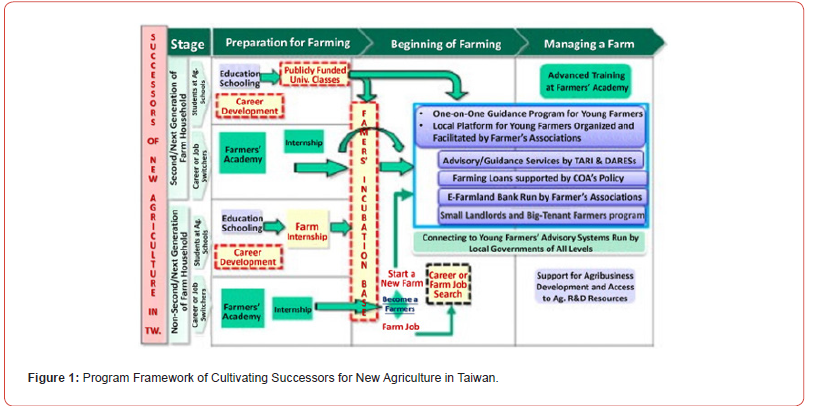
The tasks strive to build an environment that can attract young people to engage themselves in agriculture, and overcome barriers of farming or working in agriculture as a profession. The goal is to systematically train outstanding young people to develop their career in agriculture, encourage young farmer’s innovations and learn value-added activities related to agriculture, which eventually revitalize the agricultural and rural workforce. The program framework for supporting young people to succeed in farming or being engaged in agriculture and become the successors of new agriculture in Taiwan is illustrated in (Figure 1). The successor cultivation or cultivating green talents consists of agricultural extension programs developed from both the school and practical field sides, and various supports for newcomers of farmers are available at three stages: preparation for farming, at the beginning of farming and the stage of managing a farm.
Extension Programs Starting at the School Side
Starting in 2015, COA offers publicly funded agricultural classes at technical-oriented universities in addition to the existing agricultural colleges at comprehensive universities in Taiwan. Students are specifically recruited and prepared for entering agriculture as a farmer or employee in certain agriculturalrelated workplaces after graduation for at least four years. Since then, a total of 827 publicly funded college students in 24 classes have been supported by six schools up to the academic year of 2021, including the National Chiayi University, National Pingtung University of Science and Technology, Mingdao University, National Ilan University, National Taitung Junior College, and National Kaohsiung University of Science and Technology. Publicly funded students recruited from almost the second or next generation of farm households spend four years at school, similar to those studying at other colleges and universities. Upon graduation, these students receiving a bachelor’s degree in agriculture must have already learned certain vocational knowledge and practical skills to work in agriculture under the tailor-made curriculum designed for a professional farm practitioner or manager.
When these graduates from six publicly funded agricultural classes who are ready to go into actual farming with their families, they also have priority access to publicly supported resources from the agricultural sector of COA, such as qualification for purchasing farmland through the e-farmland bank run by farmers’ associations. They begin the process of applying for start-up loans and avail themselves of various extension and advisory/guidance services throughout their farming careers. As for students who are not from farm households but are studying in agriculturalrelated departments or programs and majors, etc., in order to increase their interests in agriculture, different farm internship opportunities, which are supported by COA to help them obtain certain practical experiences in farming and agribusiness activities as career development, are provided. Both the Farm Job Shadowing and Summer Vacation Part-Time Work implemented in 2014 belong to one kind of student internships.
These activities help students understand their career interests and the capabilities needed to anchor their future careers in agriculture. Agricultural enterprises are involved as a part of the Farm Job Shadowing to facilitate students’ reflection on their potential to meet or fit the requirements for value-added innovations of the industry. The Summer Vacation Part-Time Work offers youngsters a channel for exploring their career development in agriculture, consequently reducing their time needed to adapt to an agricultural work environment when getting into the field. As far as school students are concerned, COA’s successor cultivation program also coordinates with other youth development programs supported by the Ministry of Education and Ministry of Labor. By doing so, newcomers in agriculture can further apply for the educational and employment subsidies of NT$10000 per month for a maximum of three years. Besides, the farmer’s incubation bases established by COA in collaboration with the District Agricultural Research and Extension Stations (DARESs) and Taiwan Agricultural Research Institute (TARI), etc. are further available to the welleducated students when they start farming but more professional development is needed in terms of practical experiences.
Moreover, the program is linked links to Taiwan’s New Southbound Policy to recruit Chinese young people from 17 Southeast Asian partner countries to study for an academic degree or be part of an internship in agricultural related fields. A customized curriculum combining learning along with practice in the field has been designed for these classes, which aims to help agribusinesses to reduce recruitment costs and precisely train manpower on demand. When completed, these young people can either apply for an agricultural related job in Taiwan as an alternative supply of human resources or return to their home countries to act as representatives to help promote or diffuse Taiwan’s agricultural practice overseas. In the meantime, these students can help address the urgent need of the agricultural sectors or agribusinesses stationed oversea for talents specializing in farm technology management and technical operations.
Extension Programs Starting at the Practical Field Side
The Farmers’ Academy set up by COA in 2012 offers systematic training to newcomers of farming and farmers of all kinds through integrating extension resources from 14 DARESs, the TARI and Livestock Research Institute (LRI), the International Centre for Land Policy Studies and Training (ICLPST), etc. The academy’s goal is to train and cultivate outstanding agricultural talents by offering lifelong learning opportunities to the people with an intention to work in agriculture as well as become professional farmers who would like to pursue continuing education. All farmers’ trainings are carried out in 14 training centres run by DARESs, TARI, and LRI, etc. and planned by taking into consideration of the needs of agricultural industries and farmers, covering diversified subjects such as general knowledge about agricultural industry, production technology and technical skills, professional knowledge about the improvement of farm environment and risk controls, quality control and assurance, and farm operation and management, etc.
Recently, the farmer’s training is further developed upon the occupational competency standards (OCSs) promoted by the Ministry of Economic and Ministry of Labor. Additionally, field internship through hands-on training is offered wherein professional farmers are invited to teach and guide trainees, allowing them to personally participate in agricultural production and farm management practices and apply the knowledge they gained in class in real-field settings.
The systematic courses offered by Farmers’ Academy are
divided into four levels:
a) Introductory courses, a 3-day training, which provides
trainees who are interested in farming with an overview of
agricultural practices.
b) Beginner’s courses, a training of 10-20 days, which
includes practical training and teaches beginner farmers the
basics of production technologies.
c) Intermediate-level courses, a 3-day or 5-day training,
in which professional farmers are engaged in the concepts
and practical training of technology upgrades and quality
management.
d) Advanced-level courses, wherein agricultural leaders
or experts are invited to lecture participants on business
management and share their expertise and professional
experiences.
When young people or rural youth wish to engage in agriculture or return to farming for a career change, they are advised to first consider the training offered by Farmers’ Academy. As for those from the second or next generation of farm households, when completing the training and internship required of an official farmer, they are ready to join their family and get themselves involved in farming activities. Meanwhile, they are qualified for the access to publicly supported resources, such as the e-farmland bank, credit loans, and needed extension and advisory/guidance services throughout their farms as a farm successor. On the other hand, young people without farming family background are guided to make a decision whether to start a new farm of their own or look for a job in agriculture upon the completion of training and internship provided by Farmers’ Academy. In the case of becoming a new farmer and running their own farms, young beginner farmers are advised to take advantage of agricultural extension services. This not only includes the linkage to varied publicly supported resources, but also the access to advanced training as well as needed advisory and guidance that would be made available to them. Part of the program additionally makes a complete guide for young people seeking employment in agriculture.
The Advances in Existing Extension Services Included in the Program
It is evident that newcomers of farming are likely face the challenges related to lack of land, capital, facilities and equipment or tools, marketing know-how, and farm management skills, etc. after beginning to farm and when running a small-scale farm. Built upon the existing agricultural extension services, the program provides the new coming young farmers with the advanced support system to retain these well-educated and trained youth resources in agriculture. For instance, an initiative to offer individualized oneon- one guidance for the Top 100 Young Farmers was introduced in 2013. Every two years, 100 young farmers aged 18-45 are selected and offered a 2-year period one-on-one guidance or counselling. The integrated advisory resources from government, academia, and industry are made available to the selected young farmers by DARESs. The offerings include to further their capacity building through individualized personal training as needed.
Moreover, based on each individual’s farming progress, the needed assistance in acquiring farmlands and business capitals, submitting applications for facility and equipment subsidies, coping with legal regulation, providing product marketing design and so on are covered by this counselling services. The aim is to help outstanding young farmers establish, stabilize and expand their agribusinesses for collaboratively developing an innovative agroindustry in Taiwan while retaining them in agriculture. These young farmers may have peer effects on attracting and bringing in more young farmers to join, and participate in the development of new agriculture in Taiwan. Furthermore, in order to care for those young farmers who were not selected as Top 100 Young Farmers, farmers’ associations of all levels throughout the nation are coordinated to establish 16 networking and communication platforms to provide more support to local young farmers as newcomers in agriculture.
The objective of the platform is to create a positive environment where local young farmers can exchange ideas, cooperate with each other, form the strategic alliance of their own, and share agricultural practical experiences in production or marketing. Through this platform, young farmers can closely connect with each other as well as with the existing agricultural extension system as a team. Gradually, the platform acting as a local exchange network for young farmers can lead the way to greater organization, resource integration, and collective cooperation while developing a stronger sense of professional and social identity for young farmers. Farmers’ associations throughout the nation continue to play a key role in agricultural and rural extension system in Taiwan. To address young farmers’ problems of farmland acquisition, the E-Farmland Banks are managed by farmers’ associations in combination with the previous COA’s programs of Small Landlords and Big-Tenant Farmers that was initiated in 2009 and Adjusting Farming System and Activating Farmlands. The goal of E-Farmland Bank which offers information regarding farmlands and loans for running farming businesses is to help young farmers easily acquire or rent farmlands.
Rural Up Programs for Taiwan’s Rural Newcomers
Rural up programs take a different extension approach for capacity building to enable youth to firstly be active and gradually become engaged into rural agriculture as a way of life. Along with the legislation of Rural Rejuvenation introduced in 2010, the Rural Up programs were kicked off since 2011 by the Soil and Water Conservation Bureau (SWCB) of COA and further integrated as the Rural Young Programs of 2017. The program goals focus on involving young people to help solve the problems of rural communities from their own points of view and by taking advantage of their specialities with the support system to retain them in rural areas for a long time. In addition, the target audiences of Rural Up programs are college students from all kinds of background in terms of their families and academic areas. The program also aims to empower young people, particularly college students to become the agricultural successors to help develop new agriculture and revitalize the declining rural economy in Taiwan.
The initial move of participating in Rural Up programs is made by young people as a team, and the programs facilitate them to acquaint themselves with the rural communities by a short-stay experiences for seeing rural areas in Taiwan from their standpoints during the winter break. Next, a competition on solving the problems of rural communities is designed to call for college students’ participation also as a team during the summer break. Their summer mission is to try out their new ideas and come up with ways of coping with issues or problems faced by the rural communities through immersing themselves and living in the areas for at least one month. The actions and innovations of youth teams are facilitated with a specifically planned support and reward systems by Rural Up programs. Introduced in 2015, the Rural Up II attracts many young people with rural up competition experiences and stills show a great interest in continuously working in rural communities. Nevertheless, certain support remains necessary.
The youth once participating in Rural Up competition is qualified for applying for the program’s resources to support or prolong their innovations for continuously dealing with the problems or development obstacles faced by rural communities. In addition to the college students previously involved with the programs, there are still a lot of young people, rural youth and young farmers who are also fond of this problem-based and participatory approach adopted by the programs to get involved in agriculture and rural communities. The Rural Young is then proposed to extend its program scope by including more young people’s participation in agricultural related activities and solving the rural communities’ problems without the limit on the pervious experiences in Rural Up programs. The main focus of Rural Young lies in the use of rural or agricultural resources by young people to come up with unique value-added innovations that can eventually become beneficial to sustainable development in rural communities.
Specifically, the program emphasizes more on a successful business model and way of living in rural communities to be addressed in their actions developed and implemented by young people as the expected key results. The program outcomes clearly show there are a variety of micro-enterprises and social enterprises established by taking advantage of local agricultural and rural resources. Moreover, the program outputs have achieved a contribution to promote the economic growth and activation of social interactions as well as social exchanges between the rural and urban communities to some extents. The overall program framework is illustrated in Figure 2. First, the programs call for college youth’s attention and participation in having an experience in rural communities. When a rural stay plan is submitted by their team, young applicants need to specify their interests, intentions, expectations and experiential aims of interacting with the rural communities they choose to stay.
After the plan is selected, a field trip along with several workshops are provided to young people to help them see, explore, observe, think and reflect about the rural areas in Taiwan based on their viewpoints. As for the Rural Up competition, college students need to also organize a team consisting of at least 5 members to examine the development status quo and problems of one rural community and then come up with a proposal for problem solving. After the proposal is selected, all the teams need to attend the workshop in which they are provided a set of courses along with the field trips and hands-on practices to help them accomplish the action plan and for capacity building. During their stay in rural communities for one month, the action plan of innovative problemsolving is implemented with support of the needed resources and professional guidance from experts and practitioners. The final outputs and outcomes achieved by each team are also evaluated as well as shared among teams at the end of competition at the end of the year.
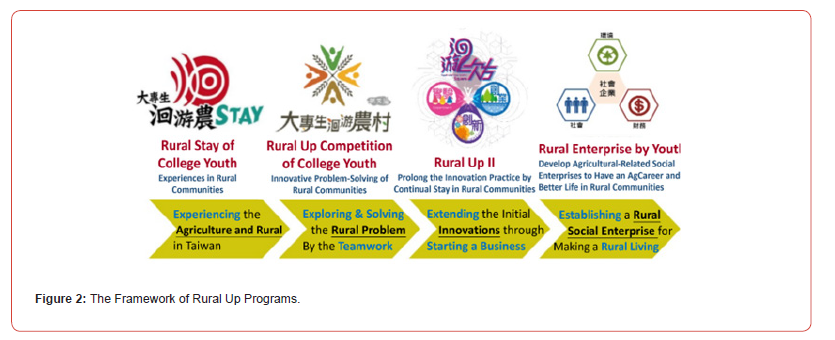
As for the programs of Rural Up II and creating rural enterprise of Rural Young, young people are required to be more realistic and specific about what the sustainable agribusiness models are and their effects in terms of economic, social and environmental values that can be created or added for rural communities along with the implementation of their innovations. During the process of carrying out their action plans, the support system including the various training for capacity building, exchange of experiences, ideas or supports among each other and multiple-stakeholders, and the needed resources and practical guidance, etc. is provided (Figure 2). The primary goal of Rural Up programs aims to attract university students and young people to propose creative or innovative ways to make a change in the agricultural industry or rural areas in Taiwan. It is the belief that agriculture needs human resources from different professional fields, in order to enhance the agricultural values of public identity.
Meanwhile, rural areas need interdisciplinary professionals to make a significant change in improving agricultural production, living quality, and ecology as a whole. The first three Rural Up programs annually attract about 80 interdisciplinary student teams across colleges and/or universities to take part in since 2011. Within few years, more than 60% of higher education institutions nationwide have their students enrolled and participated in this particular program. A total of about 4400 college students has participated in the programs linking to more than 160 rural communities in Taiwan. Nowadays, it keeps enabling university students to take advantage of different domains of knowledge and skills to work together with local communities in the field of rural areas. Through active participation, young people are provided with unique extension education that involves reflective observation of particular social or agricultural issues, learner-cantered learning aimed at problem-solving, and collaborative rural partnership to collectively make contributions to moving agricultural and rural development from the status quo towards a new era, young people are provided with unique extension education.
Also, through the cross-sector collaboration, college students can integrate their various knowledge and professional skills learned from schools to realize their innovative ideas into a realworld project making impacts on agricultural industry and rural areas, which is far more beyond an in-class or a school project. More importantly, students get rewards beyond a course score but are honoured by a sense of accomplishment from the gratitude of rural communities they together with. All of the competition achievements have been based on volunteering participation of students with certain aids or support from their teachers and varied resources from the host authorities by cross-sector collaborations. Up to date, there are more than 1415 young people who are continuously engaged in rural development through solving rural communities’ problems based on their specialities by the programs. As a start in developing college students’ participation in agriculture and rural areas by having them work on a real social issue or problem, SWCB continues to provide similar support to youngsters who have willingness and commitment to devote themselves in rural communities for realizing of their innovations initiated previously or for the first time.
The programs have so far been connected to about 525 young people in rural communities by creating values of all kinds through startup of micro-enterprises or rural micro agribusiness. Many of them further establish certain networks or platforms to help following rural newcomers. Through the aids of this informal platform, these followers can better become adapted and accessible to resources needed for making a living in agriculture or rural communities. In the meantime, it is the belief that continuous support and enabling environment to facilitate dynamic, active and well-educated young people to work in the rural areas remain necessary. This common spirit becomes the upmost honourable consensus making the entire Rural Up programs be considered unique in guiding the young generations in Taiwan to find their own paths to get in and become part of agricultural and rural sectors.
Extension About Connecting Youth to Agriculture for Green Talent Development
Two types of extension approaches are identified in the present agricultural extension system in Taiwan as far as developing the youth talents in agriculture is concerned. Taking into account the first approach of cultivating successors for new agriculture in Taiwan, all the capacity building activities through school education and internships supplemented with the support of needed resources throughout the farming process in order to promote changes in young people’s behaviours, can be considered as more likely a top-down approach. As the successors’ cultivation programs provide education and training by elevating the value of agricultural expertise, refine farmers’ training system based on OCSs, set up the information platform to meet farmers’ needs for farmlands, business loans, etc., and accelerate the cultivation of talents based on industrial movement and development instead of young farmers’ own demands, the programs’ situational analysis is not done with the clients.
The rural up programs, on the other hand, with an emphasis on young people’s participatory experiences and then the capacity building for enhancing their problem-solving capacities as well as providing them with support for actions’ completion lean towards a button-up approach. In other words, the rural up programs can also be viewed as demand-driven extension compared with the programs of cultivating successors. Both the successors’ cultivation and rural up programs use the strategy to take school education as the foundation for developing a future career for young people in agricultural or rural communities. Also, the link up with other institutional resources to establish pluralistic partnerships, including partnerships with the school systems, farmers’ associations, and other government as well as the private sector has occurred. This government-led pluralism can help improve the agricultural extension effectiveness of public sector [7].
At the same time, it is expected to have the convergence effects on inciting interdisciplinary students or other young people’s interests and intentions to engage in agriculture. Not only the programs of cultivating successors, but also the rural up programs have decentralized their extension activities to different levels of government sector and to NGOs as well as those in the private sector through outsourcing. When young farmers attempt to achieve steady business operations through networking or cooperation, farmers’ associations of all levels are delegated by COA to establish 16 networking and communication platforms in which more appropriate support for new coming young farmers are offered at the local level. Once in the rural up programs, the young rural entrepreneurs are guided by the different Districts of SWCB when taking on the responsibilities of implementing innovations and becoming rural micro-enterprisers with an attempt to increase the competitiveness for local agriculture.
Due to the insufficient preparation on the extension management, this decentralized move has been modified at present. In the rural up programs, young people are always reminded and facilitated to interconnect with rural people and other local or global stakeholders to carry out their rural innovations, in particular the market-driven innovations. As for the programs of cultivating successors, young generations are systematically connected to varied stakeholders through an existing agricultural extension system. When the development strategies are considered in extension activities, communication or the so-called co-creation of knowledge should be viewed as an outcome of interactions or dialogues among stakeholders. Consequently, the rural newcomers of youth or newcomers of youth farming have their roots in and become embedded in rural areas due to various exchanges among all stakeholders, including the public sector.
To facilitate more participation of young people in agriculture is one of COA’s key mission as to effectively achieving the development of new agriculture. No doubt it is necessary to continue to provide the attractive context as well as easy access to the needed resources and support for young people to engage in farming, expand their agribusiness, and add value to the industry. All of these efforts aim to make the concept of youth farming a value that is widely identified within Taiwan’s society. Furthermore, prompting the improvement of agricultural workforces by the cultivation of new farmers has also become the new hope of Taiwan’s agricultural industry.
Conclusion
This paper addresses agricultural extension initiatives about facilitating young people to engage in farming or be involved in the agricultural sector for sustainable rural development in Taiwan. Both the involvement of youth from rural and non-rural areas is considered to maximize the effects of leveraging youth human resources for achieving MOA’s vision of new agriculture. The changes of agricultural extension modality are also identified in many recent programs initiated for providing young people in Taiwan with much easier access to farming and entering the agricultural sector. To engage the youth not only in agricultural production activities, but also in non-farming ones, such as the development of a wide variety of rural micro-enterprises and agrientrepreneurs, is highly recognized. The fact is that in Taiwan, most of the interest of young people in agriculture are not really related to farming or farm production. Agricultural extension, thus, needs to be advanced in both production knowledge and the whole range of agricultural or rural development capabilities for all newcomers of young generations.
By doing so, it remains fit in the whole umbrella of agricultural extension to provide the continuing learning and development activities related to agriculture for multiple audiences and various purposes (Rivera, 2001). Its further echoes with an emphasis on participation of various stakeholders at all times, particularly the end-user group, in the extension approach. Moreover, the extension goals concerned are likely to go beyond farm-related and include rural development suitable for cultivating specific green talents for the new agriculture in Taiwan. When an expanded concept of agricultural extension is adopted, certain innovations in extension services and programs are necessary along with its extended purposes. To better serve the target audiences of young newcomers in agriculture, both initial technical extension and marketing as well as market-related extension for value-added activities are needed. Clearly, more variety of content areas and different approaches are demanded, which lead to the pluralism of extension providers. Although MOA still plays the most important key role in charge of agricultural extension in Taiwan, many government extension institutes or agencies have developed pluralistic partnerships with NGOs and others in the private sector to cope with the extension challenges of agricultural and rural development.
In this regard, governments of various levels need to analyse the advantages and disadvantages of new arrangements given the tasks’ multiplicity for agricultural and rural extension systems. Meanwhile, the advancement of information and communications technologies increasingly affects the methodologies and delivery of agricultural and rural extension services. Preparing extension agents to better take advantage of advanced technologies and new media depends on a proper target group analysis upon which extension services are possibly well developed. In some cases of involving youth in agriculture, using participatory extension approach with the support of technologies may also lead to a good fit for agricultural and rural development in terms of being purpose-oriented, target-oriented or need-oriented. To create a demand-driven technology-based extension system requires a direct involvement of target groups in identifying problems, prioritizing resources and acts, implementing on-farm research and so on, in particular desirable in agricultural and rural extension for young generations. Sustainable developments in agriculture and rural society require a new vision and revitalization of agricultural human resources in meeting the public needs in Taiwan.
Both agriculture and rural development should be a central concern of the whole nation; a transformation of agricultural extension system in Taiwan also maintains and extends its services into more diversified areas with a right mix of approaches, measures and tools, etc. For instance, to focus on agro-food education of all ages and respond to food crises by connecting and cooperating with other government sectors to manage food distribution and education requires pluralistic extension systems. Likewise, all of the abovementioned about preparing and involving youth generations in agriculture has increasingly incorporated and integrated interdisciplinary resources from those previously not engaged in agricultural and rural extension services to promote MOA’s policy about developing green talents. The vision of new agriculture proposed by MOA underscores the goals of fostering Taiwanese agricultural identity of its general public while continuously empowering and advancing farmer and rural communities’ capacities with the support of a better tuned agricultural and rural advisory system. The goal is also making Taiwan’s agriculture and rural development effectively to keep up with the ever-changing pace of global agricultural system.
Acknowledgement
None.
Conflict of Interest
No Conflict of interest.
References
- Rigg J, Phongsiri M, Promphakping B, Salamanca A, Sripun M (2020) Who will tend the farm? Interrogating the ageing Asian farmer. The Journal of Peasant Studies 47(2): 306-325.
- Council of Agriculture (2021) Statistics Data.
- Hamilton W, Bosworth G, Ruto E (2015) Entrepreneurial younger farmers and the young farmer problem in England. Poljoprivredai Sumarstvo 61(4): 61-69.
- Suphannachart W (2017) What drives labour productivity in the ageing agriculture of Thailand? Advances in Management and Applied Economics 7(1): 89-105.
- White B (2012) Agriculture and the generation problem: Rural youth, employment and the future of farming. IDS Bulletin 43(6): 9-19.
- Council of Agriculture (2006) New Agriculture Movement: Developing Organic Agriculture, Statistics and Publication.
- Rivera WM (2001) Agricultural and rural extension worldwide: Options for institutional reform in the developing countries. Rome Italy: FAO.
-

This work is licensed under a Creative Commons Attribution-NonCommercial 4.0 International License.