




 Opinion
Ecosystem Services of Sacred Forests in the Contemporary Scenario of Climate Change in the 21st Century
Maharaja Sri Ram Chandra Bhanja Deo University, Baripada-757003, Mayurbhanj, Odisha, India.
Received Date: October 06, 2025; Published Date: October 23, 2025
Abstract
Sacred forests represent a unique biocultural approach to climate resilience and biodiversity conservation. These community-governed, spiritually significant forest patches deliver intertwined ecological and cultural benefits, functioning as living climate infrastructure. They sustain biodiversity comparable to adjacent natural forests, conserve species and habitats, and maintain genetic reservoirs critical for ecosystem stability. Sacred forests store substantial carbon in biomass and soils, contributing meaningfully to climate mitigation goals. Their dense vegetation buffers local microclimates, stabilizes soils, and enhances water security by supporting aquifer recharge and riparian corridors. These attributes collectively reduce vulnerability to droughts and floods, while promoting soil health and nutrient cycling. Beyond ecological services, sacred forests uphold cultural heritage and traditional ecological knowledge, reinforcing community stewardship and spiritual values. They provide medicinal plants, non-timber forest products, and livelihood opportunities, strengthening socio-economic resilience. Recognizing sacred forests as Other Effective Area-Based Conservation Measures (OECMs) and integrating them into national adaptation and mitigation strategies can accelerate progress toward global biodiversity and climate targets such as 2030 and Nationally Determined Contributions (NDCs). Policy instruments like ecosystembased adaptation frameworks and community climate finance can further scale their impact while safeguarding custodian rights. This opinion communication emphasizes the multifunctional role of sacred forests in biodiversity conservation, climate regulation, and cultural preservation. By bridging traditional governance systems with modern conservation and climate policies, sacred forests offer a cost-effective, socially inclusive pathway to achieve sustainability goals. Their recognition and integration into formal planning frameworks are essential for amplifying ecological benefits and honoring the cultural ethos that sustains these landscapes.
Keywords: Sacred forests; sacred groves; OECM; biodiversity; ecosystem services; adaptation; mitigation; environmental protection; naturebased solutions
Key Highlights:
• Sacred forests can store ~400 tC/ha as total ecosystem carbon.
• Meta-analysis confirms biodiversity levels comparable to protected forests.
• Riparian sacred groves buffer floods and sustain baseflows.
• Microclimate moderation observed in Himalayan temple forests.
• OECM recognition and community carbon finance can scale impact.
Graphical Abstract
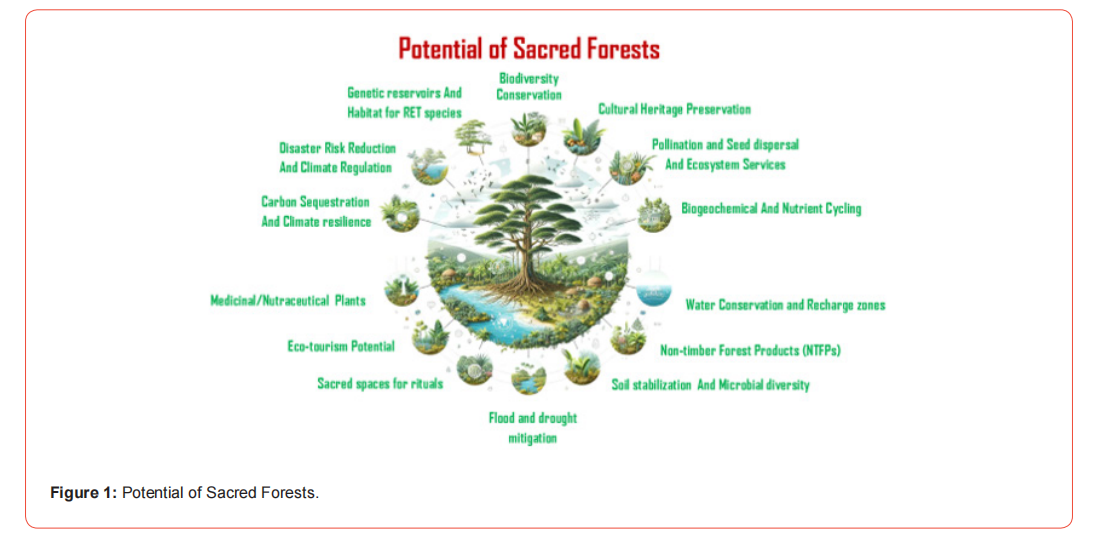
(Figure 1) Potential of Sacred Forests.
Why Sacred Forests Matter Now
Sacred forests are increasingly recognized as critical biocultural assets for biodiversity and climate resilience. Global syntheses confirm that sacred natural sites deliver positive biodiversity outcomes across continents (Zannini et al., 2021), and metaanalyses show they harbor species richness comparable to adjacent forests, with particularly strong effects for plants [1,2]. The IPBES Global Assessment [3] emphasizes strengthening Indigenous and local stewardship as a cornerstone of conservation. Designating sacred forests as Other Effective Area-Based Conservation Measures (OECMs) enables contributions to global targets such as 30×30 while safeguarding custodianship [4,5].
How Sacred Forests are effective in Biodiversity Conservation
Sacred forests play a pivotal role in sustaining biodiversity and ecosystem integrity. They maintain high plant diversity and structural complexity, supporting species-rich habitats [2,6]. Regional studies from Central India report 109 tree species with mean total carbon stocks (tree biomass plus soil organic carbon at 0–30 cm) around 154 tC/ha, with maxima exceeding 450 tC/ ha [7]. These forests also enhance microclimatic stability and favor sensitive taxa such as lichens, indicating their ecological significance [8-10].
Can Sacred Forest aid in Climate Change Adaptation
Sacred forests contribute significantly to climate adaptation through their strategic hydro-ecological placement near streams and recharge zones, providing riparian buffering and mitigating local flood and drought risks [6,11] (Table 1). The IPCC AR6 [12] identifies ecosystem-based adaptation as a high co-benefit pathway, and sacred forests exemplify this approach with strong social legitimacy. Their integration into mixed governance systems enhances durability and adaptive capacity [13,14]. By combining ecological functionality with cultural stewardship, sacred forests offer nature-based solutions that strengthen resilience in vulnerable landscapes.
How can Sacred Forests facilitate Climate Change Mitigation (Carbon Storage)
Sacred forests serve as significant carbon sinks, storing biomass and soil carbon at densities comparable to or exceeding managed landscapes. Zagros oak groves report total carbon stocks of approximately 339 tC/ha, including soil organic carbon (SOC), compared to 113 tC/ha in silvopastoral lands, with SOC alone reaching 125 tC/ha versus 71 tC/ha [15]. Central and eastern Indian and sacred groves range from 45 to 455 tC/ha [7,16], while Ethiopian sites store 128–319 tC/ha in biomass [17]. Additional evidence from Southwest Nigeria and Uttar Dinajpur shows aboveground carbon between 24 and 198 tC/ha [14,18] (Table 2).
Table 1: Policy and finance standards for adoption of sacred-forest climate solutions.

Table 2: Surveillance and Monitoring priorities.

Environmental Protection through Sacred Forest Ecosystems
Sacred forests play a crucial role in maintaining soil and watershed health. Their soils typically exhibit higher carbon and nitrogen percentages and lower bulk density compared to adjacent land uses, which reduces erosion and enhances water infiltration [19,20]. These characteristics help stabilize landscapes and support groundwater recharge. Reviews consistently link sacred forests to watershed protection and hydrological regulation [8]. Furthermore, cultural and spiritual values embedded in these ecosystems foster strong community stewardship, creating cobenefits for environmental protection and sustainable resource management [4].
Sacred Forests are essential: Ecosystem Services and their Necessities
Sacred forests deliver multifunctional ecosystem services that integrate ecological and cultural dimensions. They conserve biodiversity by maintaining species richness, genetic diversity, and microhabitat integrity [2,6]. Climate regulation services include carbon sequestration in biomass and soils, microclimate buffering, and riparian protection, reducing flood and drought risks [7,9,15]. Cultural and livelihood services encompass spiritual heritage, traditional ecological knowledge, medicinal plants, nontimber forest products, and eco-cultural tourism opportunities [1,3,17]. These services collectively strengthen resilience, support global biodiversity targets, and uphold community stewardship, positioning sacred forests as cost-effective nature-based solutions for sustainability
Conclusions
Sacred forests are biocultural climate solutions: they conserve biodiversity effectively, store substantial carbon (often rivaling formally protected forests), buffer microclimates and water regimes, and deliver cultural values that sustain stewardship. Recognizing them as OECMs, aligning with REDD+ finance and safeguards, and upgrading monitoring can amplify their role in 21st century climate adaptation, mitigation, and environmental protection while honoring the communities who have conserved them for generations.
Acknowledgements
SR is thankful to MSCBU Seed fund 2022 for this study.
References
- Rath S, Ormsby AA (2020) Conservation through traditional knowledge: A review of research on the sacred groves of Odisha, India. Human Ecology 48(4): 455-463.
- Sullivan MK, Browne L, Penagos Zuluaga JC, Liu J, Surendra A, et al. (2023) Sacred Forest biodiversity conservation: A meta‑analysis. Conservation Science and Practice 6(1): e13055.
- IPBES (2019) Summary for policymakers of the global assessment report on biodiversity and ecosystem services.
- IUCN‑WCPA Task Force on OECMs (2019) Recognizing and reporting other effective area‑based conservation measures.
- IUCN (2008) Sacred natural sites: Guidelines for protected area managers.
- Rath S, John R (2018) What factors influence the abundance and distribution of sacred forests in Odisha, a densely forested state in eastern India? International Journal of Environmental Studies 75(3): 1-12.
- Dar JA, Kothandaraman S, Khare PK, Khan ML (2023) Sacred groves of Central India: Diversity status, carbon storage, and conservation strategies. Biotropica, 54(6): 1400-1411.
- Rawat L (2014) Role of sacred groves in ameliorating microclimate: A case study of Nagdev temple forest of Pauri Garhwal, Uttarakhand Himalaya, India. International Journal of Biodiversity and Conservation 6(1): 50-58.
- Rath S, Banerjee S, John R (2020) Greater tree community structure complexity in sacred forest compared to reserve forest land tenure systems in eastern India. Environmental Conservation 47(1): 1-8.
- Upadhyay S, Joshi Y, Bisht K, Joshi P, Kumar V (2018) Macrolichen diversity associated with a regenerating sacred grove (Uttarakhand, India). International Journal of Ecology and Environmental Sciences 44(2): 199-205.
- Bhagyanathan A, Dhayanithy D (2025) Sacred groves and riparian conservation: Nature‑based solutions towards local climate adaptation in the Malabar Coast of India. Landscape Research 50(4): 598-621.
- IPCC (2022) Climate Change 2022: Impacts, Adaptation and Vulnerability (WG II).
- Samuel Adeyanju, Janette Bulkan, Jonathan Onyekwelu, Guillaume Peterson St-Laurent, Robert Kozak, et al. (2022) Drivers of biodiversity conservation in sacred groves: A comparative study of three sacred groves in south‑west Nigeria 16(1): 94-107.
- Onyekwelu JC, Agbelade AD, Stimm B, Mosandl R (2024) Role of sacred groves in southwestern Nigeria in biodiversity conservation, biomass and carbon storage. Environmental Monitoring and Assessment 196: 269.
- Moradi A, Shabanian N (2023) Sacred groves: A model of Zagros forests for carbon sequestration and climate change mitigation. Environmental Conservation, 50(3): 163-168.
- Rath S, Ormsby AA (2025) Introduction to the sacred groves of Odisha. In The Routledge Handbook of Cultural Ecosystem Services.
- Maru Y, Gebrekirstos A, Haile G (2022) Indigenous sacred forests as a tool for climate change mitigation: Lessons from Gedeo Community, Southern Ethiopia. Journal of Sustainable Forestry 42(3): 260-287.
- Sarkar K, Barman T, Choudhuri C, Chowdhury M (2024) Carbon storage in sacred groves of Uttar Dinajpur: Implications for climate change mitigation and conservation strategies. Environment, Development and Sustainability.
- Moradi A, Shabanian N (2022) Land‑use change in the Zagros forests and its impact on soil carbon sequestration. Environment, Development and Sustainability 25(6): 5411-5426.
- Rath S, Ormsby AA (2025) Cultural ecosystem services of the sacred groves of Kandhamal, Odisha, India. In The Routledge Handbook of Cultural Ecosystem Services, Routledge, pp. 107-117.
-

This work is licensed under a Creative Commons Attribution-NonCommercial 4.0 International License.




