


 Review Article
Demystifying Financial Literacy, Financial Capability and Financial Education: A Practitioner’s Narrative Review and Perspective
Faculty of Economics and Administrative Services, Near East University, Turkey
Received Date: January 09, 2026; Published Date:January 22, 2026
Abstract
This article seeks to highlight key considerations in understanding the terms Financial Literacy, Financial Education and Financial Capability. This review synthesized the latest literature from the Web of Science database and provides for the basis of the key findings herein. The narrative literature review approach has enabled the linkage of the findings to the research aim of demystifying the key terminologies of Financial Literacy, Financial Capability and Financial Education citing notable considerations to guide financial sector consumers and practitioners on their usage. The findings indicate the feasibility to use the three terms interchangeably given their grand intersect. In unison; FL, FE or FC provide the same knowledge and require its application into one’s day to day life so as to make wiser financial decisions and progressively leading to an improved financial transformation aligned to one’s socio – economic realities. Further studies could exhaust findings into the FinTech implications of FL, FC or FE. Researchers could also review the FE, FL, and FC strategy documents of various countries to further evaluate the detail therein that could explore the considerations of FL, FC and FE as having akin program developments.
Introduction
What is Financial Literacy (FL)? How is Financial Literacy related to Financial Education (FE)? Does Financial Capability (FC) have a relationship with Financial Literacy and Financial Education? If someone is Financially literate, should we assume that they are financially capable too? Is Financial Education a stepping stone to Financial Capability? What contributes most to the financial wellbeing of a financial consumer; is it FC, FL or FE? Does FE lead to FC? Is there a significant interlink between FL, FC and FE? These and more questions linger in the minds of both the financial consumer and the financial sector practitioners. At the financial regulatory realm, it’s much more prudent to understand these terms better and thus be in position to provide suitable guidance to the financial consumer segments of a given jurisdiction. [1] indicated that FE is a tool for FL and that FL is a narrower concept that builds into FC. However, there is need to explore the latest review of the same to inform the currently suitable outlook.
Defining FL, FC and FE
[2] in the document “Strategy for Financial Literacy in Uganda”, provides for the vision of FL; indicating that “Ugandans have the knowledge, skills and confidence to use their money well”. [3] considers FE as a process of providing people with the knowledge, skills, attitude and exposure to relevant information and training to enable them to make informed financial decisions and take actions appropriate to their circumstances. FC is defined as an individual’s confidence and competencies in financial knowledge, skills and behaviors needed to undertake informed, confident and relevant decisions and actions about personal and household finances to improve one’s financial well-being [3].
From the aforementioned definitions, it’s clear that there are key elements that feature in each definition, signifying an interconnect that may indicate synonymity. It is clear that FE is also looked at as a process and can be adopted at the inception of a given project aimed at increasing the financial knowledge of recipients, however, in the practitioner’s perspective, since it is not mainstream education that is sometimes received for the sake of knowledge acquisition, FE intrinsically seeks to improve financial behavior and therefore culminates into confident financial decision making as seen by the expected outcome of FL and FC. An individual being able to apply suitable financial knowledge, perform requisite financial behaviors, and maximize available financial opportunities aimed at an enhanced financial well-being is an indication of FC [4]. Therefore, confident financial decision-making channels the efforts of an individual towards the improvement of their financial wellbeing, thus the linkage between FL and FC. FC considers the capacity of consumers to undertake financial activities that are comprehensive enough for them to attain financial wellbeing [5].
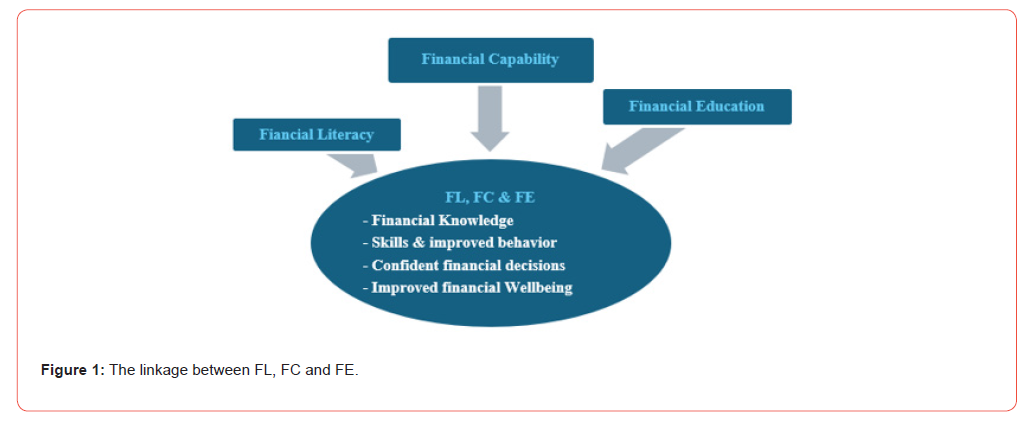
This signifies that there is an amalgamation of FE through the acquisition of financial knowledge, that culminates to FL with the application of the knowledge to transform the skills of an individual and ultimately leading to the attainment of the capacity and confidence to apply this to one’s day to day life; that is, FC. Figure 1 below indicates the key elements that are interlinked between FL, FC and FE.
The Practical Discussion of FL, FC and FE
[6] consider the need to incorporate financial literacy education as a life course that seeks for economic empowerment for financial stability and independence in the long run. Notably merging “financial literacy education” that indicates the connection between FL and FE. Furthermore, FE is found to be a major contributor to FC [7-9]. FE is considered a facilitating avenue for FL in some perspectives [3]. The indication of spearheading FE as an inception intervention for the dissemination of financial knowledge is notable with the ultimate goal of attaining FC and FL.
Uganda’s Financial Capability Survey (2020) clearly highlights that FL and FC are uses synonymously in the report given the overlap of the findings, indicating that the two terms were synonymous. The FL key messages as seen from the Strategy for Financial Literacy in Uganda Core Messages 2019, include topics on Personal Financial Management / Budgeting, Saving, Investment, Loans Management, Retirement, Insurance, Financial options, etc. This is an indication that the FL, FE and FC financial knowledge is similar and can be adapted to a given country’s context. The National Strategies of other countries on the FL, FE and FC knowledge can be evaluated in future research to ascertain the aforementioned interlink.
FL was disseminated to enable recipients to make wise financial choices [10]. Efforts towards FE are reviewed among young individuals establishing the need for FL to enable them to handle their finances successfully [11]. This is therefore an indication that FL and FE can majorly be measured as per a given intervention and its roll out, however, application of the acquired knowledge is a lifelong process applicable to all people from all segments in society. [12] highlight the need for the FL to be incorporated in public health for the attainment of both financial empowerment and mental health resilience. This is realized in practice where the situations one faces in life determine the applicable decision; for example, a youth may have learned about saving, investment or retirement in FL or FC or FE at the University, however, these topics specifically may make more pertinency after this individual is employed or has an income source. Nonetheless, this is an indication too that FL, FE and therefore FC are substantially similar in dissemination and application.
In some instances, FE will be utilized to signify only the dissemination of financial knowledge. Practitioners have over time indicated that since this knowledge is attained majorly outside the duration of the formal education cycle of an individual, FE can still be seen to be applicable towards behavioral change at any point in one’s life; from childhood, to retirement and beyond. FL, FC and FE are thus indicated as lifelong skills, applicable at any point of one’s life cycle and lead to continuous learning alongside commensurate behavioral change. There is limited evidence on the impact of FC on financial behavior [8]. This is especially attributed to the fact that attaining financial well-being remains a lifelong quest and thus it’s not feasible to establish a clear indication of attainment through short term study tools.
The application of technological advancements, with the mediation of FE enhances the capability to provide financial services to the underserved communities [13]. FL and FC also aim to reach the excluded communities effectively and the need to utilize FinTech for faster and deepened access to financial knowledge is essential. This provides for a realization of the equivalent need for practitioners in FL, FC or FE; to innovate digital interventions so that grassroot communities have access to finance majorly through their mobile phones. FinTech is established as an enabler for FE and furthermore, facilitates, through digital innovation, the linkage between FL and the wellbeing of the society [14]. The need for digital tools in the roll out of FE for children is highlighted with an emphasis of the need to explore the digitalization of FL [15]. This shows a similarity in to the future trends of FL, FC and FE.
Conclusion
The similarities between FL, FC and FE are pertinent to note, given their overlapping usage. From the definitions, its clear that the three terminologies intersect with the attainment of knowledge, skills and the confidence that enables the improvement of one’s financial well-being as per their socio – economic circumstances. Depending on the preference of a given user of these terminologies, the findings herein indicate that FL, FC and FE could be used interchangeably and the term used ought not derail practitioners from seeking to achieve the end goal of heightened financial well-being. In other instances, FE is used to emphasize the initial acquisition of financial knowledge while FL and FC further link this to the application of the knowledge to improved skills and confidence of the financial consumer for an improved financial well-being. Further studies could explore the detailed FinTech implications and researchers could also review the FE, FL, and FC strategic documents of various countries to further evaluate the detail therein that could explore the considerations of FL, FC and FE as akin terminologies.
Acknowledgement
This paper is dedicated to the FL, FE and FC trainers and practitioners are dedicated to disseminating financial knowledge aimed at improving the well-being of the financial consumers.
Conflicts of Interest
None
References
- World Bank (2014) Financial Education Programs and Strategies. World Bank Document
- Bank of Uganda (2019) Strategy for Financial Literacy in Uganda. Bank of Uganda | Financial Literacy.
- AFI (2021) Alliance for Financial Inclusion National Financial Education Toolkit NFES_toolkit_22082022.pdf
- Xiao JJ, Huang J, Goyal K, Kumar S (2022) Financial capability: a systematic conceptual review, extension and synthesis. International Journal of Bank Marketing 40(7): 1680-1717.
- Lučić A, Barbić D, Uzelac M (2023) Theoretical underpinnings of consumers’ financial capability research. International Journal of Consumer Studies 47(1): 373-399.
- Akbaş MÇ, Seedsman T (2024) Financial literacy as part of empowerment education for later life: a spectrum of perspectives, challenges and implications for individuals, educators and policymakers in the modern digital economy. Economics 18(1): 20220097.
- Viitasalo K, Kaitsaari T, Kaittila A, Moisio M, Hakovirta, M (2024) Promoting financial capability within the field of social work practice among families with children: a systematic review. European Journal of Social Work 27(3): 505-518.
- Birkenmaier J, Maynard B, Kim Y (2022) Interventions designed to improve financial capability: A systematic review. Campbell Syst Rev 18(1): e1225.
- Birkenmaier J, Kim Y, Maynard B (2022) Financial outcomes of interventions designed to improve financial capability through Individual Development Accounts: A systematic review. Journal of Evidence-Based Social Work 19(4): 408-439.
- Kutschke MJ, Fadale PD (2025) Personal Financial Literacy for the Orthopaedic Trainee and Early Career Surgeon: A Review of the Basics. J Am Acad Orthop Surg 33(3):108-116.
- Kovács L, Terták E (2024) Thematic review of financial education and financial literacy in the digital age. Acta Oeconomica 74(4): 483-506.
- Valdebenito-Niesel J, Dote Pardo JS (2025) Mental health and financial behavior: there are a link between these two spheres? Mental Health and Social Inclusion.
- Menberu AW (2024) Technology-mediated financial education in developing countries: A systematic literature review. Cogent Business & Management 11(1): 2294879.
- Croitoru IM, Dragan PP, Ignat ND, Jumanca R (2025) Exploring Financial Literacy in Higher Education with the Help of FinTech: A Bibliometric Analysis of Linkages to Access, Behavior, and Well-Being Through Digital Innovation. FinTech 4(1): 4.
- Mancone S, Tosti B, Corrado S, Spica G, Zanon A, et al. (2024) Youth, money, and behavior: The impact of financial literacy programs. In Frontiers in Education 9:1397060.
-

This work is licensed under a Creative Commons Attribution-NonCommercial 4.0 International License.