


 Research Article
AI-Integrated Response Control Framework for Station-Keeping of Large Floating Platforms
1,2 Dept of Ocean Engineering, Indian Institute of Technology Madras, India
Received Date: December 15, 2025; Published Date:December 19, 2025
Abstract
Station-keeping of large floating structures, such as drillships, becomes more difficult under non-linear, unpredictable wave conditions, where traditional Dynamic Positioning Systems (DPS) that utilise fixed-gain controllers often perform poorly. This study introduces a conceptual framework that integrates Artificial Intelligence (AI) to enhance a standard DPS through a physics-based, data-informed methodology. Rather than relying on neural networks or reinforcement learning, the proposed controller utilises a well-structured database of hydrodynamic response-force correlations generated from numerical simulations. In operational settings, the platform’s real-time responses are compared with the database to calculate corrective control forces, utilising Piecewise Cubic Hermite Interpolating Polynomial (PCHIP) interpolation to adapt to real-time conditions. Numerical simulations conducted on a typical large floating platform exposed to irregular waves reveal a notable decrease in surge response, with root mean square (RMS) values dropping by about 60% compared to the uncontrolled scenario. The proposed framework presents an intelligent and computationally efficient solution for future AI-powered dynamic positioning of floating offshore structures.
Keywords:Dynamic positioning; artificial intelligence; station-keeping; large floating platforms; response-based control
Introduction
Large floating platforms, such as drillships and floating production units, depend on Dynamic Positioning Systems (DPS) to maintain their position during offshore activities. Traditional DPS architectures often use fixed-gain Proportional–Integral–Derivative (PID) controllers, which perform adequately under moderate environmental conditions but may show reduced effectiveness under strong nonlinear wave actions, sensor inaccuracies, and unaccounted hydrodynamic influences. Recent progress in Artificial Intelligence (AI) has inspired the development of intelligent control methods for marine systems. Many current AI-based DPS solutions utilise neural networks or reinforcement learning, which necessitate large training datasets and may encounter issues with interpretability and poor extrapolation beyond their training domain. These drawbacks limit their direct use in safety-critical offshore operations.
Position-keeping during drilling and production is achieved using position-restraint systems, which are either mooring systems (passive) or Dynamic Positioning Systems (active) [1]. A standard DPS consists of
• thrusters and propellers for corrective thrust,
• Position reference systems (including acoustic beacons,
GPS, and INS),
• control systems (PID, nonlinear, or hybrid controllers),
and
• power generation systems to satisfy the thrust demands.
Model-based control methods enable smooth transitions between station-keeping and position-tracking [2]. Over the years, PID controllers have been implemented to improve robustness and reliability [3]. However, conventional DPS encounter challenges; for instance, heave compensation systems are only effective when operating within linear limits during irregular waves [4]. To tackle uncertainties and disturbances, researchers have suggested robust techniques such as sliding mode control [5] and fault-tolerant supervisory control [6]. These innovations underscore ongoing difficulties in balancing robustness, redundancy, and cost.
Recent research highlights the enhancement of DPS with intelligent and adaptive techniques. Multibody dynamics, which consider a complex environment, are utilized to improve prediction accuracy (Lee and Roh, 2018). Adaptive fuzzy control contributes to better heading and position accuracy in the presence of nonlinear dynamics [7]. Augmented Reality (AR)-based monitoring using SSD detectors has been explored for real-time obstruction detection and visualization [8]. One of the most notable advancements is the incorporation of Artificial Intelligence. AI-enabled controllers trained on datasets capturing platform responses across various sea states can interpolate thrust requirements for previously unseen conditions. This feature ensures independence from seabed acoustic beacons and increases accuracy in challenging sea environments. Additional methods include intelligent hybrid optimization schemes utilizing Kalman filtering and swarm intelligence [9], which further support this assertion. While multi-hazard loads, such as fire [10,11] and impact loads from collisions [12], are crucial to design methodologies, AI-integrated fuzzy control and AR-based monitoring are suitable candidates for enhanced autonomy, robustness, and safety in ultra-deepwater drilling contexts. Recent research into AI-assisted station-keeping for drillships has shown significant improvements in both resilience and autonomy in multi-hazard scenarios [13].
To fill this gap, the current study introduces a conceptual AIintegrated response-based control framework that improves DPS functionality without utilising neural networks or online training. The controller functions by learning the response–force relationships from physics-based numerical simulations and applies this understanding in real time to estimate corrective control forces. This paper focuses on clearly delineating the conceptual architecture, control philosophy, and practical advantages of the proposed method, supported by a relevant numerical demonstration.
Framework of AI-Integrated Response Control
Control Philosophy
The proposed framework shifts the control philosophy from conventional error-based correction to response-based intelligent compensation. Instead of relying solely on position or heading error, the controller determines corrective forces directly from the measured platform response, leveraging previously learned hydrodynamic behaviour. Although the controller does not employ neural networks or reinforcement learning, it qualifies as an AIbased system because it:
• Learns response–force mappings from data (offline),
• Generalises to unseen conditions through interpolation,
• Makes autonomous control decisions during operation.
Offline Knowledge Generation
In the offline stage, time-domain hydrodynamic simulations are performed for representative sea states. For each simulation, the platform response in the horizontal plane (surge, sway, and yaw) is obtained along with the corresponding ideal corrective force, computed from the governing equations of motion. These response–force pairs are stored in a structured database, forming the knowledge base of the AI controller. This database encapsulates the physical relationship between environmental excitation, platform response, and required control action.
Online AI-Assisted Control
During operation, real-time motion measurements are obtained from onboard sensors, including the Inertial Navigation System (INS) and GPS. The AI module continuously compares the measured response with entries in the response–force database:
• If an exact or near-exact match exists, the associated
corrective force is retrieved directly.
• If the measured response lies between stored values,
the control force is estimated using Piecewise Cubic Hermite
Interpolating Polynomial (PCHIP) interpolation.
PCHIP interpolation is adopted because it preserves monotonicity and local gradients, preventing artificial oscillations and ensuring physically realistic control forces. The estimated corrective force is supplied to the DPS as a compensatory input, while the conventional thruster allocation and power management logic remain unchanged. This modular integration allows the proposed AI controller to be incorporated into existing DPS architectures with minimal modification.
Numerical Model of Large Floating Vessel
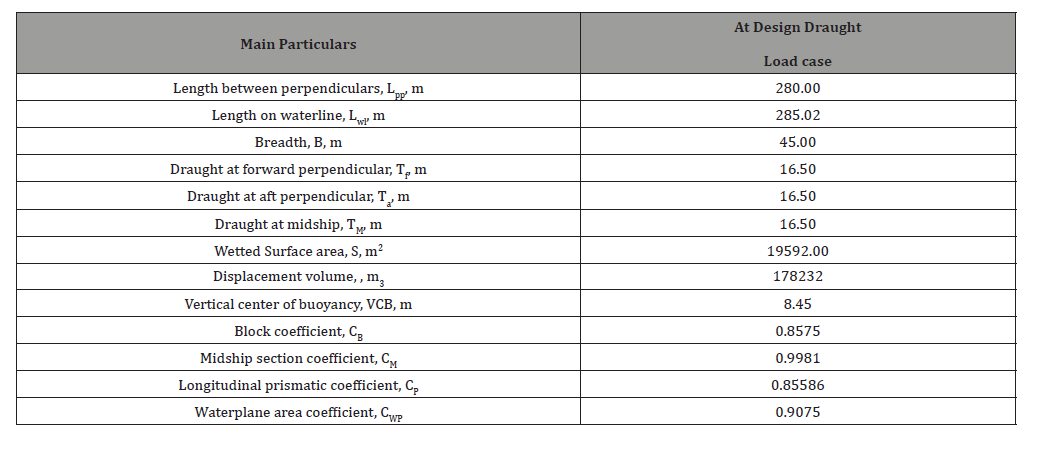
A numerical representation of the large floating structure, shown in Figure 1, is created following the framework outlined in the earlier section. The main specifications of the platform are shown in Table 1.
Numerical Analysis
To demonstrate the effectiveness of the proposed AI-integrated framework, a numerical analysis was carried out on a bulk carrier, with the geometric specifications listed in Table 1. The platform experienced irregular wave excitation that corresponds to a common offshore sea state. The responses of the platform were calculated in the time domain using standard hydrodynamic analysis methods for the specific irregular sea state. In this study, the JONSWAP spectrum was utilized to model the irregular sea conditions. An example of the JONSWAP spectrum is presented in Figure 2. This spectrum adheres to the JONSWAP formulation, which is commonly used to depict fetch-limited sea states typical of the area. The JONSWAP spectrum incorporates the effects of limited fetch and wind duration, thereby allowing for a more accurate representation of the actual ocean conditions found in the Gulf of Mexico.
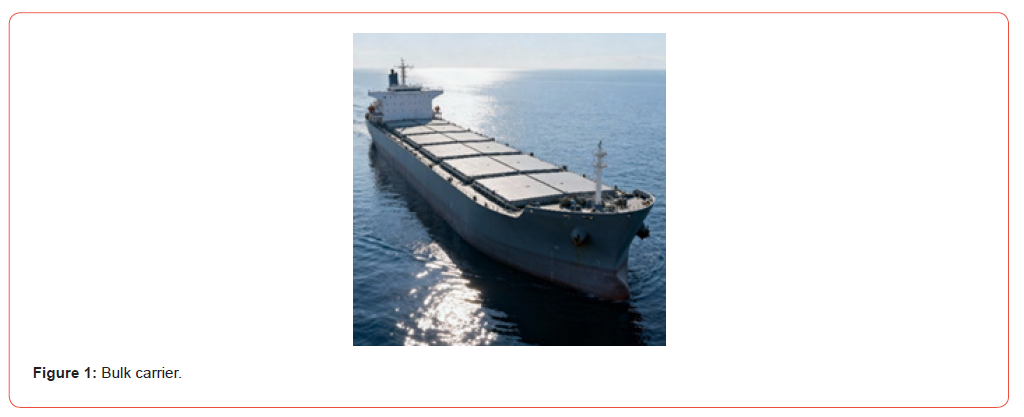
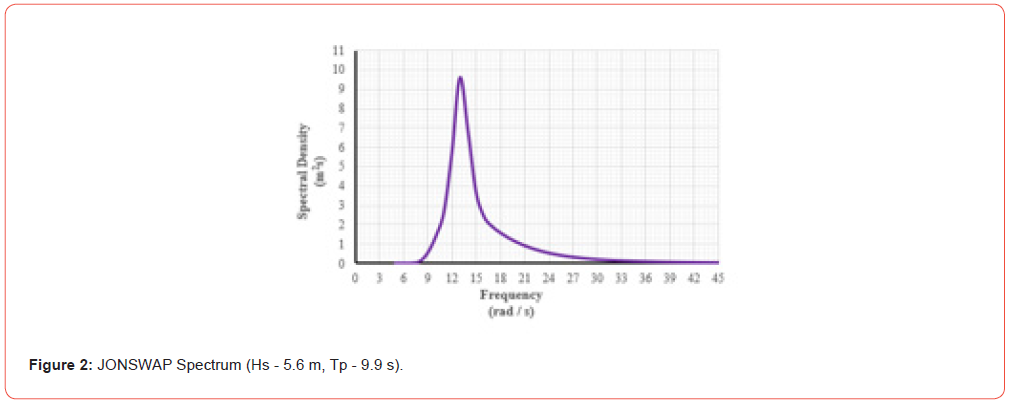
Table 1:
The surge response of the platform was examined for two
cases, namely
• without AI-integrated control, and
• with AI-integrated response-based control.
Figure 3 shows the surge response under both cases. As seen in the figure, in the former, the surge displacement gradually increased and exceeded permissible operational limits. In contrast, when the AI-integrated controller was activated, the surge response remained within acceptable bounds throughout the simulation duration. Quantitatively, the AI-assisted control achieved an approximate reduction of about 60% in the RMS surge response, demonstrating its effectiveness in improving station-keeping under irregular sea states. The performance of the proposed AI-integrated responsebased control framework is illustrated through a numerical study conducted under an irregular sea state characterised by a significant wave height (Hs) of 5.6 m and a peak wave period (Tp) of 9.3 s. Figure 2 presents a comparison of the platform surge response with and without the application of the AI-assisted control force.
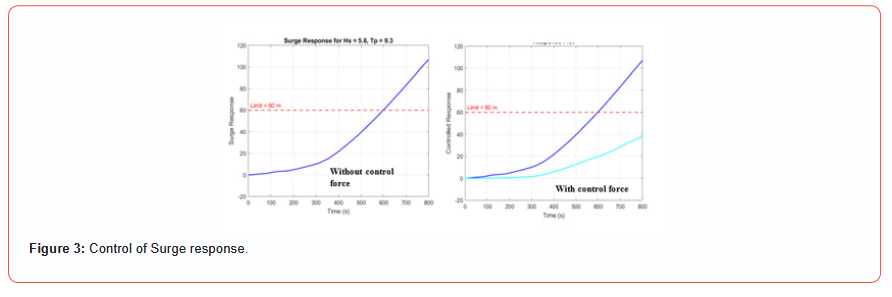
Without control, the surge displacement exhibits a monotonic increase driven by nonlinear wave excitation, eventually exceeding the prescribed operational limit of 60 m. This behaviour highlights the limitations of uncontrolled or conventionally controlled systems under severe environmental loading. When the AI-integrated controller is employed, the surge response is substantially attenuated, and the displacement remains within acceptable limits throughout the entire simulation. This demonstrates the controller’s ability to estimate and apply appropriate corrective forces based on real-time response information.
Conclusion
This paper presented a conceptual AI-integrated responsebased control framework for improving the station-keeping performance of large floating platforms. The proposed approach augments a conventional Dynamic Positioning System by utilising a database of physics-based hydrodynamic response–force relationships, thereby eliminating the need for neural network training or complex optimisation. Numerical demonstrations showed a significant reduction in surge response under irregular wave loading, confirming the effectiveness of the approach. Due to its simplicity, interpretability, and computational efficiency, the proposed framework is well-suited for real-time offshore applications, providing a practical pathway toward next-generation AI-enabled dynamic positioning systems. Future work may extend the framework to include wind and current effects, multi-DOF coupled control, and experimental validation.
Acknowledgement
None.
Conflicts of Interest
No Conflicts of Interest.
References
- Chandrasekaran S, Uddin SA (2020) Postulated failure analyses of a spread-moored semi-submersible. Innov Infrastruct Solut 5(2).
- Sørensen AJ, Fossen TI, Sagatun SI (1996) Design of a dynamic positioning system using model-based control. Control Engineering Practice 4(3): 359-368.
- Sørensen AJ (2011) A survey of dynamic positioning control systems. Annual Reviews in Control 35(1): 123-136.
- Korde UA (1998) Active heave compensation on drill ships in irregular waves. Ocean Engineering 25(7): 541-561.
- Gao X, Li T (2024) Dynamic positioning control for marine crafts: A survey and recent advances. J Mar Sci Eng 12(3): 362.
- Lee HW, Roh MI (2018) Review of the multibody dynamics in the applications of ships and offshore structures. Ocean Engineering 167: 65-76.
- Hu X, Du J, Shi J (2015) Adaptive fuzzy controller design for the dynamic positioning system of platforms. Appl. Applied Ocean Research 53: 46–53.
- Li J, Zhang Y, Xu H (2022) Ship detection and AR-based obstruction display using single-shot multibox detectors. Appl. Ocean Res 120: 103062.
- Guan H (2024) Intelligent control algorithm for a dynamic positioning control system. Front Mech Eng 10: 1371218.
- Chandrasekaran S, Srivastava G (2022) Fire-resistant design of structures. In: Fire Resistant Design of Structures 1-198.
- Chandrasekaran S (2015) Advanced Marine Structures, CRC Press, Florida (USA) ISBN 978-14-987-3968-9.
- Chandrasekaran S (2020) Offshore semi-submersible platform engineering.
- Perala M, Chandrasekaran S, Begovic E (2025) Artificial intelligence-assisted station keeping for improved drillship operations. An International Journal of Optimization and Control: Theories & Applications 15(2): 202–214.
-

This work is licensed under a Creative Commons Attribution-NonCommercial 4.0 International License.