




 Research Article
Estimation Of Strength for Inhomogeneous Sample of the Porous Plate with Taking into Account of the Internal Heat Sources Power
Received Date: February 24, 2026; Published Date: March 13, 2026
Abstract
In this paper we introduce on the first stage the results of investigation of wave propagation into inhomogeneous sample of porous ceramic plate with slowly varying refractive index. This approach considering the results, taking into account the resolving of wave equation for the plate polarized electromagnetic wave, which is transferring through the porous plate perpendicularity to the external surface. We are using the corresponding boundary conditions for the model parameters. For electromagnetic wave we are reviewing the transverse electrical (T.E.) as well, as the transverse magnetic (T.M.) mode, which are shortly named as the (T.E.M.) mode. It was be received the variants of solution for the approach of Wentzell- Kramers-Brilluon (W.K.B.) for the symmetric falling irradiation of the fixed power, which is generated on the surfaces of plate and the Jeffries [9] bounds was introduced, which takes the possibility to analyze the coefficients of transmission and reflection on the surfaces of plate. On the seconds stage the criterious relations for estimation of stretch for porous material with taking into account of the internal sources power which follows to crashing of the porous body are formulated.
Keywords:Porous media; Electromagnetic waves; Dielectric loss factor; The energy characteristics of interface layers; The boundaries of plasticity and strength; Criterion ratios
The scientific results
At investigation of propagation of electromagnetic waves of microwave
frequency into porous wetted media the method of local
space averaging was used [1], according to it for inhomogeneous
(nonmagnetic) multiphase material with dielectric losses and low
conductor properties [2] under frequency dispersion of dielectric
permeability of components we are using the information about
the effective generalized complex dynamic dielectric permeability
(E.G.C.D.D.P.) [3]. Such dielectric permeability into approach of
effective macroscopic field takes the possibility to determine the
lineal response of not interacting between vise verse mezoscopic
averaging volumes (R.E.V. - Representative Elementary Volume [1])
on the base of cluster approach, if into the considering object the
harmonic disturbance is occurs as a reaction on the external plate
monochromatic harmonically electromagnetic wave of microwave
frequency. For modeling of the processes into object we introduce
the dielectric permeability ef  [3], which take a possibility
to review the porous humidified media, as a homogeneous isotropic
dielectric with continuously changed into coordinate space and
time electro-physical properties (this is the continuous media or
the field approach). Taking into account, that mutual displacement
of phases joined with hydrodynamic (mechanical) moving of liquid
or gas into porous skeleton is unsignifical on the distances of еру
electromagnetic wave length, which interacts with body. Also, according
to the slow varying conditions of volume characteristics of
porous material we are considering the not important (light) time
dependence of E.G.C.D.D.P. during the period of oscillation. Relaying
to this the effective complex dielectric permeability
[3], which take a possibility
to review the porous humidified media, as a homogeneous isotropic
dielectric with continuously changed into coordinate space and
time electro-physical properties (this is the continuous media or
the field approach). Taking into account, that mutual displacement
of phases joined with hydrodynamic (mechanical) moving of liquid
or gas into porous skeleton is unsignifical on the distances of еру
electromagnetic wave length, which interacts with body. Also, according
to the slow varying conditions of volume characteristics of
porous material we are considering the not important (light) time
dependence of E.G.C.D.D.P. during the period of oscillation. Relaying
to this the effective complex dielectric permeability  is reviewing as slow varying function of coordinate and time. The
equation of field from which we get the expression for the power
of microwave heat sources is resolved abstractedly from the heat
and mass transfer equations into modelled porous (humidified)
material.
is reviewing as slow varying function of coordinate and time. The
equation of field from which we get the expression for the power
of microwave heat sources is resolved abstractedly from the heat
and mass transfer equations into modelled porous (humidified)
material.
We are considering the porous media as composite concrete
ceramics which consist the large number of interconnected pores
with the little size and porous skeleton (S is the solid phase) [5].
We assume that the media of the object (body) is unsaturated,
in particular, into pores exist the substance in the liquid (L) and
gas like phase (G). The last one is the two-component mixture of
atmospheric dry air and water vapor [3]. The pores into the fist
approach are modelled by the spherical inclusions with linear
radius R: the micro pores (R < 2 nm), mezzo pores (2nm
We are considering the solution of received into harmonically
approach the equations [4] for electromagnetic field (E.M.F.), in
which the such parameters are fulgurated: the  is the complex
amplitude of the E.M.F.
is the complex
amplitude of the E.M.F.  into porous cell of considering media
(here
into porous cell of considering media
(here  is the real quantity of the complex amplitude
) as well, as
is the real quantity of the complex amplitude
) as well, as  is the effective generalized complex dynamical
dielectric permeability (E.G.C.D.D.P.) [3] (here the time t is into
content of a parameter, by means of which the moving of phases
according to deformation process of solid phase (skeleton) and
flowing phases (liquid or gas) under influence of evaporation or
condensation during heat and mass transfer are considered. The
mentioned parameters we are considering the slowly (light) varying
functions of coordinate. Then equations for the plate (transverse)
polarized T.E.M. [7] monochromatic wave in the stretch of
electric field
is the effective generalized complex dynamical
dielectric permeability (E.G.C.D.D.P.) [3] (here the time t is into
content of a parameter, by means of which the moving of phases
according to deformation process of solid phase (skeleton) and
flowing phases (liquid or gas) under influence of evaporation or
condensation during heat and mass transfer are considered. The
mentioned parameters we are considering the slowly (light) varying
functions of coordinate. Then equations for the plate (transverse)
polarized T.E.M. [7] monochromatic wave in the stretch of
electric field  into porous composite media [2] takes the form

Here  is the effective generalized complex dynamical
dielectric permittivity,
is the effective generalized complex dynamical
dielectric permittivity,  is the
complex refractive index;
is the
complex refractive index;  is the wave vector into the porous
(inhomogeneous) media;
is the wave vector into the porous
(inhomogeneous) media;  (here
(here 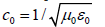 is the velocity of light) is the wave vector of electromagnetic wave
into vacuum, ω = 2π v is the corner frequency of E.M.F. (ν is the linear
frequency), μ0
and ε0 are correspondingly the magnetic and
electric constants into vacuum.
is the velocity of light) is the wave vector of electromagnetic wave
into vacuum, ω = 2π v is the corner frequency of E.M.F. (ν is the linear
frequency), μ0
and ε0 are correspondingly the magnetic and
electric constants into vacuum.
The bounds between the measured  and modeled
 indexes we describe into approach of the effective field
(E.M.A.) according to well known Bruggeman [3] formula
indexes we describe into approach of the effective field
(E.M.A.) according to well known Bruggeman [3] formula
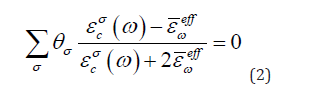
here  is the static complex dielectric
permittivity for σ = {S, L,G} phase under E.M.F. frequency ω
for investigated porous composite media, where is takes formally
is the static complex dielectric
permittivity for σ = {S, L,G} phase under E.M.F. frequency ω
for investigated porous composite media, where is takes formally
 according to ergodicity hypotheses.
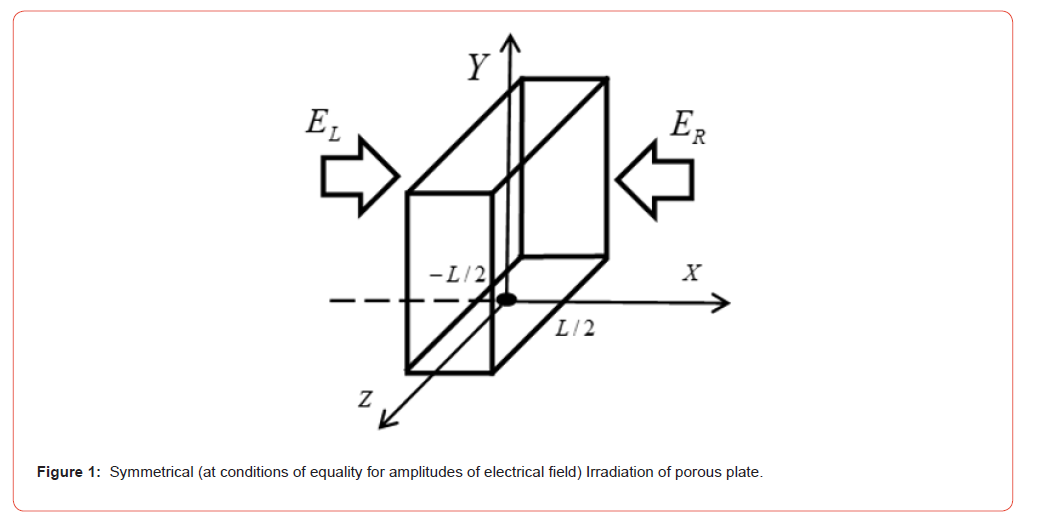
As a porous sample during numerical experiment, we review the porous wetted (unlimited) porous plate. By the selection of the direction of distribution for electromagnetic wave along the axis 0X at the fixed polarization along 0Y (axis of ordinate Y) (Figure1) the wave equation (2) takes [2] the following view
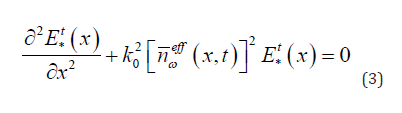
where  is the complex amplitude of electric field stretch
along the axis 0Y.
is the complex amplitude of electric field stretch
along the axis 0Y.
We use the Wentzel-Kramers-Brillouin (W.K.B) approximation
[9] and will look for a partial solution of equation (3) in the form
 , where A is the unknown complex constant
and φ (x,t ) is the the phase of an electromagnetic wave varies
depending on coordinates and time. After substituting the specified
expression for
, where A is the unknown complex constant
and φ (x,t ) is the the phase of an electromagnetic wave varies
depending on coordinates and time. After substituting the specified
expression for  into relation (3), we obtain the equation
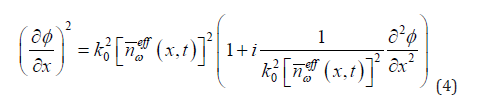
Let us assume that the last term in (4) can be neglected due to the weak phase variability perpendicular to the wave propagation front. Then the condition of weak variation in the coordinate space (for the variable x it is the one-dimensional case) according to the relation (4) takes the following form:
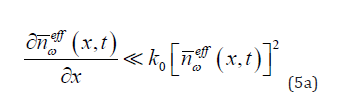
Relation (4) under the condition of (5a) is fulfilled, as a result of the series arrangement, it is simplified and will have the following form

We seek a partial solution of the wave equation (3) in the following (6) form
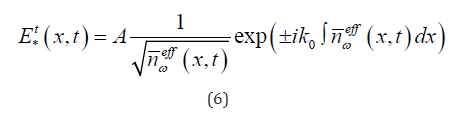
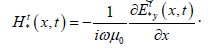
The complex amplitude of the magnetic field strength is
obtained according to the wave equations [2] by differentiation
 .
.
In this  is the component of the magnetic field strength
vector along the 0Z axis, and
is the component of the magnetic field strength
vector along the 0Z axis, and 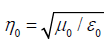 is the wave resistance
(impedance) in vacuum. If the weak variation condition (5) is
satisfied, we obtain
is the wave resistance
(impedance) in vacuum. If the weak variation condition (5) is
satisfied, we obtain

It should be noted that the choice of sign in expressions (6) and (7) has more illustrative than physical meaning.
The condition of weak variability of the field (5a) in the coordinate space is clearly formulated if we take into account that

where  (here
(here  and
and  is the electromagnetic
wavelength and wave vector in vacuum) is the variable wavelength
of the microwave EMF and the wave vector in a continuous porous
(effective) medium. Then the corresponding relation (5) acquires
a transparent physical meaning and the condition for it can be
written:
is the electromagnetic
wavelength and wave vector in vacuum) is the variable wavelength
of the microwave EMF and the wave vector in a continuous porous
(effective) medium. Then the corresponding relation (5) acquires
a transparent physical meaning and the condition for it can be
written:
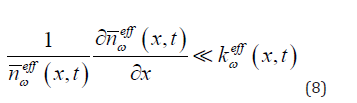
where 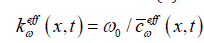 (here
(here
 is the speed of light propagation in an
effective medium) is the wave vector in a porous (wetted) medium
modeled according to the effective dielectric characteristics [3].
is the speed of light propagation in an
effective medium) is the wave vector in a porous (wetted) medium
modeled according to the effective dielectric characteristics [3].
The condition of weak variation of the dielectric properties of the material in the coordinate form (6) is usually ensured for most composite bodies with low electrical conductivity (2) due to the large value of the linear frequency v0 of microwave radiation in vacuum. In the following, we will neglect the dispersion of the wave characteristics of the material under study at a constant value ω0 = 2π v0 of the angular frequency of microwave radiation in vacuum, considering the propagation of electromagnetic waves in the internal volume of a porous (wetted) flat plate, which takes place when taking into account scattering effects.
Thus, we arrive at a closed (complete) set of conditions for weak variability of dielectric (wave), bulk (phase) and wave properties of a three-phase (wetted) porous medium in the coordinate and time space of variables
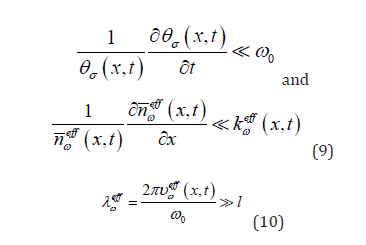
Here  is the
wave vector and phase velocity of electromagnetic (TEM) wave
propagation in the simulated medium, is the effective value of
the refractive index,
is the
wave vector and phase velocity of electromagnetic (TEM) wave
propagation in the simulated medium, is the effective value of
the refractive index,  is the volume fraction σ = {S, L,G}
phase ω0
, - constant angular frequency of EMF in the microwave
frequency range, l is the characteristic area size (REV) [1] for
space averaging.
is the volume fraction σ = {S, L,G}
phase ω0
, - constant angular frequency of EMF in the microwave
frequency range, l is the characteristic area size (REV) [1] for
space averaging.
Relations (9)-(10) make it possible to apply the approximation of the effective macroscopic field [4] when studying (calculating) the effective electrophysical characteristics of a porous material within the framework of the approximation [1] of the theory of local spatial averaging.
Relations (9)-(10) make it possible to apply the approximation of the effective macroscopic field [4] when studying (calculating) the effective electrophysical characteristics of a porous material within the framework of the approximation [1] of the theory of local spatial averaging.
According to the properties of the solutions of the W.K.B model, when the conditions of weak variability (9) and (10) of the electrophysical characteristics of the porous (wetted) material are satisfied, the general solution of the wave equation (3) for a plane transverse (T.E.M.) electromagnetic wave can be written [14] in the form
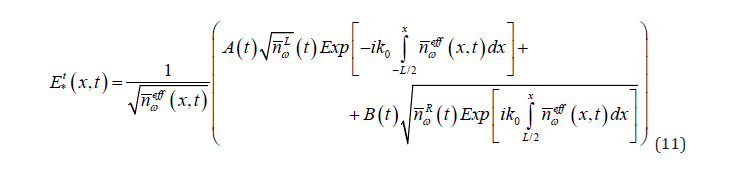
where  is the value of
the refractive index that varies over time due to the sorption or
desorption of liquid on the surfaces of the plate, A(t) and B(t ) are
unknown functions of time, andexp[...] is notation of the exponent.
is the value of
the refractive index that varies over time due to the sorption or
desorption of liquid on the surfaces of the plate, A(t) and B(t ) are
unknown functions of time, andexp[...] is notation of the exponent.
In the left (L) and right (R) half-space, external (Figure 1) with respect to the boundaries (edges) of the plate, which is modeled by vacuum, the electric field strength (under external microwave irradiation) will be considered in the form of expressions
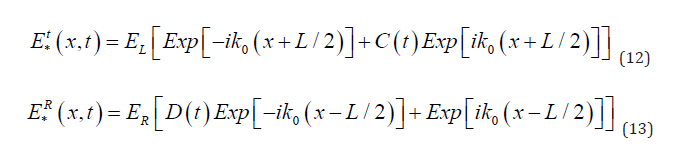
where C(t) and D(t) are unknown functions, EL and ER are actual amplitudes of the external electromagnetic field (E.M.F.).
Let us write the boundary conditions for the components (Figure 1) of the electric field strength

and derivatives that correspond to the component strengths of the magnetic field

Such conditions (14) and (15) make it possible to take into account the dependence of the field amplitudes on the wetting at the boundaries (edges) of the plate, the value of which (volume fraction θL of liquid or saturation ηL of pores with liquid) changes dynamically depending on the power of the internal (thermal) heating sources and the implementation of heat and mass transfer conditions at the edges of the plate.
In accordance with the described expressions (11), (12) and (13) for the electric field strengths according to the continuity condition (14) of the components

and continuous (15) of derivatives

we obtain a system of linear equations (16) and (17) for determining the unknown (variable in the simulation time interval) coefficients that specify the amplitude of the E.M.F. at the edges of the plate, in the accepted notations

Such coefficients, taking into account the relation (18), will have the form

where  (here α = {L, R} is the index corresponding to the left (L) and right (R)
edges of the plate) are, respectively, the transmission and reflection coefficients of the T.E.M wave at the plate boundaries.
(here α = {L, R} is the index corresponding to the left (L) and right (R)
edges of the plate) are, respectively, the transmission and reflection coefficients of the T.E.M wave at the plate boundaries.
Thus, according to (11) and the expressions for the coefficients and (19) which are determined from the continuity conditions (14) and (15) of the field components, we obtain a partial solution of the wave equation (3) in the electric and magnetic field strengths
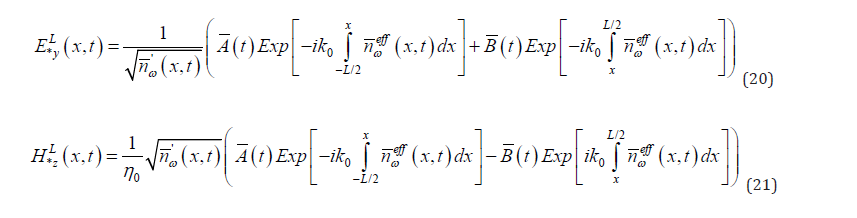
here  determined according to relations (19) and normalized according to the values
 (where α = {L, R} - index of the plate edges) of the refractive index at the edges of the plate complex amplitudes of
the electromagnetic wave, and
(where α = {L, R} - index of the plate edges) of the refractive index at the edges of the plate complex amplitudes of
the electromagnetic wave, and  characteristic resistance (impedance) in a vacuum.
It is known [7] that for the wave vector of a T.E.M. wave in a continuous (effective) medium the following relation holds:
 , where are absorption and propagation
indicators of T.E.M waves.
, where are absorption and propagation
indicators of T.E.M waves.
Let us define the tangent of the dielectric loss angle  in the simulated porous (wetted) material
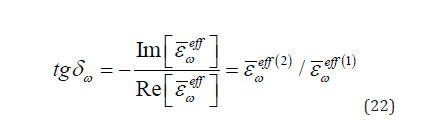
where 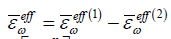 is the effective generalized complex dynamic permittivity (E.G.C.D.D.P), and
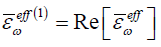 і
і
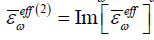 denoting the real and imaginary parts respectively.
Then the absorption α (x,t ) and propagation β (x,t ) indices of the T.E.M wave are described by the expressions
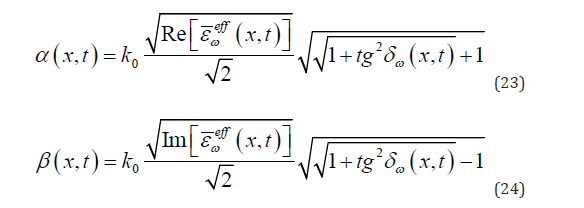
subject to performance 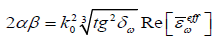 normalizing ratio.
Considering the above ratio  , where
  are the above-mentioned absorption and propagation parameters of a plane electromagnetic wave, we obtain the effective values of the
wavelength
are the above-mentioned absorption and propagation parameters of a plane electromagnetic wave, we obtain the effective values of the
wavelength  and the depth
  of wave penetration
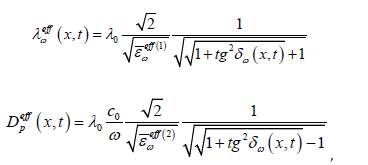
where  is the dielectric loss tangent.
The power of the E.M.F energy flow in a diffuse wave process can be calculated according to the definition of the Umov-Pointing vector [4] by the relation
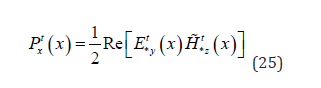
where  is the complex conjugate value of the averaged amplitude of the magnetic field strength
Analyzing expression (18), for the model parameter we obtain

here 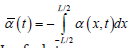 are integral values of the absorption and propagation coefficients of an electromagnetic wave through the
thickness L of plate correspondingly, and
are integral values of the absorption and propagation coefficients of an electromagnetic wave through the
thickness L of plate correspondingly, and 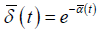 is the amplitude multiplier, which is determined by the damping coefficient that
varies with time (due to the movement of fluid phases in a porous material).
is the amplitude multiplier, which is determined by the damping coefficient that
varies with time (due to the movement of fluid phases in a porous material).
Then, according to the definition (25) and the expressions for the electric (20) and magnetic (21) field strengths for the microwave
radiation flux power in the accepted (26) notations in the large thickness approximation L of plate  (26) and symmetrical edges
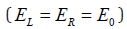 (if E0 - amplitude value of the external E.M.F intensity), the relationship for the power of the energy flow in a porous
wetted material with effective wave properties will be
(if E0 - amplitude value of the external E.M.F intensity), the relationship for the power of the energy flow in a porous
wetted material with effective wave properties will be
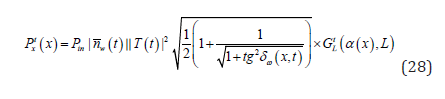
Were,
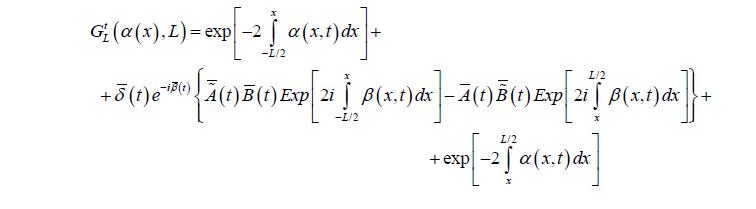
is the notation; 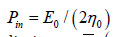 is the power of
external microwave radiation;
is the power of
external microwave radiation;  and
and
 is the the value of the refractive index and
transmission coefficient of the electromagnetic T.E.M. wave at the
edges of the plate;
is the the value of the refractive index and
transmission coefficient of the electromagnetic T.E.M. wave at the
edges of the plate;  is the attenuation
coefficient of the T.E.M. wave.
is the attenuation
coefficient of the T.E.M. wave.
Let us assume that the total amount of E.M.F energy supplied to the material under study at microwave intermediate resolution is completely converted into heat due to scattering (diation) effects. Thus, we neglect the processes of performing work by the studied thermodynamic system due to internal (ponderomotor) forces acting on the porous frame (including thermal expansion of the plate).
Then the expression for calculating the power of electromagnetic (dielectric or microwave) heating sources has the form
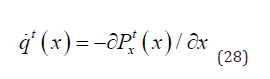
where  is the value of the Umov-Pointing vector [4] at the
edges and in the internal volume of the plate.
is the value of the Umov-Pointing vector [4] at the
edges and in the internal volume of the plate.
For the power of internal heat sources  under symmetric
external (microwave) irradiation, which is determined by the
expression for the E.M.F energy flow in the material (25), when
approximating large thicknesses
under symmetric
external (microwave) irradiation, which is determined by the
expression for the E.M.F energy flow in the material (25), when
approximating large thicknesses  of the plate according
to (26), we obtain
of the plate according
to (26), we obtain
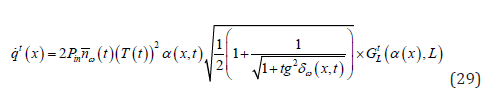
In relation (29), the notations are equivalent to the physical quantities described according to (28) and

The numerical modelling
As before, the Bruggeman formula [3] was used in the numerical simulation of the heat source power (28) in the EMA approximation.
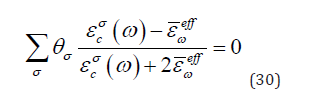
and the expression (31) obtained in [15] for finding the uniform
wetting  of a porous material
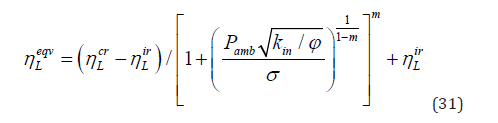
here ϕ - averaged porosity,  - critical and residual
pore saturation with liquid, amb P - pressure value in the surrounding
environment, kin - inherent permeability of the frame, σ - surface
tension coefficient, m - model parameter.
- critical and residual
pore saturation with liquid, amb P - pressure value in the surrounding
environment, kin - inherent permeability of the frame, σ - surface
tension coefficient, m - model parameter.
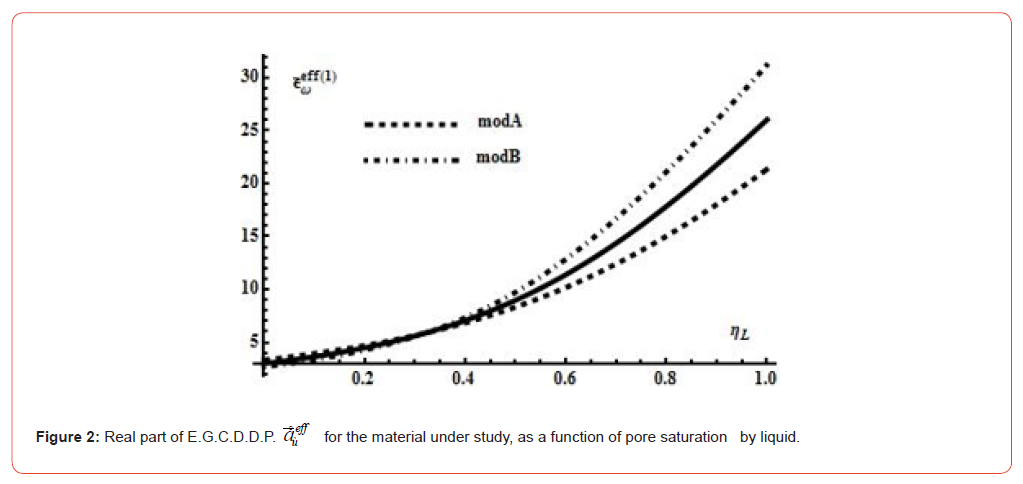
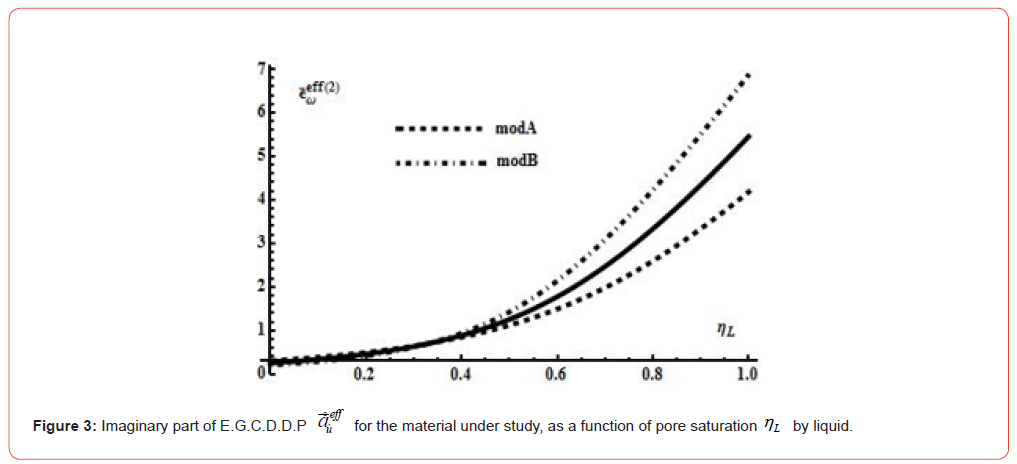
For the material under study, namely historical ceramic brick (ϕ = 0, 46 - averaged porosity) and two modification (ϕ = 0, 4 - modA and ϕ = 0,52 - modB), with known values of dielectric (static) permittivities of phases,
Table 1: Dielectric constants of components for the studied material (historical ceramic brick) according to the spherical inclusion model [ εS - solid phase, εL - liquid phase (water), εG - gas phase ( dry air )].

which are given above in Table 1, by relation (27) we obtain the
corresponding graphical dependencies for the real
 (Figure
2) and imaginary
(Figure
2) and imaginary  (Figure 3) part of effective generalized
complex dynamic permittivity (EUCDDP)
(Figure 3) part of effective generalized
complex dynamic permittivity (EUCDDP)  porous moistened
material at a typical (standardized) frequency of external microwave
irradiation
porous moistened
material at a typical (standardized) frequency of external microwave
irradiation  from the saturation
ηL by liquid.
from the saturation
ηL by liquid.
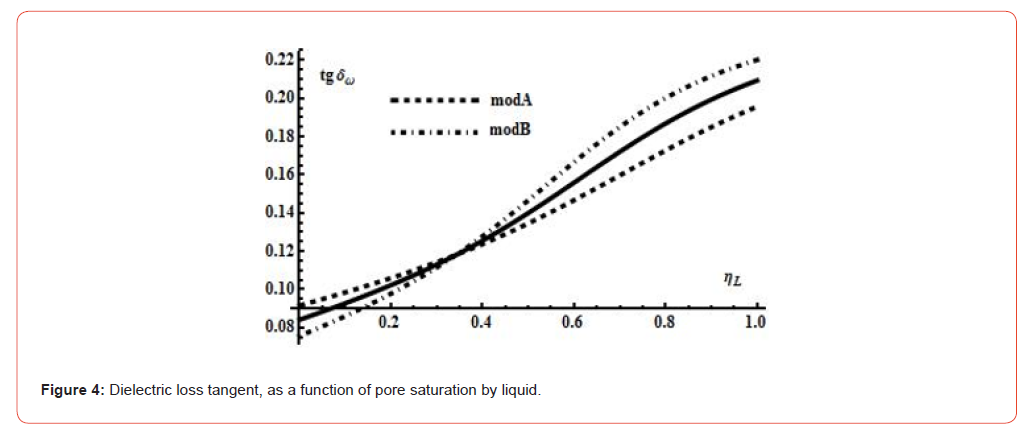
Below is also graphically depicted (Figure 4) the dependence of
the dielectric loss tangent angle  at different
humidity values ηL of the investigated porous material at a specified
frequency of microwave irradiation.
at different
humidity values ηL of the investigated porous material at a specified
frequency of microwave irradiation.
For such a material, according to the moisture dependence L η
from the effective pore radius  is established [15], that under porosity
ϕ = 0, 46 from the effective pore radius
is established [15], that under porosity
ϕ = 0, 46 from the effective pore radius  and critical
 pore fluid saturation, as well as the value of the model
parameter m = 0,67 in the semi-empirical model of moisture
release or retention by van Genuchten [16]. Then, according to
relation (31), the macroscopic (homogeneous or uniform) value
of wetting of such (porous) material under normal conditions is
(when
pore fluid saturation, as well as the value of the model
parameter m = 0,67 in the semi-empirical model of moisture
release or retention by van Genuchten [16]. Then, according to
relation (31), the macroscopic (homogeneous or uniform) value
of wetting of such (porous) material under normal conditions is
(when  , where
  - external pressure relative
to the moistened macroscopic porous material) corresponds to value
- external pressure relative
to the moistened macroscopic porous material) corresponds to value
 , which coincides with the maximum of the pore size
distribution function over the effective radius.
, which coincides with the maximum of the pore size
distribution function over the effective radius.
Under the described conditions of uniform (homogeneous)
wetting of the porous material, the absorption indices (23) and
propagation (24) of the TEM wave, as well as the transmission and
reflection coefficients in expressions (1.16) for the amplitudes of
the electromagnetic wave on the boundary surfaces of the porous
plate (Figure 1) do not depend on time due to the constant value
 of liquid saturation. In this case, the distribution of EMF power
in the material under symmetric microwave irradiation according
to (27) is determined by the thickness L of plate, equilibrium value
of pore saturation with liquid
of liquid saturation. In this case, the distribution of EMF power
in the material under symmetric microwave irradiation according
to (27) is determined by the thickness L of plate, equilibrium value
of pore saturation with liquid  and dielectric (relaxation)
properties of the phases. This is due to the fact that, that ЕУКДДП
and dielectric (relaxation)
properties of the phases. This is due to the fact that, that ЕУКДДП
 moistened porous material (ϕ = 0, 46 )is defined according to
the EMA approximation [3] (30) (Figure 2 and Figure 3), as well as
the dielectric loss tangent tg δω (Figure 4), are determined by the
equilibrium constant value
moistened porous material (ϕ = 0, 46 )is defined according to
the EMA approximation [3] (30) (Figure 2 and Figure 3), as well as
the dielectric loss tangent tg δω (Figure 4), are determined by the
equilibrium constant value
 saturation of pores with liquid.
Then the power of internal heat sources (microwave heating) according to expression (28) for the EMF energy flow in the plate material can be calculated numerically and displayed graphically in Figure 5 and Figure 6.
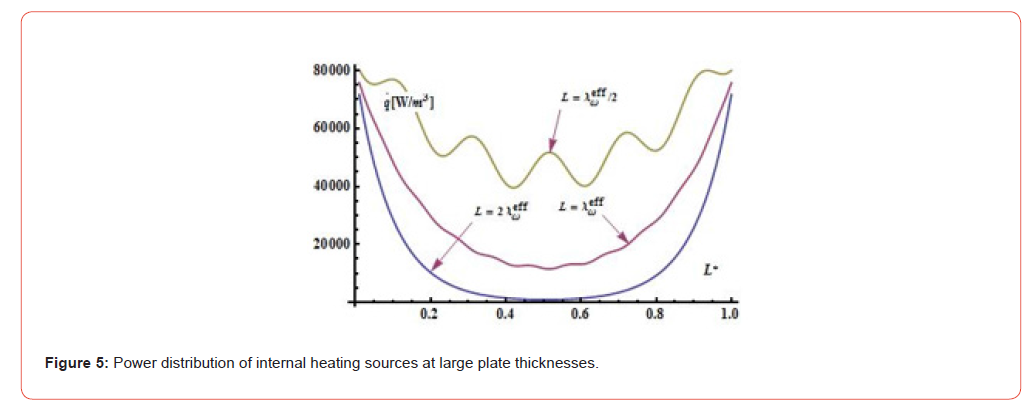
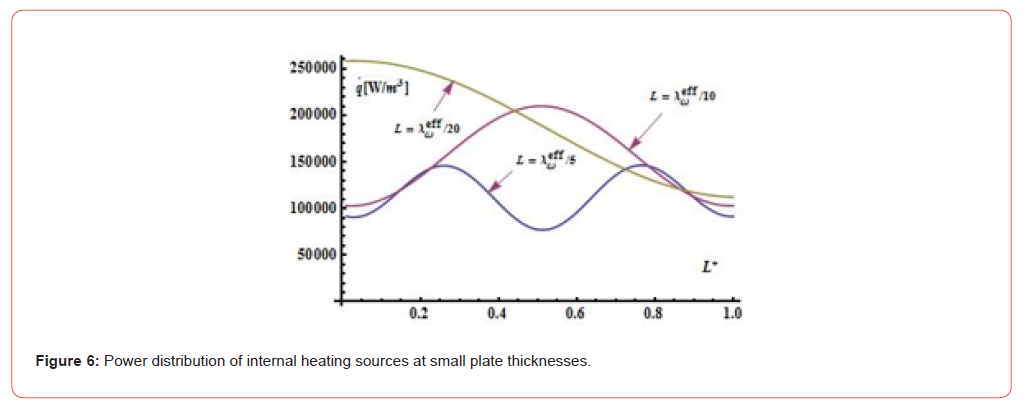
Graphical results of numerical modeling (Figure 5 and Figure
6) of the power of internal (volumetric) heat sources  in a
porous (unconfined) moistened plate at different thicknesses L
of plate (where L = nΔL / L(n = ΔL / L) - dimensionless plate
thickness, and n - number of breakpoints), which are multiples of
the wavelength
in a
porous (unconfined) moistened plate at different thicknesses L
of plate (where L = nΔL / L(n = ΔL / L) - dimensionless plate
thickness, and n - number of breakpoints), which are multiples of
the wavelength  in the environment, obtained for the following
values of microwave irradiation parameters and properties (parameters
or characteristics) of the investigated porous material:
1. External microwave irradiation: power -
in the environment, obtained for the following
values of microwave irradiation parameters and properties (parameters
or characteristics) of the investigated porous material:
1. External microwave irradiation: power -  , frequency -
  ; 2. Porous humidified medium:
ϕ = 0, 46 - averaged porosity,
; 2. Porous humidified medium:
ϕ = 0, 46 - averaged porosity,  - intrinsic
permeability of the skeleton,
- intrinsic
permeability of the skeleton,  - equilibrium
saturation of pores with liquid, T = 298,15[K] - thermodynamic
temperature,
- equilibrium
saturation of pores with liquid, T = 298,15[K] - thermodynamic
temperature, 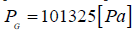 - pressure value in the gas phase,
 - the length of an electromagnetic wave
in a medium.
- the length of an electromagnetic wave
in a medium.
The strength criterion for a moistened porous plate, the dielectric properties of which are described by relations (1)-(31), is formulated as [18]:

where P(J) - function of the boundary surface in the deviatoric
plane; σ0 =I1 /3 - average tension; τ0 =(2J2/3)0,5 -octahedral shear
stress; I1 the first invariant of the stress tensor; J2, J3 - second and
third invariant of the stress deviator; 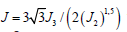 - alternative
invariants of stress deviators J2, J3; α, β, C0, C1, C2 – material constants
that are established experimentally based on the methodology
[18].
- alternative
invariants of stress deviators J2, J3; α, β, C0, C1, C2 – material constants
that are established experimentally based on the methodology
[18].
There is a transition layer with sufficient adhesion between the liquid in the pore and the solid phase. Adhesive bond energy γad and it changes Δγad depend on the energy characteristics of the coating and the porous carcase [19]. Let us formulate the strength criterion [19] for the transition layer at the pore boundary in the form
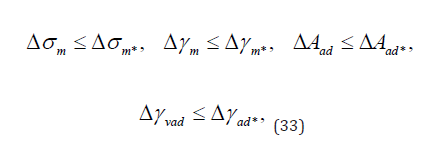
where Δσm – change in interfacial tension; Δγm – change in interfacial energy; Δ – symbol of deviation (change) of a parameter or energy characteristic of the surface (interfacial) layer; ΔAad – change in adhesion work; Δσm#, Δγm#, Δ Aad#, Δγad#– empirical constants.
Relations (31), (32) together constitute a generalized version of the strength criterion for a porous material (such as concrete). The parameters of expression (31) are determined on the basis of experiment, and the parameters of relations (32) are estimated on the basis of a computational experiment [20].
If adhesion is broken, the pore size increases, the pores merge and can form a crack (a microcrack to begin with).
The criteria for ultimate plasticity ΘT and strength ΘS for the tip of a defect (microcrack) can be formulated as dimensionless relations.
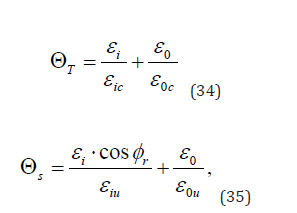
where εi - intensity of deformations; ε0 - volumetric deformation; ϕr - volumetric deformation, рад; εic - intensity of destructive deformations; ε0c - destructive volumetric deformation; εiu – ultimate strain intensity; ε0u -limiting volumetric deformation.
Transition from deformation components εjk (34) and (35) to mechanical stresses σjk We carry out the calculations based on the model relations described in the work [19] (j, k =1, 2, 3). In particular, an equation of the Hooke’s law type is used.
Due to the influence of internal gas and liquid pressure in the pore, a zone of plastic deformation appears in the vicinity of the crack tip, to which the pressure corresponds pcr1(σT), and in the second stage – a critical state pcr2 (σS) [σT – plastic limit; σS – strength limit (destructive stress of a solid body, i.e. a skeleton)]
Parameters pcr1 and pcr2 are important for assessing the strength, reliability, and service life of a porous material under the influence of internal (volumetric) heat sources.
Let us supplement the relation (32)-(35) with the expression of
the limitation on the power of internal heat sources  , which
is determined from the relation (29) taking into account (30) and
(31):
, which
is determined from the relation (29) taking into account (30) and
(31):
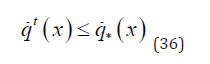
where  – the maximum value of the power of internal
heat sources that lead to the destruction of the porous body.
– the maximum value of the power of internal
heat sources that lead to the destruction of the porous body.
Relations (29)–(36) constitute a new version of the strength criterion for a porous body (compared to (32)–(35)) taking into account the power of internal heat sources that lead to the destruction of the porous body (i.e., to the formation of a micro crack, which over time can turn into a main crack).
Conclusions
From the considered graphical dependencies it follows that
at plate thicknesses the exponential law of power attenuation
of Beer-Lambert microwave heating sources is realized [16].
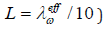
If  wave a periodical effects occur (see Figure 5 (when
 and Figure 6 (when
  and
and
 , which can be localized at plate thicknesses that are
commensurate with the minimum (Fig. 6,when
, which can be localized at plate thicknesses that are
commensurate with the minimum (Fig. 6,when  and
and
 ) symmetric with respect to the center of the plate, the
anharmonicity value. It is clear that the wave (aperiodic) properties
of heat sources will change depending on the value of equilibrium
humidification
) symmetric with respect to the center of the plate, the
anharmonicity value. It is clear that the wave (aperiodic) properties
of heat sources will change depending on the value of equilibrium
humidification
 porous plate material, which is determined
by the structure parameters: ϕ - porosity and kin - the inherent
permeability of the skeleton. Criterion ratios have been formulated
for assessing the strength of a porous material, taking into account
the power of internal heat sources that lead to the destruction of a
porous body.
porous plate material, which is determined
by the structure parameters: ϕ - porosity and kin - the inherent
permeability of the skeleton. Criterion ratios have been formulated
for assessing the strength of a porous material, taking into account
the power of internal heat sources that lead to the destruction of a
porous body.
Acknowledgements
The author is grateful to the parents for their patience in conducting this study.
Conflict of Interest
No conflict of interest.
References
- Lee, S hyun, Kim Mi Na (2008) This is my paper, ABC Transactions on ECE 10(5): 120-122.
- Gizem, Aksahya, Ayese, Ozcan (2009) Communications & Networks, Network Books, ABC Publishers.
- Howes AH, Whitaker S (1980) The spatial averaging theorem revisited, Chemical Engineering Science 23(12): 1613-1623.
- (2006) Моделювання та оптимізація в термомеханіці електропровідних неоднорідних тіл (під. ред. Я.Й.Бурака і Р.М. Кушніра, Т 1,2) - Львів: Сполом, 474с.
- Hachkevych O R, Terlets’kyi RF, Holubets’ TV (2010) Calculation of effective electrophysical characteristics of moitened porous, Journ. of Math. Sci 168(5): 699-711.
- Ландау Л.Д., Лифшиц Е.М. Электродинамика сплошных сред.-Москва: “Наука”, 1982.
- Wyrwal J (2004) Thermodynamiczne podstawy fizyki budowli. Opole: Politechnika Opolska, 251s.
- (1972) IUPAC. Manual of symbols and terminology for physico-chemical quantities and units. Appendix II, Pure and Appl. Chemistry 31(4): 577-621.
- Семенов (1973) НА Техническая електродинамика, М: Связь, 480с.
- Каценеленбаум БЗ (1966) Высокочастоная електродинамика. Основы математического апарата, М: Наука,.240с.
- Ugwu EI, Agbo A (2007) Wave propagation in non-homogenous thin films of slowly varing refractive index: W.K.B. solution model, The Pacific Journal of Science and Technology 8(2): 246-251.
- Ayappa KG, Davis HT, Barringer SA, Davis EA (1997) Resonant microwave power adsorption in slabs and cylinders. I. Ch. I. Journal 43(3): 615-624.
- Basak T (2003) Analysis of resonances during microwave thawing of slabs, International Journal of Heat and Mass Transfer 46: 4276-4301.
- Chamchong M, Datta AK (1999) Thawing of foods in a microwave over. Effect of power levels and power cycling, Jounal of Microwave Power and Electromagnetic Energy 34: 9-21.
- Zang H, Datta AK, Taub IA, Doona C (2001) Electromagnetics heat transfer and thermokinetics in microwave strerilization, A. I. Ch. I. Journal 47: 1957-1968.
- Голубець ТВ, Терлецький РФ (2011) Застосування методу W.K.B. до розрахунку діелектричних втрат у пористому зволоженому середовищі за мікрохвильового опромінення, Прикладні проблеми механіки і математики 9: 22-129.
- Holubets TV (2016) Investigation of the structural properties of porous material according to the sorption isoterms or dranage curves, Mathematical Mjdelling and Computing 3(1): 23-32.
- Van Genuchten MT (1980) A Closed-Form Equation for Predicting the Hydraulic Conductivity of Unsaturated Soils, Soil Science Society of America Journal 44(5): 892-898.
- Swinehart J (1962) The Beer-Lambert law, J. Chem. Educ 39(7): 333.
- V Yuzevych, N Pavlenchyk, O Zaiats, N Heorhiadi, V Lakiza (2020) Qualimetric Analysis of Pipelines with Corrosion Surfaces in the Monitoring System of Oil and Gas Enterprises, International Journal of Recent Technology and Engineering (IJRTE) 9(1): 1145-1150.
- Podgórski J (2016) The criterion for determining the direction of crack propagation in a random pattern composites, Meccanica 52(8): 1923-1934.
- Koman BP, Yuzevich VM (2015) Energy Parameters of Interfacial Layers in Composite Systems: Graphene - (Si, Cu, Fe, Co, Au, Ag, Al, Ru, Hf, Pb) and Semiconductor (Si, Ge) – (Fe, Co, Cu, Al, Au, Cr, W, Pb), Journal of nano- and electronic physics 7(4): 04059-1,04059-7.
-

This work is licensed under a Creative Commons Attribution-NonCommercial 4.0 International License.




