




 Mini-Review Article
Distributed AI for Robotics and Automation: From Multi-Agent Coordination to Federated Edge Learning
Received Date: September 09, 2025; Published Date: September 17, 2025
Abstract
Distributed AI (DAI)-encompassing multi-agent coordination, distributed control, and federated/edge learning-is now central to automating
robotic work cells and mobile fleets where tight latency budgets, data sovereignty, and operational resilience dominate system design. Rather than
a monolithic “brain in the cloud,” a DAI approach decomposes autonomy into local perception/decision/control loops with only the necessary
coordination across peers. This mini-review distils a practical blueprint:
(i) Multi-robot task allocation and consensus to decide who does what, when;
(ii)Distributed model predictive control (DMPC) to decide how robots move together safely and efficiently;
(iii)Federated learning (FL) to adapt perception and predictive models on-device; and
(iv)Runtime safety envelopes via Control Barrier Functions (CBFs). We emphasize edge-first layering (cell → line/fleet → plant/cloud), standardsbased
interoperability (ROS 2/DDS and OPC UA), and twin-first validation. The core message is actionable: combining auctions/consensus, DMPC,
FL, and CBFs over deterministic ROS 2/DDS transports provide a tractable path from pilots to brownfield scale-up without sacrificing safety, uptime,
or auditability.
Keywords:Distributed AI; Multi-robot systems; Federated learning; Dis- tributed MPC; ROS 2; DDS; OPC UA; Digital twin; Multi-agent RL; Runtime safety
Abbreviations:DAI: Distributed Artificial Intelligence; MARL: Multi-Agent Reinforcement Learning; DMPC: Distributed Model Predictive Control; FL: Federated Learning; CBF: Control Barrier Function; AMR: Autonomous Mobile Robot.
Introduction
Modern robotic lines and AMR fleets are cyber-physical systems (CPS) with geographically and functionally distributed intelligence. Centralized orchestration often collapses under real- time jitter, privacy constraints, and single points of failure. The DAI framework in [1] addresses these limitations by structuring autonomy around cooperating agents that keep fast loops local while exposing lean, standards-based interfaces for coordination. This framing bridges long-standing strands of research-task allocation and consensus for multi-robot cooperation [2-4], dis- tributed optimal control for joint motion planning [5], and edge learning for perception & maintenance [6, 7]-into a deployable, modular stack. Interoperability and determinism are achieved by combining ROS 2’s publisher/ subscriber graph with DDS Quality- of-Service (QoS) policies for reliability, deadlines, and liveliness [8, 9]. OPC UA (IEC 62541) bridges IT/OT boundaries via secure information models [10]. Digital twins de-risk change management by stress-testing policies and control updates before rollout [11, 12]. Together, these ingredients transform autonomy from a lab artifact into a production capability with traceable behavior and service-level objectives (SLOs).
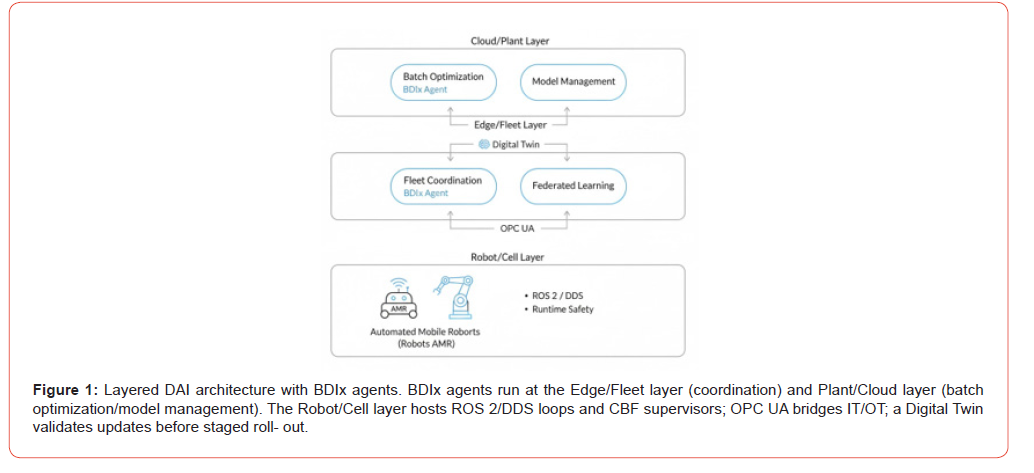
DAI Framework (According to [1])
Layering and roles. Robot/Cell agents (ROS 2 nodes on robots/ PLCs) close sub-10ms loops for actuation, perception pre- processing, and device health. The Edge Line/Fleet layer arbitrates shared resources (e.g., aisle right-of-way, tool/changeover windows) and schedules jobs under local constraints. The Plant/Cloud layer handles slower-time-scale optimization (e.g., shift-level scheduling), model lifecycle (train/validate/sign), and global KPIs. Clear role separation prevents control interference and simplifies certification. Communication. DDS QoS provides predictable pub/ sub behavior (bounded latency, reliable delivery, liveliness monitoring). Topics encode state, intents, and bids; namespaces isolate cells while enabling selective cross-cell exchange. OPC UA exposes equipment hierarchies and alarms to MES/SCADA and supports secure handshakes for command authorization.
Learning at the edge. FL aggregates model updates rather than raw data, preserving privacy while leveraging fleet-wide experience [6, 7]. Non-IID data and connectivity heterogeneity are handled via client sampling, adaptive learning rates, and compression (e.g., sparsification/quantization). On-device drift detectors trig- ger light-weight personalization between federated rounds. Assurance and safety. CBF-based supervisors wrap learned or optimal controllers. At each cycle, a small QP minimally modifies the command to keep the system within a certified safe set [13]. This yields graceful degradation during anomalies (sensor dropout, packet loss) and makes learning compatible with safety standards.
Automation Patterns & How-To
Who does what, when
Use the Gerkey-Matarić taxonomy to match problem structure to allocation methods [2]. Market-based approaches (auctions, contract nets) scale gracefully under changing workloads by converting tasks into bids scored on travel time, energy, capability, and deadlines [3]. Distributed consensus stabilizes shared beliefs (e.g., queue states) and enables coordinated decisions without a central arbiter [4]. In non-stationary environments, MARL can learn dispatching heuristics online; policy updates should be rate-limited, with rollback hooks and CBF-wrapped exploration to bound risk.
How robots move together
DMPC couple’s local trajectory optimizers through exchanged
plans or compact intent messages [5]. Practical deployments rely
on:
(i) short horizons with warm starts from the last feasible plan;
(ii) constraint tightening to absorb model mismatch;
(iii) asynchronous updates to tolerate network jitter; and
(iv) priority rules for deadlock-prone spaces (narrow aisles, intersections).
Feasible- but-suboptimal plans are preferred
over brittle global optima; CBF layers guarantee collision and
speed-limit compliance if neighbours misbehave or packets
drop.
Learning at the edge
For vision/QA and predictive maintenance, FL avoids central data pooling. Choose compact backbones that fit device memory and thermal envelopes; schedule federated rounds off-shift or during charging. Handle device churn with partial participation; use twin- generated augmentations for rare defect classes. Maintain a signed model registry; only models that pass twin-based regression and safety checks are promoted to production.
Trust and safety
CBFs define forward-invariant safe sets from task-relevant constraints (separation, speed near humans, keep-out zones). Each cycle solves a tiny QP to project the nominal action back into the safe set with minimum deviation [13]. This makes safety orthogonal to the controller choice (PID, DMPC, RL) and provides auditable guarantees that align with certification audits.
Brownfield checklist (quick start)
• Pilot a cell: Map robot/PLC I/O to ROS 2 nodes; tune DDS QoS
(reliable, deadline, liveliness) for state/control topics; ex- pose
PLC tags via OPC UA with role-based access.
• Edge coordinator: Start with auctions for tasking; add DMPC
for shared-space traffic; encode simple priority rules to break
ties.
• FL loop: Deploy a compact model per robot; run nightly/weekly
federated rounds; enable on-device drift triggers for interim
adaptation; track model lineage.
• Safety: Wrap controls with CBF supervisors; add health checks
and watchdogs; PTP time-sync for consistent logs and event
ordering.
• Twin-first: Validate policies and models in the digital twin; use
staged rollouts (canary → cell → line); monitor KPIs and autorollback
on regression.
Case Vignette: AMRs with Edge Vision & DMPC
Consider a kitting line with heterogeneous AMRs. Each robot runs a ROS 2 stack providing localization, battery/health telemetry, and an on-device defect detector for bins. A line-edge coordinator exe- cutes periodic auctions that assign pick missions using bid scores combining distance, residual battery, and congestion estimates. A DMPC layer regulates hallway right-of-way: robots share planned velocities over DDS; when packets arrive late, CBF supervisors bound speeds and enforce separation until the plan refreshes. Federated rounds aggregate detector updates during the night shift, while a twin replays the next day’s job mix and human traffic pat- terns to validate the candidate model before promotion. This combination reduces dispatch oscillations, smooths hallway flows, and contains risk: when one AMR reboots mid-mission, others replan locally while CBFs ensure safe yields.
Conclusion
DAI turns autonomy into an engineered system property: agents negotiate tasks, coordinate motion, and adapt perception locally, while twins, DDS/OPC UA, and CBFs keep behavior predictable, explainable, and certifiable. The framework in [1] offers a pragmatic path from pilots to fleet-scale deployments-with measurable gains in throughput and availability-without surrendering safety or data control.
Acknowledgements
The author thanks colleagues at CYENS and the University of Cyprus.
Conflict of interest
The author declares no conflicts of interest.
References
- Ioannou I, Nagaradjane P, Vassiliou V, Pitsillides A, Christophorou C (2024) Distributed Artificial Intelligence for 5G/6G Communications: Frameworks with Machine Learning (1st ed.). CRC Press.
- Gerkey BP, Matarić MJ (2004) A formal analysis and taxonomy of task allocation in multi-robot systems. Int J Robotics Res 23(9): 939-954.
- Dias MB, Zlot R, Kalra N, Stentz A (2006) Market-based multirobot coordination: a survey and analysis. Proc IEEE 94(7): 1257-1270.
- Olfati Saber R, Fax JA, Murray RM (2007) Consensus and cooperation in networked multi-agent systems. Proc IEEE 95(1): 215-233.
- Camponogara E, Jia D, Krogh BH, Talukdar S (2002) Distributed model predictive control. IEEE Control Syst Mag 22(1): 44-52.
- McMahan HB, Moore E, Ramage D, Hampson S, Aguëra y Arcas B (2017) Communication-efficient learning of deep networks from decentralized data. AISTATS. arXiv:1602.05629.
- Bonawitz K, Eichner H, Grieskamp W (2019) Towards federated learning at scale: System design. arXiv:1902.01046.
- Maruyama Y, Kato S, Azumi T (2016) Exploring the performance of ROS 2. Proc 13th ACM Int Conf.
- Object Management Group (2015) Data Distribution Service (DDS) v1.4.
- Mahnke W, Leitner S-H, Damm M (2009) OPC Unified Architecture. Springer.
- Negri E, Fumagalli L, Macchi M (2017) A review of the roles of digital twin in CPS-based production systems. Procedia Manufacturing 11: 939-948.
- Lu Y, Liu C, Wang K, Huang H, Xu X (2020) Digital twin-driven smart manufacturing: reference model and applications. Robotics Comput-Integr Manuf 61: 101837.
- Ames AD, Xu X, Grizzle JW, Tabuada P (2017) Control barrier function based quadratic programs for safety critical systems. IEEE Trans Autom Control 62(8): 3861-3876.
-

This work is licensed under a Creative Commons Attribution-NonCommercial 4.0 International License.




