

 Mini- Review
Phantom Puffs: A Phantom Lung to Emulate Smoking Behavior
Received Date:August 28, 2024; Published Date:September 10, 2024
Abstract
Testing sensors on human subjects is fraught with challenges such as extensive setup times and inconsistent data collection. This study explores the use of phantom organs as a solution to streamline sensor testing and validation. By replicating essential organ functions, phantom organs can provide a consistent and repeatable testing environment, improving data accuracy and reliability. Our development of a phantom lung, capable of emulating human breathing patterns, exemplifies this approach. This phantom lung could facilitate the testing of ENDS monitoring sensors, allowing for the safe and controlled simulation of smoking combustible and electronic cigarettes. The use of phantom organs not only reduces reliance on human subjects in sensor development but also fosters innovation by allowing experimentation with novel sensing mechanisms. This research highlights the potential of phantom organs to revolutionize sensor testing practices, ultimately accelerating the advancement of sensing technologies in various fields.
Introduction
Sensor testing on human subjects presents numerous challenges, including extensive setup times, and inconsistent and potentially limited data collection. The development of phantom organs and body parts offers a promising solution [1] enabling more efficient sensor testing and validation. By focusing on replicating essential organ functions rather than their complex intricacies, researchers can streamline testing procedures, improve data collection, and advance sensor technologies with greater efficiency. This paper explores the benefits and implications of using phantom organs in sensor development, particularly in Electronic Nicotine Delivery Systems (ENDS) monitoring systems.
Traditional sensor testing on human subjects often requires elaborate preparations and adherence to ethical standards, which can be time-consuming and resource intensive. Human variability can introduce inconsistencies in sensor testing, making it difficult to obtain reliable data. Phantom organs provide a consistent and repeatable testing environment, ensuring that sensors are evaluated under uniform conditions. This consistency enhances the accuracy and reliability of the data collected, facilitating the optimization of sensor performance. Moreover, using phantom organs in sensor development opens new avenues for innovation. Researchers can experiment with novel sensing mechanisms and materials without the ethical and practical constraints associated with human testing. This freedom fosters creativity and accelerates the discovery of groundbreaking sensor technologies that can be applied in various fields, including healthcare, environmental monitoring, and consumer electronics.
Overview
One notable application of phantom organs in sensor development is the creation of an phantom lung designed to emulate human breathing patterns. This phantom lung can accurately replicate the inspiration and expiration air pressures of the human pulmonary system, providing a safe and realistic testing environment for monitoring gas intake. Specifically, we leveraged this to monitor the use of electronic nicotine delivery systems (ENDS). The following are key aspects of this development.
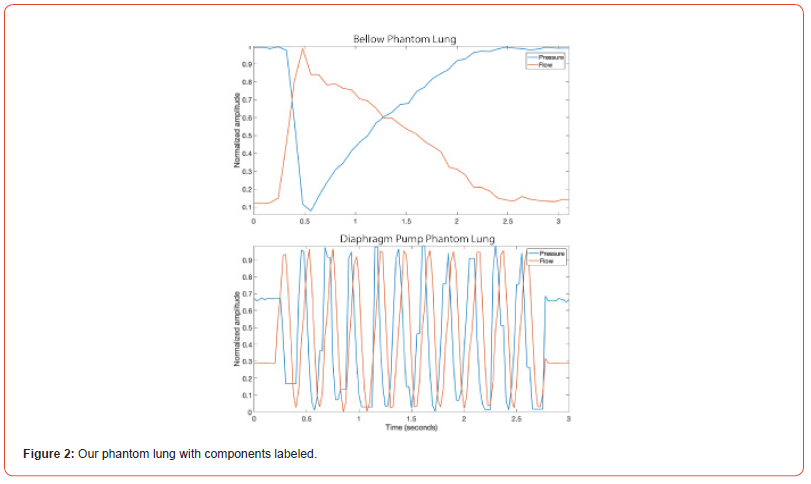
Emulating Human Breath: Typically, to move gas we leverage electronic pumps. There are a few variations in the mechanisms that move the air. For smaller systems, they are typically either peristaltic or diaphragm pumps. While the mechanism to move the air in these systems is very different, they each work by displacing a fixed volume of gas with the output dependent on the rate of displacement. The human pulmonary system, however, works by inflating the lungs in one continuous stream of intake and deflating the lungs in a continuous output of gas. In figure 2 we show how the flow and pressure of gas through a tube behaves when using a diaphragmatic pump. As seen, it is a repeating pattern of high and low pressure, showing the volume of gas moved by the diaphragm of the pump.
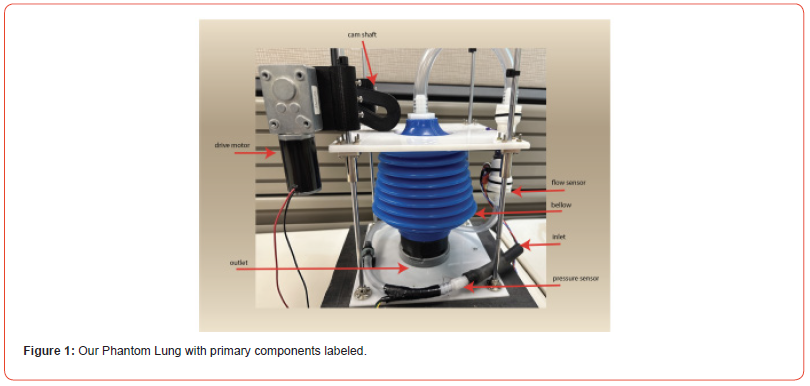
While with the right setup, we can minimize this, it never goes away entirely. To resolve this, we leveraged a bellow, which has a continuous draw of gas through the inlet (figure 1). To drive this mechanism, we use a worm-gear motor with a camshaft. By adjusting the distance of the shaft to the top plate of the bellow, we can control the amount of displaced gas. With the currently sized cam shaft, we can change the range of 200ml (a small child’s lungs) to 500ml of air displaced (a large adult’s lungs). The phantom lung mimics the dynamic process of human breathing, including the morphology of the waveform, volume, variations in air pressure during inhalation and exhalation. This emulation is crucial for testing sensors used with respiratory activities, as it ensures that the sensors respond accurately to real-life conditions.
Testing Combustible tobacco and ENDS: By using the phantom lung, researchers can simulate the act of smoking both traditional combustible cigarettes and ENDS [2]. This capability allows for the development and testing of devices that monitor the use of these products, such as sensors that detect nicotine levels, harmful chemicals, and usage patterns [3]. The phantom lung provides a controlled and safe environment for such experiments, eliminating the need for human subjects during the initial development.
Advancing Monitoring Technologies for ENDS: The data collected from tests using the phantom lung can be used to refine and enhance ENDS monitoring sensors [4]. For instance, sensors can be calibrated to detect specific substances with greater accuracy or to provide real-time feedback to users. This iterative process of testing and refinement is crucial for developing effective and reliable ENDS monitoring systems that can help address public health concerns related to smoking and vaping.
Conclusion
The integration of artificial organs into sensor development represents a significant advancement in the field of sensing technology. By replicating key organ functions, researchers can streamline testing procedures, improve data collection, and foster innovation. The case study of the artificial lung for ENDS monitoring demonstrates the practical benefits of this approach, highlighting its potential to revolutionize sensor testing and validation practices. As technology continues to evolve, the use of artificial organs in sensor development is poised to accelerate innovation and enhance the performance of sensors across various applications, ultimately contributing to improved public health and safety.
Acknowledgement
None.
Conflict of Interest
No conflict of interest.
-

This work is licensed under a Creative Commons Attribution-NonCommercial 4.0 International License.