


 Mini Review
Operative Technique: Early Anterior Approach in Total Mesorectal Excision in Robotic Surgery
Received Date:November 11, 2024; Published Date:December 05, 2024
Abstract
Total Mesorectal Excision has been described in numerous ways, from laparotomy to minimally invasive techniques such as laparoscopy and robotic surgery. However, there is a challenge for each type of technique, the most difficult of which is standardization. This is due to various surgeons giving their opinions without a consensus on the technique. To this end, we decided to standardize the early anterior approach in Total Mesorectal Excision as an option for improving the robotic technique.
Description of the technique
Since the introduction of total mesorectal excision by Heald [1,2,3], this practice has become the gold standard for improving oncological results in surgery for the resection of malignant rectal tumors. In addition to resection, neoadjuvant treatment and pathological assessment are also used, thus achieving a reduction in locoregional recurrence with very significant results. This whole discussion, when it was introduced to the world of colorectal surgery, was initially discussed in laparotomic surgeries, but with the advent of minimally invasive techniques, this resection has become more visible and palpable, avoiding complications through better imaging and the introduction of medical device that have an impact on bleeding control and ergonomics, as well as safer suturing and stapling, avoiding fistulas and/or colonic ischemia [4]. However, about minimally invasive aspect, there are many ways of standardizing total mesorectal excision in order to improve ergonomics and achieve resection with the appropriate oncological standards [5,6]. Discussing laparoscopy, the challenge is how to have a good exposure to the rectum through traction and contraction, in addition to the learning curve being a long one of high-volume demand to acquire experience. When dealing specifically with the rectum, this learning curve increases a little more, from 30 to 40 cases of experience on supervision from a teacher [5].
There are currently numerous ways of approaching the mesorectum, and a standardized approach has already been published, with the posterior wall first followed by the anterior wall. This approach was standardized due to an international questionnaire with various experts and in most of them this was the most widely used laparoscopic approach. Mainly due to the fact that traction has to be done by the assistant and therefore anterior traction needs posterior space to be exposed [5]. Nowadays with the introduction of robotic surgery, other questions began to be asked, including whether the standardization of total mesorectal excision should be the same as laparoscopic excision. With this in mind, we currently have a more active platform on the market, but numerous other platforms are already being implemented, so a standardization that adapts to the resection will make it easier to disseminate the technique and thus increase the quality of robotic surgery. It is clear that there are several factors that increase the difficulty of resection and dissection, ranging from obesity, age, radiotherapy and the surgeon’s experience. The proposal would be to take an early approach to the anterior route of the rectum in order to allow for greater angulation of the rectum and thus avoid nerve damage.
The rationale for taking an anterior approach is to widen the view of the attack by increasing the angle at which the posterior dissection can be performed. Due to the fact that laparoscopically there is a need to gain space for the traction of the assistant, the posterior approach was necessary first, however with better visualization of the robot and the articulation of the clamps, the anterior approach would be easier and since the anterior approach is the most difficult technical part and so the early anterior approach can show this pathway more easily. Therefore, the early anterior approach, step by step, would only change as the angle is increased in order to acquire more space for dissection.
For this approach no matter if you are using DaVinciTM X or Xi, the approach of the trocars is the same.
Technique step by step
1. Position of the trocars
2. Open the anterior fascia of the rectum
3. Exposition of the Dennovelier’s fascia
4. Open anterior space (pushing back to the promontorium)
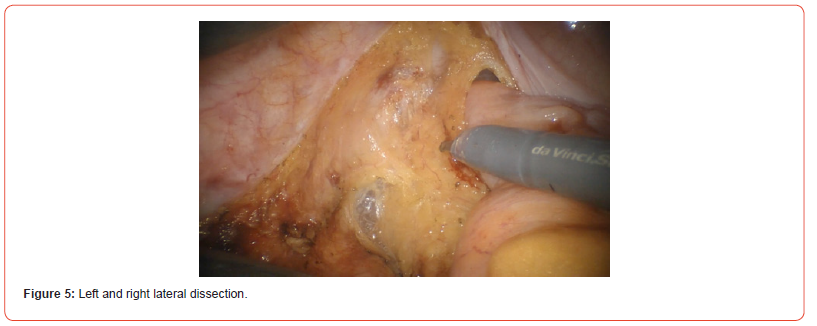
5. Left and right lateral dissection
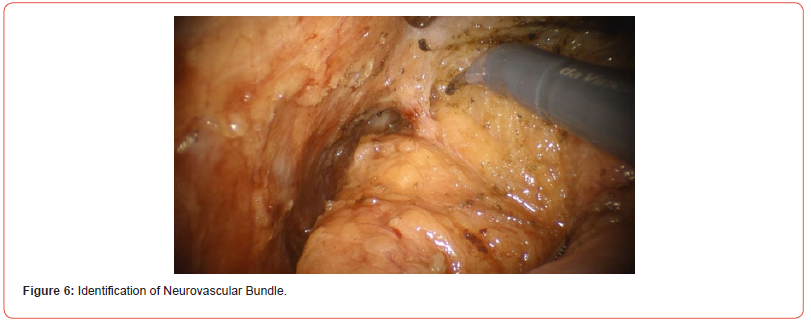
6. Identification of Neurovascular Bundle
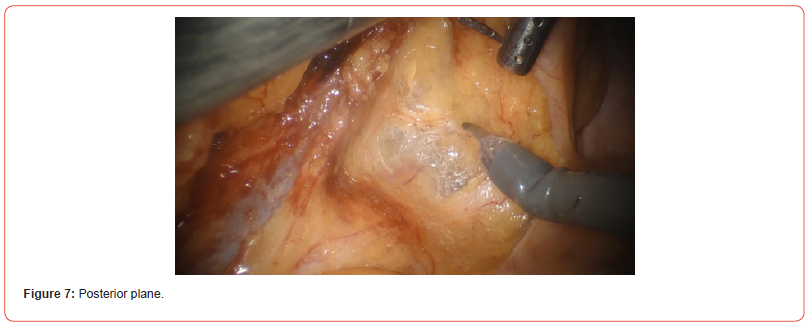
7. Posterior plane
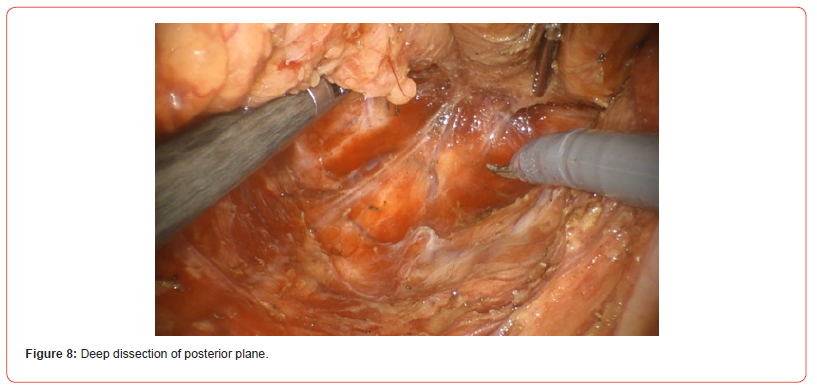
8. Deep dissection of posterior plane
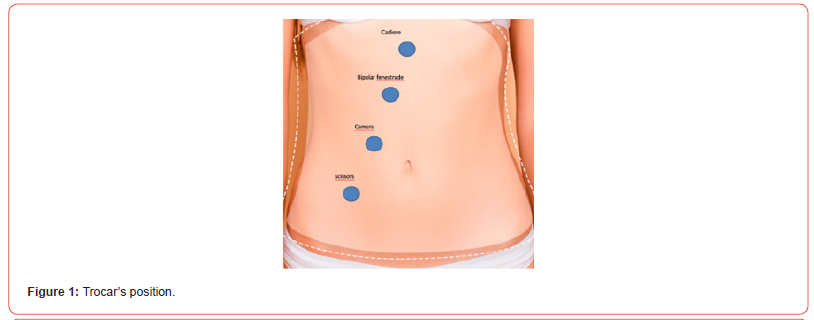
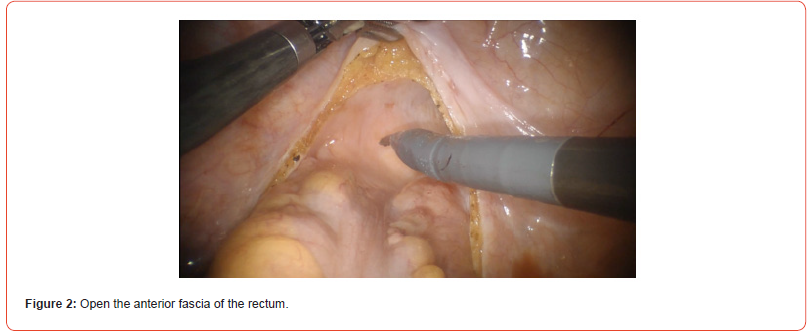
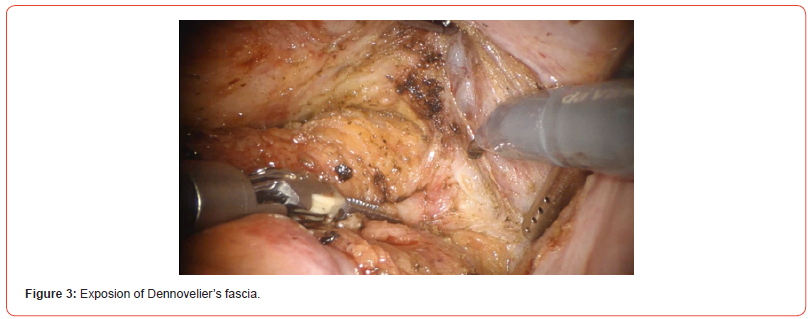
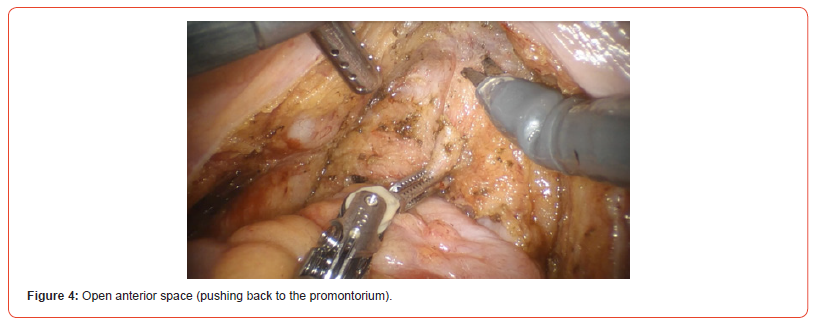
As you can see in this picture the anterior approach first you can provide a good exposition of the anterior organs, and you can have more traction before starting the posterior dissection.
Conclusion
Although there is standardization of the technique for accessing the mesorectum via laparoscopy, the robotic approach, as well as other access routes, must be considered in order to form the best resection, since they are access routes with different platforms. In this way, the early anterior approach can be an access route that helps to avoid injuries when the access is robotic.
Acknowledgement
None.
Conflict of Interest
No conflict of interest.
References
- Heald RJ (1979) A new approach to rectal cancer. Br J Hosp Med. 22(3): 277-281.
- Miskovic D, Foster J, Agha A, Delaney CP, Francis N, et al. (2015) Standardization of laparoscopic total mesorectal excision for rectal cancer: a structured international expert consensus. Ann Surg. 261(4): 716-22.
- Knol J, Keller DS (2020) Total Mesorectal Excision Technique-Past, Present, and Future. Clin Colon Rectal Surg. 33(3): 134-143.
- Knight CD, Griffen FD (1980) An improved technique for low anterior resection of the rectum using the EEA stapler. Surgery. 88(5): 710-714.
- Heald RJ (1988) The Holy Plane of rectal surgery. J R Soc Med. 81(9): 503-508.
- Heald RJ, Santiago I, Pares O, Carvalho C, Figueiredo N (2017) The Perfect Total Mesorectal Excision Obviates the Need for Anything Else in the Management of Most Rectal Cancers. Clin Colon Rectal Surg. 30(5): 324-332.
-

This work is licensed under a Creative Commons Attribution-NonCommercial 4.0 International License.