

 Mini-Review
From Industry 4.0 To Industry 5.0: The Evolution of Robotics and Automation
Received Date:May 31, 2025; Published Date:June 23, 2025
Introduction
This paper examines the trajectory from Industry 4.0 to Industry 5.0, addressing how intelligent automation is reshaping industries and societies globally. The ongoing digital transformation necessitates a closer look at how technologies like artificial intelligence (AI), robotics, and the Internet of Things (IoT) are moving beyond efficiency and productivity to embrace human-centric, sustainable, and value-driven goals. Industry 5.0 is built on the progress made in Industry 4.0. While Industry 4.0 brought about smart factories and connected technologies, Industry 5.0 takes it further by blending the unique strengths of people, like creativity and problem- solving, with the speed and accuracy of machines. This, therefore, changes how we think about the goal of the industry, not only about technology improvement. it also queries the fairness in innovation, the responsible use of technology, and how jobs will evolve. In addition, this paper takes a look at all these and also explores the potential advantages and possible disadvantages.
Historical Overview: From Industry 1.0 to 5.0
There is an interesting history of industrialization and industrial
revolutions. The history offers valuable insights into how production
and society have evolved:
• Industry 1.0 (Late 18th Century): Industry 1.0 severely
changed the world. It was more than just a change in how things
were made, it was a change in how people lived. This is the period
of the advent of mechanization using steam power and water. Me
chanical manufacturing equipment was introduced during this rev
olution which is responsible for the transformation of textile and
agriculture-based economies into industrial powerhouses.
• Industry 2.0 (Late 19th Century): This is the period when
electricity was widely adopted and assembly line procedure
also started for manufacturing, resulting in efficiency by the
widespread adoption of electricity and the development of
assembly line production. Innovations like the telegraph, railroads,
and internal combustion engines also are responsible
for significant increase in productivity and accessibility.
• Industry 3.0 (Mid 20th Century): this revolution started with
the rise of electronics, IT, and early automation. This is also followed
by the introduction of computers, semiconductors, and
programmable logic controllers (PLCs) revolutionized data
processing, paving the way for mass customization.
• Industry 4.0 (Early 21st Century): This is the revolution
built on digital technologies. The building blocks of this industry
4.0 are concepts like artificial intelligence (AI) and machine
learning (ML), which let machines get smarter on their own.
Then there’s the Internet of Things (IoT), which connects devices
to talk to each other and share information. And let’s not
forget Big Data - this is all about crunching huge amounts of
information to make smarter decisions. - cyber physical
• Industry 5.0 (Emerging): this is industrial revolution that can
be said to be an enhancement revolution instead of being a replacement
like its predecessors. It changes position of humans
to be at the center of industrial innovation with emphasis on
collaboration between people and intelligent machines to foster
personalization, sustainability, and resilience.
Understanding Industry 4.0
Industry 4.0 signifies a significant technological leap that connects digital systems with physical manufacturing. Its fundamental purpose is to automate and simplify industrial activities using interconnected machinery and strong analytics.
Key Features:
• Cyber-Physical Systems (CPS): This is a system that involves
digital and physical processes in real-time. Cyber-Physical
Systems (CPS) are engineered systems that integrate computational
elements with physical processes.
• Industrial Internet of Things (IIoT): Enables machine-to-machine
communication and real-time monitoring.
• Big Data and Analytics: It provides insights from vast data
streams for predictive maintenance and performance optimization.
• Cloud Computing: It offers scalability, data storage, and remote
processing capabilities.
• Smart Manufacturing: Automated systems that can adapt and
optimize production with minimal human intervention.
Impact on Industry:
• Enhanced operational efficiency and flexibility.
• Improved supply chain transparency.
• Introduction of autonomous systems in logistics and production.
Despite its many advantages, Industry 4.0 also raised issues with regional digital divides, expensive infrastructure expenditures, and employment displacement.
Emergence of Industry 5.0
The trend toward greater integration of human duties in the industrial environment is what Industry 5.0 is, not a departure from the past. It emphasizes values like innovation, sustainability, and human decency.
Defining Characteristics: Human-Centric Approach: Prioritizes
the well-being of workers and focuses on enhancing human-machine
collaboration.
• Personalized Production: Enables mass customization, satisfying
individual customer needs.
• Sustainability: Advocates eco-conscious manufacturing practices.
• Resilience: Builds adaptive systems that can withstand disruptions
(e.g., pandemics, cyber threats).
Drivers of the Transition:
• Societal push for ethical and responsible technology.
• Demand for personalized and sustainable products.
• Limitations of full automation in complex, creative tasks.
Industry 5.0 aims to create intelligent ecosystems where machines augment rather than replace human capabilities.
Key Technologies Driving Intelligent Automation
The convergence of several cutting-edge technologies underpins
the transformation toward Industry 5.0:
• Artificial Intelligence (AI): Facilitates decision-making, quality
control, and process optimization.
• Collaborative Robots (Cobots): Work safely and effectively
alongside humans on manufacturing lines.
• Digital Twins: Virtual replicas of physical systems used for
simulation and monitoring.
• Edge Computing: Reduces latency by processing data closer to
the source.
• Augmented Reality (AR): Enhances real-time interaction and
training by overlaying digital information onto physical environments.
• Blockchain: Ensures secure, transparent, and tamper-proof
transactions across supply chains.
These technologies are not only increasing productivity but also enabling human operators to make smarter, faster, and more informed decisions.
Comparative Analysis: Industry 4.0 vs. Industry 5.0
Understanding the key differences and synergies between Industry 4.0 and 5.0 helps in charting future strategies:
Table 1:
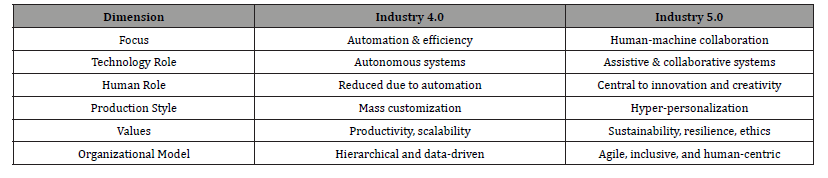
Instead of discarding the technologies of Industry 4.0, Industry 5.0 builds upon them to create a sustainable, ethical, and balanced future. Industry 4.0 concentrated on digitizing and automating processes, while Industry 5.0 reintroduces the human element as a vital innovation driver.
Applications of Industry 5.0 in Modern Sectors
Industry 5.0 technologies are being applied across multiple sectors,
delivering transformative results:
• Manufacturing: Human-centric cobots and AI-driven customization
enable agile production.
• Healthcare: AI supports diagnostics, robotic surgeries, and
personalized treatments.
• Agriculture: Smart farming utilizes IoT, drones, and AI to optimize
yield and sustainability.
• Retail: AR, AI, and data analytics personalize customer experiences
and supply chains.
• Education: Virtual reality and AI-powered tutors offer immersive
and adaptive learning.
These applications demonstrate how Industry 5.0 is advancing human potential and social progress.
Ethical, Social, and Environmental Implications
As technologies become more advanced, addressing their
broader impact becomes crucial:
• Ethical AI: Transparent, fair, and accountable AI systems must
be prioritized.
• Data Privacy: Secure handling of personal and industrial data
is imperative.
• Job Transition: Workers must be upskilled to thrive in new collaborative
roles.
• Environmental Sustainability: Green technologies and circular
economies help reduce industrial waste and carbon footprints.
• Digital Inclusion: Access to technology and skills must be equitable.
Policymakers and industries must work together to ensure technology supports inclusive and sustainable growth.
Future Outlook and Challenges
While Industry 5.0 promises a human-centric and intelligent
future, several challenges remain:
• Integration Complexity: Seamlessly blending human input
with AI and robotics.
• Cybersecurity Threats: Protecting complex networks from
evolving cyber risks.
• Regulatory Frameworks: Developing global standards for AI,
data use, and robotics.
• Cultural Adaptation: Encouraging acceptance of new technologies
and work models.
Nevertheless, the continued evolution toward Industry 5.0 offers a powerful vision where technology enhances human life and societal well-being.
Conclusion
Industry 5.0 is a clear shift in industrialization because it fuses human creativity and empathy with the efficiency of technology. it is built on the digital underpinnings of Industry 4.0, and offers a more sustainable and inclusive future vision. Organizations and society may achieve unprecedented levels of productivity, resilience, and well-being by adopting ethical principles, technological innovation, and human collaboration.
Acknowledgement
None.
Conflict of Interest
No conflict of interest.
References
- Xu X, Xu Y, Li L (2021) Industry 4.0 and Industry 5.0: Current status and future trends. Journal of Intelligent Manufacturing 32(3): 1-18.
- Nahavandi S (2019) Industry 5.0-A human-centric solution. Sustainability 11(16): 4371.
- European Commission (2021) Industry 5.0: Towards a sustainable, human-centric and resilient European industry.
- Javaid M, Haleem A (2020) Industry 5.0: Potential applications in COVID-19. Journal of Industrial Integration and Management 5(04): 507-530.
- Wang K, Lee J (2022) Intelligent manufacturing systems: A roadmap to Industry 5.0. Procedia CIRP 100: 68-75.
- Aderounmu GA (2021) ICT and sustainability in the Industry 5.0. ITPulse.
-

This work is licensed under a Creative Commons Attribution-NonCommercial 4.0 International License.