




 Case Report
Sinonasal Undifferentiated Carcinoma (SNUC) of Maxillary Sinus
Ent Department-Dorban Hospital, Faculty of Medicine, University of Badji Mokhtar, Algeria
Received Date: March 03, 2026; Published Date: March 16, 2026
Abstract
We describe the case of a 46-year-old man who referred in our ENT department with pain and left facial swelling. No medical, surgical or toxic history is founded. Endonasal endoscopy shows a deviation of lateral nasal way without endonasal tumor. Imaging (CT scan) revealed extensive mass occupied the left maxillary sinus with bone lysis. We proceed at removing the tumor by sub labial approach.
Histopathologic exam confirmed the diagnosis of sinonasal undifferenciated carcinoma (SNUC) and the patient receive post operative radiation with safety after 60 mouths.
This clinical case provides an opportunity to discuss the anatomoclinical and therapeutic aspects of SNUC.
Keywords: SNUC; Cytokeratines; Chemoradiation
Introduction
Sinonasal malignancies make up less than 5% of all head and neck neoplasms. WHO defined undifferenciated sinonasal carcinoma (SNUC) as a very aggressive tumor and no EBV (Epstein Barr Virus) associated carcinoma [1].
SNUC is rare high-grade epithelial malignancy with an annual incidence ranging from 0,5 - 2,6 cases per 100 000 per year [2].
The first description of SNUC was reported by FRIERSON in 1986 [3].
SNUC are highly aggressive lesions which usually arise in the superior nasal cavity and paranasal sinuses. SNUC usually presents at advanced stage and the prognosis is usually poor with high rates of locoregional recurrence and tendency to metastasis.
Multimodality treatment is usually recommended for treating SNUC.
Clinical Case
A 46-year-old male presented with facial pain and swallowing in left side since few weeks. The patient is farmer without medical or surgical history. The inspection notes a moderate left jugal tumefaction with normal skin and a less deficit in V2 area. The orbital exam is normal. The endonasal endoscopic evaluation notes a deviation of the lateral wall without tumor. Oral cavity is normally, especially velo palatal structure (no exteriorization).The neck and complete ENT evaluation where negative.
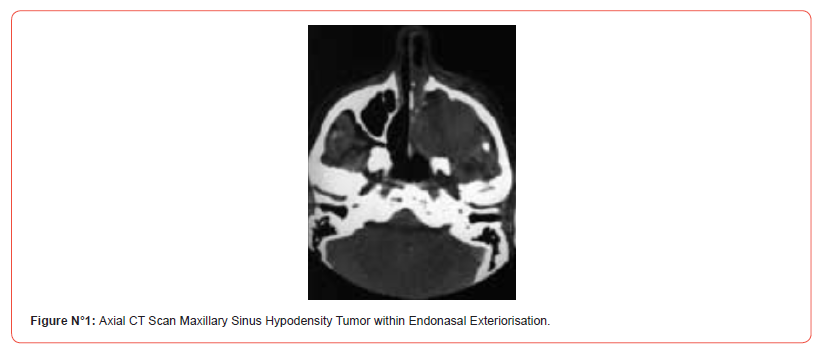
Computed tomography (CT) revealed intra sinusal (maxillary sinus) hypo dense mass 5x7 cm without calcification but a bone lysis (limited). The orbital and skull base evaluation where healthy (Figure N°1). The malignant tumor was suspected and we propose a surgical exploration by open way.
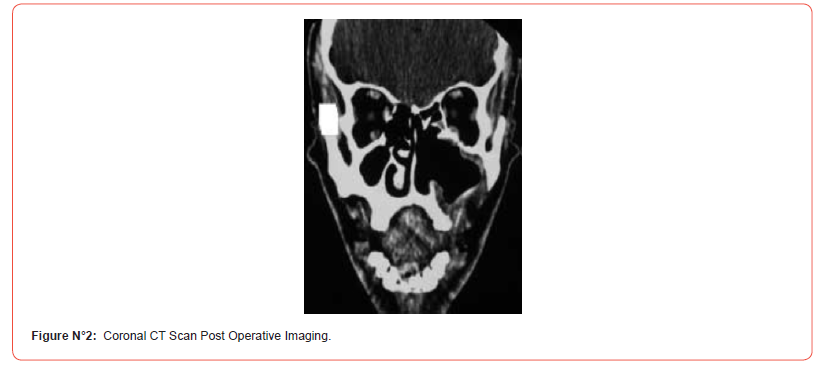
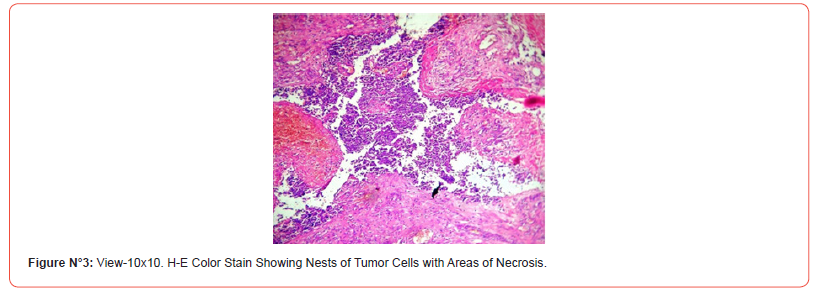
A left sub labial approach is making and allow a resection of the intra sinusal tumor. (Figure N°2) The histopathologic exam revealed large pleomorphic tumor cells with a high nuclear to cytoplasm ratio, prominent nucleoli and focal areas of necrosis in favour of sinonasal undifferenciated cancer after positive reaction about CK7, CK8 (immunochemistry) (Figure N°3).
AJCC classification after cheek-up was T3N0 staging III and a post operative radiation was performed. The patient was controlled regularly to be disease-free 60 mouths post treatment.
Discussion
SNUC is a rare high grade carcinoma that originates from the epithelium of nasal cavity and paranasal sinuses. This variety of tumor make up less 5% of all sinonasal malignancies [2, 4].
There was a higher incidence in males than females (0,03 vs 0,01 / 100 000) and the median age 50-60 years [4].
SNUC is described also in child and the first case was published in 2006 [5] HERDINI report in 2024 one case of SNUC in 10 year-oldboy manifested by epistaxis, facial asymmetry and proptosis treated by induction chemotherapy and concurrent chemoradiotherapy with safe result after 2 years follow up [6].
Ethiopathology of SNUC is unknown and we note in different publication the association between SNUC and exposure tobacco, coal industry, chrome plating industry [4]. There is controversy surrounding other probable risk factors associated EBV (Epstein Barr Virus) and additional studies failed to confirm any association between EBV and SNUC [1, 7].
It is generally diagnosed at an advanced stage (84 to 92 % of patients present with T4 disease) and shows an extensive invasion of adjacent anatomical structures.
The symptomatology of SNUC is no specific and depends to the tumoral site (ethmoid, maxillary sinus, naso ethmoidal) and the clinical stage. Patients report nasal obstruction, epistaxis, bloody rhinorhea, headache, facial pain, diplopic or orbital involvement. In some cases we found palatal manifestation, facial swelling. The nasal endoscopic exam shows the tumor, extension and biopsy. In some cases the tumor is confined inside the maxillary sinus and we can just note the deviation of lateral nasal way.
The neck evaluation (clinical exam, CT scan) is an important stapes and 10–30 % of patients have a node-positive disease at diagnosis [8].
Imaging is essentially to evaluate the location and extension of the tumor and repose in CT scan and MRI. It typically shows a large mass with local invasive growth. On CT imaging, SNUC tumors are no calcified and can lead to sinus obstruction. On MRI, signal intensity was found to be iso intense to muscle on T1- weighted images, isoto hyper intense on T2, and heterogeneous enhancement was seen with gadolinium [4].
Total Body scan and scintigraphy helps the pre therapeutic evaluation.
PETscan is helpful and appreciate the general status of the disease. The most common sites of metastasis were bone (10.2%), cervical lymph node (9.5%), lung (5.8%), brain (5.8%), and liver (4.4%) (9)(10). The AJCC TNM and Stages is making after the imaging cheek-up.
Actually SNUC is considered to be part of the spectrum of neuroendocrine carcinomas including esthesioneuroblastoma, neurondocrine carcinoma, and small cell carcinoma [11].
The histopathologic exam show small to medium-sized cells, pleomorphic, and arranged in ribbons, sheets, large nests, trabeculae, and an organoid pattern. There is scant cytoplasm, hyperchromatic nuclei, prominent nucleoli, and homogenous chromatin.
The immunohistochemical profile is characterized by negative Protein S-100, HMB 45 and expression of cytokeratins 7, 8, and 19 [12]. The differential diagnosis is important and must to distinguish a lymphoepithelial carcinoma and neuroblastoma of the olfactory tract (negative for the expression of cytokeratins).
There possible association with p16 and KIT (CD117) is a not proved and may be result to the expression of a simple epithelial tract expressive.
The first aim of SNUC management is to propose a specific and adaptative protocol to each patient. The pre therapeutic evaluation (CT, MRI, PETscan), staging (TNM) and the possibility or not of surgery (unresectable tumors) are very important to considerate.
The best option favorises a multimodal approach incorporating surgery and radiation therapy with or without chemotherapy.
Surgery is the gold standard and prior option. The aim of surgery is complete resection with microscopically negative margin.
Habitually in majority of cases we prefer the open ways (craniofacial resection, facial approach and skull base reconstruction).
Endoscopic surgery is also possible and favored by a lot of surgeons and shown similar efficiency in tumor control and less morbidity, leading to reduced hospital stay compared with open surgery.
Radiations are habitually associated in post operative with 50 or 60 Grays in IMRT modality.
The treatment of cervical lymphatic nodes is not codified with abstention and follow up in patients initially CN0 in the pre therapeutic evaluation. Radiations with or without surgery is indicate in cases with cervical metastatic adenopathy
Chemotherapy is combined in many protocols; induction, concurrent chemoradiation or adjuvant regime. Drogues used generally in association where Cisplatine, Fluorouracil, Etoposide, Docetaxel. Intra arterial perfusion reduces the systemic toxicity with maximal impregnation in tumoral site [13].
Furthermore induction chemotherapy may be a useful guide for selection of patients for chemoradiotherapy or surgery [14].
The other challenge about the amelioration of loco regional control and the survival score is the approach and management for the metachrone cervical metastatic adenopathy in patients with initially N0. Effectively the follow up of SNUC patients (Clinical N0) shows 9% of them with regional recurrence disease (cervical adenopathy) [15].
Elective neck treatment (irradiation or lymph node dissection) for patients with clinically node-negative disease leads to a lower risk of regional recurrence compared to observation alone [15].
The RADPLAT protocol involves intra-arterial infusion of Cisplatin with intra-venous systemic neutralization using Thiosulfate. This protocol is used in unresecable tumors and may be to ameliorate the loco regional response and perhaps the survival outcome.
NOTICEWALA report 4 years lasting decrease control for a patient T4N0 SNUC treated by RADPLAT (16).
In fine the management of sinonasal undifferenciated carcinoma needs to be ameliorating from obtaining optimal results in tumor control and overall survival. The multimodal approach and chemotherapy (induction, concurrent and adjuvant) are the fundament of this view [13, 14, 17]. There is a real interest to going in new strategies: clinical essay, targeted therapies (Avelumab) [18], new energies (proton, ion carbone) in radiotherapy.
Table 1:SNUC Management.
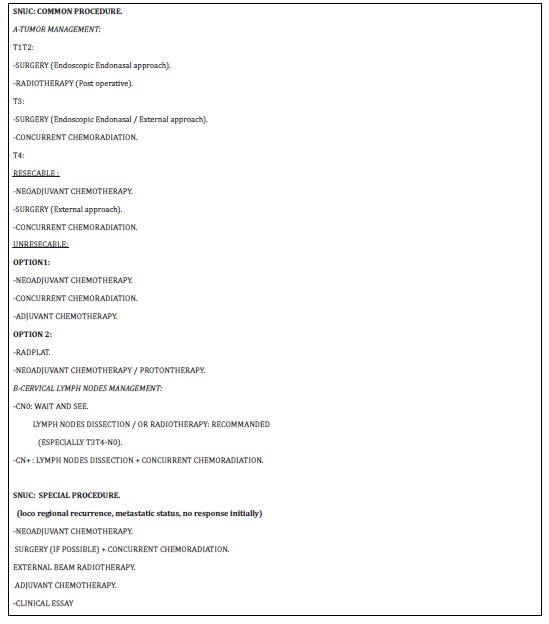
It is important also to elaborate some criteria (genetic) for few SNUC patients eligible for the best protocol with highly results (Table N°1).
The prognosis of SNUC is very poor and the global mortality rates are high 5 years survival ranging from 20% to 63% in the literature [3-5].
If we considerate the treatment modality we found the fiveyear survival rates following surgery, radiation, or combination of surgery and radiation were 38.7%, 36.0%, and 39.1%, respectively [4].
Conclusion
SNUC is an aggressive neoplasm that frequently presents at an advanced stage. Clinical presentation is not specific and tumoral biopsy authorizes the diagnosis. Imaging is essential to evaluate loco regional and general status. Immunohistology is necessary to distinguish SNUC and eliminate others similar tumors (neuroendocrine carcinomas). Multimodality treatment is usually recommended for treating SNUC. Induction chemotherapy is an interesting modality with possible positive impact in disease control.
The author indicate no potential conflicts of interest.
Acknowledgement
None.
Conflicts of Interest
The author indicates no potential conflicts of interest.
References
- Kutok J, Wang F (2006) Spectrum of Epstein-Barr Virus-Associated Diseases. Annu Rev Pathol Mech Dis 1: 375-404.
- London Jr NR, Mohyeldin A, Daoud G, Gamez ME, Blakaj D, et al., (2020) Sinonasal undifferentiated carcinoma: institutional trend toward induction chemotherapy followed by definitive chemoradiation. Head Neck 42 (11): 3197-3205.
- Frierson Jr HF, Mills SE, Fechner RE, Taxy JB, Levine PA (1986) Sinonasal Undifferentiated Carcinoma. An Aggressive Neoplasm Derived from Schneiderian Epithelium and Distinct from Olfactory Neuroblastoma. Am J Surg Pathol 10: 771-779.
- Lopez F, Suárez V, Vivanco B, Suárez C, Llorente JL (2015) Current management of sinonasal undifferentiated carcinoma. Rhinology 53(3): 212-220.
- Kumar R, Chandra A, Rastogi A (2006) Intracranial sinonasal undifferentiated carcinoma (SNUC) in a child. Childs Nerv Syst 22: 1208-1211.
- Herdini C, Setiawan DA, Yudistira D, Indrasari SR (2025) Pediatric sinonasal undifferentiated carcinoma resolved with chemoradiotherapy: A case report and literature review. Cancer Res Ther 21(3): 746-750.
- Cerilli LA, Holst VA, Brandwein MS, Stoler MH, Mills SE (2001) Sinonasal undifferentiated carcinoma: immunohistochemical profile and lack of EBV association. Am J Surg Pathol 25(2): 156-163.
- Chen AM, Daly ME, El Sayed I (2008) Patterns of failure after combined-modality approaches incorporating radiotherapy for sinonasal undiferentiated carcinoma of the head and neck. Int J Radiat Oncol Biol Phys 70: 338-343.
- Jones AV, Robinson I, Speight P M (2005) Sinonasal undifferentiated carcinoma: Report of a case and review of literature. Oral Oncology Extra 41: 299-302.
- D'Aguanno V, Ralli M, Cerbelli B, Greco A, De Vincentiis M (2019) Liver metastases from maxillary sinus sinonasal undifferentiated carcinoma: A case report. Oncol Lett 17(6): 5811-5814.
- Rosenthal DI, Barker JL Jr, El-Naggar AK, Glisson BS, Kies MS, et al. (2004) Sinonasal malignancies with neuroendo crine differentiation: Patterns of failure according to histologic phenotype. Cancer 101: 2567-2573.
- Wadsworth B, Bumpous JM, Martin AW, Nowacki MR, Jenson AB, et al. (2011) Expression of p16 in sinonasal undifferentiated carcinoma (SNUC) without associated human papillomavirus (HPV). Head Neck Pathol 5(4): 349-354.
- Abdelmeguid AS, Bell D, Hanna EY (2019) Sinonasal Undifferentiated Carcinoma. Curr Oncol Rep 21(3): 26.
- Amit M, Abdelmeguid AS, Watcherporn T, Takahashi H, Tam S, et al. (2019) Induction Chemotherapy Response as a Guide for Treatment Optimization in Sinonasal Undifferentiated Carcinoma. Clin Oncol 37(6): 504-512.
- Ahn PH, Mitra N, Alonso-Basanta M (2016) Nodal metastasis and elective nodal level treatment in sinonasal small-cell and sinonasal undifferentiated carcinoma: a surveillance, epidemiology and end results analysis. Br J Radiol 89(1058): 20150488.
- Noticewala SS, Mell LK, Olson SE, Read W (2015) Survival in unresectable sinonasal undifferentiated carcinoma treated with concurrent intra-arterial cisplatin and radiation. World J Clin Cases 3(2): 191-195.
- Wang L, Wang J, Tang T, Yan L MD, Song X (2023) Definitive-intent (chemo) radiotherapy for sinonasal undifferentiated carcinoma. Br J Radiol 96(1141): 20220244.
- Hoke ATK, Takahashi Y, Padget MR, Gomez J, Amit M, et al. (2024) Targeting sinonasal undifferentiated carcinoma with a combinatory immunotherapy approach. Transl Oncol 44: 101943.
-

This work is licensed under a Creative Commons Attribution-NonCommercial 4.0 International License.




