



 Case Report
Radial Forearm Free Flap Harvested with Connecting Superficial and Deep Venous Systems Following Ipsilateral Axillary Lymph Node Dissection
Assistant Professor, Department of Oral & Maxillofacial Surgery, University of Alabama at Birmingham Birmingham, AL 35233, USA
Received Date: February 17, 2026; Published Date: February 25, 2026
Abstract
Introduction: Patients who have been treated for breast cancer via axillary lymph node dissections and/or radiation are not infrequently given precautions for the remainder of their life, including avoidance of blood pressure readings, blood draws, or intravenous line placement in that limb to avoid complications of lymphedema and infection. This presents a difficulty and uncertainty of outcomes for surgeons needing to utilize that upper extremity.
Case: A female patient who presented with a malignant neoplasm of the tongue requiring reconstruction following tumor extirpation. Following discussion with the patient of reconstructive options and those commonly performed at our institution, the patient elected to undergo radial forearm free flap reconstruction of her tongue. The flap would be harvested from the ipsilateral forearm as an axillary lymph node dissection and radiation therapy approximately eight years prior. The contralateral arm was not used due to concern for vascular integrity from previous trauma.
Discussion: The patient underwent successful transfer of a radial forearm free flap using the profunda cubitus vein extending to the proximal cephalic and median antecubital veins, as is the common harvest practice for this author. She experienced 100% take of her split thickness skin graft on the donor site and experienced no postoperative lymphedema or infection up to one year postoperatively. While broad conclusions cannot be drawn from a single case study, this article should serve as evidence that this type of procedure can be successful despite previous axillary lymph node dissection and radiation therapy.
Keywords: Breast cancer; Axillary lymph node dissection; Radial forearm free flap; Profunda cubitus; Reconstruction; Free tissue transfer; Head and neck cancer; Radiation therapy
Introduction
The radial forearm free flap (RFFF) is a highly versatile form of free tissue transfer, widely used for reconstruction of soft tissue defects throughout the human body. It was first described by Yang and Chen in 1981 and has maintained favor for its relatively predictable anatomy, exceptional pedicle length, and tolerable donor site morbidity [1]. However, its use may be discouraged in a patient with a history of ipsilateral breast cancer treatment as interventions even as minor as blood pressure monitoring or blood draws are often discouraged. This report demonstrates its use for reconstruction of an oral tongue defect in a patient with history of an ipsilateral axillary node dissection and radiotherapy treatment for breast cancer eight years prior. While only one other case is documented in the literature, this patient underwent a more extensive venous dissection as per the author’s routine in harvesting this flap.
Case Report
A 58-year-old female with a history of breast cancer, hypertension, gastroesophageal reflux disease, and hypothyroidism following radioactive iodine use over twenty years prior was referred to the oral and maxillofacial surgery clinic for management of biopsy-proven cT2 cN0 cM0 squamous cell carcinoma of the left lateral tongue. Following clinical staging and workup, she was scheduled for a left partial glossectomy, left selective neck dissection, tracheostomy, dental extractions, dental implant placement, radial forearm free flap reconstruction, and split thickness skin graft (STSG).
Of particular note was the patient’s previous diagnosis of invasive ductal carcinoma of the right breast (ER-negative, HER-2 positive, node positive) eight years prior. She had undergone a right breast lumpectomy, right axillary lymph node dissection, radiation treatment (6100 cGy), and chemotherapy. The chemotherapy port had been placed on the contralateral (left side). Due to scarring and previous trauma on the contralateral forearm it was not considered for free flap harvest. There was no clinical evidence of lymphedema in either upper extremity at her initial visit. Pre-operative Allen’s test was positive in both upper extremities. She was right-hand dominate.
The patient was counselled in other options for reconstruction of the defect, including using a lateral arm or anterolateral thigh (ALT) free flap. The lateral arm free flap could lead to less morbidity as there is less donor site area and thus could potentially cause less disruption of lymphatic channels. However, the shortened and typically narrower pedicle increases difficulty of the microvascular anastomosis. By contrast, the ALT free flap would have the least donor site morbidity but would likely provide excessive tissue bulk considering the size of the proposed ablative defect. After thorough discussion with the patient of risks, benefits, and alternatives, they elected to pursue the more traditionally performed radial forearm free flap on the ipsilateral side (right) as the previously performed axillary lymph node dissection and radiation. They were made aware of the increased possibility of infection, lymphedema, and potentially poor wound healing in the forms of skin graft failure or tendon exposure.
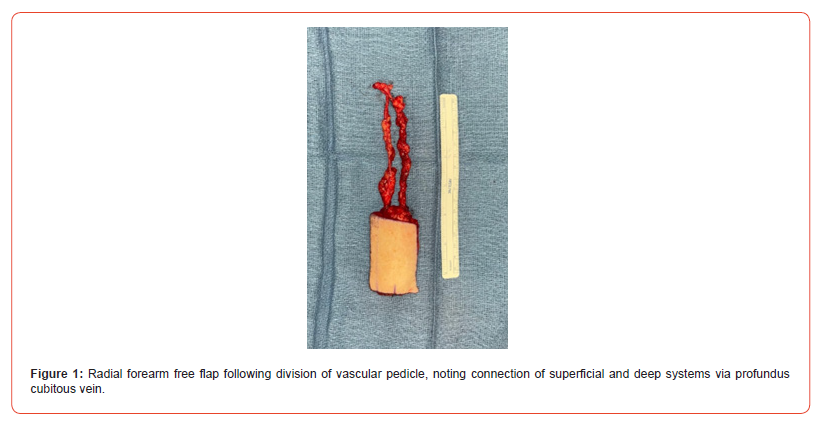
At the time of surgery, a tourniquet set to 250mmHg was applied to the patient’s right upper limb for ninety-three minutes following limb exsanguination. The RFFF was harvested in the routine fashion. The vascular pedicle harvested included the radial artery, both venae comitantes, and the cephalic vein (Figure 1). The veins were dissected past the confluence of the venae comitantes, along the profundus cubitus to gain dual venous drainage of the superficial and deep systems, and proximal up along the cephalic and median cubital veins. Typically, if this connection exists, the donor vein with either be the more proximal cephalic vein or the median cubital vein. The radial artery was sutured to the left facial artery using 8-0 nylon sutures. The median cubital vein was anastomosed to the left common facial vein using a 4.0 mm venous coupler. A split thickness skin graft (STSG) harvested from the right thigh was used to cover the flap skin paddle donor site defect. Postoperatively a wound vacuum was placed over the skin graft for 5 days. It underwent daily dressing changes under a forearm splint for four weeks.
The patient’s final pathology was a stage IV pT3 p2b cM0 squamous cell carcinoma of the left oral tongue. The pathology report was also significant for perineural invasion and metastatic spread to 4/24 lymph nodes without extranodal extension. All margins were negative. The patient was referred for adjuvant radiation and received a total of 6000 cGy intensity modulated radiation therapy (IMRT).
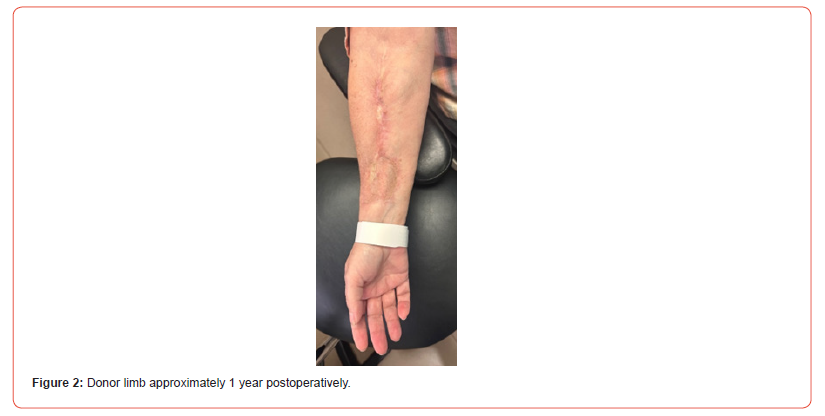
She followed up with the oral and maxillofacial surgery department at 2 weeks, 4 weeks, 6 months, and 1 year postoperatively. Her free flap donor site remained free of lymphedema or infection, and she appreciated 100% take of her STSG (Figure 2).
Discussion
Lymphedema is a potentially serious complication that in the case of an upper limb can result in persistent and sometimes severe swelling of the upper extremity with life-impacting sequelae [2]. These include pain, limited range of motion, limb heaviness, and decreased self-image due to body distortion. To decrease the incidence of lymphedema, patients who have been treated for breast cancer are sometimes cautioned to avoid venipuncture, injections, and blood pressure monitoring on the ipsilateral arm. One prospective study has questioned the necessity of these recommendations [3]. It further implies that a more morbid surgical procedure, such as harvesting of a radial forearm free flap on the ipsilateral limb as a prior axillary lymph node dissection, could carry a further increased risk for postoperative complications. Limited literature on hand surgery has shown a potentially low risk for postoperative lymphedema in this patient population [4]. Additionally, it has been suggested that many hand surgeons and breast surgeons support the necessary use of a torniquet in this patient population, and an increased percentage of hand surgeons to breast surgeons feel prior axillary lymph node dissection is not a contraindication to ipsilateral carpal tunnel repair [5].
The only other case ever published on the ability to harvest a free flap on the ipsilateral upper extremity as a previous axillary lymph node dissection was written by Subramaniam in 2023 for maxillary reconstruction [6]. This study also harvested the venae comitantes and cephalic vein for reconstruction but used a more limited dissection in that the veins were not dissected to include the more proximal portion of the cephalic vein or median cubital vein. Using this more proximal dissection, one can take advantage of the profundus cubitus venous connection between the superficial and deep systems, and drainage of both can be achieved through one venous anastomosis [7, 8]. This form of dissection necessitates the ligation of numerous feeding vessels within the antecubital fossa to isolate both venous systems on a common venous pedicle, which theoretically could increase the risk of postoperative lymphedema.
This study gives further legitimacy that the harvesting of a free flap in this clinical scenario can be a safe procedure without significant complications, though caution may be taken especially in patients who underwent a more recent treatment for their breast cancer. It has been shown that about 70% of cases of lymphedema develop within two years of axial lymph node surgery, 90% within three years, and 1% after three years [9]. The patient treated in this study was eight years following breast cancer treatment while the patient treated by Subramanian was treated ten years prior. It is possible the extended period in both these scenarios allowed for the formation of accessory lymphatic channels that may have helped facilitate adequate lymphatic drainage. Additional data on interventions in the arm and forearm following axillary lymph node dissection may shed light on the likelihood of adverse outcomes and could lead to potential changes in recommendations following breast cancer treatment.
Acknowledgment
None.
Conflict of Interest
No Conflict of Interest.
References
- Yang G Y, Gao Chen (1981) Forearm free skin flap transplantation. Nat Med J China 61 (1981) 139.
- Nadine R Taghian, Cynthia L Miller, Lauren S Jammallo, Jean O’Toole, Melissa N Skolny (2014) Lymphedema following breast cancer treatment and impact on quality of life: A review. Crit Rev Oncol Hematol 92(3): 227-234.
- Ferguson CM, Swaroop MN, Horick N, Skolny MN, Miller CL, et al. (2016) Impact of Ipsilateral Blood Draws, Injections, Blood Pressure Measurements, and Air Travel on the Risk of Lymphedema for Patients Treated for Breast Cancer. J Clin Oncol 34(7): 691-698.
- Fitzgerald MJ, Galina J, Kolodka E (2023) The Risk of Lymphedema After Breast Cancer Surgery Should Not Restrict Necessary Hand Surgery Interventions. HAND 19(6): 995-1001.
- Fulford D, Dalal S, Winstanley J, Hayton MJ (2010) Hand surgery after axillary lymph node clearance for breast cancer: contra-indication to surgery? Ann R Coll Surg Engl 92(7): 573-576.
- Subramaniam SS (2023) Radial forearm free flap following axillary node dissection and radiotherapy: is it safe? Int J Oral Maxillofac Surg 52(12): 1244-1245.
- Gottlieb L J, Tachmes L, Pielet RW (1993) Improved venous drainage of the radial artery forearm free flap: use of the profundus cubitalis vein. J Reconstr Microsurg 9: 281-284.
- Germano S, Borsetti M, Gangemi EN, Clemente A, Rivarossa F, et al. (2023) "DO ONE, GET TWO": dual venous drainage of the radial forearm free flap by a single venous anastomosis. Oral Maxillofac Surg 27(2): 283-288.
- Larocque G, McDiarmid S (2019) The legacy of lymphedema: Impact on nursing practice and vascular access. Can Oncol Nurs J 29(3): 194-203.
-

This work is licensed under a Creative Commons Attribution-NonCommercial 4.0 International License.




