



 Case Report
Kyrgyzstan Adaptation of the Questionnaire Functioning After Pediatric Cochlear Implantation (FAPCI)
1Department of Otorhinolaryngology, The National Center of Maternity and Childhood Care, Bishkek, Kyrgyzstan
2Department of Otorhinolaryngology, Head and Neck Surgery, KMG Klinikum, Güstrow, Germany
3Department of Audiology, KMG Klinikum, Güstrow, Germany
Received Date: September 10, 2025; Published Date: September 19, 2025
Abstract
Objective: This two-center study aims to adapt the English version of the FAPCI into Kyrgyz to measure the development of verbal communicative performance in CI children in Kyrgyzstan.
Subjects and Methods: The original FAPCI questionnaire was translated into Kyrgyz by two professional translators from Kyrgyzstan proficient in both languages. A few cultural adaptations were required. The 23-item FAPCI-Kyrg instrument was distributed in the National Center of Maternity and Childhood Care in Bishkek (Kyrgyzstan). Those included in the study were healthy children of hospital employees and persons accompanying children being treated in the hospital and prelingual bilateral deaf children who were implanted between 2021 and 2024. The questionnaires were distributed exclusively to parents of children raised speaking Kyrgyz, aged 22–108 months. The children’s hearing age (duration of CI use) was calculated from the time of initial fitting of the speech processor and ranged from eight months to 4.6 years.
Results: Cronbach’s alpha for internal consistency was 0.97 for the CI group, ranging from 0.67 to 0.92, and 0.97 for the NH group, ranging from 0.62 to 0.88. Pearson’s correlation test revealed a significant positive correlation between test and retest scores of the children from the CI group (r27 = 0.91, p < 0.05). Analyses indicated a positive correlation in the NH group between FAPCI-Kyrg scores and age (r30= 0.671, p < 0.001). Analyses revealed a positive correlation in the CI group between FAPCI-Kyrg scores and age (r27= 0.799, p < 0.001) and the duration of CI use (hearing age) (r27= 0.781, p < 0.001). The positive weak correlation between FAPCI-Kyrg scores and age at implantation was not significant (r27= 0.33, p = 0.092).
Conclusion: The Kyrgyz version of the FAPCI questionnaire shows psychometric characteristics similar to the English and German versions. Its use can be recommended for Kyrgyz-speaking children to assess early childhood communication skills after cochlear implantation. For children in Kyrgyzstan who do not speak Kyrgyz, it is particularly important to create a separate version.
Introduction
Cochlear implantation has become a routine surgical procedure worldwide for the treatment of profound bilateral hearing loss in humans who do not benefit from bilateral well-fitted hearing aids. While cochlear implant (CI) surgery began in Germany in the 1980s, the first CIs in Kyrgyzstan were done by foreign colleagues from Russia, Ukraine, and Germany approximately ten years ago. As no CI program was available in Kyrgyzstan until recently, some parents sent their children abroad for surgery. Until 2020, Kyrgyzstan had a quota system. The CI surgeries were carried in Turkey.
Since 2018, several initiatives and local programs have been launched to provide hearing-impaired children in Kyrgyzstan with access to CI.
With an estimated 140,000 to 160,000 newborns per year in Kyrgyzstan, there is a projected need for at least 50 to 150 CIs for deaf children annually. Besides a nationwide newborn hearing screening program, a CI program for children has been initiated locally.
The question arose regarding how to assess speech development following CI surgery in Kyrgyzstan, as no validated measuring instruments are currently available. Various measures exist to evaluate speech perception and language skills in children, of which visual-habitual procedures in the presence of speech competitors or proxy assessments should be noted [1]. The most frequently used parent-proxy instruments are the Little Ears Auditory Questionnaire [2] and the Infant-Toddler Meaningful Auditory Integration Scale [3]. Both instruments are designed to monitor the early auditory behavior of infants and toddlers aged less than 24 months.
The Functioning after Pediatric Cochlear Implantation (FAPCI) instrument was developed in 2007 [4]. This questionnaire assesses the communicative abilities of children older than 24 months. The FAPCI tool is a psychometrically validated scale designed to evaluate the communicative performance of children aged 2 to 5 years, considering the conceptual framework of the World Health Organization’s International Classification of Functioning [5]. The FAPCI instrument comprises 23 items/questions, each with a fivelevel response scale, yielding total scores ranging from 23 to 115 [4, 6, 7]. The instrument captures children’s everyday expressive and receptive communicative behaviors as reported by parents or primary caregivers. It has been validated and demonstrates good reliability. Originally provided in American English, the FAPCI has been translated and adapted into German [8, 9], Korean [10], Portuguese [11], and Hindi [12]. Kyrgyz and Russian are the official national languages in Kyrgyzstan, with several minority languages also spoken, including Uzbek, Tajik, and Uyghur. Communication in English or German is also possible.
This two-center study aims to adapt the English version of the FAPCI into Kyrgyz to measure the development of verbal communicative performance in CI children in Kyrgyzstan. Since most Kyrgyz children grow up speaking both Kyrgyz and Russian, a Russian version of the FAPCI questionnaire will be created in a second step. The results of Kyrgyz children will later be compared with those of healthy children from Germany.
Materials and Methods
Ethical considerations
The study design was approved by the Ethics Committee of the General Medical Council of Mecklenburg-West Pomerania (A 2025- 0079). This study was conducted in strict adherence to the revised version of the Helsinki Declaration. The Kyrgyz version of the ethics application was made available to the Kyrgyz colleagues.
Procedure
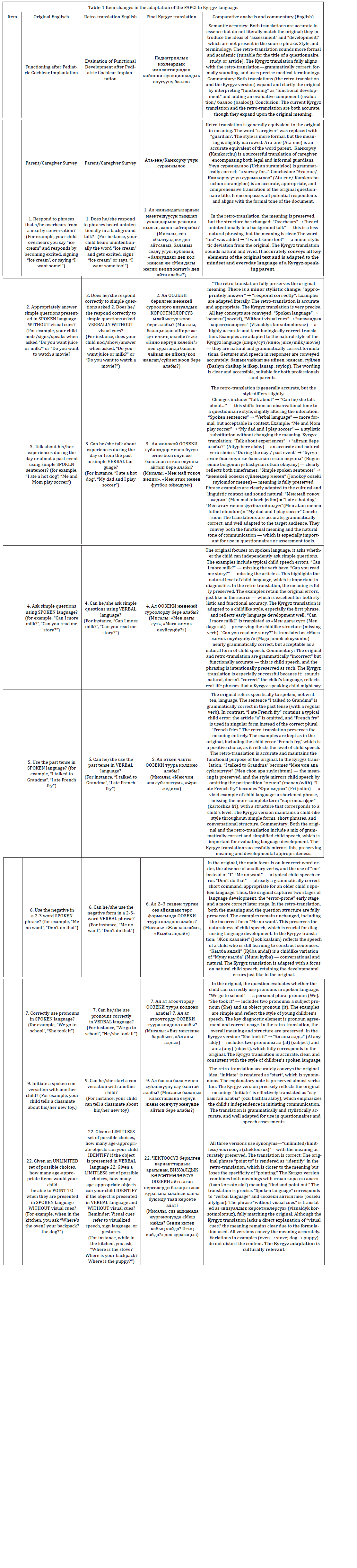
In the first step, the original FAPCI questionnaire was translated into Kyrgyz by two professional translators from Kyrgyzstan proficient in both languages. Following the guidelines for the crosscultural adaptation of self-reporting measures [13], a few cultural adaptations were required. However, the original essence of the questions was preserved to the extent possible. Table 1 outlines all the adaptations and changes needed. The Kyrgyz version maintains a child-friendly style throughout, with simple forms, short phrases, and a conversational structure (Table 2). The questionnaire items were translated into Kyrgyz with grammatical accuracy to the local context for optimal comprehension. The examples, however, contain deliberate errors, as in the original, to reflect the speech patterns of a young child who is just beginning to talk. The Kyrgyz translation successfully mirrors this, preserving both meaning and developmental appropriateness.

Participants
Normal hearing cohort: The 23-item FAPCI-Kyrg instrument was distributed in the National Center of Maternity and Childhood Care in Bishkek (Kyrgyzstan) in cooperation with the Department of Otorhinolaryngology, Head and Neck Surgery at the KMG Klinikum in Güstrow (Germany). Those included in the study were healthy children of hospital employees and persons accompanying children being treated in the hospital.
All parents and children older than six, if appropriate, were informed about the study aims and provided their written consent. Parents were asked to complete the survey. The mean age of the NH group was 56.2 months ± 26.3 months, while the age range was 24–114 months (Table 3).
The 23-item FAPCI-Kyrg instrument was also distributed in the National Center of Maternity and Childhood Care in Bishkek (Kyrgyzstan) to 28 parents of prelingual bilateral deaf children who were implanted between 2021 and 2024. The mean age of the NH group was 64.4 months ± 22.1 months, with an age range of 22–108 months (Table 3). To ascertain the test-retest reliability, the questionnaire was distributed to the parents of CI children a second time within two to three weeks.
The questionnaires were distributed exclusively to parents of children raised speaking Kyrgyz, aged 22–108 months (Table 3). The children’s hearing age (duration of CI use) was calculated from the time of initial fitting of the speech processor and ranged from eight months to 4.6 years. The initial fitting of the speech processor was done four weeks after the CI surgery. Therefore, the date of the initial fitting was used as the basis for calculating the hearing age. The proportion of children receiving bilateral CI was 22.2%. Neither the life age nor the hearing age differed significantly from that of the children with unilateral CI (all p’s > 0.05).
Standardized audiologic rehabilitation for implanted children was performed every three months during the first year and every five to six months during the second year. From the third year onward, adjustments to the speech processor are carried out annually at the clinic. Since there is currently no state program for the rehabilitation of children with CI, speech therapy rehabilitation has been carried out at private centers, educational institutions, and private audiologists’ practices in the children’s places of residence, usually financed by the parents, by Qatari projects, and by Rotary Club Kühlungsborn (Germany).

Statistical Analyses
FAPCI questionnaire data were entered into an electronic database in Güstrow (Germany) and verified by double-data entry. FAPCI scores range from 23 to 115, with higher scores indicating better communicative performance. FAPCI scores were calculated by summing up the scores of all items and assigning a score of 0 to items with no response. Missing data on several items were found in one survey, resulting in only 27 surveys being used for evaluation. Exploratory analyses were conducted using graphical displays and frequency distributions to identify potential outliers for further data validation.
SPSS Version 30.0 (SPSS Inc., Chicago, IL, USA) was used for statistical analyses. Data were evaluated using descriptive statistical methods and comparative tests. The numerical tests were expressed as mean ± standard deviation, and the categorical variables presented as percentages. Statistical tests (Kolmogorov test and Shapiro-Wilk test) indicated a non-normal distribution for all parameters (all p-values < 0.05). Nonparametric tests were performed for group comparisons whenever appropriate. Pearson statistics were used for correlational analyses. A p-value of < 0.05 was accepted as statistically significant in all analyses. To verify the internal consistency of the 23 items of the FAPCI-Kyrg instrument, Cronbach’s alpha was calculated. There are different reports about the acceptable values of alpha, ranging from 0.70 to 0.95 [14]. A maximum alpha value of 0.90 has been recommended [15]. Curve fitting was performed using polynomial terms in linear regression.
Results
FAPCI-Kyrg score results were collected from a longitudinal cohort of CI children and from 31 parents of children with normal hearing (Table 1). The results of an autistic child were excluded.
Cronbach’s alpha for internal consistency was 0.97 for the CI group, ranging from 0.67 to 0.92, and 0.97 for the NH group, ranging from 0.62 to 0.88 (Table 4). Pearson’s correlation test revealed a significant positive correlation between test and retest scores of the children from the CI group (r27 = 0.91, p < 0.05). Analyses indicated a positive correlation in the NH group between FAPCI-Kyrg scores and age (r30= 0.671, p < 0.001).

Introduction
Figure 1 displays the group median and distributions. Comparison analyses revealed significantly better FAPCI-Kyrg scores in children with normal hearing (100.9 ± 19.1) than in children with CI (72.6 ± 24.3) (p < 0.001).
Analyses revealed a positive correlation in the CI group between FAPCI-Kyrg scores and age (r27= 0.799, p < 0.001) and the duration of CI use (hearing age) (r27= 0.781, p < 0.001). The positive weak correlation between FAPCI-Kyrg scores and age at implantation was not significant (r27= 0.33, p = 0.092).
Cross-sectional FAPCI-Kyrg scores from 30 NH children show that the scores consistently increase with age (Figure 2). The communicative performance in healthy children, as measured by FAPCI-Kyrg, rapidly increases until three years before a stable plateau is reached.
Figure 3 portrays the results of the survey depending on age in children with CI. According to the original publication, the data on the age at implantation were considered. The FAPCI score tends to increase in both groups with increasing age. As the children who received early implants were younger than those who received late implants, a comparison of the scores is not meaningful. Considering the regression lines of Figure 3, children who received implants early showed a faster increase in FAPCI-Kyrg scores than those who received implants later. However, there are significant individual variations. One child received a unilateral implant at 8 months and wore the CI for at least 6 hours a day for 31 months. However, she achieved a FAPCI score close to the minimum score. Another child receiving an implant at 24 months wore it for 4 years and achieved a FAPCI score close to the maximum of 115.


Considering the age at implantation, the regression lines indicate that children who received implants early and wore them for a short period achieved lower FAPCI scores than those who received implants later (Figure 4). However, as the age of hearing increased, the values rose more quickly than in children who received implants.

Discussion
To establish a CI program in Kyrgyzstan, standardized postoperative care should be implemented, including audiological and speech therapy rehabilitation, besides neonatal hearing screening, standardized preoperative diagnostics, and the training of CI surgeons. This study aimed to adapt the established Englishlanguage FAPCI questionnaire and create a Kyrgyz version thereof. The results of the reliability analysis, with Cronbach’s alpha of 0.97, correspond to those of the original English version by Lin et al., which was reported as 0.86 [6]. As deleting individual questions did not improve internal consistency, all questions were retained. The FAPCI versions now available in other languages achieve similarly high internal consistency scores (German between 0.795 and 0.987 [9], Hindi 0.90 [12], Brazilian 0.948 [11]). The validity analysis suggests that the FAPCI score increases with the children’s age. However, it must be considered that this is a cross-sectional study and not a longitudinal study. The regression curves shown in Grugel et al. [9] approximate the regression lines of actual temporal hearing-speech development. It would be useful to have the FAPCI questionnaire completed to assess the communication skills of healthy children aged 2–6 to map the actual progression. The few children who received early implants were also younger than those who received late implants. Therefore, it is understandable that they sometimes had lower scores. Older children can compensate cognitively. With increasing duration of CI use (hearing age), the FAPCI score improved more rapidly in children who received early implants than in those who received them late. However, the quantity and quality of speech therapy post- CI surgery, besides the duration of use, are key factors not adequately reflected in this study.
After 6 years and 6 months, a so-called ceiling effect sets in [9], i.e., the greater the age, the more children achieve the possible maximum score of 115. Therefore, the use of the FAPCI questionnaire for assessing the language development of older children appears to be less useful. However, our data also indicate that two older children with normal hearing did not achieve the maximum score of 115. Therefore, it is important to include 7- to 9-year-old children in a follow-up study.
The comparison of FAPCI scores of children with normal hearing and CI children demonstrated deficits in communication among children with CI. Several factors determine speech development with CI. Besides biological factors (e.g., intact auditory nerve, normal brain development), underlying pathologies, the presence of other disabilities, correct electrode insertion, and proper adjustment of the speech processor, the timing of implantation in cases of congenital deafness and audiological and speech therapy rehabilitation after CI surgery are decisive factors in the success of CI surgery [16]. Interindividual variation in general may also play a role in the development of communication performance [6].
The timing of CI surgery was shown to have a stronger influence on the speech development of the child than the duration of implant use [17]. Children implanted between 16 and 24 months reached a preschool language scale comparable to hearing age-mates by 4.5 years. Children implanted after 24 months did not keep up with hearing peers. To minimize the time of deafness and the lack of sensory input to the brain, CI surgery should be performed before the age of 2 [18-20].
Only about a quarter of the bilaterally prelingually deaf children examined (N = 7) received implants before the age of 2. Seventy-four percent of the children received their implants between the ages of 3 and 4. The present study’s CI group was quite heterogeneous concerning the age of CI surgery, pathology, and hearing rehabilitation. All implanted children were born deaf in both ears. Genetic testing was not performed. Previous infections that could have contributed to deafness were not reported. Despite the very different rehabilitation programs the children received in their hometowns, the results of the study show a significant improvement in the communication skills of the implanted children in Kyrgyzstan. This is also thanks to the high level of commitment shown by the parents, who take every opportunity to provide their children with hearing therapy. However, in Kyrgyzstan, rehabilitation facilities in the clinics and outside the clinics that perform the implantations (family centered intervention) need to be established in the medium and long term.
On the one hand, the results of the study show the applicability of the questionnaire developed to assess the communication skills of Kyrgyz-speaking healthy children and children with CI aged 2–6. On the other hand, the study highlights the need for early CI in prelingually deaf children. Based on the limited data of the study, the results confirm that the earlier the implantation, the faster the communication skills of CI children improve.
The limitation of the study is the limited data on children with normal hearing and those with CI implants. The aim is therefore to conduct a follow-up study to better validate the results statistically. According to the original study [4], the study design was to include only Kyrgyz-speaking children to prevent data distortion due to parents’ linguistic difficulties. The inclusion of bilingual children cannot be ruled out with certainty. It would also be interesting to see to what extent the communication skills of bilingual or multilingual Kyrgyz children can be assessed using the FAPCI-Kyrg questionnaire.
Conclusion
The Kyrgyz version of the FAPCI questionnaire shows psychometric characteristics similar to the English and German versions. Its use can be recommended for Kyrgyz-speaking children to assess early childhood communication skills after cochlear implantation. For children in Kyrgyzstan who do not speak Kyrgyz, it is particularly important to create a separate version.
Funding
Results
Conflict of Interest
The authors declare that there are no conflicts of interest.
Results
The authors thank Svetlana Alexandrovna Kompantseva and Nazima Myrsakovna Sulaimanova for their translation of FAPCI into Kyrgyz and re-translation into English.
Svetlana Alexandrovna Kompantseva graduated from the Faculty of Linguistics of Kyrgyz-Turkish “Manas” University in 2008, Bishkek, Kyrgyzstan. In 2010, she earned a Master of Business Administration (MBA) from the Academy of Public Administration under the President of the Kyrgyz Republic, Bishkek, Kyrgyzstan.
Nazima Myrsakovna Sulaimanova graduated in 2008 from the Faculty of Linguistics of Kyrgyz-Turkish “Manas” University, Bishkek, Kyrgyzstan. Nazima holds a Master’s Degree in pedagogy. In 2013, she graduated from the Faculty of Humanities and Educational Sciences of Kyrgyz-Turkish “Manas” University, Bishkek, Kyrgyzstan.
We also thank Dr. phil. Yvonne Seebens for insightful comments on earlier versions of the manuscript.
References
- Grieco-Calub TM, Saffran JR, Litovsky RY (2009) Spoken word recognition in toddlers who use cochlear implants. J Speech Lang Hear Res 52(6): 1390-1400.
- Coninx F, Weichbold V, Tsiakpini L, Autrique E, Bescond G, et al. (2009) Validation of the LittlEARS((R)) Auditory Questionnaire in children with normal hearing. Int J Pediatr Otorhinolaryngol 73(12): 1761-1768.
- Robbins AM, Koch DB, Osberger MJ, Zimmerman-Phillips S, Kishon-Rabin L, et al. (2004) Effect of age at cochlear implantation on auditory skill development in infants and toddlers. Archives of Otolaryngology-Head & Neck Surgery 130(5): 570-574.
- Lin FR, Ceh K, Bervinchak D, Riley A, Miech R, et al. (2007) Development of a communicative performance scale for pediatric cochlear implantation. Ear Hear 28(5): 703-712.
- World Health Assembly (2001) International classification of functioning, disability and health. Geneva: World Health Organization.
- Lin FR, Wang NY, Fink NE, Quittner AL, Eisenberg LS, et al. (2008) Assessing the use of speech and language measures in relation to parental perceptions of development after early cochlear implantation. Otol Neurotol 29(2): 208-213.
- Clark JH, Aggarwal P, Wang NY, Robinson R, Niparko JK, et al. (2011) Measuring communicative performance with the FAPCI instrument: preliminary results from normal hearing and cochlear implanted children. Int J Pediatr Otorhinolaryngol 75(4): 549-553.
- Grugel L, Streicher B, Lang-Roth R, Walger M, Meister H, et al. (2011) Measuring communicative performance with the German version of the FAPCI-instrument: normative data and longitudinal results. Int J Pediatr Otorhinolaryngol 75(4): 543-548.
- Grugel L, Streicher B, Lang-Roth R, Walger M, von Wedel H, et al. (2009) Development of a German version of the Functioning After Pediatric Cochlear Implantation (FAPCI) questionnaire. HNO 57(7): 678-684.
- Lee MY, Kim HH, Kim LS, Lee YM, Kendrick A (Eds.), (2009) Communicative performance measured by FAPCI-K in children with cochlear implants and children with normal hearing. 7th Asia-Pacific Symposium on Cochlear Implants and Related Sciences.
- Vassoler TM, Cordeiro ML (2015) Brazilian adaptation of the Functioning after Pediatric Cochlear Implantation (FAPCI): comparison between normal hearing and cochlear implanted children. Jornal de Pediatria 91(2): 160-167.
- Alam MN, Munjal S, Panda N (2019) Adaptation of Functioning After Pediatric Cochlear Implantation (FAPCI) into Hindi Language. Indian J Otolaryngol Head Neck Surg 71 (Suppl 2): 1603-1608.
- Beaton DE, Bombardier C, Guillemin F, Ferraz MB (2000) Guidelines for the process of cross-cultural adaptation of self-report measures. Spine (Phila Pa 1976) 25(24): 3186-3191.
- Bland JM, Altman DG (1997) Cronbach's alpha. BMJ 314(7080): 572.
- Streiner DL (2003) Starting at the beginning: an introduction to coefficient alpha and internal consistency. J Pers Assess 80(1): 99-103.
- Richter B, Eissele S, Laszig R, Lohle E (2002) Receptive and expressive language skills of 106 children with a minimum of 2 years' experience in hearing with a cochlear implant. Int J Pediatr Otorhinolaryngol 64(2): 111-125.
- Nicholas JG, Geers AE (2007) Will they catch up? The role of age at cochlear implantation in the spoken language development of children with severe to profound hearing loss. J Speech Lang Hear Res 50(4): 1048-1062.
- Geers AE (2004) Speech, language, and reading skills after early cochlear implantation. Arch Otolaryngol Head Neck Surg 130(5): 634-8.
- Baumgartner WD, Pok SM, Egelierler B, Franz P, Gstoettner W, et al. (2002) The role of age in pediatric cochlear implantation. Int J Pediatr Otorhinolaryngol 62(3): 223-228.
- McConkey Robbins A, Koch DB, Osberger MJ, Zimmerman-Phillips S, Kishon-Rabin L, et al. (2004) Effect of age at cochlear implantation on auditory skill development in infants and toddlers. Arch Otolaryngol Head Neck Surg 130(5): 570-574.
-

This work is licensed under a Creative Commons Attribution-NonCommercial 4.0 International License.




